
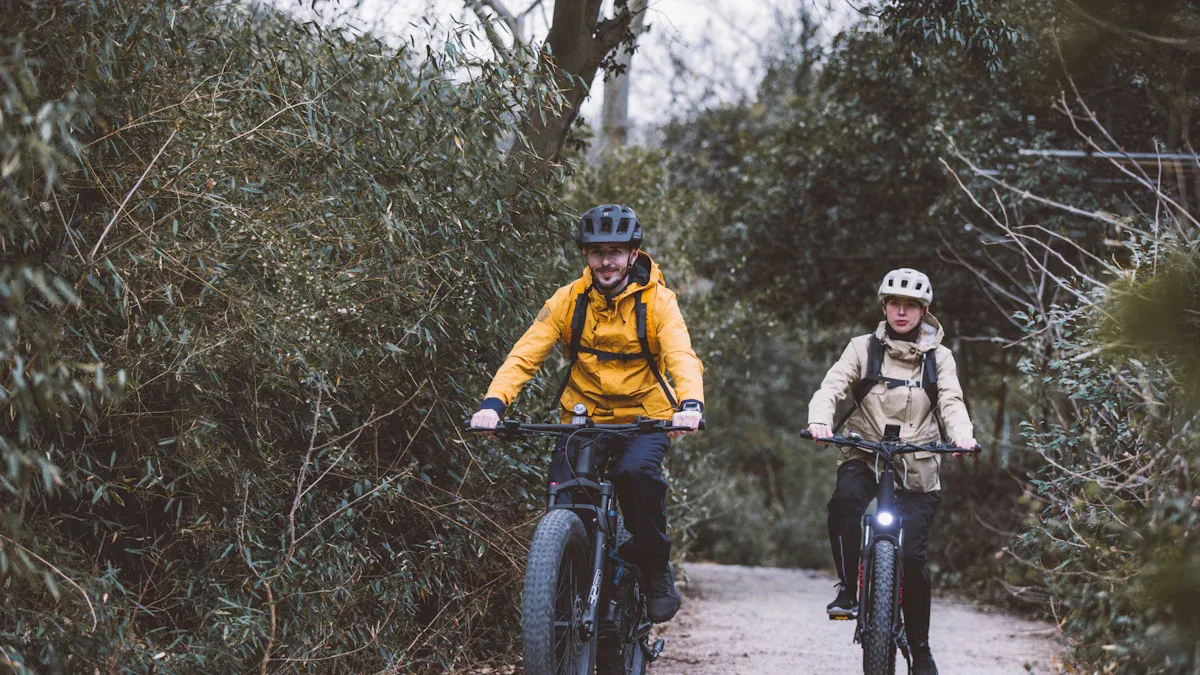
Are you looking for a bike that reliably accompanies you on long distances? With a trekking e-bike, you can enjoy high comfort and strong performance. The motor supports you when going uphill or when the wind picks up. Modern technology ensures that you feel safe on asphalt, gravel, or small forest paths. A trekking e-bike adapts flexibly to your needs and makes every tour a pleasure.
Key Findings
Trekking e-bikes offer high comfort due to an upright seating position, good suspension, and ergonomic features that make long rides pleasant.
Modern motors and large batteries enable powerful support and ranges of up to 100 kilometers, ideal for long tours and daily use.
The versatility of trekking e-bikes allows for rides on various surfaces, from asphalt to easy forest paths, with suitable equipment for every situation.
Regular maintenance and the correct adjustment of the seating position, tire pressure, and assist level ensure safety, efficiency, and a long service life for the e-bike.
When purchasing, you should pay attention to your individual needs, high-quality equipment, and a reliable service network to find the right trekking e-bike.
Trekking E-Bike Advantages
Comfort
You feel the difference immediately when you sit on a trekking e-bike. The comfortable and upright seating position relaxes your muscles and is easy on your back. Well-tuned suspension, consisting of a suspension seat post and a suspension fork, absorbs shocks from uneven surfaces. This allows you to remain pain-free even on long journeys and reduces fatigue. The frame geometry ensures a pleasant riding experience. A robust yet lightweight aluminum frame provides stability without making the bike heavy. Ergonomic controls and a sporty yet comfortable riding stance help you stay relaxed even after many kilometers.
Tip: Scientific studies show that the correct seating position and an ergonomically adjusted saddle reduce pressure on the pubic area. This noticeably increases comfort, especially on long tours.
Performance
With a trekking e-bike, you can master even challenging routes. Modern motors like the Bosch Performance Line offer you 250 watts and up to 85 Newton meters of torque. This means: You get powerful support when going uphill or facing headwinds. Large batteries with 500 to 700 watt-hours ensure that you are out for a long time without having to constantly recharge. The actual range depends on the model and battery size. In practical tests, many models reach impressive distances:
Model |
Range (km) |
Battery Capacity (Wh) |
Note |
|---|---|---|---|
Canyon Pathlite:ON 6 SUV |
96.1 |
706.8 |
Test winner, longest range |
Giant |
79.3 |
602.8 |
Runner-up |
T-66e |
78.7 |
558.7 |
Powerful Bosch motor |
Brennabor / Liv |
approx. 72.9-79.3 |
- |
Mid-range |
Decathlon Rockrider e-actv 500 LF |
54.8 |
443.6 |
Budget-friendly, more for everyday use |
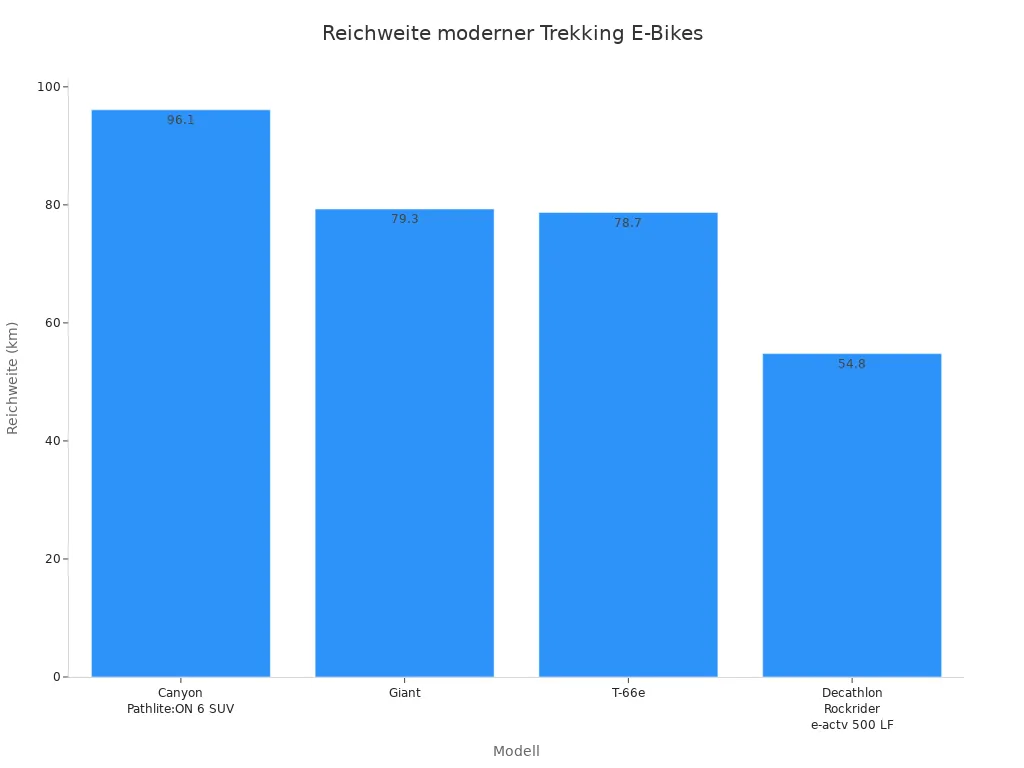
The range depends on the battery capacity and the motor. The Canyon Pathlite:ON 6 SUV achieves almost 100 kilometers with its large battery. Even cheaper models offer solid values for everyday use.
Versatility
A trekking e-bike adapts to your everyday life and your adventures. You use it for the commute to work, for weekend excursions, or for multi-day trips with luggage. The equipment including a luggage rack, lighting system, and mudguards makes the bike suitable for daily use. You ride safely on asphalt, gravel, or easy forest paths. There are classic models with narrow tires for fast tours and SUV variants with wider tires and full suspension for more comfort and safety off-road.
Area of application / Feature |
Description |
|---|---|
Everyday city life |
Ideal for daily commuting and shopping. |
Excursions and day trips |
Perfect for medium distances, even with luggage. |
Multi-day trips with luggage |
High payload and sturdy luggage racks enable longer tours. |
Various types of terrain |
From asphalt to easy trails, depending on the model. |
Variants |
Classic 28-inch models or SUV e-bikes with more off-road capability. |
SUV e-bikes offer you even more possibilities. They combine the advantages of city, trekking, and e-mountain bikes. With full suspension, wide tires, and high-performance equipment, you are equipped for almost any adventure. These all-rounders cover more areas of use than classic trekking bikes and offer you maximum flexibility.
Equipment
Motor
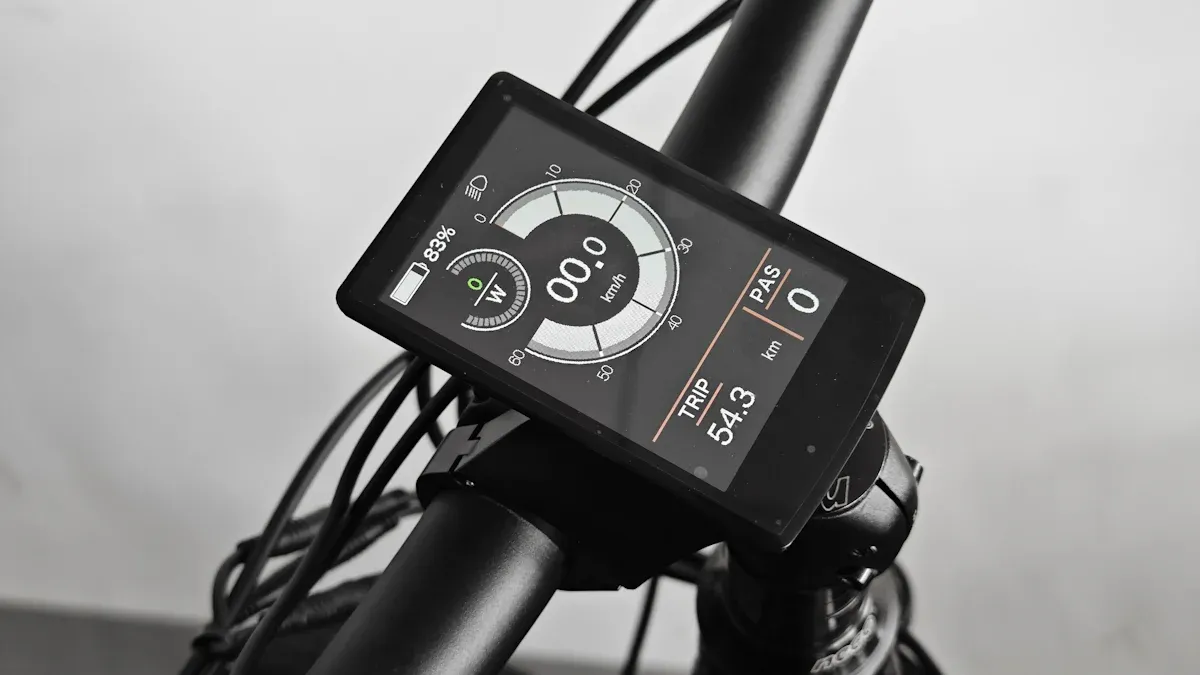
With a trekking e-bike, you benefit from modern motors that offer you reliable support on long distances. The most important manufacturers are Bosch, Shimano, and Yamaha. Bosch dominates the market in Germany with a market share of around 70%. Shimano follows with around 12%. These motors are known for their reliability, performance, and dense service network.
Motor manufacturer |
Market share Germany |
Market share Europe |
Special features |
|---|---|---|---|
Bosch eBike Systems |
approx. 70 % |
approx. 50 % |
Market leader, high quality, mid-motors |
Shimano |
approx. 12 % |
approx. 20 % |
Light, quiet, versatile |
Brose |
approx. 6 % |
N/A |
Premium segment, sporty e-bikes |
Yamaha |
N/A |
N/A |
Sensitive support, long range |
Bafang |
N/A |
approx. 15 % |
Niche supplier, affordable e-bikes |
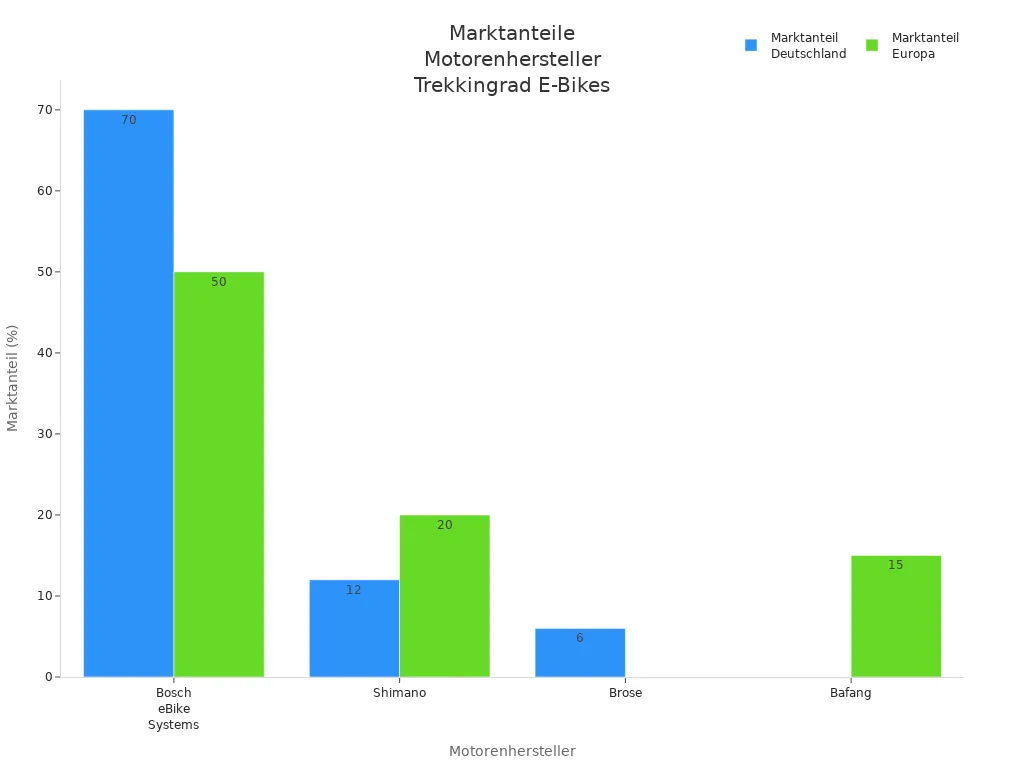
The motors offer you 250 watts of power and a torque between 60 and 85 Newton meters. Bosch motors impress with their system integration, Shimano scores with low weight, and Yamaha offers particularly high ranges. You can choose between different assist modes that adapt to your riding style.
Battery
The battery determines how far you can go with your trekking e-bike. The most common capacities are between 400 and 600 watt-hours. With a 500 Wh battery, you often reach more than 60 kilometers, and under optimal conditions, even up to 200 kilometers. The actual range depends on your weight, the terrain, and the selected assist level. Many users get by with one battery charge between 40 and 120 kilometers. For everyday life, this is usually sufficient, as most ride less than 80 kilometers per week.
Battery capacity (Wh) |
Typical range (km) |
Application area |
|---|---|---|
300 |
20-40 |
City traffic, short distances |
400 |
40-60 |
Vacation, longer tours |
500-600 |
>60 |
Sporty riding, long day tours |
The service life of a battery is on average 3 to 5 years or 500 to 1,000 charging cycles. You can extend the lifespan by not running the battery down completely and storing it at room temperature.
Tip: Keep the charge level between 30 and 60% if possible to increase the lifespan of your battery.
Drivetrain
You have the choice between derailleur gears and hub gears. Derailleur gears offer you many gears and are suitable for changing terrain and steep inclines. They are lightweight and inexpensive to repair, but require regular maintenance. Hub gears are low-maintenance and durable. You can also shift while stationary, which is practical in city traffic. They are heavier and offer fewer gears.
Drivetrain type |
Advantages |
Disadvantages |
|---|---|---|
Derailleur gears |
Many gears, light, inexpensive to repair |
Higher maintenance effort, sensitive to dirt |
Hub gears |
Low maintenance, durable, shifting possible while stationary |
Fewer gears, heavier, more expensive |
Due to the motor support, greater forces act on the drivetrain. You should clean and lubricate regularly, especially with derailleur gears. Automatic transmissions with belt drives are particularly low-maintenance and adjust the gear ratio automatically.
Suspension
The suspension ensures comfort on uneven paths. Many trekking e-bikes have a suspension fork at the front and often a suspension seat post. There are various systems:
Suspension system |
Effect on handling |
Examples |
|---|---|---|
Single-pivot |
Simple, can cause brake jack |
Focus VAM², Scott Lumen |
Four-bar linkage |
Good separation of braking and drive influences |
Canyon Torque:ON, Thok Gram |
Dual-link |
Diverse wheel travel curves, more complex feel |
Santa Cruz Heckler, Giant Trance |
Six-bar linkage |
Very precise, but complex |
Yeti 160E |
High-pivot |
Better impact absorption, less intuitive |
Rocky Mountain Altitude Powerplay |
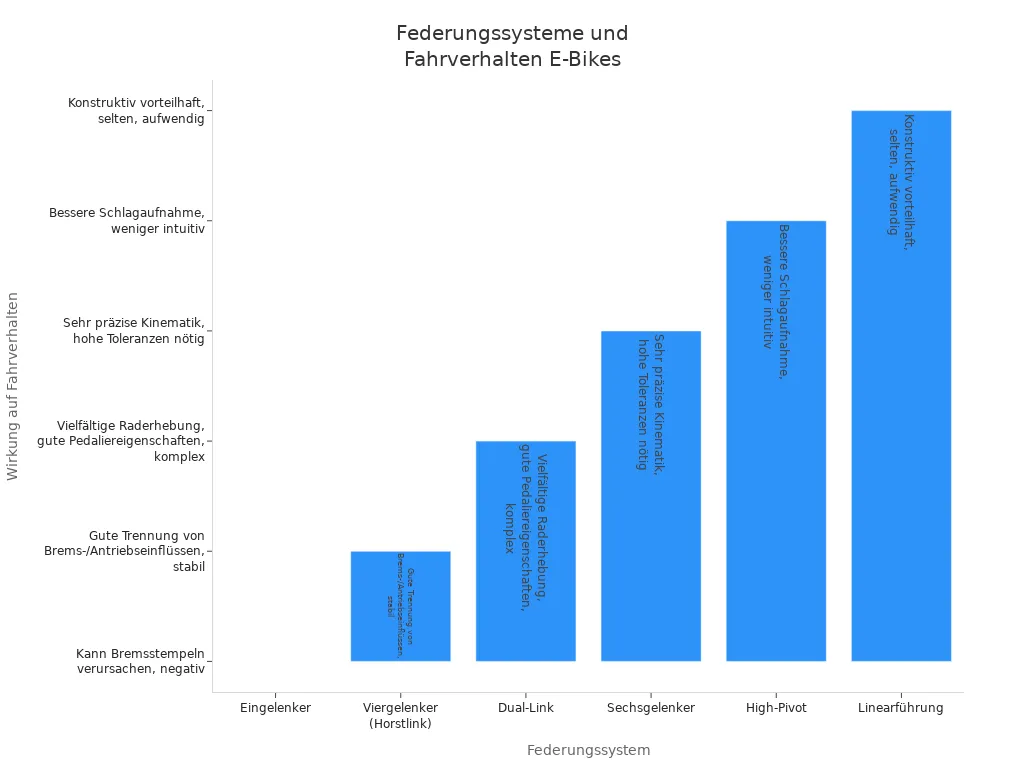
Good suspension protects you from shocks and ensures safe handling, especially on long tours and changing terrain.
Seating position
The correct sitting position is crucial for your comfort. Experts recommend an upright posture with a slightly higher handlebar and a saddle positioned further back. This relieves strain on your back and wrists. A straight back and relaxed shoulders will help you stay pain-free even on long rides.
Parameter |
Recommendation |
|---|---|
Sitting position |
Comfortable, upright |
Handlebar height |
2 to 5 cm above the saddle |
Upper arm-torso angle |
70 to 90 degrees |
Tip: Change your grip position regularly to avoid tension.
Tires
The tires on your trekking e-bike affect both comfort and safety. For high puncture protection, models with special inserts such as DuraSkin, SafetyPlus, or PunctureGuard are suitable. Tubeless tires offer particularly good protection as they do not require an inner tube, and sealant plugs small holes. Heavily treaded tires like the Schwalbe Marathon XR offer very high puncture protection but are heavier. Medium-width tires with a shallow tread roll easily and provide a good compromise between comfort and safety. Ensure the correct tire pressure to avoid punctures.
Lighting
The lighting on your trekking e-bike must comply with legal requirements. In Germany, the StVZO applies. You need:
A white front headlight with at least 10 lux.
A red rear light with at least 10 lux.
Yellow reflectors on both sides of the pedals.
Side reflectors on the spokes or tires.
The lighting must bear a K-number, which confirms compliance with StVZO.
Flashing lights are not permitted.
Brake lights, high beams, and daytime running lights have been permitted since 2017.
Note: Missing or defective lighting can lead to fines.
Luggage Rack
A sturdy luggage rack is indispensable for longer tours. The maximum load capacity for many models is 60 kilograms, usually 30 kilograms per rail. This is sufficient for saddlebags, panniers, or a child seat. Be careful not to exceed the permissible total weight. The load capacity also depends on the nose weight of the trailer hitch if you are using a trailer.
Model |
Maximum total load |
Maximum load per rail |
|---|---|---|
Bullwing SR10 |
approx. 60 kg |
approx. 30 kg |
Bullwing SR11 |
approx. 60 kg |
approx. 30 kg |
Bullwing SR1 Pro |
30 kg |
30 kg |
Tip: Use sturdy panniers and secure your luggage with tension straps so nothing slips.
Buying Guide
Needs
First, you should consider how you want to use your trekking e-bike. Do you ride to work every day, or are you planning long tours with lots of luggage? Would you also like to ride on gravel roads or forest paths? Experts recommend paying attention to the following points:
A stable and torsion-resistant frame provides safety, especially on unpaved paths.
Touring-ready tires ensure good grip on various surfaces.
The correct frame size and shape support a healthy sitting posture and prevent pain.
Ergonomic components such as saddles, handlebar grips, and pedals increase comfort.
Good suspension protects your back on long routes.
A powerful motor helps you on inclines or when carrying a lot of luggage.
Sufficient battery capacity (at least 500 Wh) allows for long tours without constant recharging.
Test various models to find the bike that is right for you.
Tip: A test ride helps you discover the right sitting position and the best riding feel.
Price-Performance
The price ranges for trekking e-bikes differ significantly. You will find affordable entry-level models, solid mid-range bikes, and high-quality premium bikes. The following table shows you what you can expect in each price range:
Equipment |
|
|---|---|
Under 1000 euros |
Simple, functional components, inexpensive motors and batteries |
Up to approx. 1500 euros |
Aluminum frame, suspension fork, Shimano shifting, good brakes, mudguards, light, luggage rack |
Over 1500 euros |
High-quality motors, powerful batteries, lightweight frames, better suspension, modern gear systems, top-tier brakes |
With an increasing price, you get more comfort, better technology, and longer durability. For occasional riders, an affordable model is often sufficient. For frequent riders, investing in quality is worthwhile.
Test Criteria
Specialist magazines examine trekking e-bikes very closely. They test the motor, brakes, gear system, handling, and comfort. Range, weight, and safety also play a role. The most important test categories are:
Test category |
Number of criteria |
Examples / Details |
|---|---|---|
Laboratory tests |
over 20 values |
Technical measurements |
Practical tests |
over 40 criteria |
Motor, brakes, shifting, comfort, handling |
Other factors |
- |
Dealer network, warranty |
Specific aspects |
- |
Weight, equipment, range, price-performance |
You should look for a mid-drive motor, as it ensures good weight distribution and makes the riding feel more natural.
Service
A good service network is very important for you. You benefit if you can have your e-bike repaired quickly in the event of problems. Many manufacturers work with local bicycle shops and mobile technicians. This way, you get quick help, no matter where you are. A comprehensive service network increases comfort and gives you security on every tour.
Note: When purchasing, ensure that the manufacturer offers good customer support and many service partners near you.
Models
Model Overview
Today, you will find many recommendable trekking e-bike models that trade magazines highlight for 2024. These bikes offer you powerful motors, long-lasting batteries, and a lot of comfort. Brands like Riese & Müller, Kalkhoff, Gazelle, and M1-Sporttechnik stand for quality and innovation. The Riese & Müller Culture Mixte Vario, for example, impresses with its practical utility and modern technology. Many current models rely on powerful drive systems and long ranges. They are suitable for long tours, everyday use, and demanding routes. Experts especially praise the versatility and high riding comfort of these e-bikes.
Comparison
A direct comparison helps you find the right trekking e-bike for your needs. The following table shows important differences in range, motor power, and equipment:
Model |
Range (km) |
Battery capacity (Wh) |
Motor power (Nm) |
Support factor |
Speed at 6% incline (km/h) |
Equipment highlights |
Braking performance |
|---|---|---|---|---|---|---|---|
Canyon Pathlite:ON 6 SUV |
706.8 |
85 |
3.8 |
22.2 |
Suspension seat post, mountain bike tread tires, very good brakes |
Test winner, best range and equipment |
|
Giant Anytour X E+ 0 |
79.3 |
602.8 |
85 |
3.8 |
18.7 |
Automatic shifting, profiled tires, carbon belt, suspension seat post |
Second best braking values, highest-quality equipment |
Liv |
N/A |
N/A |
75 |
3.8 |
23 |
Good motor power, off-road capability |
Good braking values |
Brennabor |
N/A |
N/A |
85 |
3.5 |
22.4 |
Suspension seat post, brake light function |
Good braking values |
Decathlon Rockrider e-actv 500 LF |
54.8 |
443.6 |
55 |
2.8 |
17.2 |
Automatic mode in app, attractively priced |
Lower braking performance, compromises in comfort |
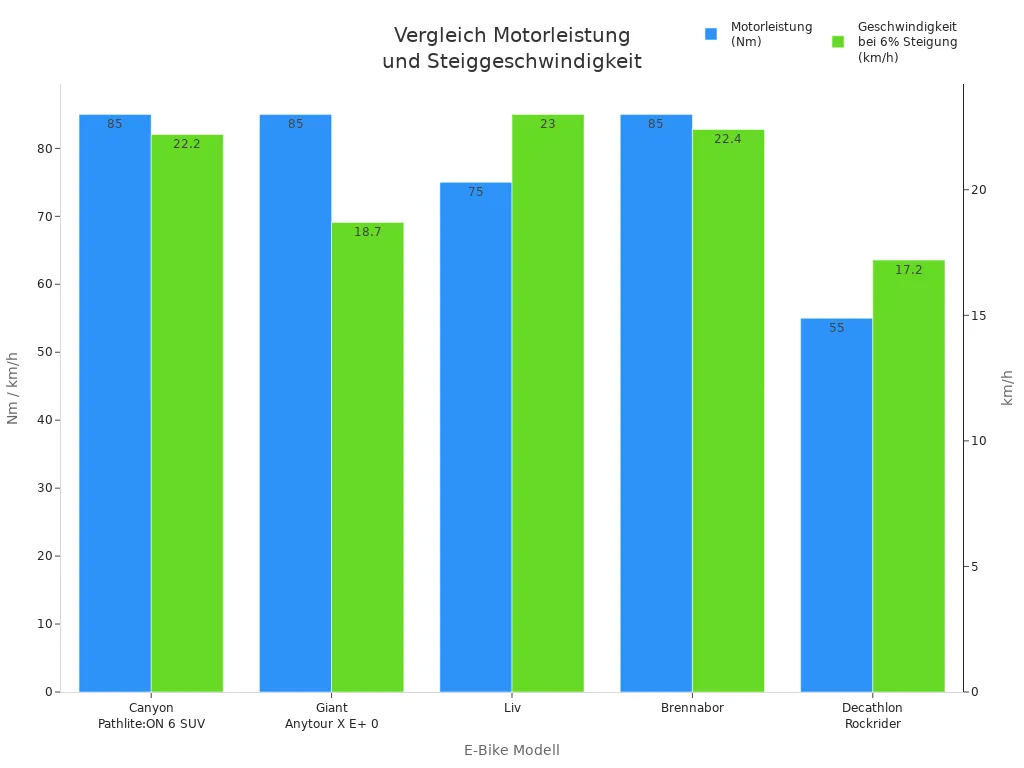
The Canyon Pathlite:ON 6 SUV offers you the best range and equipment. Giant impresses with high-quality technology, while Liv and Brennabor score with comfort and motor power. Decathlon is particularly suitable for everyday use.
SUV Trekking E-Bike
SUV trekking e-bikes offer you special advantages if you are often on demanding routes:
Full-suspension chassis with 100–140 mm travel ensure comfort and dampen impacts on uneven paths.
Powerful motors like the Bosch Performance Line CX assist you even on steep climbs.
Large batteries up to 1,050 Wh allow for long tours without charging breaks.
Robust frames and wide tires (2.0 to 2.8 inches) give you stability and grip on gravel, forest paths, and off-road.
Ergonomic features such as adjustable cockpits and dropper seat posts increase comfort and safety.
High-quality equipment with mudguards, luggage racks, and lighting makes the bike suitable for everyday use.
Tip: An SUV trekking e-bike is a true all-rounder. You can master both the commute to work and demanding adventures off paved roads.
Tips
Setup
A good setup makes your tour more pleasant and efficient. Experts recommend adjusting your trekking e-bike individually. The following table shows you important points for optimal use:
Topic |
Recommendation |
|---|---|
Support level |
Adjust the mode to the route and fitness level to save battery. |
Cadence |
Maintain a steady frequency of 75–80 rpm for best efficiency. |
Shifting |
Shift proactively, especially on inclines, to protect the motor and battery. |
Tire pressure |
Check the pressure before every tour. The correct value reduces rolling resistance. |
Battery temperature |
Store the battery at 10–20 °C. Plan tours in cold weather carefully, as capacity decreases. |
E-bike care |
Regularly check brakes, chain, and belt. Have maintenance carried out by experts. |
Tour planning |
Note the route profile. Plan for a spare battery or charging options on long tours. |
Tip: A bike fitting by experts or with an app helps you find the perfect sitting position. This prevents pain and allows you to ride more relaxed.
Care
With proper care, your e-bike will remain reliable for a long time. You should never fully discharge the battery and should remove the charger after charging. Always store the battery at 10–20 °C and protect it from heat and direct sunlight. Clean the battery only with a damp cloth, never with a water jet or steam. Check the contacts regularly and have a professional look at it if problems arise. Use energy-saving modes to preserve the battery. Thick tires and good suspension protect the technology from shocks.
Check the contacts regularly
Clean only with a damp cloth
Carry out regular maintenance of the entire e-bike
Note: After long tours, you should clean the e-bike thoroughly and remove the battery and display beforehand.
Safety
Safety always comes first. Always wear a helmet, even if it is not mandatory. Your e-bike needs StVZO-compliant lighting so that you are clearly visible. For theft protection, a high-quality lock is recommended, such as a folding lock. When transporting on a rear rack, remove the battery and display and stow them safely in the car. Protect all electrical parts from rain and dirt with suitable covers. Never leave your e-bike in the car in extreme heat, as the battery may be damaged.
Use a high-quality lock
Secure the e-bike against slipping
Pay attention to e-bike rules when traveling by train
Tip: Plan your tour so that you always arrive safely and relaxed.
With a trekking e-bike, you enjoy comfort, powerful performance, and versatility on every route. You benefit from modern technology, long battery life, and an ergonomic seating position.
Choose the model that suits your goals.
-
Pay attention to equipment and service.
Start your next tour and discover how much fun long rides can be!
FAQ
How far can I go on one battery charge?
The range depends on the battery, motor, weight, and route. You can usually manage 60 to 120 kilometers. Use Eco mode to go further. Check the charge level before every tour.
Do I need to service my trekking e-bike regularly?
Yes, you should check your e-bike regularly. Check the chain, brakes, and tires. Charge the battery correctly. Have a professional check everything once a year.
Can I also use a trekking e-bike in winter?
You can ride your e-bike in winter. Make sure you have good lighting and suitable tires. Protect the battery from the cold. Charge it at room temperature.
How heavy is a trekking e-bike?
Most trekking e-bikes weigh between 22 and 28 kilograms. The weight depends on the frame, battery, and equipment. You should keep this in mind when transporting it.
Do I need a driver's license for a trekking e-bike?
You do not need a driver's license for a trekking e-bike with a maximum speed of 25 km/h. You are allowed to use bike paths. Observe traffic rules and always wear a helmet for more safety.