
A high-quality electric motor plays a major role in how well an e-bike rides. You’ll feel the difference right away: more torque, smoother acceleration, and a longer range. In 2025, new technologies are revolutionizing the industry. Manufacturers are developing more efficient and lighter systems. The goal? More power with less energy consumption. Criteria such as torque, energy efficiency, and value for money can help you find the best e bike electric motor for your needs. A good motor makes the difference between an average ride and an exceptional one.
Key Takeaways
An e-bike motor’s power shapes your riding experience. Look at torque and wattage to make sure you get good assistance.
Low energy consumption matters on long rides. Choose an efficient motor so you can go farther.
The price should match the performance. An expensive motor should be powerful, durable, and efficient.
The motor’s weight affects how the bike rides. Lightweight motors are more agile, while heavier motors have more power.
Think about where you ride. Lightweight motors are better in the city, while you’ll need a powerful motor for the mountains.
Criteria for Evaluating E-Bike Electric Motors
Performance: Torque, Wattage, and Acceleration
An e-bike motor’s performance directly affects how powerful and responsive your bike is. Torque, wattage, and acceleration are key factors. Higher torque delivers more power, especially on steep climbs. For e-city bikes, the ideal torque is around 40 Nm, while e-mountain bikes need 60 to 80 Nm.
Motor |
Torque (Nm) |
Power (W) |
|---|---|---|
Bosch Performance CX |
85 |
600 |
Actual values |
79 |
566 |
Wattage indicates how much energy the motor delivers. A 600 W motor provides powerful assistance, but the actual figure (e.g., 566 W) also matters. Acceleration depends on the combination of torque and wattage. A powerful e bike electric motor delivers smooth, quick acceleration, enhancing the riding experience.
Efficiency: Energy Consumption and Range
Efficiency is essential if you want to ride long distances. An efficient motor uses less energy and allows for greater range. Factors such as motor weight and battery quality affect efficiency.
Tip: Choose a motor that strikes a good balance between performance and energy consumption. That way, you can enjoy longer rides without constantly having to recharge the battery.
A lightweight motor weighs less and requires less energy, increasing range. In 2025, modern motors use innovative technologies to minimize energy consumption and maximize range.
Value for Money: Cost Compared to Features
Value for money helps you find the best motor for your budget. An expensive motor should be not only powerful but also durable and efficient. Tests show that motor performance often depends on cadence.
Test Type |
Description |
Result |
|---|---|---|
Motor at a fixed cadence and simulated rider output |
Measurement of electrical and mechanical power |
|
Cadence test |
Predetermined rider output at increasing cadences |
How performance depends on cadence |
Good value for money means you’re paying for genuine features and quality, not just the brand. Make sure the motor meets your needs, whether for city commuting or challenging mountain rides.
Weight and Compactness: Impact on Handling
An e-bike motor’s weight plays a crucial role in your riding experience. A heavy motor can make your bike harder to handle, especially through tight corners or during quick changes of direction. Lightweight motors, on the other hand, improve agility and make riding more enjoyable, particularly in the city or on trails.
Tip: Choose a motor that’s light enough not to negatively affect handling, while still providing sufficient power.
The motor’s compactness also affects how easily the e-bike can be controlled. A compact motor integrates better into the bike frame. This not only creates a more streamlined look but also improves weight distribution. As a result, the bike feels more stable, especially at higher speeds.
Benefits of a Lightweight, Compact Motor:
Better control: You can maneuver your bike more easily.
Greater comfort: Less weight means less effort when pedaling.
More efficient energy use: A lightweight motor requires less energy, increasing range.
Drawbacks of a Heavy Motor:
More difficult handling: Especially in stop-and-go situations or on uneven terrain.
Higher energy consumption: A heavy motor puts more strain on the battery.
One example of a lightweight, compact motor is the TQ HPR50. At just 1.8 kg, it’s one of the lightest models on the market. Despite its low weight, it delivers an impressive 50 Nm of torque, making it ideal for commuters and recreational riders.
Note: Think about where and how you plan to use your e-bike. For city riding, a lightweight motor is often the better choice. For mountain rides, a somewhat heavier motor with more power may make sense.
Weight and compactness affect not only performance but also how much you enjoy riding. A good balance between these factors delivers an optimal riding experience.
The Top 10 E-Bike Electric Motors of 2025
Bosch Performance Line CX 4.0 – Technical Specifications, Pros, Cons, Ideal Uses
The Bosch Performance Line CX 4.0 is one of the most powerful motors for e-mountain bikes and trekking bikes. With a maximum torque of 85 Nm and peak power of 600 watts, it delivers powerful assistance, especially on steep climbs. The motor weighs 2.85 kg, so it isn’t the lightest, but it impresses with its robust design and reliability.
Pros:
High performance and sporty ride feel.
Continuous development by Bosch.
Low pedaling resistance of just 9.1 watts.
Cons:
Rattling on descents can be distracting.
Full power requires forceful pedaling.
Ideal for:
E-mountain bikers and trekking riders who value power and reliability. The motor is especially well suited to challenging trails and long rides.
Motor Name |
Maximum Torque |
Weight |
Use |
|---|---|---|---|
Bosch Performance Line CX |
2.85 kg |
E-mountain bikes, trekking |
DJI Avinox – Technical Specifications, Pros, Cons, Ideal Uses
The DJI Avinox is an innovative e bike electric motor with impressive specifications. With a maximum torque of 105 Nm and peak power of 850 watts, it delivers exceptional performance. The motor weighs 2.575 kg and can briefly reach 980 watts in Boost mode. These features make it one of the most powerful motors on the market.
Pros:
Highly controllable power, ideal for precise riding.
Lightweight and compact, improving handling.
High peak power for challenging routes.
Cons:
Less long-term experience compared with established brands.
Higher energy consumption at maximum power.
Ideal for:
Riders seeking maximum power and precision. Especially suited to steep climbs and technical trails.
Motor |
Maximum Torque |
Peak Power |
Weight |
|---|---|---|---|
DJI Avinox |
105 Nm |
850 watts |
2.575 kg |
Shimano EP801 – Technical Specifications, Pros, Cons, Ideal Uses
The Shimano EP801 combines power and efficiency in a compact design. With 85 Nm of torque and peak power of 600 watts, it provides solid assistance for a variety of uses. The motor weighs 2.65 kg, making it lighter than many of its competitors. Third-party batteries can be used without any problems, offering greater flexibility.
Pros:
Easy handling, ideal for beginners.
Compatible with third-party batteries.
Lightweight and efficient.
Cons:
Less powerful than Bosch.
Rattles on uneven terrain.
Ideal for:
City and trekking riders, as well as beginners looking for a reliable, easy-to-use motor.
Motor |
Maximum Torque |
Peak Power |
Weight |
|---|---|---|---|
Shimano EP801 |
85 Nm |
600 watts |
2.65 kg |
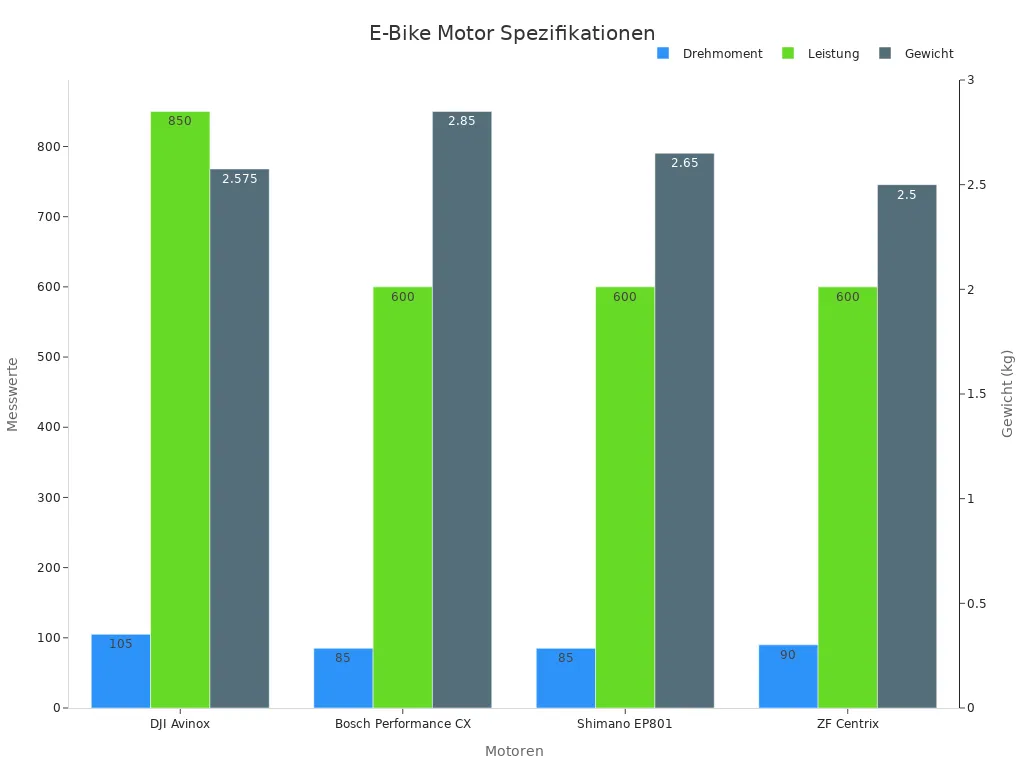
Tip: If you’re looking for an e bike electric motor that delivers both power and efficiency, consider the specific requirements of how you’ll use it. Bosch, DJI, and Shimano each offer unique advantages tailored to different needs.
Yamaha PW-X3 – Technical Specifications, Pros, Cons, Ideal Uses
The Yamaha PW-X3 is a compact, powerful motor designed specifically for demanding riders. With a maximum torque of 85 Nm and a weight of just 2.75 kg, it offers an impressive combination of power and lightness. Its peak power of 500 watts delivers powerful assistance, especially on steep climbs and technical trails.
Pros:
Compact design: The motor is smaller than its predecessor, allowing for better integration into the bike frame.
Lightweight: At just 2.75 kg, it’s one of the lighter models in its performance class.
High efficiency: The Yamaha PW-X3 makes excellent use of energy, increasing your e-bike’s range.
Smooth assistance: Assistance is delivered consistently and without delay, improving the riding experience.
Cons:
Limited peak power: At 500 watts, its power is somewhat lower than that of other models.
Noise: The motor can be somewhat louder under heavy load.
Ideal for:
The Yamaha PW-X3 is an excellent choice for mountain bikers looking for a lightweight, compact motor. It’s ideal for technical trails and steep climbs where precision and control are essential.
Motor |
Maximum Torque |
Peak Power |
Weight |
|---|---|---|---|
Yamaha PW-X3 |
85 Nm |
500 watts |
2.75 kg |
Tip: If you’re looking for a lightweight and efficient e-bike electric motor, the Yamaha PW-X3 could be the right choice for you.
Brose Drive S Mag – Technical Specifications, Pros, Cons, Ideal Use
The Brose Drive S Mag combines power and quiet operation in a robust design. With maximum torque of 90 Nm and peak power of 565 watts, it provides powerful assistance that is especially noticeable on steep climbs. The motor weighs 2.9 kg and is made from a magnesium alloy, which adds stability.
Pros:
High power: With 90 Nm of torque, this motor is one of the most powerful in its class.
Quiet operation: The Brose Drive S Mag operates almost silently, making for a more pleasant riding experience.
Flexibility: The motor supports a cadence of up to 120 rpm, making it ideal for sporty riders.
Durability: The magnesium alloy ensures a long service life and high stability.
Cons:
Weight: At 2.9 kg, the motor is slightly heavier than comparable models.
Price: Its high quality is reflected in the price, making it less attractive to budget-conscious buyers.
Ideal for:
The Brose Drive S Mag is perfect for sporty riders and mountain bikers who value power and quiet operation. It is particularly well suited to challenging trails and long rides.
Motor |
Maximum torque |
Peak power |
Weight |
|---|---|---|---|
Brose Drive S Mag |
90 Nm |
565 watts |
2.9 kg |
Note: If you’re looking for a powerful, quiet motor, the Brose Drive S Mag is an excellent choice.
TQ HPR50 – Technical Specifications, Pros, Cons, Ideal Use
The TQ HPR50 is an ultralight motor designed specifically for riders who value a natural riding feel. Weighing just 1.8 kg and delivering 50 Nm of torque, it is one of the lightest motors on the market. Despite its low weight, it offers impressive power and efficiency.
Pros:
Ultralight: At just 1.8 kg, the TQ HPR50 is one of the lightest motors in its class.
Natural riding feel: Assistance is smooth and consistent, enhancing the riding experience.
High efficiency: The motor uses little energy, increasing your e-bike’s range.
Compact design: The motor integrates seamlessly into the frame, enhancing the bike’s design.
Cons:
Limited torque: At 50 Nm, it offers limited power for steep climbs.
Intended use: The motor is less suited to extreme mountain bike trails.
Ideal for:
The TQ HPR50 is ideal for commuters and recreational riders looking for a lightweight, efficient e-bike. It is particularly well suited to city rides and light trails.
Motor |
Maximum torque |
Peak power |
Weight |
|---|---|---|---|
TQ HPR50 |
50 Nm |
300 watts |
1.8 kg |
Tip: If you’re looking for a lightweight e-bike with a natural riding feel, the TQ HPR50 is the perfect choice.
Fazua Ride 60 – Technical Specifications, Pros, Cons, Ideal Use
The Fazua Ride 60 is an innovative motor distinguished by its light weight and versatility. Weighing just 1.96 kg, it is one of the lightest models on the market. It delivers 60 Nm of torque and peak power of 450 watts. This motor was designed specifically for riders looking for a natural riding feel and subtle assistance.
Pros:
Lightweight and compact: Weighing less than 2 kg, the Fazua Ride 60 is ideal for e-bikes designed to keep overall weight low.
Natural riding feel: Assistance is smooth and consistent, which is particularly comfortable on longer rides.
Flexibility: The motor can be completely disengaged when needed, allowing you to ride the e-bike like a regular bicycle.
Energy efficiency: Low energy consumption delivers impressive range.
Cons:
Limited power: With 60 Nm of torque, the motor is less suited to steep climbs or challenging trails.
Intended use: The Fazua Ride 60 is designed primarily for city rides and light touring.
Ideal for:
Commuters and recreational riders looking for a lightweight, efficient e-bike. The motor is particularly well suited to city traffic and flat to gently rolling routes.
Motor |
Maximum torque |
Peak power |
Weight |
|---|---|---|---|
Fazua Ride 60 |
60 Nm |
450 watts |
1.96 kg |
Tip: If you’re looking for an e-bike with a natural riding feel and low weight, the Fazua Ride 60 is an excellent choice.
Specialized SL 1.2 – Technical Specifications, Pros, Cons, Ideal Use
The Specialized SL 1.2 is a motor designed specifically for lightweight e-bikes. With 50 Nm of torque and a weight of just 1.95 kg, it provides subtle assistance that is perfect for sporty riders. Its peak power of 320 watts is sufficient for flat routes and moderate climbs.
Pros:
Lightweight: At 1.95 kg, the Specialized SL 1.2 is one of the lightest motors in its class.
Quiet: The motor operates almost silently, making for a more pleasant riding experience.
Efficient assistance: Its power is optimally tuned for sporty riders who prefer subtle assistance.
Integration: The motor blends seamlessly into the frame, creating an elegant design.
Cons:
Limited power: With 50 Nm of torque, the motor is not suited to steep climbs.
Intended use: The Specialized SL 1.2 is less suited to extreme mountain bike trails.
Ideal for:
Sporty riders and commuters looking for a lightweight, elegant e-bike. The motor is particularly well suited to flat to gently rolling routes and city traffic.
Motor |
Maximum torque |
Peak power |
Weight |
|---|---|---|---|
Specialized SL 1.2 |
50 Nm |
320 watts |
1.95 kg |
Note: The Specialized SL 1.2 is ideal for riders who value minimalist design and subtle assistance.
Giant SyncDrive Pro – Technical Specifications, Pros, Cons, Ideal Use
The Giant SyncDrive Pro is a powerful motor designed specifically for demanding riders. With 85 Nm of torque and peak power of 750 watts, it provides powerful assistance that is especially noticeable on steep climbs. The motor weighs 2.7 kg, making it somewhat heavier, but it stands out for its robust construction and reliability.
Pros:
High power: With 85 Nm of torque, the Giant SyncDrive Pro is one of the most powerful motors in its class.
Dynamic assistance: The motor automatically adjusts to your pedaling force, enhancing the riding experience.
Versatility: The Giant SyncDrive Pro is suited to a range of uses, from city riding to challenging trails.
Reliability: Its robust construction ensures a long service life.
Cons:
Weight: At 2.7 kg, the motor is heavier than some competitors.
Noise: The motor can get somewhat louder under heavy load.
Ideal for:
Mountain bikers and sporty riders looking for a powerful, reliable motor. The Giant SyncDrive Pro is particularly well suited to challenging trails and steep climbs.
Motor |
Maximum torque |
Peak power |
Weight |
|---|---|---|---|
Giant SyncDrive Pro |
85 Nm |
750 watts |
2.7 kg |
Tip: If you’re looking for a high-performance, versatile e-bike electric motor, the Giant SyncDrive Pro is an excellent choice.
Panasonic GX Ultimate – Technical Specifications, Pros, Cons, Ideal Use
The Panasonic GX Ultimate is one of the most powerful motors on the market. With maximum torque of 95 Nm and peak power of 750 watts, it provides powerful assistance that excels particularly on steep climbs and challenging routes. The motor weighs 2.9 kg, making it robust without being too heavy. Its compact design ensures optimal integration into the bike frame.
Technical specifications
Feature |
Value |
|---|---|
Maximum torque |
95 Nm |
Peak power |
750 watts |
Weight |
2.9 kg |
Assistance modes |
Several (Eco, Normal, High) |
The motor offers several assistance modes that you can adjust to suit the route and your needs. Its high efficiency helps you achieve good range, even on longer rides.
Pros
High power: With 95 Nm of torque, you can tackle steep climbs with ease.
Robust construction: The motor can withstand even intense use.
Versatility: You can choose between different assistance modes to save energy or get maximum power.
Compact integration: The motor blends seamlessly into the frame and improves weight distribution.
Tip: If you often ride challenging trails, the Panasonic GX Ultimate provides the power and reliability you need.
Cons
Weight: At 2.9 kg, the motor is heavier than some competing models.
Noise: The motor can be audible under heavy load.
Price: Its high performance and quality are reflected in the price.
Ideal for
The Panasonic GX Ultimate is perfect for mountain bikers and sporty riders who value maximum power and reliability. You can use it on challenging trails, steep climbs, and long rides.
Use |
Recommendation |
|---|---|
Mountain bike trails |
Very suitable |
Steep climbs |
Ideal |
City traffic |
Less suitable |
Note: If you’re looking for an e-bike that can support you in extreme conditions, the Panasonic GX Ultimate is an excellent choice.
Comparative Analysis of the Top Motors
Differences in Power and Efficiency
The power and efficiency of an e-bike motor directly affect your riding experience. Torque, weight, and efficiency are key factors. Higher torque provides more power, especially on steep climbs. Lightweight motors such as the Mahle X30 (1.9 kg) offer a natural riding feel, while models such as the Villiger Dynamic, with 100 Nm of torque, are designed for maximum power.
Motor |
Weight (kg) |
Torque (Nm) |
Efficiency (%) |
Special features |
|---|---|---|---|---|
Mivice X365 |
2.1 |
65 |
over 78 |
High efficiency, natural riding experience |
Shimano EP5 |
3 |
60 |
N/A |
Smooth riding feel, automatic gear shifts |
Mahle X30 |
1.9 |
45 |
N/A |
Smart batteries, modular control unit |
DOGA hub motor |
N/A |
65 |
N/A |
Silent operation, regenerative braking function |
Villiger Dynamic |
3.8 |
100 |
N/A |
Two motors, continuously variable transmission |
Truck Run M11 |
1.7 |
70 |
N/A |
Discreet integration, smooth assistance |
ZF CentriX |
2.5 |
90 or 75 |
N/A |
Flexible batteries, smartphone app |
OLI PICO |
<2.5 |
70 |
N/A |
Discreet integration, quiet operation |
High efficiency, such as that of the Mivice X365 (over 78%), saves energy and increases range. You should compare motors that offer both power and efficiency to get the most out of your e-bike.
Price-performance ratio compared
Price-performance ratio is a key factor when choosing an e-bike. Mid-drive motors such as the Bosch Performance Line CX are often more expensive, but offer better integration and higher performance. Hub motors such as the DOGA hub motor are more affordable and ideal for city riders.
E-bikes vary widely in price, depending on the motor, battery and other components.
Mid-drive motors are often found in higher price ranges.
Hub motors are often used in more affordable models.
Tip: Choose an e-bike that is not only attractively priced but also meets your needs. Good value for money means paying for quality and features, not just the brand name.
Recommendations for different uses (e.g., city, mountains, commuting)
Choosing the right motor depends on your intended use. Lightweight, efficient motors such as the Mahle X30 are suitable for city riding. Commuters benefit from S-pedelecs, which can cover longer distances at higher speeds. For mountain rides, powerful motors such as the Villiger Dynamic or the ZF CentriX are ideal.
Intended use |
Description |
|---|---|
City |
E-bikes are ideal for commuters who ride to work every day. S-pedelecs can offer advantages here if the route allows for it. |
Mountains |
E-bikes requiring registration are unsuitable for recreational riders on singletrack trails, as they are not permitted on many routes. |
Commuting |
S-pedelecs are suitable for commuters who want to cover longer distances, but their actual speed should be tested in practice. |
Note: Think about where you plan to use your e-bike most often. A lightweight motor is ideal for the city, while a powerful motor is better suited to mountains and trails.
Technological trends in e-bike electric motors in 2025

Advances in energy efficiency
Energy efficiency remains a key focus in the development of e-bike motors. Manufacturers are adopting innovative technologies to reduce energy consumption and increase range. You benefit from motors that require less energy without sacrificing performance. Lightweight materials such as magnesium and aluminum reduce motor weight, further increasing efficiency.
Another advance is the optimization of battery capacity. Modern systems analyze the remaining energy and adjust motor assistance accordingly. This lets you cover longer distances without worrying about the battery.
Tip: Choose a motor that offers a good balance between performance and energy consumption. This will help you get the most out of your e-bike.
Smart control systems and connectivity
E-bike motor control systems are becoming increasingly intelligent. You can choose between different riding modes, controlled via a display or an app. Automatic detection systems adjust the level of assistance in real time based on your riding style and the terrain.
Aspect |
Description |
|---|---|
Riding style |
Data on users' riding style is collected to optimize motor assistance. |
Battery capacity |
Information about battery capacity helps improve the range and efficiency of e-bikes. |
Terrain |
Analyzing trail conditions makes it possible to adapt motor output to the surroundings. |
Motor output |
Motor output data is used to adjust assistance in real time. |
The integration of AI technologies makes control even more precise. Systems analyze riding data and tailor motor assistance to each rider. You can count on a seamless and efficient riding experience.
Regenerative braking and other innovations
Regenerative braking is one of the most exciting innovations in 2025. This technology lets you recover energy when you brake. The recovered energy is fed directly into the battery, increasing your e-bike's range.
Manufacturers are also improving connectivity. You can connect your e-bike to your smartphone to analyze riding data and adjust settings. Some models even offer GPS tracking and theft protection.
Note: Regenerative braking is especially useful for riders who frequently ride downhill. It not only increases range but also improves safety.
The combination of efficiency, intelligent control and innovative technologies makes modern e-bike motors an essential component of an optimal riding experience. The e-bike electric motor of 2025 is not only powerful, but also smarter and more sustainable.
The best e-bike motors of 2025 offer an impressive combination of power, efficiency and versatility. Lightweight models with smooth acceleration and long range are suitable for city riders. Mountain bikers benefit from powerful motors with high torque. Commuters appreciate motors with long battery life and multiple riding modes.
Feature |
Details |
|---|---|
Motor |
|
Battery |
500 Wh, range of 70–100 km |
Gearing |
7-speed Shimano gearing |
Brakes |
Hydraulic brakes |
Top speed |
25 km/h |
Future developments will focus on even more efficient motors, intelligent control systems and regenerative technologies. This will make your riding experience more sustainable and comfortable.
FAQ
What is the difference between a mid-drive motor and a hub motor?
A mid-drive motor is mounted centrally at the bottom bracket and offers better weight distribution. Hub motors are located in the wheels and are often quieter. Mid-drive motors are suitable for steep climbs, while hub motors are ideal for city riding.
Tip: Choose the motor that suits your riding style.
How much torque do I need for my e-bike?
It depends on how you plan to use it. 40–50 Nm is enough for city riding. Mountain bikers need 70–90 Nm for steep climbs. More torque means more power, but also higher energy consumption.
Note: Consider whether you prefer more power or a longer range.
Can I use my e-bike battery with any motor?
Not always. Many motors are compatible with specific batteries. Some models, such as the Shimano EP801, allow third-party batteries. Check compatibility before buying.
Motor |
Battery compatibility |
|---|---|
Shimano EP801 |
Third-party batteries supported |
Bosch Performance CX |
Bosch batteries only |
Are lightweight motors always better?
Lightweight motors improve handling and range, but often offer less power. They are ideal for city riding, while heavier motors with more torque are better suited to the mountains.
Tip: Choose the weight based on your riding style and intended use.
How do I maintain my e-bike motor?
Keep the motor clean and dry. Avoid pressure washers, as water can get into the electronics. Check the bolts regularly, and have a professional inspect the motor if any problems arise.
Note: Regular maintenance extends the life of your motor.