
Summary
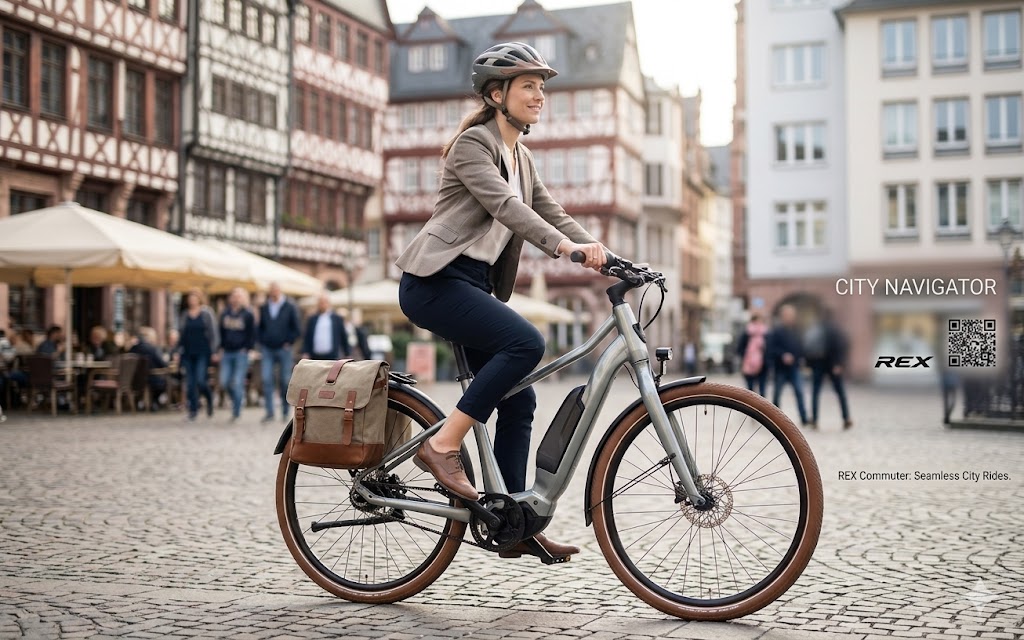
Sustainability begins in everyday life. This article shows how an electric cycle like the Rex Commuter S not only improves one's personal CO₂ footprint but also contributes to urban transformation. With facts, personal experiences, and practical tips for a greener life.
Introduction: Why every kilometer counts
We live in a time of transition. Climate change, air pollution, noise pollution – the problems of our cities are omnipresent. We often feel powerless. What can a single person really do?
The answer: More than you think. Especially when it comes to mobility.
The transport sector is responsible for about 20% of German greenhouse gas emissions. The majority of this comes from individual transport with internal combustion engines. Every trip you take on an e bike electric bike instead of a car is an active contribution to change.
This is not a moralizing treatise. It is an invitation to discover possibilities.
The CO₂ footprint: Numbers that convince
Let’s talk facts. How much CO₂ do you actually save with an e-bike?
Comparison of transport modes (CO₂ per person-kilometer)
Means of transport |
CO₂ emissions (g/km)* |
Cost per km |
|---|---|---|
Car (gasoline, alone) |
164 |
€0.35 |
Car (gasoline, full) |
55 |
€0.12 |
E-bike |
14** |
€0.03 |
Bicycle (conventional) |
0 |
€0.02 |
Public transport |
66 |
€0.15 |
Electric car |
48*** |
€0.10 |
*Source: German Environment Agency 2023**Includes electricity production and battery manufacturing***Depends on the electricity mix
With a daily commute of 24 km (round trip), you save the following compared to a car using the Rex Commuter S:
Annual savings:
CO₂: approx. 900 kg
Costs: approx. €2,700
Time: approx. 50 hours (less traffic congestion, direct routes)
This is equivalent to a flight from Berlin to Mallorca or the absorption of about 45 trees per year.
Beyond CO₂: The hidden environmental benefits
Riding a better ebike means more than just lower emissions. Here are the often overlooked advantages:
1. Air quality
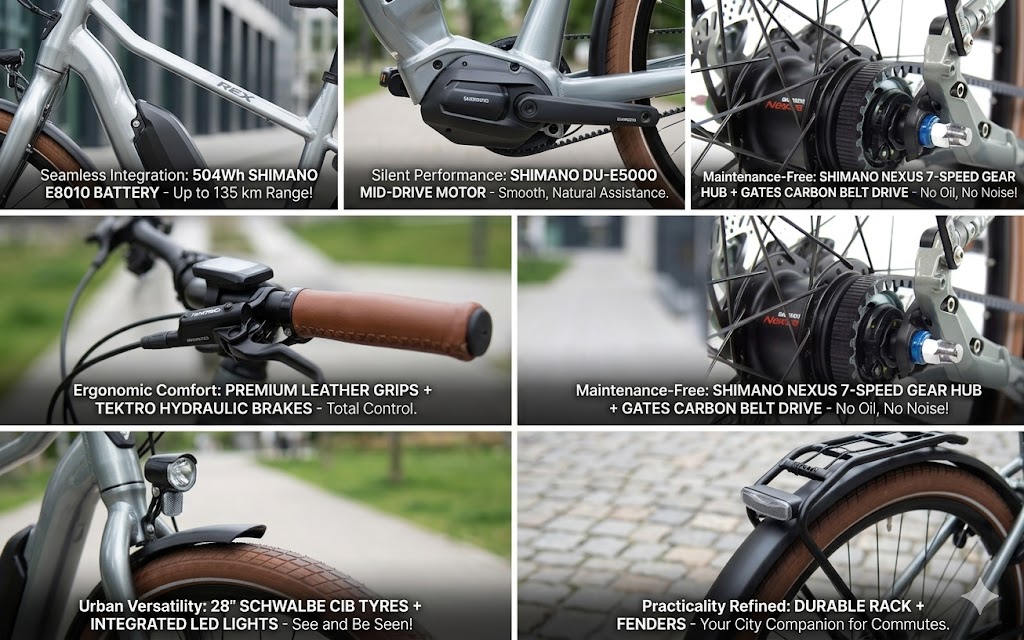
Fine dust and nitrogen oxides burden our cities. Cars produce not only exhaust gases but also tire and brake wear. The Rex Commuter S, with its hydraulic disc brakes and low-maintenance Gates belt drive, further minimizes this burden.
2. Noise reduction
Traffic noise is a serious health problem. The WHO estimates that noise pollution leads to thousands of premature deaths in Europe annually. E-bikes are quiet – especially the Shimano DU-E5000 motor, which operates almost silently.
3. Space usage
A parking space for one car holds about 10-12 bicycles. Fewer cars mean more space for:
Green spaces
Playgrounds
Bike lanes
Meeting zones
4. Resource consumption
Manufacturing a car requires about 10 times the material and energy compared to an e-bike. With an average lifespan of 5-7 years (battery) or 10+ years (frame), the resource efficiency is significantly better.
My path to green mobility
I was skeptical. "An electric cycle? Isn't that just a trend for hipsters?" But then I did the math.
My starting situation
Daily commute: 24 km
Previous vehicle: Diesel compact car
Consumption: 6.5L/100km
Annual mileage: 6,000 km (commuting only)
The decision
When I first saw the Rex Commuter S, I was surprised. For €1,049.00 (instead of €2,599.00), I got:
A solid 504Wh battery
A Shimano motor
A maintenance-free Gates belt
The belt, in particular, convinced me: No oil, no dirt, long service life. As someone who keeps their e bike white, I appreciate the clean solution.
The first 100 days
I kept a small diary. Here are my findings:
Days 1-7: Uncertainty. Am I too slow? Will I arrive on time?Days 8-30: Routine emerges. I know my times, my routines.Days 31-100: I don't miss the car. Not even in the rain.
What does an e-bike really weigh? – The overall ecological balance
Critics often ask: "What does an e bike weigh in the environmental balance sheet when you factor in battery production?"
A fair question. Here is the answer:
Battery production
Manufacturing a 504Wh battery causes about 50-80 kg of CO₂. Sounds like a lot? In context:
A car tank (50L gasoline) burns in 10,000 km: ~1,200 kg of CO₂
The e-bike battery pays for itself after about 600-800 km compared to the car
With my annual commute of 6,000 km, I cleared the "battery debt" in less than two months. Everything after that is net gain.
Recycling
Modern e-bike batteries are 70-90% recycled. Lithium, cobalt, nickel – these valuable raw materials return to the cycle. Important: Take old batteries to official collection points, not in the household trash.
The Rex Commuter S as part of the solution
Why this particular model as an electric brand bike for environmentally conscious people?
Sustainable component selection
Gates CDX Carbon Belt:
Service life: up to 30,000 km
No oil necessary (avoids water pollution)
Recyclable at the end of its service life
Shimano components:
Durable and repairable
Spare parts widely available
Avoids a throwaway mentality
Hydraulic brakes:
Longer service life than mechanical ones
Brake fluid rarely needs to be changed
Economic efficiency promotes sustainability
At €1,049.00, the Rex Commuter S is affordable. Sustainability should not be a luxury. The more people who can afford an e bike electric bike, the greater the collective effect.
Practical tips for the green switch
Want to try it? Here are my recommendations:
1. Start small
Do you really have to switch every day? Start with 2-3 days a week. Increase slowly.
2. Invest in good accessories
Weatherproof clothing (makes rain bearable)
Quality lock (protects against theft)
Rack/bags (transport without a car)
3. Plan your route
Use apps like Komoot or Google Maps (bicycle mode). Often there are more beautiful, safer routes that you would never have discovered by car.
4. Charge green
If possible, charge your battery with green electricity. Many providers have special e-mobility tariffs. Even better: Your own solar system on the roof.
5. Become part of the community
Local cycling groups, online forums, Critical Mass events – the exchange motivates and helps with problems.
The bigger picture
Riding an electric cycle is more than an individual decision. It is a political statement.
Infrastructure follows demand
The more people who cycle, the more cities invest in:
Protected bike lanes
Secure parking facilities
Charging infrastructure for e-bikes
Copenhagen showed: When the share of cycling rises to over 30%, city politics change fundamentally.
Economic transformation
The bicycle industry is growing. Jobs are created in:
Production
Retail
Service/repair
Tourism (cycling trips)
A local bike shop creates more jobs per euro invested than a motorway.
Honest assessment of challenges
Sustainability is not always easy. Here is my honest list:
Winter operation: Cycling is not much fun at -10°C. I sometimes use public transport then. Perfectionism is counterproductive.
Range anxiety: At the beginning, I was afraid of getting stuck. After 6 months: Unfounded. The 504Wh battery easily lasts for a week.
Theft risk: Yes, e-bikes are desirable. Good insurance (approx. €10/month) provides security.
Social acceptance: Some see e-bikes as "cheating." This opinion is changing – slowly but steadily.
/🛒 BUYBOX: Rex Commuter S E-Bike
Conclusion: Small steps, big impact
The Rex Commuter S is not perfect. But it is a tool for change. A tool that is in my hands. Every single day.
After one year of green mobility, I take stock:
CO₂ saved: ~900 kg
Money saved: ~€2,500 (incl. car maintenance costs)
Time gained: ~50 hours (no traffic jams, more direct routes)
Health: Significantly better (according to doctor)
Quality of life: Immeasurably higher
But the most important realization: I no longer feel powerless. I am doing something. Concrete. Measurable. Daily.
If you are considering whether an e bike electric bike is right for you: Try it out. Not out of guilt. Not out of morality. But because it feels good. Because it works. Because it is the future.
The cities of tomorrow will not be car-friendly. They will be people-friendly. And we can start shaping them today. Kilometer by kilometer.
FAQ
Is an e-bike really more environmentally friendly than a car?Yes, clearly. Even taking battery production into account, the CO₂ footprint is better after just a few hundred kilometers.
How do I dispose of an old e-bike battery?At official collection points, recycling centers, or in specialist shops. Never in the household trash.
Can I charge my e-bike with solar power?Absolutely! A typical household battery can be easily charged with a small PV system.
How much does the electricity for a full charge cost?At 504Wh and an electricity price of €0.30/kWh, about €0.15 per charge.
Are there support programs for e-bikes?Yes, in some cities and regions. Some employers subsidize job bikes. Inform yourself locally.
Is the Rex Commuter S also available as an e bike white?Yes, the model is available in several colors, including white.
Sustainability is a process, not a state. Every step counts.