
Summary
A detailed cost-benefit analysis of the Rex Commuter S e-bike. We calculate total costs, compare them with alternatives, and demonstrate its true cost-effectiveness. Includes a 5-year forecast, amortization calculation, and a decision-making guide for price-conscious buyers.
Introduction: Price in Context
€1,049.00 instead of €2,599.00. That figure sounds tempting. But is the Rex Commuter S really a bargain? Or are there hidden costs that aren't apparent at first glance?
This analysis looks beyond just the purchase price. We calculate the true costs over 5 years and compare them with all relevant alternatives, for anyone who wants to know if this e-bike electric bike makes financial sense.
Acquisition Costs in Detail
Base Price
Item |
Amount |
|---|---|
RRP |
€2,599.00 |
Current Price |
€1,049.00 |
Savings |
€1,550.00 (60%) |
This already shows that the Rex Commuter S is positioned well below the recommended retail price. But why?
Possible reasons:
Introductory offer from a new brand (electric brand bike)
Direct sales without middlemen
Competitive pressure in the growing e-bike market
Necessary Accessories
You don't ride an electric cycle naked. Here are the realistic additional costs:
Accessory |
Price Range |
Recommendation |
|---|---|---|
Bicycle Helmet |
€50-150 |
€80 (mid-range) |
Bicycle Lock |
€80-200 |
€120 (good folding or U-lock) |
Lighting* |
€30-100 |
€50 (USB-rechargeable) |
Rack/Bags |
€50-200 |
€100 (for commuters) |
Mudguards** |
€40-80 |
€60 (if not included) |
Tools/Spare Tube |
€30-50 |
€40 |
Total Accessories |
€280-780 |
€450 |
*Often already included, check! **Partially included with the Rex Commuter S, quality may vary
Realistic total initial costs: €1,049 + €450 = €1,499.00
Annual Running Costs
Fixed Costs
Item |
Cost/Year |
Note |
|---|---|---|
Insurance |
€120 |
E-bike full coverage (~€10/month) |
Maintenance/Inspection |
€60 |
Annual check-up at a dealer |
Wear Parts |
€50 |
Brake pads, tires (varies significantly) |
Electricity |
€30 |
For daily use, ~€0.30/kWh |
Total Fixed Costs |
€260 |
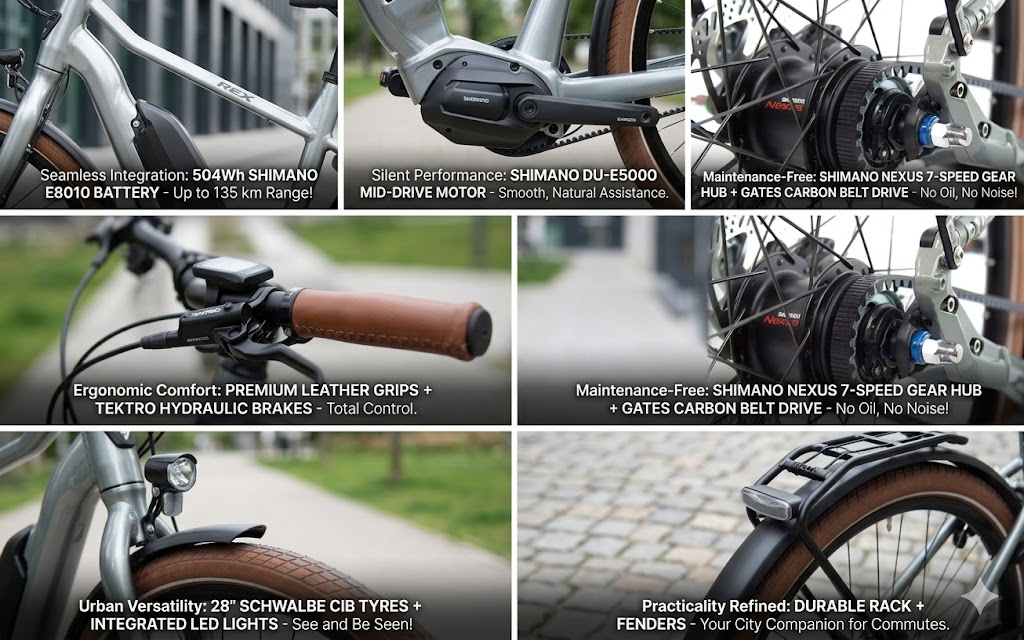
Thanks to the Gates CDX carbon belt, there is no need for chain oil or frequent chain replacements. This saves about €30-50/year compared to chain-driven models.
Variable Costs (Usage-dependent)
Usage |
Additional Cost/Year |
|---|---|
Low mileage (<1,000 km) |
€50 (less wear) |
Average (2,000-4,000 km) |
€100 (normal wear) |
High mileage (>5,000 km) |
€200+ (more frequent tires/brakes) |
For our calculation, we assume an average commuter covering 3,000 km/year.
5-Year Total Cost Calculation
Now it gets interesting. What does the Rex Commuter S really cost over its lifespan?
Scenario: Average Commuter (3,000 km/year)
Year |
Item |
Amount |
Cumulative |
|---|---|---|---|
0 |
Purchase price + Accessories |
€1,499 |
€1,499 |
1 |
Running costs |
€360 |
€1,859 |
2 |
Running costs |
€360 |
€2,219 |
3 |
Running costs |
€360 |
€2,579 |
4 |
Running costs |
€360 |
€2,939 |
5 |
Running costs + battery replacement* |
€860 |
€3,799 |
*Battery due after 5 years (approx. 1,000 charging cycles), cost: ~€500
Total costs over 5 years: €3,799.00 Cost per year: €760.00 Cost per kilometer: €0.25/km
This is impressively low. For comparison: A car costs an average of €0.35-0.50/km in fixed costs alone (excluding purchase price).
Comparison with Alternatives
Alternative 1: Budget e-bike (€800)
Factor |
Rex Commuter S |
Cheap e-bike |
|---|---|---|
Purchase price |
€1,049 |
€800 |
Motor |
Shimano DU-E5000 |
No-name |
Battery |
504Wh Shimano |
400Wh Generic |
Drive |
Gates belt |
Chain |
Maintenance/year |
€60 |
€100+ |
Lifespan |
5-7 years |
3-4 years |
5-Year Costs |
€3,799 |
€4,200* |
*Higher maintenance + earlier replacement + lower resale value
Conclusion: The seemingly cheap model costs more in the end. A classic "buy cheap, buy twice" scenario.
Alternative 2: Premium e-bike (€2,500)
Factor |
Rex Commuter S |
Premium model |
|---|---|---|
Purchase price |
€1,049 |
€2,500 |
Motor |
Shimano DU-E5000 |
Bosch Performance |
Battery |
504Wh |
625Wh |
Equipment |
Medium |
High |
Resale (after 5 years) |
~€400 |
~€800 |
5-Year Net Costs |
€3,399 |
€4,500 |
Conclusion: More equipment doesn't automatically mean better cost-effectiveness. For pure commuters, the Rex Commuter S is the more rational choice.
Alternative 3: Public transport
For a 3,000 km/year commute (using Germany's "Deutschlandticket"):
Item |
Cost/Year |
5 years |
|---|---|---|
Deutschlandticket |
€588 |
€2,940 |
Additional trips |
€100 |
€500 |
Total |
€688 |
€3,440 |
Comparison:
Public transport: €3,440 (5 years)
Rex Commuter S: €3,799 (5 years)
Difference: €359 in 5 years (€6/month)
For only €6 more per month, you get:
Independence from timetables
Direct routes
Exercise in the fresh air
No crowded trains
Alternative 4: Keep the car
At 6,000 km/year (commuting + private):
Item |
Cost/Year |
5 years |
|---|---|---|
Depreciation |
€2,000 |
€10,000 |
Fuel (6.5L/100km) |
€1,170 |
€5,850 |
Insurance |
€600 |
€3,000 |
Tax/maintenance/tires |
€800 |
€4,000 |
Parking fees |
€240 |
€1,200 |
Total |
€4,810 |
€24,050 |
Savings with Rex Commuter S: €20,251 in 5 years!
Even if you keep the car in parallel (for vacations, large grocery trips), you still save €15,000+ because you use it significantly less.
Amortization Calculation
When does the e-bike pay for itself?
Compared to the car
Investment e-bike: €1,499
Monthly car costs (fixed): €400
Monthly e-bike costs: €30
Monthly savings: €370
Amortization after: 4 months
You will have recouped your investment in just three months. Everything after that is pure profit.
Compared to public transport
E-bike investment: €1,499
Monthly public transport costs: €49
Monthly e-bike costs: €30
Monthly savings: €19
Amortization after: 79 months (6.5 years)
It takes longer here, but keep in mind: After 5 years, you can still sell the bike for ~€400. Realistic amortization: ~5 years.
Hidden financial benefits
1. Tax advantages (commuting)
If your employer offers a company bike scheme:
Up to 40% savings through salary sacrifice
Example: €1,049 becomes €630 net
New amortization compared to a car: 2 months
2. Healthcare costs
Studies show: Regular cyclists have lower healthcare costs.
Fewer sick days
Lower risk of cardiovascular disease
Better mental health
Hard to quantify, but real. Count on €200-500/year in savings for the healthcare system (in economic terms).
3. Productivity
No traffic jams means:
More punctual for meetings
Less stress
A better start to the day
For freelancers and entrepreneurs: Time is money. 50 hours/year less in traffic can easily be worth €1,000+.
4. Resale value
The Rex Commuter S as an electric brand bike with Shimano and Gates components retains its value better than no-name alternatives.
Estimated values:
After 2 years: ~€650 (62%)
After 4 years: ~€500 (48%)
After 5 years: ~€400 (38%)
A no-name e-bike is often at 20-25% after 5 years.
The question: How much does an e-bike weigh financially?
The question "what does an e-bike weigh" takes on a new dimension here. It is not the physical weight that counts, but the weight in your budget.
Budget impact analysis (with €3,000 net monthly income)
Item |
% of net income |
|---|---|
Purchase price (one-time) |
50% (one month) |
Running costs/month |
1% |
Compared to car |
10-15% lower monthly mobility costs |
For most households, an e-bike in this price range is affordable – especially when you factor in the savings.
Risk factors and uncertainties
Let's be realistic. Not everything goes perfectly.
Possible additional costs
Risk |
Probability |
Costs |
|---|---|---|
Theft |
Medium |
€1,049 (covered by insurance) |
Battery defect before warranty ends |
Low |
€0 (warranty) |
Battery replacement after 5 years |
High |
€500 |
Frame breakage |
Very low |
€0-500 (depending on warranty) |
Vandalism |
Medium |
€100-300 (partially insured) |
Recommendation: The €10/month for insurance is money well spent.
Market uncertainties
New technologies could devalue current models
Subsidies could be cut
Energy prices could rise (though this affects everyone)
Counter-argument: A car is also subject to these risks – even more so.
🛒 BUYBOX: Rex Commuter S E-Bike
Conclusion: A rational decision
After this comprehensive analysis, it is clear that:
The Rex Commuter S makes financial sense if:
✓ You commute at least 15 km daily✓ You can replace a car or use one significantly less✓ You use the bike for at least 4-5 years✓ You value low maintenance costs (Gates belt!)✓ You want a better ebike with solid components
Less suitable if:
✗ You ride very irregularly (<500 km/year)✗ You need extreme ranges (>150 km daily)✗ You have to carry the bike up stairs daily (premature wear)✗ You live in very flat terrain with no cycling infrastructure
The hard numbers summarized
Metric |
Value |
|---|---|
Total acquisition |
€1,499 |
5-year total costs |
€3,799 |
Cost per kilometer |
€0.25 |
Amortization vs. car |
4 months |
5-year savings vs. car |
€20,251 |
Resale value (5Y) |
~€400 |
The Rex Commuter S is not a bargain at any price. It is a well-thought-out e-bike electric bike with a fair price-performance ratio. The 60% discount on the MSRP is not a marketing gimmick, but reflects genuine, competitive pricing.
For price-conscious commuters who think long-term, it is one of the most rational mobility decisions you can make.
And let's be honest: when was the last time you made an investment that paid for itself after 4 months and saved you €370 every month thereafter?
FAQ
Is an e-bike worth it for short distances (<5 km)?Financially yes, but the health benefits are lower. A conventional bike might make more sense here.
What happens to the battery after 5 years?It can be replaced (approx. €500). However, it often still has 70-80% capacity and remains usable.
Can I deduct the e-bike from my taxes?As a professional commuter, yes (commuter allowance). As an employee, you can save up to 40% via company bike schemes.
Is insurance mandatory?No, but highly recommended. E-bike theft would otherwise be a significant financial loss.
Is the model also available as an e-bike in white?Yes, the Rex Commuter S is available in several colors. The price does not vary by color.
How do rising electricity prices affect costs?Minimally. Even if they doubled to €0.60/kWh, the annual costs would only increase by €15.
All calculations are based on average values. Individual results may vary. Status: 2024.