
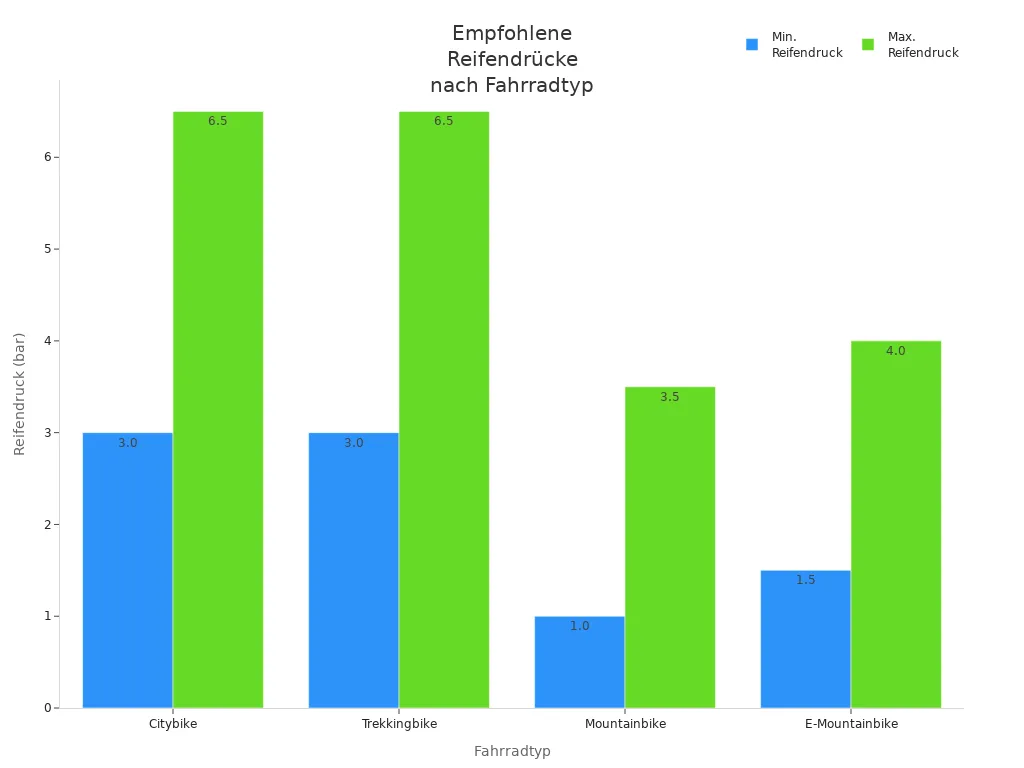
Are you wondering how much air your e-bike tires need? For city and trekking e-bikes, experts usually recommend 3.0 to 6.5 bar. Due to the battery and motor, e-mountain bikes require about 0.5 bar more than classic MTBs, often ranging from 2 to 4 bar. The optimal setting depends on your weight, the surface, and the tire width. Check your e-bike tire pressure regularly to ensure a safe and comfortable ride. The following table shows the most important guide values:
Bike Type |
Tire Width (mm) |
Recommended Tire Pressure (bar) |
Adjustment Tips |
|---|---|---|---|
City Bike |
approx. 30 - 50 |
approx. 3.0 to 6.5 |
Lower for comfort, higher when loaded |
Trekking Bike |
approx. 30 - 50 |
approx. 3.0 to 6.5 |
Dependent on luggage and surface |
Mountain Bike |
approx. 50 - 59 |
approx. 1.0 to 3.5 |
Lower pressure for grip, less air for tubeless |
E-Mountain Bike |
- |
approx. 0.5 bar more than MTB |
Recommended due to extra weight |
Key Takeaways
Adjust the tire pressure to your weight, tire width, and surface to improve safety and comfort.
Check the tire pressure at least once a week with a pressure gauge to prevent punctures and wear.
Inflate the rear tire with about 0.5 bar more air, as it carries more weight than the front tire.
Use the manufacturer's specifications on the tire sidewall as an important guide for minimum and maximum pressure.
Wider tires and tubeless systems allow for lower pressure and offer more comfort and puncture protection.
E-bike Tire Pressure: Values
City & Trekking E-Bikes
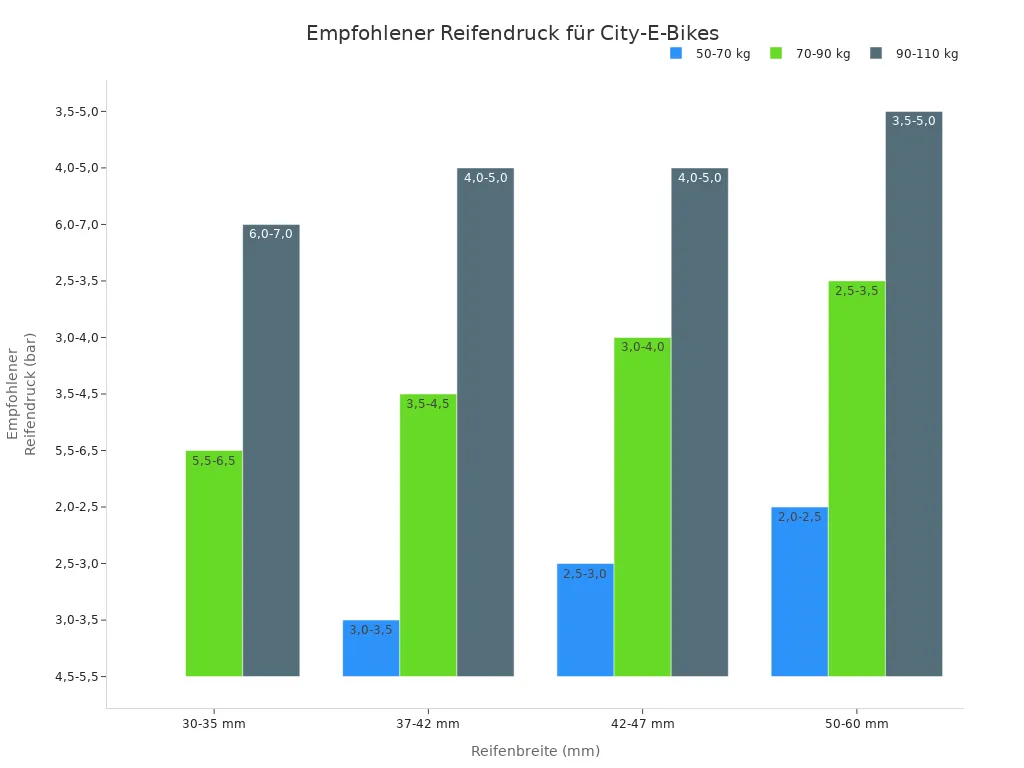
Would you like to know how much air your city or trekking e-bike needs? The optimal tire pressure depends primarily on your body weight and the tire width. For city e-bikes, you can find specific recommendations in the table below:
Body Weight (kg) |
Tire Width (mm) |
Recommended Tire Pressure (bar) |
|---|---|---|
50 - 70 |
30 - 35 |
4.5 - 5.5 |
50 - 70 |
37 - 42 |
3.0 - 3.5 |
50 - 70 |
42 - 47 |
2.5 - 3.0 |
50 - 70 |
50 - 60 |
2.0 - 2.5 |
70 - 90 |
30 - 35 |
5.5 - 6.5 |
70 - 90 |
37 - 42 |
3.5 - 4.5 |
70 - 90 |
42 - 47 |
3.0 - 4.0 |
70 - 90 |
50 - 60 |
2.5 - 3.5 |
90 - 110 |
30 - 35 |
6.0 - 7.0 |
90 - 110 |
37 - 42 |
4.0 - 5.0 |
90 - 110 |
42 - 47 |
4.0 - 5.0 |
90 - 110 |
50 - 60 |
3.5 - 5.0 |
For trekking e-bikes, similar values apply. You can use the figures for city e-bikes as a reference. Always check the maximum pressure rating on the tire sidewall to ensure you are riding safely. A higher weight due to luggage or shopping requires slightly higher pressure. For more comfort on cobblestones or poor roads, you can slightly reduce the pressure.
An important tip: The rear wheel usually carries more weight than the front wheel. You should therefore inflate the rear tire with about 0.5 bar more air. The table below shows typical differences:
E-Bike Type |
Position |
Recommended Tire Pressure (bar) |
Adjustment Tips |
|---|---|---|---|
City E-Bike |
Front Wheel |
3.0 - 4.0 |
More comfort at lower pressure |
Rear Wheel |
3.5 - 4.5 |
Higher pressure for more load capacity |
Tip: The narrower the tire, the higher the pressure should be. With additional weight (e.g., luggage), increase the pressure by about 1% per kilogram.
E-Mountain Bikes
Due to their motor and battery, e-mountain bikes usually need a bit more air than classic MTBs. The correct e-bike tire pressure ensures grip, control, and puncture protection. The values depend on the tire width and the system (with or without an inner tube):
Tire Type / Width |
Recommended Tire Pressure (bar) |
Recommended Tire Pressure (psi) |
|---|---|---|
Tubeless 2.35–2.5 inch |
approx. 1.8 |
26 |
Tubeless 2.6–3.0 inch |
approx. 1.4 |
20 |
With tube 2.35–2.5 inch |
approx. 2.0 |
29 |
With tube 2.6–3.0 inch |
approx. 1.6 |
24 |
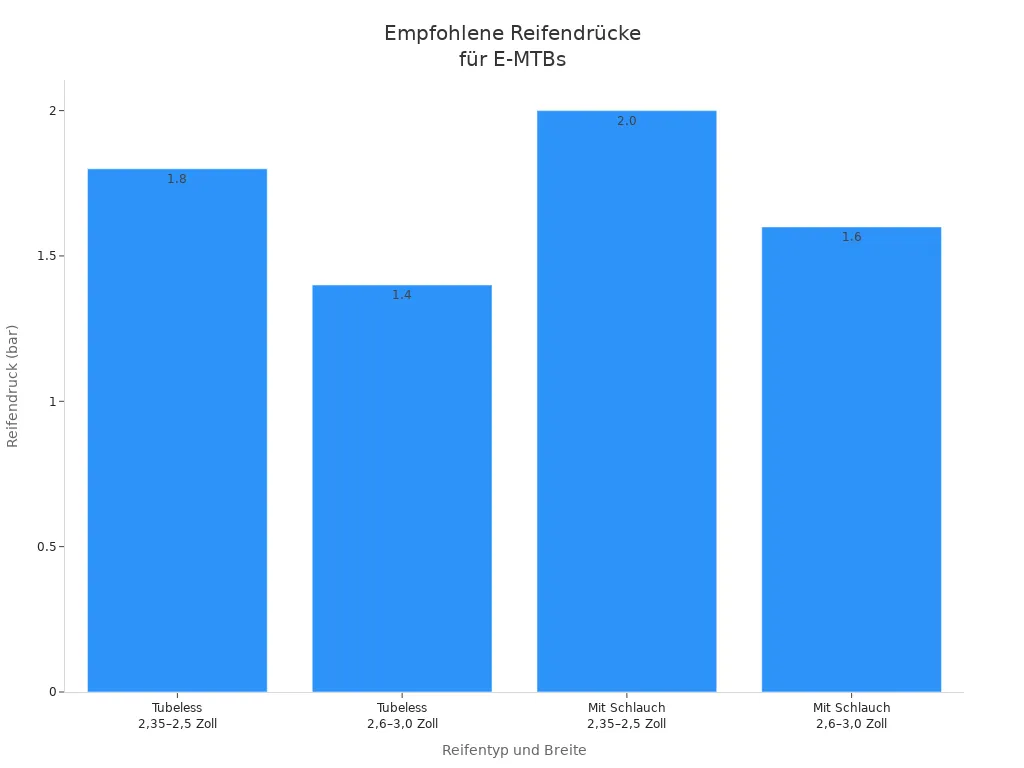
You can choose a pressure about 0.2 bar lower for the front wheel than for the rear wheel. This improves balance and grip. Wider tires allow for lower pressure and offer more comfort off-road. Adjust the e-bike tire pressure to your riding style and the terrain. For technical trails, it is recommended to lower the pressure incrementally until you find the best mix of grip and stability.
Note: Tubeless tires offer more puncture protection and allow for lower pressures. They are particularly suitable for sporty riders and difficult terrain.
Wide Tires & Tubeless
Wide tires (e.g., 51 to 54 mm) have a larger air volume. You can therefore ride with less pressure without the tire bottoming out. This provides more comfort and better traction, especially on uneven paths. Excessively high pressure makes the tire hard and reduces traction. Excessively low pressure increases the risk of punctures and damage.
Tubeless systems offer you many advantages. You can choose a lower e-bike tire pressure than with classic tube tires. This improves ride comfort and control, especially on poor roads or off-road. The sealant in the tire ensures that small holes are sealed immediately. This makes your ride safer and reduces punctures. However, you should check and refill the sealant regularly.
Remember: The specifications on the tire sidewall show the minimum and maximum air pressure. You must not exceed or fall below these values. Within this range, you can adjust the pressure individually according to your weight, luggage, and the surface.
Tire Width (mm) |
Front Wheel (Bar) |
Rear Wheel (Bar) |
|---|---|---|
40 |
4.0 |
4.5 |
54 |
2.5 |
3.0 |
60 |
2.0 |
2.5 |
70 |
1.3 |
1.8 |
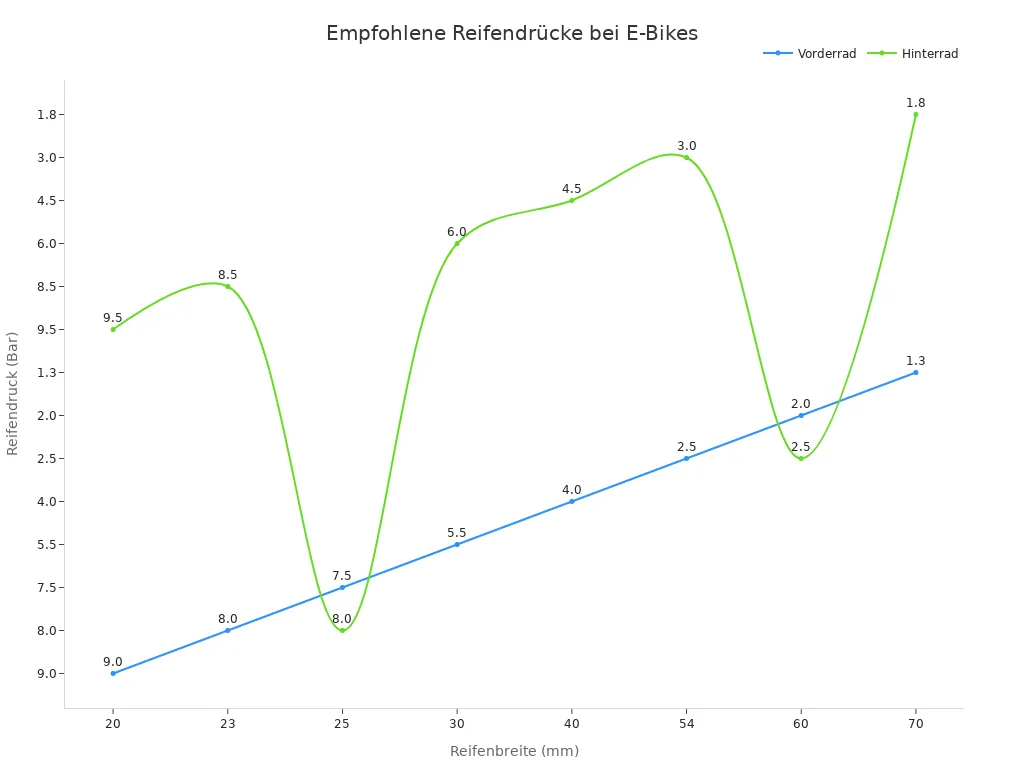
Conclusion: The manufacturer's specifications on the tire sidewall are your most important guide. Within these limits, you can find the optimal e-bike tire pressure for yourself through experimentation.
Influencing Factors
Tire Width
Tire width determines how much air you should pump into your e-bike tires. Wider tires have more volume. They allow you to ride with less pressure without the tire becoming unstable. This ensures more comfort and better grip, especially on uneven paths. Studies show that lower pressure in wide tires reduces rolling resistance off-road and improves handling characteristics.
Description |
|
|---|---|
Larger volume due to wider tires |
Allows for lower air pressure with the same puncture protection |
Lower tire pressure |
Increases grip and comfort, reduces rolling resistance off-road |
Wider rims and tires |
Allow for reduction of tire pressure, which improves efficiency and handling |
Limitations |
Tire pressure must be adjusted based on tire/rim width, rider weight, and riding technique |
Rule of thumb for air pressure (hobby freerider approx. 75 kg) |
Front approx. 1.5 bar, rear approx. 1.7 bar |
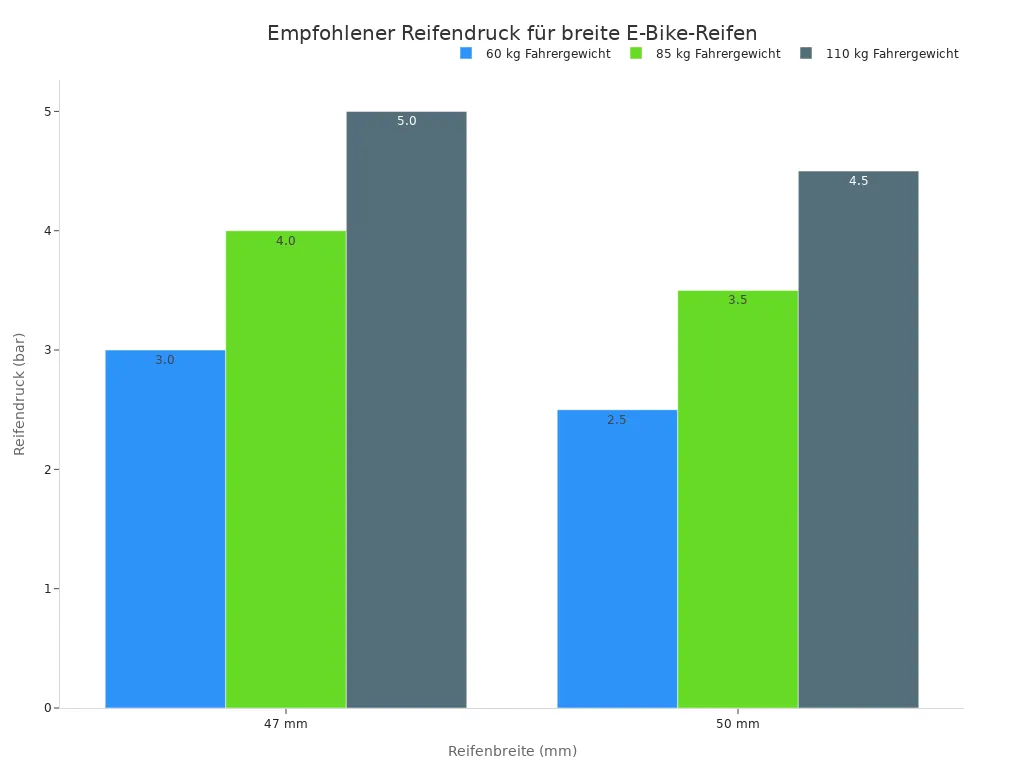
If you have particularly wide tires, you can lower the pressure further. The following diagram shows how tire width and rider weight affect the recommended tire pressure:
Rider Weight
Your weight plays a major role in determining the optimal tire pressure. The heavier you are, the more air your tire needs so that it doesn't bottom out. A rule of thumb: Increase the pressure by about 1% per kilogram of additional weight. E-bikes are heavier than normal bicycles due to the battery and motor. Therefore, you should increase the pressure by 0.2 to 0.4 bar.
Recommendation / Effect on tire pressure |
|
|---|---|
Standard body weight |
Base recommendation at approx. 75 kg rider weight |
Additional weight (rider + luggage) |
Increase tire pressure by approx. 1% per kg of additional weight |
Total e-bike weight |
Generally 0.2 to 0.4 bar higher tire pressure due to battery and motor |
Tire width |
Wider tires tend to allow for lower tire pressure |
Tip: The rule of thumb for e-bikes: 1% of your body weight in bar plus 0.5 bar for battery and motor.
Surface
The surface influences how much air you should pump into your tires. If you mostly ride on asphalt, a higher pressure makes sense. This reduces rolling resistance and saves energy. On gravel, forest paths, or sand, you should lower the pressure. This increases the contact patch, the tire adapts better to unevenness, and you have more grip.
On soft ground such as sand or gravel: lower pressure for more traction.
Check the pressure regularly and adjust it to your route.
Riding Style & Manufacturer Specifications
Your riding style helps determine how much air you need. If you ride sportily and fast, you usually need slightly more pressure. If you prefer comfort and often ride off-road, you can lower the pressure. The information on the tire sidewall shows you the permitted range. You must not go below or exceed this range.
Note: Manufacturer specifications are your most important guide. Adjust the pressure to your weight, riding style, and the surface. Too little or too much air can lead to poor grip, higher wear, or even accidents.
Consequences of Incorrect Values
Pressure too low
If you ride with too little air in your tire, you risk many problems. Your e-bike feels spongy, especially in corners. The tire can slip on the rim. This increases the risk of the valve tearing off. Furthermore, your braking distance increases because the tire has less grip on the road.
Permanently low tire pressure leads to heavy wear. Cracks in the tire casing appear faster. The service life of your tires decreases significantly. You have to buy new tires more often. The risk of punctures also increases. Especially with tube tires, so-called "snake bites" can occur. This is when the tube gets pinched and damaged between the rim and the casing.
Tip: Correct tire pressure not only protects your tires but also improves the range of your e-bike. You reach your destination further and more safely.
Here are the most important consequences of low pressure at a glance:
Increased wear and cracks in the tire casing
Higher risk of punctures and snake bites
Poorer ride stability, especially in corners
Longer braking distances and less grip
Tire does not sit firmly on the rim
Pressure too high
Too much air in the tire is also not good. You feel every bump on the road. The ride becomes hard and uncomfortable. Your e-bike vibrates at every small pothole. The tire can cushion less. This makes longer rides strenuous.
Excessive tire pressure reduces grip. Your bike slides away more easily, especially on wet or loose ground. Puncture protection decreases because the tire cannot give way as much. Small stones or sharp edges can damage the casing more easily.
Manufacturers like Continental and Schwalbe recommend not exceeding the maximum pressure listed on the tire sidewall. Optimal pressure ensures longer durability, better grip, and more range. You should choose the pressure so that comfort and safety remain in balance.
Remember: A well-adjusted tire pressure is crucial for your safety, riding pleasure, and the lifespan of your tires.
Measuring E-Bike Tire Pressure
Equipment & Valves
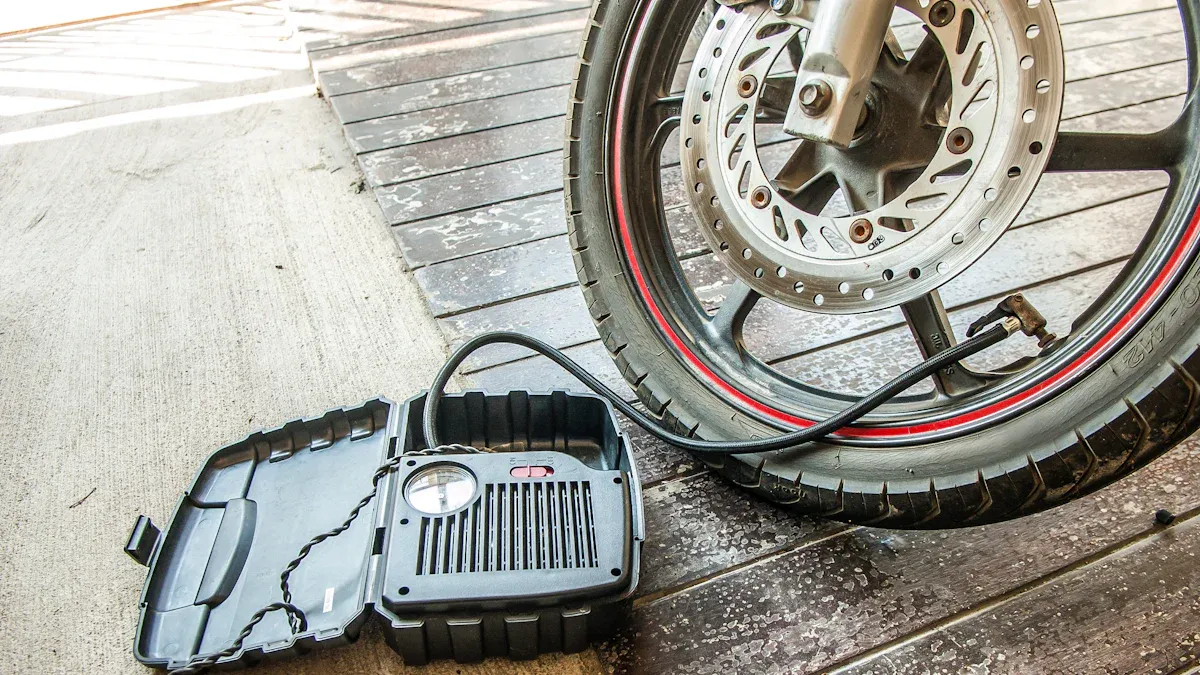
You need the right tools to measure your e-bike's tire pressure accurately. It is best to use a calibrated pressure gauge or a digital pressure gauge. Digital gauges provide particularly precise values and are easy to use. Many cyclists use a floor pump with an integrated gauge. This combination helps you reach the desired pressure quickly. Avoid makeshift tools, as they often provide inaccurate results. Check the pressure at least once a week or before longer tours.
For pumping and measuring, you must know the appropriate valve. There are different types of valves that you can find on your e-bike:
Valve Type |
Design & Features |
Handling when pumping |
Prevalence & Application |
|---|---|---|---|
Schrader |
Robust, like car valve, thick valve stem |
Remove valve cap, attach pump head, pump air |
Common on touring bikes, pumpable at gas stations |
Presta |
Thin valve, with locking nut to release valve pin |
Remove valve cap, loosen valve pin, pump carefully |
Preferred for road bikes and narrow rims |
Dunlop |
Simple tube with side hole |
Remove valve cap, more force required when pumping |
Formerly widespread, rarely used today |
Blitz |
Similar to Dunlop, requires higher pump pressure |
Remove valve cap, pumping requires more effort |
Often on everyday bikes in Germany |
Many modern e-bikes offer additional aids. Tire pressure sensors measure the pressure directly in the tire and send the data to a display. You see immediately if the pressure is correct. There are two systems:
System Type |
Functionality |
Advantages |
Disadvantages |
|---|---|---|---|
Direct TPMS |
Sensor measures pressure and temperature in the tire, sends data |
Very accurate, shows errors immediately, more safety |
More expensive, complex installation |
Indirect TPMS |
Uses ABS sensors, estimates pressure via rolling circumference |
Cheap, easy to install |
Less accurate, only measures while riding |
Step-by-step
This is how you correctly measure and set your e-bike tire pressure:
Press the tire with your thumb. If it can be pressed in more than a centimeter, it lacks air.
Read the minimum and maximum values on the tire sidewall (for example: Min 2.0 bar – Max 4.0 bar).
Attach the pressure gauge or the pump with a gauge to the valve.
Pump air in until the desired value is reached. For firm ground, choose a higher pressure; for unpaved paths, a lower one.
After pumping, check the tire for cracks, cuts, or foreign objects.
Tip: Use a digital pressure gauge for particularly accurate results. Check the pressure regularly to maintain safety and ride comfort.
Inspection & Maintenance
Inspection Frequency
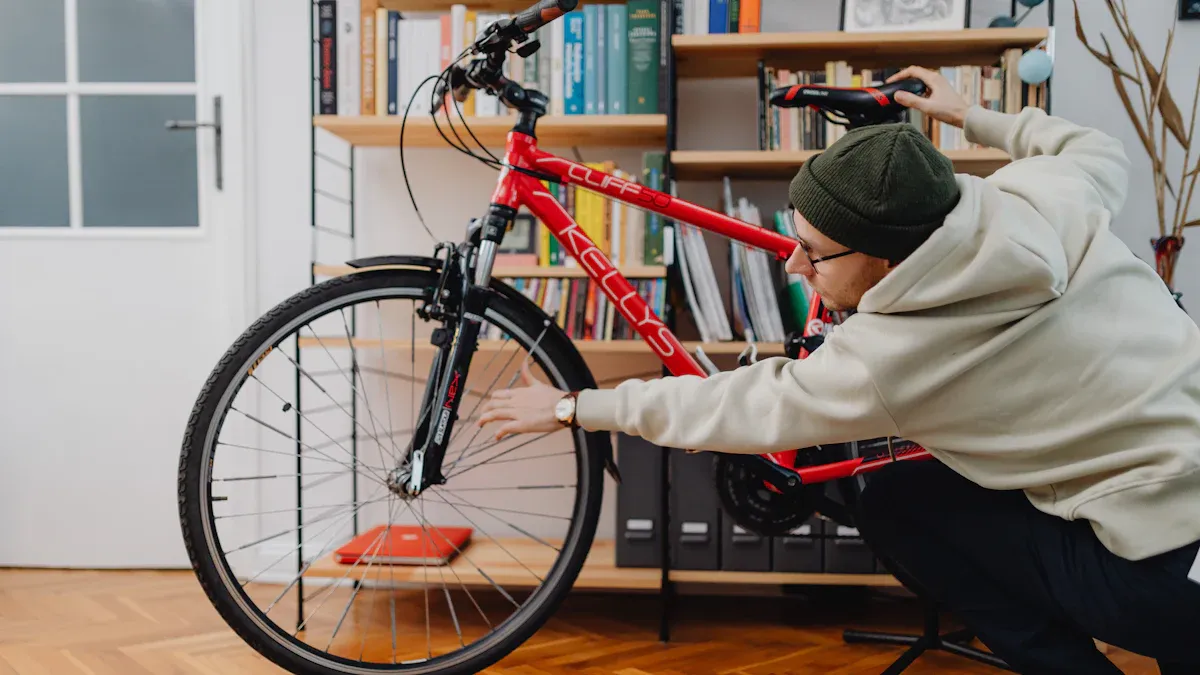
You should check your e-bike's tire pressure regularly. Tires always lose some air over time, even if you don't have a flat. Experts recommend checking the pressure at least once a week. Before longer tours or during strong temperature fluctuations, an additional check is worthwhile. Especially in winter, the pressure drops faster because cold air has less volume. A pressure loss of about 0.1 bar per 10 °C temperature drop is normal. Check the pressure also after rides on uneven terrain or if you feel that the handling has changed.
Tip: It is best to check the e-bike tire pressure in the morning when the tires are still cold. This gives you the most accurate value.
Everyday Tips
With a few simple measures, you can keep your e-bike tire pressure stable in the long term and ensure more safety. The following table shows you important maintenance tips and influencing factors:
Maintenance Tip / Influencing Factor |
Description |
|---|---|
Regular pressure check |
Tires lose air naturally, so regular checking is essential. |
Rider and bike weight |
The tire pressure should be approx. 10% of the total weight (rider + bike). The pressure is increased by 1% for every additional kilogram. |
Different pressures front/rear |
60% of the weight is on the rear wheel, so the pressure should be higher in the back for more stability. |
Surface and road condition |
Smooth ground requires higher pressure, bumpy or wet surfaces lower pressure for comfort and grip. |
Temperature |
When the temperature drops, the tire loses approx. 0.1 bar per 10 °C, which must be taken into account during the pressure check. |
Wheel size and tire width |
Narrower tires require higher pressure, wider tires less. For every millimeter of less width, the pressure is increased by 0.5 bar. |
Bike type |
MTB, road bike, and other types require different pressure ranges depending on use and terrain. |
You can set a reminder on your phone so you don't forget the check. Use a floor pump with a gauge or a digital measuring device for precise values. Make sure to set the pressure differently on the front and rear wheels. The rear wheel usually carries more weight. Adjust the pressure to your weight, the surface, and the season. This keeps your ride safe and comfortable.
Summary
Most important points
Here you will find the three most important things that you should always keep in mind regarding tire pressure on your e-bike:
Adjust the air pressure to the tire width and the e-bike model. Narrow tires need more pressure than wide tires.
Take the total weight into account. The heavier you, your e-bike, and your luggage are, the higher the air pressure should be.
Check the tire pressure regularly with a gauge. Always adhere to the minimum and maximum values specified by the manufacturer on the tire sidewall. This way you ride safely and comfortably.
Tip: Optimally adjusted tire pressure ensures more safety, better handling characteristics, and a longer lifespan for your tires.
Call to action
You now have the necessary knowledge to optimally adjust the tire pressure on your e-bike. Check the pressure at least once a week. Use a floor pump with a gauge or a digital measuring device for this purpose. Ensure that you set the pressure differently for the front and rear wheels because the rear wheel usually carries more weight. Adjust the air pressure to your weight, tire width, and surface. Check the condition of your tires before every longer tour. Small adjustments often make a big difference in ride comfort and safety.
If you implement these tips regularly, you will benefit from more riding fun and reduce the risk of punctures. Stay attentive and make checking the tire pressure a fixed part of your e-bike routine. This way, you are always on the road safely and relaxed.
You should always adjust the air pressure on your e-bike to your weight, the bike, and the surface. Check the tire pressure at least once a month, and even more often if used frequently or during temperature fluctuations. An optimal value ensures more comfort, safety, and a longer lifespan for your tires. Increase the pressure by about 1% per kilogram for extra luggage. This prevents punctures and helps you enjoy every ride. A regular check protects you from surprises and makes your e-bike experience safer and more pleasant.
FAQ
How often should you check the e-bike tire pressure?
You should check the tire pressure at least once a week. Before longer rides, it is best to check it additionally. This way you ride safely and protect your tires from damage.
Which tire pressure is optimal in rain or cold?
In rain or cold, lower the pressure slightly. This gives you more grip. Make sure not to go below the minimum value on the tire sidewall.
Can you use a normal bicycle pump for e-bike tires?
Yes, you can use a normal bicycle pump. Make sure it matches the valve type. A gauge helps you reach the correct pressure.
What happens if you set the tire pressure too high?
Too high a pressure makes the tire hard. You feel every bump. The grip on wet or loose surfaces decreases. The risk of damage to the tire increases.
How do you find the right tire pressure for your e-bike?
Factor |
What you should consider |
|---|---|
Rider weight |
More weight = more pressure |
Tire width |
Wide tires = less pressure |
Surface |
Terrain = less pressure |
Manufacturer specifications |
Always follow |
Test different values until you feel comfortable.