
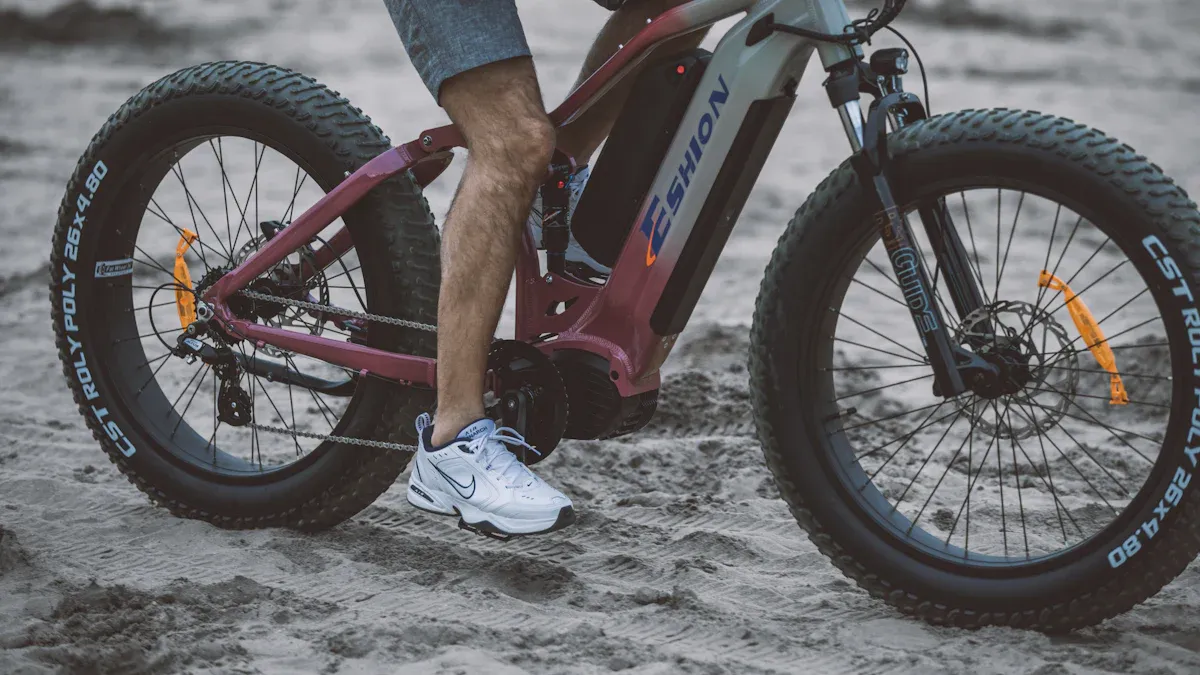
Are you wondering how much air actually belongs in your e-bike tires? E-bikes carry more weight than regular bikes due to their motor and battery. That is why you should pump in about ten percent more pressure when dealing with e-bike tire pressure – usually about half a bar more than for a classic bicycle. This ensures more safety, better comfort, and a longer range. Small adjustments make a big difference. Try it out and feel the change immediately!
Key Takeaways
E-bikes need about 10% more tire pressure than regular bicycles because of their higher weight.
The right tire pressure ensures more safety, better ride comfort, and a longer battery range.
Weight, terrain, and riding style influence the optimal air pressure – adjust it regularly.
Distribute your luggage evenly and ensure a good seating position for more stability.
Check the tire pressure at least once a month with an accurate gauge.
Tire Pressure for E-bikes
Importance for Safety and Comfort
You have surely noticed: e-bikes are heavier than regular bicycles. The motor, battery, and a sturdier frame add significant weight. That is why you usually need higher tire pressure for your e-bike. This provides more stability and protects the tires from damage.
Tip: Well-adjusted tire pressure on e-bikes makes your ride not only safer but also much more pleasant. You roll easier, feel fewer vibrations, and have more control – especially when you are riding with luggage.
Here are a few important points on why the right tire pressure is so critical for e-bikes:
The higher weight requires more robust tires and more air pressure.
Higher pressure reduces rolling resistance. This saves energy and lets you go further on one battery charge.
The tires last longer because they deform less and do not wear out as quickly.
The rear wheel in particular carries a lot of weight. You should ensure sufficient pressure here.
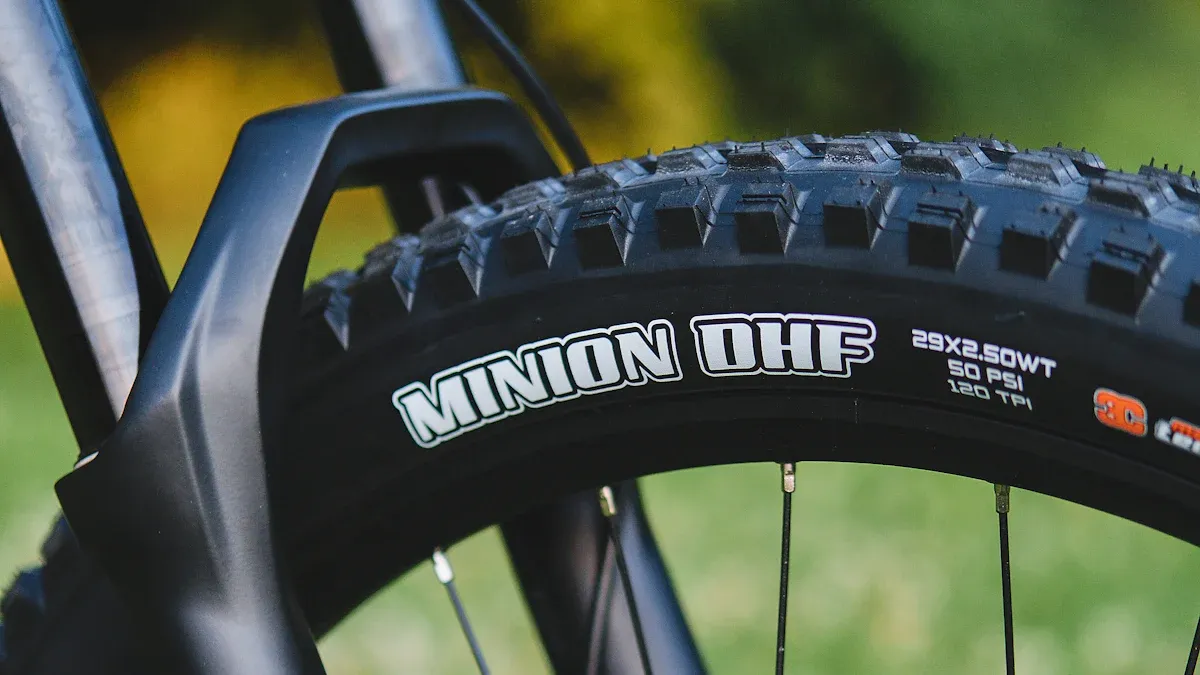
Manufacturers usually specify a minimum and maximum pressure. You can find these values on the tire, in the owner's manual, or sometimes on a sticker on the frame. The specifications always refer to cold tires. Therefore, it is best to measure the pressure before you start your ride.
Different types of e-bikes also require different pressures:
E-mountain bikes often run with less pressure for more grip off-road.
City e-bikes are in the mid-range.
E-road bikes need quite a bit of pressure so you can ride quickly and safely.
Consequences of Incorrect Pressure
Incorrect tire pressure on e-bikes can quickly become a problem. Too little or too much air directly affects safety, comfort, and range.
Here is an overview of the most important consequences:
Consequence / Aspect |
Tire pressure too low |
Tire pressure too high |
|---|---|---|
Stability |
Tires deform, instability |
Tire can be damaged or burst |
Control / Handling |
Worse handling due to deformation |
Less traction, more difficult handling |
Braking |
Braking distance increases, tire deforms |
Tire slips more easily, braking effect decreases |
Rolling resistance / Friction |
Higher, riding becomes more strenuous |
Lower traction, less comfort |
Risk of flat tires |
Higher due to overheating and wear |
Higher due to overload and possible damage |
Ride comfort |
Less comfort, unstable riding feel |
More vibrations, uncomfortable ride |
Risk of falling |
Increased due to instability |
Increased due to slipping while braking and turning |
Tire pressure that is too low increases rolling resistance. This means your motor has to work harder, the battery runs out faster, and you don't travel as far as planned. Studies show that the range can decrease by up to 15 kilometers if you ride with too little air. Additionally, the tires wear out faster, and you risk damage to the rim and casing.
Too much pressure is not good either. The tires barely cushion anymore, and you feel small bumps much more strongly. That can make the ride uncomfortable and even cause the tire to burst.
Remember: Check your e-bike's tire pressure regularly. Adjust it to your weight, the surface, and the tire type. This way, you ride safely and comfortably!
Influencing Factors
Weight and System Weight
Your weight and that of your e-bike play a major role in achieving the correct air pressure. The heavier you and your bike are, the more pressure the tire needs. A simple rule of thumb: Increase the pressure by 0.1 to 0.2 bar for every 10 kg of additional weight. This provides more stability and protects against punctures. The rear wheel, in particular, often carries more load because that is where the motor and battery are located. You should choose a slightly higher pressure here than at the front. Check regularly if the pressure is still correct – even small changes are noticeable when riding.
Tire Width and Tire Type
Wider tires have many advantages. They offer more comfort because they cushion bumps better. Furthermore, they distribute the weight more evenly and ensure more grip, especially on soft surfaces like sand or snow. For example: With the Schwalbe PickUp, you can pump up to a maximum of 4.5 bar despite its robust construction. For the front wheel, a pressure of 2.0 to 2.5 bar is often sufficient, while the rear wheel needs 2.2 to 3.0 bar depending on the rider's weight. Thin tires, such as those on road bikes, require more pressure to stay stable. The tire type also counts: folding tires and wire-bead tires react differently to low pressure. Always check the manufacturer's specifications on the tire sidewall and adjust the e-bike tire pressure regularly.
Tip: Wide tires with reinforced sidewalls increase load capacity and make your e-bike safer – especially if you have a lot of luggage or are riding off-road.
Surface and Riding Style
The surface determines how much air you need. On asphalt, you should choose the pressure at the upper end of the recommended range. This saves energy and makes riding easy. If you frequently ride on gravel or forest paths, lower the pressure slightly. This gives you more grip and comfort. Your riding style also counts: if you ride sportily and fast, you usually need slightly more pressure for stability. If you prefer a more leisurely pace, you can reduce the pressure slightly to enjoy more cushioning.
Smooth surface (e.g., asphalt): high pressure for efficiency
Rough surface (e.g., gravel, forest): lower pressure for more grip
Aggressive riding style: more pressure for puncture protection
Calm riding style: less pressure for comfort
Always adjust the pressure to your needs. This is how you get the best out of your e-bike!
Adjusting Tire Pressure
Rules of Thumb and Tables
Want to set the optimal tire pressure for your e-bike? You can quickly find the right value using a few simple rules of thumb and tables. Experts recommend adding the weight of the rider, equipment, and e-bike together. For e-bikes, add about 10 kg to the rider's weight because the motor and battery make the bike heavier.
Here is a practical table for typical tire sizes:
Rider weight incl. equipment |
60 kg |
85 kg |
110 kg |
|---|---|---|---|
Tire pressure (28" tire, ETRTO 28-622) |
5.5 bar |
6.5 bar |
7.5 bar |
Tire pressure (32-622) |
4.5 bar |
5.5 bar |
6.5 bar |
Tip: For slow off-road rides, you can lower the pressure by up to 0.5 bar. If you are riding quickly in the city, increase the pressure by 0.2 to 1 bar.
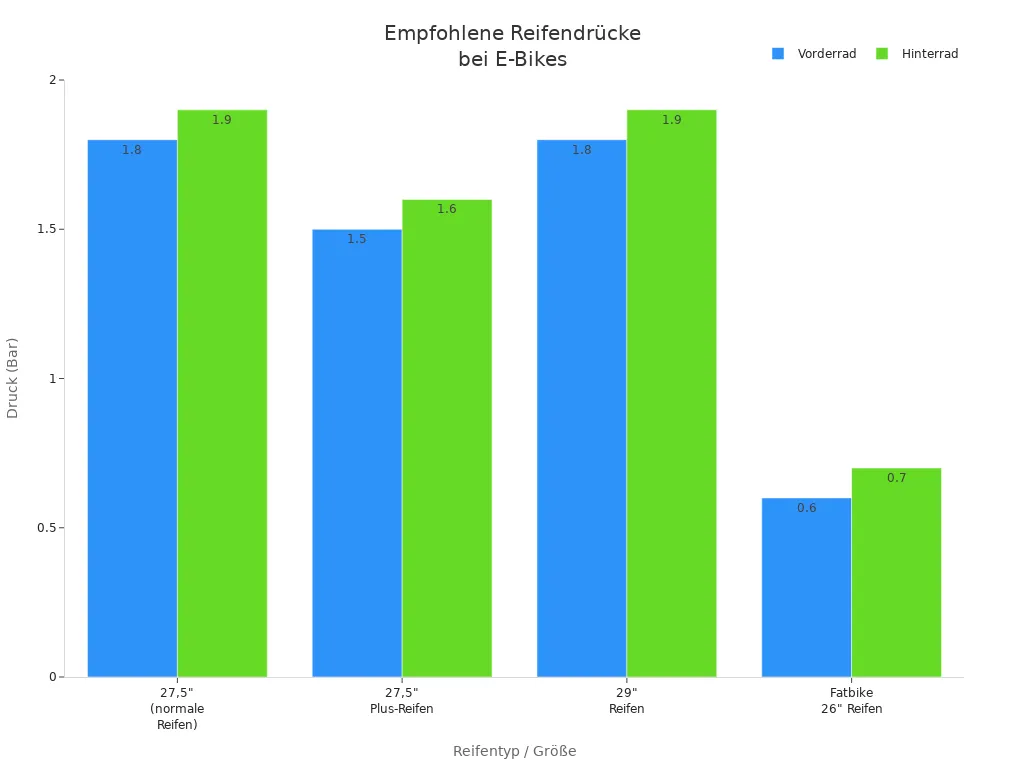
The difference between the front and rear wheel is also important. The rear wheel usually carries more weight because that is often where the motor and battery are located. Therefore, you should pump about 0.1 bar more into the rear than the front. Here is an overview for different tire types:
Tire type / Size |
Front wheel (bar) |
Rear wheel (bar) |
|---|---|---|
27.5" (standard tires) |
1.8 |
1.9 |
27.5" Plus tires |
1.5 |
1.6 |
29" tires |
1.8 |
1.9 |
Fatbike 26" tires |
0.6 |
0.7 |
You can also use tools like the "Pressure Prof" by Schwalbe. These apps help you find the perfect pressure for your e-bike.
Step-by-Step Instructions
Weigh: Find your total weight (you + equipment + e-bike).
Use the table: Check the table for the appropriate pressure for your weight and tire size.
Differentiate front and rear wheel: Pump the rear wheel about 0.1 bar higher than the front wheel.
Adjust: Tailor the pressure to your riding style and the terrain.
Test: Take a test ride and feel how the handling changes.
Measurement and Maintenance
Accurate tire pressure makes all the difference. Many pumps only show pressure roughly. For precise control, you need a good gauge. Here is an overview of popular models:
Gauge |
Measuring accuracy |
Special features |
Measuring range |
Value for money info |
|---|---|---|---|---|
SKS Airchecker |
Deviation rarely >0.05 bar |
Rotatable head, illuminated display, air release function, up to 10 bar, lightweight |
Up to 10 bar |
Affordable, good features and accuracy |
Topeak Smart Gauge D2 |
Very precise |
180° rotatable head, air release function, large display, acoustic signal |
Up to 17 bar |
Compact, good for on the go |
Michelin Tire Pressure Monitoring System |
Minor deviations |
Permanent monitoring via sensors on the valve, wireless transmission to handlebar display |
Not specified |
Practical for constant control |
Quarq TyreWiz Tire Pressure Sensor |
Precise to a hundredth of a bar |
Bluetooth transmission to smartphone app, LED alerts, waterproof |
Not specified |
Specifically for road bikes, mountain bikes, e-MTBs |
AstroAI Tire Pressure Gauge |
Accurate enough |
Illuminated display and valve attachment, low price |
Not specified |
Very inexpensive, easy to use |
Oxford Air Gauge |
Minimal deviations |
Right angle for valve access, no illuminated display |
Up to 10 bar |
Solid, cheap, but not for high demands |
Bosch EasyPump (electric) |
Reliable measurement |
Integrated pressure gauge, LED for darkness |
Not specified |
Practical, combines pumping and measuring
Xiaomi Mi electric air pump
Reliable measurement
OLED display, various profiles, manual target value input
Not specified
Affordable alternative, multifunctional
Note: Check the tire pressure on e-bikes at least once a month. It is best to check the pressure when the tires are cold. Small deviations are immediately noticeable while riding.
Many e-bikers swear by digital measuring devices. They are handy, show the pressure exactly, and fit in any bag. For frequent riders, a system with sensors that monitors pressure constantly and warns you of deviations is worthwhile.
If you check regularly and adjust the pressure, you will ride more safely and comfortably while saving energy. This keeps your e-bike in good shape for a long time and ensures you have more fun on every tour! 🚲
Weight distribution
Luggage and seating position
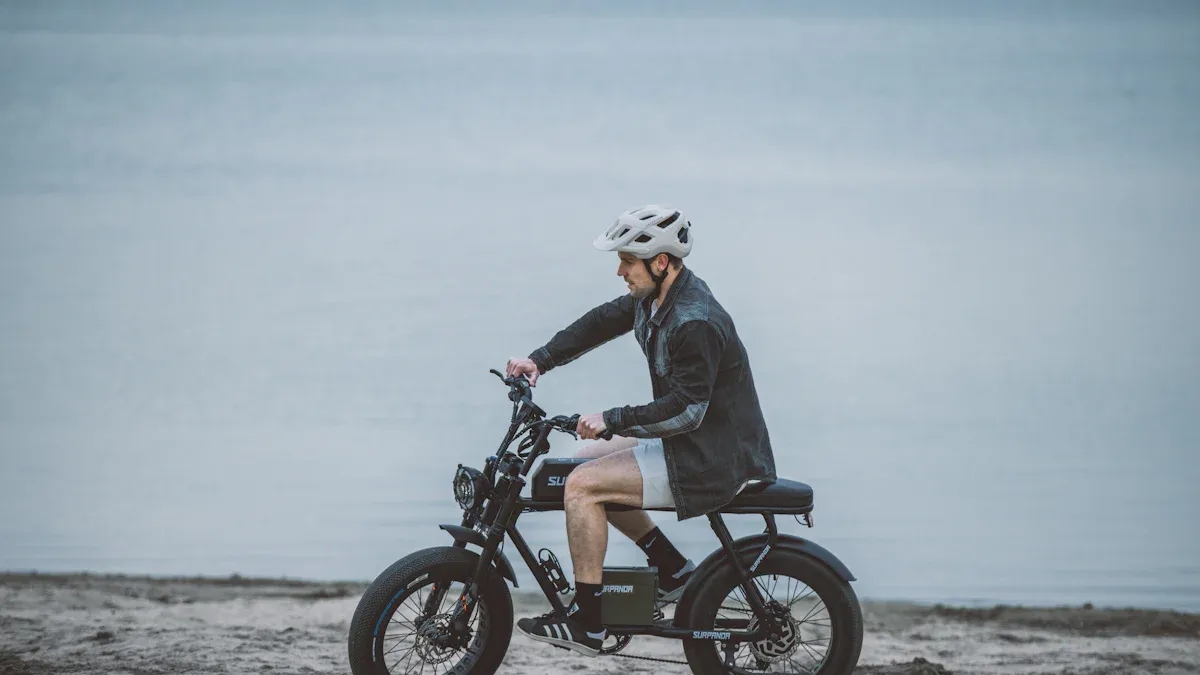
You have probably already noticed: the way you pack your luggage and how you sit on your e-bike makes a big difference. If you just throw heavy items onto the luggage rack at the back, the bike quickly feels wobbly. It is much better to stow heavy items in panniers directly on the frame. This keeps the e-bike stable, even when you go around a corner faster.
An upright seating position helps you distribute your weight evenly. You gain more control and the handling remains stable. Many e-bikes with a central motor and battery in the down tube offer a good balance right from the start. Before longer tours, consider whether your saddle and handlebars are set correctly. Small adjustments can greatly improve the riding experience.
Here are a few tips for optimal weight distribution on tours:
Choose an e-bike with a central motor and battery in the down tube.
Ensure an upright seating position.
Pack heavy items in bags close to the frame.
Use luggage racks and handlebar bags consciously.
Check if the saddle and handlebars fit you.
Tip: The right frame size ensures that you sit in a relaxed position and the weight is well distributed.
Influence on tire pressure
Weight distribution directly affects tire pressure on e-bikes. If there is more weight on one wheel, for example due to a lot of luggage at the back, you should increase the pressure there slightly. The rear wheel often requires more air than the front wheel because it carries more load. Check the pressure regularly, especially before longer trips.
If you distribute the load evenly, the handling remains safe and the tire wears out less quickly. This saves energy and gets you further on one battery charge. Small adjustments in pressure are immediately noticeable – just give it a try!
You have now learned everything important about optimal tire pressure on e-bikes and weight distribution. Here is your practical checklist:
Check the air pressure regularly, preferably before every long trip.
Adjust the pressure according to your weight, luggage, and the terrain.
Distribute luggage as evenly as possible.
Check seating position and frame settings.
Try out these tips! Even small adjustments make your ride safer and more pleasant.
FAQ
How often should you check the tire pressure of your e-bike?
You should check the tire pressure at least once a month. A quick check is always worth it before longer tours. You will feel small deviations immediately while riding.
Can too much air in the tire be dangerous?
Yes, too much air makes the tire hard. It can burst or slide away more easily. Always adhere to the specifications on the tire. This will keep you safe while riding.
What tools do you need for pressure monitoring?
A digital or analog air pressure gauge is sufficient. Many floor pumps have a display. There are small, handy devices for on the go. This allows you to check the pressure quickly.
Do I have to adjust the tire pressure in cold weather?
Yes, cold air contracts. The pressure drops. Check the tire pressure more often in winter and pump up if necessary. This keeps your e-bike safe and comfortable.
What should you do if you lose air while on the road?
Tip: Always carry a small repair kit and a mini pump with you. This way you can quickly repair the tire and continue your ride. A spare inner tube helps with more serious damage.