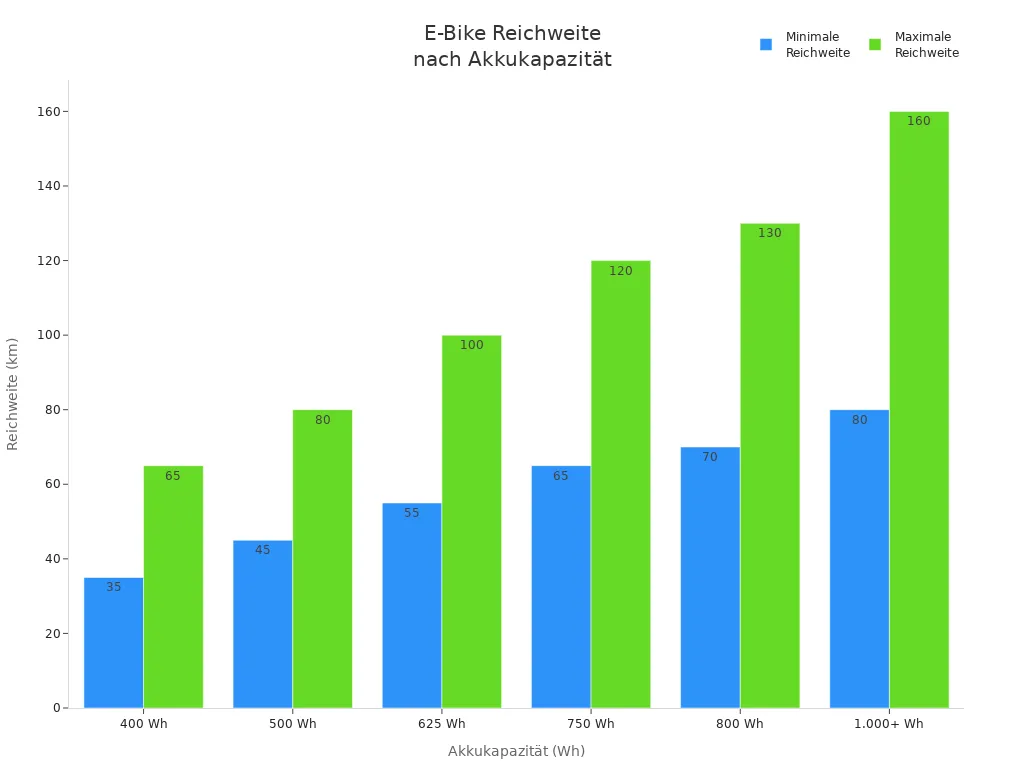
You are probably wondering: How far can your e-bike really take you? Many users are in for a surprise because manufacturer specifications often seem too optimistic. Take a look at the differences:
Capacity
Typical range
Field of application
400 Wh
35–65 km
City, short distances
500 Wh
45–80 km
Everyday use, commuting
625 Wh
55–100 km
Trekking, tours
750 Wh
65–120 km
Long-distance, MTB
800 Wh
70–130 km
Premium, long-distance
1,000+ Wh
80–160 km
Cargo, dual-battery
Many people only ride 21 to 40 kilometers per week in their everyday lives. Do you want to know how to realistically estimate your range? Here, you get clear answers and tips.
Key takeaways
Battery capacity is crucial for range. Larger batteries provide more energy for longer distances.
Factors such as weight, terrain, and weather significantly influence range. Plan your rides accordingly.
Use the eco-mode to reduce energy consumption. This allows you to maximize your e-bike's range.
Regular maintenance and checking tire pressure help increase your e-bike's efficiency.
Use online calculators or apps to realistically estimate your range and avoid surprises.
Range in everyday life
Average values of modern e-bikes
Would you like to know how far you can get with your e-bike in daily use? Most modern e-bikes achieve an average of between 50 and 80 kilometers on a single battery charge. These values fluctuate significantly because many factors come into play. A 400 Wh battery usually takes you 35 to 65 kilometers. With a 500 Wh battery, you often reach 45 to 80 kilometers. Larger batteries such as 625 Wh or 750 Wh offer even more leeway and are particularly suitable for longer tours.
Many riders experience fluctuations in their daily usage. You quickly notice that the range is not always the same. Hills, headwind, or low tire pressure can shorten the distance significantly. If you ride at high speeds or carry a lot of luggage, your range will decrease further. The surface also plays a role: asphalt consumes less energy than gravel or forest paths.
Tip: Plan your rides with a small buffer. This way, you avoid surprises if the range happens to be lower than expected.
Manufacturer specs vs. reality
Manufacturers often state very high ranges. These values are created under perfect laboratory conditions. The situation is different in practice. You rarely ride with optimal tire pressure, in mild temperatures, and without headwind. Therefore, you should view these figures critically.
You will quickly see: the range depends on many small details. If you are aware of these, you can plan your rides better and avoid surprises.
Factors influencing range
Many factors determine how far you get with your e-bike. If you know the most important influences, you can plan your rides better and avoid surprises.
Tip: A larger battery is particularly worthwhile if you often ride long distances or many vertical meters.
Assistance level
You can usually adjust the motor assistance in several levels. In eco-mode, you use 30-50% less energy than in sport or turbo mode. Only use the strongest level for steep climbs or when you really need a lot of support. On flat routes, eco-mode is often sufficient.
If you often ride uphill or on uneven terrain, the range will decrease. Paved paths are most efficient. Gravel, forest paths, or many inclines cost more energy. Tire pressure also plays a role: too little air in the tire increases rolling resistance.
Weather and temperature
Cold temperatures reduce battery performance. At 0°C, the range can drop by 15-25%, and in frost even up to 40%. It is best to ride in mild weather and store the battery indoors during winter.
Riding style and gear selection
A consistent riding style saves energy. Frequent acceleration and braking consume more power. Always choose a suitable gear so that the motor does not have to work unnecessarily hard. Shift into a lighter gear early, especially when starting off or on inclines.
Remember: With forward-looking riding and the right gear selection, you get the maximum out of your battery.
You will experience different route profiles with your e-bike. In the city, you often ride in stop-and-go traffic. Frequent starting consumes a lot of energy. In the countryside, you usually enjoy flat paths, but soft terrain like dirt roads can strain the battery more. In the mountains, every incline challenges the motor. You should know the most important factors that influence your range:
Turbo or High mode: If you use the highest assistance level, the range decreases significantly.
Stop-and-go traffic: Many starts and stops consume more battery power.
Tire pressure: Too little air in the tire noticeably reduces the range.
Soft ground: Sand, soil, or gravel cost more energy than asphalt.
Steep inclines: Riding uphill reduces range significantly.
Cadence: A low cadence puts a strain on the battery and your joints.
Tip: Check your tire pressure regularly and choose the assistance level consciously. This way, you get more kilometers out of your battery.
Range comparison table
Would you like to know how far you can get with your e-bike in different scenarios? The following table shows you typical values for different conditions:
Scenario
Battery capacity
Load (trailer)
Terrain
Range (practical)
Without trailer – flat land
625 Wh
0 kg
flat
100–120 km
With trailer – flat land
625 Wh
30 kg
flat
60–80 km
With trailer – low mountain range
625 Wh
30 kg
hilly
40–60 km
With trailer – mountains
625 Wh
30 kg
mountainous
30–45 km
With trailer – mountainous
1,000 Wh
40 kg
mountainous
70–90 km
You can see: the range depends heavily on the terrain, the load, and the battery capacity. Plan your tours with these values in mind. This way, you avoid nasty surprises and can better estimate your rides.
Calculate your own range
Online calculators and apps
Do you want to know how far your e-bike really takes you? Digital tools can help. Many online calculators and apps calculate the range based on your personal data. You enter your weight and height. The tools ask for battery capacity, assistance level, and terrain. They even take weather and wind into account. Over twenty factors are included in the analysis. This gives you a value that fits your everyday life.
You can find online calculators on the websites of many manufacturers.
Apps like Bosch eBike Connect or Specialized Mission Control offer detailed forecasts.
The tools show you how temperature or wind affect the range.
You can test and compare different route profiles.
Tip: Use the app regularly. This way, you learn how small changes affect your range.
Rule of thumb and buffer
You don't want to end up with an empty battery suddenly? A simple rule of thumb helps you. In everyday life, you should expect 60 to 70 percent of the manufacturer's spec. For mountain bikes in the terrain, 50 to 65 percent is realistic. A buffer protects you from nasty surprises. Choose a battery with 30 to 40 percent reserve when buying. A large battery is never a nuisance, but a small one can quickly become a problem.
Example: You are planning a route of 60 kilometers. Plan with a buffer of 20 percent. You should choose a battery that covers at least 72 kilometers.
If you need 600 Wh, a 750 Wh battery is recommended.
Always plan for a buffer, especially on long tours or in changeable weather.
Remember: With a generous buffer, you are on the safe side and can ride relaxed.
What to do if the battery is empty?
You are on the road and the battery is empty? Don't panic. You can also ride your e-bike without a battery. Turn off the motor and use muscle power. It is advisable to charge the battery regularly and carry a spare battery on longer routes. Choose the eco-mode or other economical programs to extend the battery life.
Ride with foresight and charge the battery in time.
A spare battery gives you peace of mind on long tours.
Use Eco mode when you notice the battery is running low.
Tip: With good planning and a buffer, you can avoid emergencies. You will remain flexible and be able to master any route.
Use Eco mode when you are on flat routes. This can reduce energy consumption by up to 80%.
Regularly check the tire pressure. Values between 3.5 and 4.5 bar are ideal and reduce rolling resistance.
Avoid frequent hard acceleration and braking. A smooth riding style saves power.
Reduce unnecessary weight. Leave heavy bags or luggage at home if you do not need them.
Note: With a proactive riding style and the right gear, you can significantly increase your range.
Maintenance and care
Good care ensures that your e-bike always performs reliably:
Regularly check the tire pressure, the chain, and the brakes.
Oil the chain every 200 to 300 kilometers to keep it running smoothly.
Make sure the brake pads are not rubbing. This saves energy.
Keep the battery contacts clean. Dirty contacts can impair energy transfer.
Schedule regular maintenance intervals. This keeps your e-bike in top shape.
Tip: A well-maintained e-bike rides more easily and takes you further – day after day.
You have now learned the most important insights regarding e-bike range. Many factors such as the battery, assist mode, weight, and terrain influence your rides. Under optimal conditions, you can reach up to 137 kilometers, about 94 kilometers in the city, and around 51 kilometers in mountainous areas. With proactive planning and a calm riding style, you can put these tips directly into practice:
Plan your route and charge the battery in good time.
Ride as consistently as possible and avoid sudden changes in load.
Regularly check the condition of your e-bike.
New technologies such as solid-state batteries and improved cell technology will continue to increase range in the future. Try out these recommendations and get a better feel for your own possibilities. This way, you stay flexible and can enjoy every tour.
FAQ
How can I best estimate the range of my e-bike?
It is best to use online calculators or apps. These tools take into account your weight, the battery, and the terrain. This gives you a realistic value for your next tour.
What do I do if my battery runs out while on the go?
You can continue riding your e-bike like a normal bicycle. Turn off the motor and use your muscle power. A spare battery can help you on long journeys.
How often should I charge my e-bike battery?
It is best to charge the battery when it still has about 20% remaining capacity. Avoid frequent complete discharges. This will extend the lifespan of your battery.
Does cold weather affect the range of my e-bike?
Yes, low temperatures reduce battery performance. In freezing conditions, the range drops by up to 40%. It is best to store the battery at room temperature and only insert it just before your ride.
Which assist mode saves the most energy?
You are most economical when riding in Eco mode. This level consumes the least power and significantly extends your range. Use higher levels only when necessary, for example on inclines.
Share
Hochleistungs-Hecknabenmotor mit präzisem Drehmomentsensor
Bis zu 40 Nm Kraft: Meistern Sie auch steile Anstiege spielend leicht.
Intelligente Sensorik: Der fortschrittliche Drehmomentsensor erkennt Ihre Tretkraft millimetergenau und unterstützt Sie stufenlos und kraftvoll.
Effizientes Hinterradantriebssystem: Direkte Kraftübertragung für ein dynamisches Fahrgefühl.
Integrierte Fahrradbeleuchtung mit kraftvollem 85 LUX Licht
Helle 85 LUX Ausleuchtung: Garantiert exzellente Sicht und maximale Sichtbarkeit bei Nacht oder in der Dämmerung.
K-Mark Zertifiziert: Erfüllt die strengen deutschen Straßenverkehrszulassungsvorschriften - rechtssicher und verkehrstauglich.
Optimal integriert: Fahrradspezifisches Design für perfekte Montage und aerodynamische Passform ohne störende Kabel oder Nachrüstteile.
Zuverlässige Sicherheit: Erhöht Ihre passive Sicherheit im Straßenverkehr durch kontinuierlich zuverlässige Beleuchtung.
Hochwertige Zellentechnologie für langlebige Leistung
Kompakte 360 Wh Power: Leicht zu transportieren, bietet aber Energie für lange Fahrten oder mehrtägige Touren.
Nahtlos integriert: Perfekt auf Ihr Fahrrad abgestimmtes Design - optisch ansprechend und aerodynamisch optimiert.
Sorgenfreies Laden: Intelligentes Batteriemanagementsystem schützt vor Überladung, Tiefentladung und Überhitzung für maximale Sicherheit und Langlebigkeit.
Premium-Zellen: Hochwertige Lithium-Ionen-Zellen garantieren hohe Energiedichte, Zuverlässigkeit und viele Ladezyklen.
Professionelle Schaltperformance für maximale Fahrrad-Vielfalt
Meistern Sie jedes Terrain: Shimano DEORE 10-Gang-Schaltung
Shimano DEORE Zuverlässigkeit: Vertrauen Sie auf die Qualität und Langlebigkeit der weltweit führenden Fahrradkomponenten-Marke.
Präzises 10-fach Schalten: Wechseln Sie mühelos und exakt zwischen den Gängen – ideal für steile Anstiege, schnelle Abfahrten und lange Strecken.
Erweiterter Nutzungsbereich: Die breite Übersetzungsbandbreite passt sich optimal jedem Gelände und Ihrer gewünschten Tretfrequenz an.
Wartungsarme Performance: DEORE-Technologie für reibungslose, verlässliche Schaltvorgänge bei jedem Wetter und auf jedem Untergrund.
Sicherheit durch Selbstjustierung: Hydraulische Scheibenbremsen
Hydraulische Präzision: Kraftvolle Bremskraft durch geschlossenes Ölsystem – auch bei Nässe, Kälte oder Verschmutzung. Selbstjustierend: Automatischer Verschleißausgleich für konstant optimale Bremsleistung – ohne manuelles Nachstellen, auch bei intensiver Nutzung. Zuverlässige Sicherheit: Kurze Bremswege und konstante Bremskraft für maximale Kontrolle und Vertrauen in jeder Situation. Robust & langlebig: Hochwertige Komponenten und wetterfeste Konstruktion für dauerhafte Performance bei minimalem Wartungsaufwand. (Optional: Geprüft nach TÜV/ISO 4210)
Minimalistisch & aerodynamisch mit Carbon-Rahmen und -Gabel
Leichtes Fahrvergnügen: Nur 16 kg
Fahrzeug Nur 16 kg Leichtgewicht: Einfacher zu bewegen, transportieren und manövrieren – mehr Agilität und weniger Kraftaufwand.
Hochwertiges Carbon: Carbon-Rahmen und -Gabel bieten hervorragende Steifigkeit, geringes Gewicht und vibrationabsorbierende Eigenschaften für ein komfortables Fahrgefühl.
Minimalistisches Premium-Design: Reduziert auf das Wesentliche – elegant, funktional und aerodynamisch optimiert.
Wendig und agil: Das geringe Gewicht und die präzise Steuerung durch Carbon machen jedes Fahrmanöver leicht und intuitiv.
Präzise verarbeitete Details für ein makelloses Gesamtbild
Zeitlose Eleganz: Minimalistisch & klare Linien
Reduzierte Ästhetik: Konzentration auf das Wesentliche – klare Formen und Linien schaffen zeitlose Schönheit und Ruhe.
Hochwertige Verarbeitung: Sorgfältig geglättete Oberflächen und nahtlose Übergänge für eine makellose Optik und Haptik.
Funktionales Design: Jedes Detail dient einem Zweck – optimale Ergonomie und intuitive Bedienbarkeit.
Premium-Eindruck: Die perfekte Symbiose aus minimalistischer Form und herausragender Handwerkskunst vermittelt höchste Wertigkeit.
Leichtgängige Leistung & nahtlose Schaltvorgänge
Sanftes Fahren: Shimano 7-Gang-Nabenschaltung
Shimano Nabentechnologie: Vertrauen Sie auf die Zuverlässigkeit und Langlebigkeit des weltweit führenden Herstellers für Fahrradkomponenten.
Präzise 7-Gang-Schaltung: Einfache und intuitive Bedienung für müheloses Schalten in jeder Situation – ob am Berg oder in der Stadt.
Nahtloser Wechsel: Ruckfreies Schalten auch unter Last für einen gleichmäßigen Trittrhythmus und maximalen Fahrkomfort.
Robust & wartungsarm: Geschlossenes System für zuverlässige Performance bei jedem Wetter und minimale Wartungsanforderungen.
Großzügige Energie, nahtlos integriert & einfach zu laden
Mehr Freiheit: Tragbare 468-Wh-Batterie & perfekte Integration
Kompakte 468-Wh-Power: Ausreichend Energie für lange Ausflüge oder mehrtägige Touren, dabei leicht zu transportieren und auszutauschen.
Nahtlos integriert: Fahrradspezifisches Design für optimale Passform, elegante Optik und aerodynamische Effizienz.
Schnell & einfach aufladen: Unkompliziertes Ladesystem für maximale Flexibilität – zu Hause oder unterwegs.
Robuste Zuverlässigkeit: Hochwertige Lithium-Ionen-Zellen und Schutz vor Witterungseinflüssen für langlebige Performance.
Hochleistungs-Mittelmotor mit 70 Nm Drehmoment
Kraftvoll bergauf: 70 Nm Mittelmotor
Kraftvollster Antrieb: 70 Nm Drehmoment für müheloses Bewältigen auch steilster Steigungen – pure Power beim Bergauffahren.
Optimale Gewichtsverteilung: Der zentral positionierte Mittelmotor sorgt für ausgewogene Fahrdynamik, bessere Traktion und ein natürliches Fahrgefühl.
Effiziente Kraftübertragung: Direkter Kraftschluss an der Tretkurbel für maximale Effizienz und spürbar mehr Vortrieb bei jedem Tritt.
Ideale Bergunterstützung: Der Drehmomentsensor erkennt präzise Ihre Tretkraft und liefert kraftvoll,angepasste Unterstützung genau dann, wenn Sie sie am meisten brauchen.
Sicherheit durch Selbstjustierung: Hydraulische Scheibenbremsen
Hydraulische Präzision: Kraftvolle Bremskraft durch geschlossenes Ölsystem – auch bei Nässe, Kälte oder Verschmutzung.
Zuverlässige Sicherheit: Kurze Bremswege und konstante Bremskraft für maximale Kontrolle und Vertrauen in jeder Situation.
Robust & langlebig: Hochwertige Komponenten und wetterfeste Konstruktion für dauerhafte Performance bei minimalem Wartungsaufwand.
Das universelle Schnellmontage-System für Ihr Fahrrad
Flexibel beladen: MIK-Gepäckträger – Sekunden für Auf & Ab
MIK-Standardkompatibel: Passt für die meisten Fahrräder mit MIK-Aufnahme – einfach aufstecken, drehen, fertig!
Sekundenschnell montiert & demontiert: Ideal für flexible Nutzung – ob Gepäcktasche, Kindersitz oder Einkaufskorb. Immer griffbereit oder platzsparend verstaut.
Robust & stabil: Hochwertige Materialien für sichere Lasten bis zu 25 kg.
Sicheres Handling: Verriegelungsmechanismus für festen Halt während der Fahrt und einfaches Lösen im Stand.
310% Schaltbereich · Drehregler für stufenlose Gangwahl
Wartungsfreie Nabenschaltung
SANFT WIE EIN RADIOKNOF – INTUITIV BEDIENBAR, DAUERHAFT WARTUNGSFREI:
• Perfekte Gangwahl bei jeder Steigung
• Kein Schaltrucken
• Allwettertauglich durch geschlossenes System
75 NM DURCHZUGSKRAFT · SCHWANKUNGSFREI
HOCHTORQUIE-ANTRIEB
LEISTUNGSSTARK UND STABIL – PRÄZISE KRAFTENTFALTUNG IN JEDER SITUATION
• Gleichmäßige Beschleunigung selbst unter Volllast
• 75 Nm Drehmoment für müheloses Bewältigen auch steilster Steigungen – pure Power beim Bergauffahren
2900mA · 14,5Ah/522Wh PRÄZISIONSELEKTROCHEMIE
HOCHENERGIEDICHTE-BATTERIETECHNIK Maximale Reichweite: 135 Km
LEISTUNGSSTABILITÄT MIT SYSTEM – DAUERHAFTE ENERGIEBEREITSTELLUNG
• CAN-Protokoll-Steuerung: Zellüberwachung · Temperaturmanagement & Cell monitoring · Thermal protection
• 135+ km Reichweite pro Vollzyklus (ECO-Modus)
• 2000+ Ladezyklen bei 80% Kapazitätserhalt
• Zuverlässiger Tiefentladeschutz & optimales Thermomanagement
• -10°C bis +55°C Allwetter-Einsatzfähigkeit
Sicherheit durch Selbstjustierung: Hydraulische Scheibenbremsen
Hydraulische Präzision: Kraftvolle Bremskraft durch geschlossenes Ölsystem – auch bei Nässe, Kälte oder Verschmutzung. Selbstjustierend: Automatischer Verschleißausgleich für konstant optimale Bremsleistung – ohne manuelles Nachstellen, auch bei intensiver Nutzung. Zuverlässige Sicherheit: Kurze Bremswege und konstante Bremskraft für maximale Kontrolle und Vertrauen in jeder Situation. Robust & langlebig: Hochwertige Komponenten und wetterfeste Konstruktion für dauerhafte Performance bei minimalem Wartungsaufwand. (Optional: Geprüft nach TÜV/ISO 4210)
Das universelle Schnellmontage-System für Ihr Fahrrad
Flexibel beladen: MIK-Gepäckträger – Sekunden für Auf & Ab
MIK-Standardkompatibel: Passt für die meisten Fahrräder mit MIK-Aufnahme – einfach aufstecken, drehen, fertig!
Sekundenschnell montiert & demontiert: Ideal für flexible Nutzung – ob Gepäcktasche, Kindersitz oder Einkaufskorb. Immer griffbereit oder platzsparend verstaut.
Robust & stabil: Hochwertige Materialien für sichere Lasten bis zu 25 kg.
Sicheres Handling: Verriegelungsmechanismus für festen Halt während der Fahrt und einfaches Lösen im Stand.
KOMFORT AUF KOPFSTEINPFLASTER – PRÄZISE DÄMPFUNG IN JEDEM TERRAIN
• 85% Stöße reduzieren durch Coil-Sprung/Dämpfer-System
• Reaktionszeit ≤0.15s bei High-Frequency Vibration
• Staub- & Wasserschutz Nordsee-Klima
• Patentiertes Komfort-Curve-Federprofil
E-Bike-Lenker mit enviolo HD Stufenlosgetriebe
Der funktionsreiche gebogene Lenker verfügt über einen 60° verstellbaren Vorbau, LCD-Display, rutschfeste Ledergriffe, Frontlicht sowie Vorder- und Hinterbremshebel. Ausgestattet mit dem zuverlässigen enviolo HD Stufenlosgetriebe.
⚠️ Wichtiger Hinweis: Verstellen Sie den enviolo-Schalter nur während der Fahrt. Schalten im Stillstand kann das Getriebe beschädigen.
REX Commuter S - Der clevere Einstieg in die urbane Mobilität
Mit hochwertigen Komponenten für eine entspannte und saubere Fahrt durch die Stadt.
Shimano Steps E5000 Mittelmotor
Reichweite bis 160 km
Gates Carbon Riemen
Schwalbe Big Ben Reifen
Leistungsstarker Mittelmotor für sanfte, sofortige Unterstützung in der Stadt.
Der Shimano Steps E5000 Mittelmotor (250 W, 40 Nm) unterstützt dich sofort an Ampeln und leichten Steigungen
Nahtloses Schalten – auch im Stand. Wartungsfrei für die Stadt.
Die Shimano Nexus 7-Gang Nabenschaltung ist ideal für den urbanen Alltag.
Weit kommen. Sicher ankommen.
Der semi-integrierte 14‑Ah‑Akku erreicht eine Reichweite von bis zu 160 km pro Ladung.
Die Schwalbe Big Ben Reifen (50 mm) bieten optimalen Pannenschutz.
Sanfte Kraft - ohne Wartungsstress.
Unser Riemenantrieb läuft leise, sauber und langlebig (2–3x länger als Kette). Keine Flecken, leicht, modern und geschmeidig.
Integriertes Rahmenschloss serienmäßig verbaut – Kein zusätzliches Schloss erforderlich
Unser integriertes Schloss ist sauber am Hinterbau montiert und harmoniert perfekt mit den kompletten Schutzblechen sowie dem Gepäckträger.