
Do you want to buy a mountain bike for men that truly suits you? Then first pay attention to the correct frame size, appropriate suspension, and the type of terrain you want to ride on. In Germany, millions of people ride mountain bikes regularly – with the right model, you can experience more fun and safety. Consider what is important to you and make your choice consciously.
Key Findings
Choose the right frame size by measuring your inseam and calculating it with the appropriate formula. This ensures you sit comfortably, avoid pain, and ride safely.
Decide between a hardtail and a full-suspension bike depending on your riding style: hardtails are lighter and low-maintenance, while full-suspension bikes offer more comfort and control on trails.
Adjust the travel to your preferred terrain: less travel for fast, easy trails, and more travel for technical and steep descents.
Consider the terrain type when choosing a bike: cross-country for fast tours, trail/all-mountain for versatility, and enduro or downhill for challenging terrain.
Test your desired bike before buying and pay attention to important details such as wheel size, seating position, and tire pressure to achieve the best riding experience.
Frame size for men's mountain bikes
The importance of frame size
The correct frame size is crucial for you as a rider. It ensures comfort, safety, and a good ride. If you choose a men's mountain bike with the wrong frame size, you risk health problems.
Common complaints due to an unsuitable frame size:
Neck pain
Numbness in the hands
Knee discomfort
Unnatural posture with long-term consequences
Especially off-road, an incorrectly adjusted bike can become dangerous.
An appropriate frame size helps you pedal efficiently and control the bike safely. You will sit more relaxed and be able to enjoy longer tours.
Calculating frame size
To determine the optimal frame size for your men's mountain bike, first measure your inseam. Clamp a book between your legs and measure from the floor to the top edge of the book. Multiply the inseam by 0.574 to calculate the frame size in centimeters. Alternatively, use the formula inseam × 0.226 for inches.
Here you will find an overview of how inseam and body height lead to the right frame size:
Inseam (cm) |
Height (cm) |
Recommended frame size (cm) |
Recommended frame size (inches) |
|---|---|---|---|
58-63 |
150-155 |
33 - 36 |
13 - 14 |
67-70 |
160-165 |
38 - 40 |
15 - 16 |
77-83 |
175-180 |
44 - 47 |
17.5 - 18.5 |
86-91 |
185-190 |
49 - 52 |
19 - 20.5 |
If you are between two sizes, choose the smaller frame for a sportier ride. For longer tours, the larger frame is recommended. A body scanning service can help you find the perfect fit, as it takes multiple body measurements into account.
Seating position and geometry
The seating position affects how you sit and ride on your men's mountain bike. A smaller frame creates a stretched, sporty posture. This position is suitable for fast rides and technical trails. A larger frame offers an upright, comfortable seating position, which is ideal for longer tours and relaxed riding.
The geometry of the frame plays a major role in handling. Various values such as seat tube angle, head tube length, or wheelbase determine how the bike behaves on terrain:
Effect on off-road handling |
|
|---|---|
Seat tube angle |
A steeper angle shifts weight forward, making climbing easier. A flatter angle ensures comfort on flat stretches. |
Head tube length |
A longer head tube leads to a more upright seating position, while a shorter one leads to a more stretched one. |
Top tube length |
A longer top tube stretches the seating position, while a shorter one allows for more freedom of movement. |
Chainstay length |
Shorter stays make the bike more agile, while longer ones provide more stability and better uphill performance. |
Bottom bracket height |
Higher bottom bracket increases ground clearance; lower improves agility but increases the risk of pedal strikes. |
Wheelbase |
A shorter wheelbase makes the bike more agile, while a longer one provides more smoothness. |
Make sure there is enough space between your inseam and the top tube. This allows you to dismount safely on terrain and avoid injury.
Tip: Use a frame size calculator or get advice from a specialist retailer. This will help you find the perfect frame size for your riding style and measurements. Professional advice helps you avoid discomfort and get the most out of your men's mountain bike.
Choosing suspension
Hardtail or full-suspension
When selecting a men's mountain bike, you are often faced with the decision: hardtail or full-suspension? Both variants offer different advantages.
Hardtail: This bike has a suspension fork only at the front. The rear remains rigid. Hardtails are lighter, stiffer, and usually cheaper. They require less maintenance because they have fewer moving parts. You benefit from a direct riding feel and easy upkeep.
Full-suspension: Here you get suspension at the front and rear. A shock in the rear provides more comfort and control, especially on uneven or technical terrain. Full-suspension bikes are heavier and cost more. They require more maintenance because the shock and bearings must be checked regularly.
Tip: Hardtails are well-suited for beginners, tourers, and those who prioritize low weight and easy maintenance. Full-suspension bikes offer you more safety and comfort if you frequently ride on challenging trails.
Feature |
Hardtail |
Full-suspension |
|---|---|---|
Suspension |
Front only (suspension fork) |
Front and rear (fork + shock) |
Weight |
Lighter (approx. 8-13 kg) |
Heavier (approx. 12-15 kg) |
Maintenance |
Low effort |
More effort |
Terrain |
Technical trails, downhill, bike parks |
|
Comfort |
Lower |
Higher due to rear suspension |
Back-friendly |
Less suitable |
Very well-suited |
Travel and application area
Travel describes how much the suspension can absorb impacts. The more travel, the better the bike absorbs bumps. There are typical values for different mountain bike types:
Mountain bike type |
Recommended travel (mm) |
|---|---|
Cross-Country (XC) |
|
Trail / All Mountain |
120 - 160 |
Enduro |
140 - 180 |
Downhill |
180 - 250 |
Cross-Country (XC): You mostly ride on firm paths and easy trails. 100 to 120 mm of travel is sufficient here. The bike remains light and efficient.
Trail and All Mountain: You want more comfort and safety on varied routes. 120 to 160 mm of travel offers enough reserves for roots and rocks.
Enduro: Challenging descents and technical sections are your goal. With 140 to 180 mm of travel, you can master difficult trails.
Downhill: You love steep descents, jumps, and rough terrain. 180 to 250 mm of travel provides maximum control and safety.
Greater travel improves shock absorption and provides more control, especially during fast descents and jumps. The tires maintain better ground contact. You tire less quickly because the bike absorbs many impacts. Important: Adjust the suspension to your weight and riding style. This is the only way to utilize the travel optimally and always have enough grip.
Note: More travel also means more weight and less efficiency when climbing. Think about the terrain you ride most often before making your decision.
Terrain types and bike recommendation
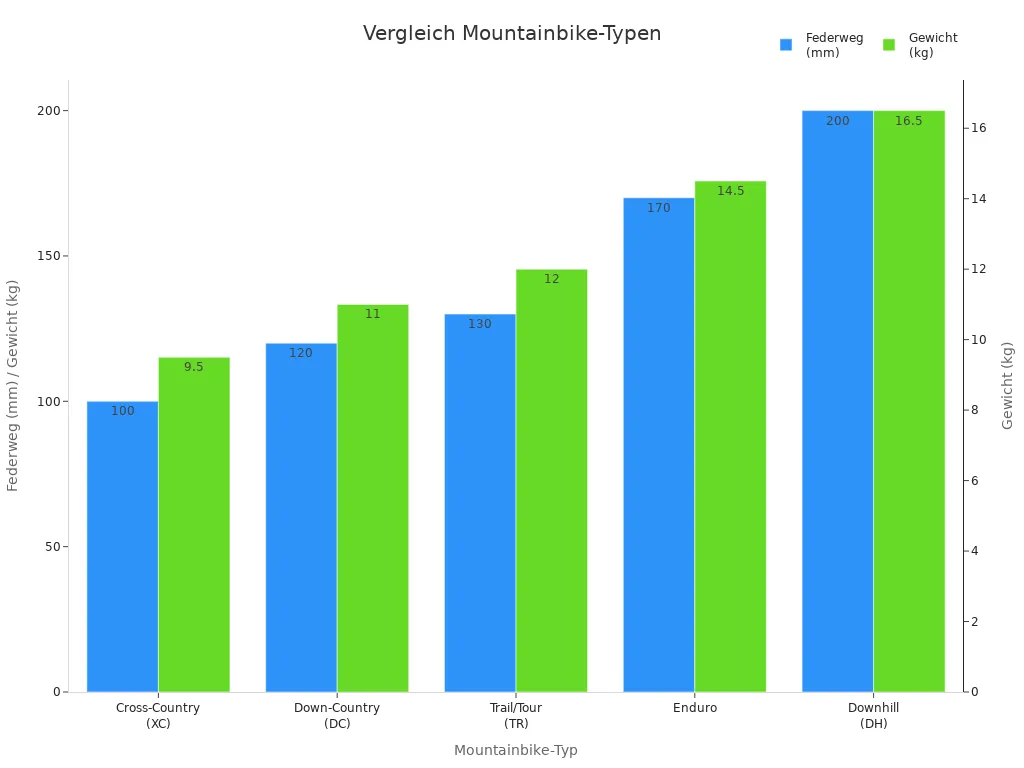
When looking for the right men's mountain bike, you should first consider the terrain you ride on most. The choice of bike depends heavily on whether you prefer fast cross-country routes, varied trails, or extreme descents. The following table gives you a quick overview of the most important mountain bike types and their areas of use:
Mountain bike type |
Travel (mm) |
Weight (kg) |
Geometry / Features |
Field of use |
|---|---|---|---|---|
Cross-Country (XC) |
approx. 100 |
9–10 |
Steep seating position, light, agile |
Racing, fast tours, easy trails |
Trail/Allmountain |
120–150 |
medium |
All-round, comfortable, versatile |
Tours, varied trails, mountains |
Enduro |
150–180 |
14–15 |
Flat, robust, descent-oriented |
Technical descents, bike park, single trails |
Downhill (DH) |
200+ |
15–18+ |
Very flat, extremely stable, heavy |
Steep, fast descents, jumps, bike park |
Cross-Country
Cross-country bikes are light and agile. They usually have about 100 mm of travel and a steep seating position. You benefit from high efficiency when climbing and fast progress on firm paths or easy trails. The tires are narrower, roll fast, and still offer good grip on rooty or rocky sections. For racing, forest paths, and long tours, a cross-country bike is the best choice.
Tip: Choose wider tires (e.g., 2.4 inches) with low tire pressure for cross-country riding. This gives you more comfort and grip without losing much speed.
Trail and All Mountain
Trail and all-mountain bikes are true all-rounders. They offer you 120 to 150 mm of travel and a balanced geometry. With them, you can master both climbs and technical descents. These bikes are more robust than cross-country models but lighter than enduro bikes. You can use them on tours, in the mountains, or on varied trails. The tires are wider and have more aggressive knobs, which gives you more safety and traction.
Note: Trail bikes are suitable for about 30% climbing, 40% trail, and 30% descending. They are ideal if you are looking for versatility.
Enduro and Downhill
Enduro and downhill bikes are built for extreme terrain. Enduro bikes offer you 150 to 180 mm of travel, while downhill bikes offer even more than 200 mm. The geometry is slack and long, which provides stability at high speeds. You get wide, knobby tires for maximum grip and powerful disc brakes for steep descents. These bikes are heavier and less efficient at climbing, but unbeatable on technical descents, jumps, and in the bike park.
Remember: The more demanding the terrain, the more important robust tires and strong brakes are. Downhill bikes are suitable almost exclusively for descents.
Selection criteria at a glance
Choosing the right bike is easiest when you keep the most important criteria in mind. You should always pay attention to your own needs and your preferred terrain. Experts recommend that you pay special attention to the following points:
Choose the model based on your area of use: A full-suspension bike is suitable for difficult terrain, a hardtail for racing and light terrain.
Wheel size (26", 27.5", or 29") influences handling. Large wheels roll over obstacles more easily, while smaller ones are more agile.
The frame height must match your body height and inseam. This is the only way to achieve comfort and optimal performance.
The frame material (aluminum, carbon, steel) determines weight, stability, and maintenance requirements.
Tire choice depends on your riding style. Narrow tires are suitable for cross-country, while wide and robust ones are for downhill.
The correct air pressure ensures comfort and extends the life of the tires.
You should adjust the seating position and saddle height individually to avoid discomfort.
Checklist
With a checklist, you can systematically check whether the bike meets your requirements. Go through the following points step by step:
Are the wheels seated firmly in the axle? Check for play in the hub bearings.
Examine the rims for dents or cracks.
Test the tires for air loss, especially with tubeless systems.
Spin the wheel quickly and observe if it "wobbles" or sways.
Center small wobbles by tightening the spokes.
Squeeze pairs of spokes together to check their tension.
Look for fine cracks around the spoke holes.
Tip: This checklist helps you identify hidden defects and avoid bad purchases.
Common mistakes
Many buyers make similar mistakes. You can easily avoid them if you stay alert:
You choose the wrong frame height and experience discomfort as a result.
You decide on the wrong model and feel insecure on the trail.
You do not pay attention to the appropriate wheel size and have problems with handling.
You forget to check the air pressure regularly.
You do not adjust the saddle and handlebars correctly and lose comfort.
Remember: If in doubt, seek advice and try out different models. That way you will find the bike that really suits you.
You will make the best choice if you consider the most important criteria. The following table helps you quickly identify the differences:
Selection criterion |
Recommendation |
|---|---|
Frame material |
Aluminum for everyday use, carbon for sport |
Frame size |
Select according to body height and riding style |
Suspension travel |
80–120 mm for beginners, 100–150 mm for touring, 150–170 mm for enduro |
Hardtail/Full-suspension |
Hardtail for low weight, full-suspension for comfort and control |
Always test your desired bike before purchasing. A test ride will show you whether the bike truly suits you and how it behaves on the trail.
1. Think about what you want to use the bike for. 2. Set your budget. 3. Check technical details and accessories. 4. Compare models objectively. 5. Take a test ride.
FAQ
How do I find the right frame height for my mountain bike?
Measure your inseam and multiply it by 0.574. The result shows the recommended frame height in centimeters. A specialist retailer can provide you with additional advice.
Which is better: hardtail or full-suspension?
Do you often ride on smooth paths? Then a hardtail is a good fit. Do you love trails and comfort? Then choose a full-suspension bike. Full-suspension bikes offer more damping, while hardtails are lighter and cheaper.
Which tire width is suitable for which terrain?
Narrow tires (2.1–2.3 inches) roll quickly on firm paths. Wide tires (2.4–2.6 inches) offer more grip and safety on loose or stony surfaces.
How important is the correct seating position?
A proper seating position protects you from pain and increases performance. You sit more comfortably and have better control of the bike. If in doubt, have it adjusted at a bike shop.
Do I have to test ride my mountain bike before buying it?
Yes, a test ride shows you whether the bike suits you. You will immediately feel if the size, geometry, and ride feel are right.
Tip: Test different models before you decide.