

A women's mountain bike adapts to your body shape. You benefit from specialized geometry that improves both comfort and control. Many women ask themselves: What should I look for when buying? Which frame size is right? You will often find differences in the saddle, handlebars, and frame. These details make riding more comfortable and safer. Especially when making your first purchase, many uncertainties arise, such as finding the right fit or equipment.
Key takeaways
Women's mountain bikes feature specific geometry that fits smaller bodies better and offers more comfort.
You can find the right frame size using your height and inseam—this ensures better safety and control.
An ergonomic saddle and narrower handlebars increase riding comfort and prevent pain.
Choose your bike based on your riding style and terrain, for example, a hardtail for easy tours or a full-suspension bike for challenging trails.
Go for a test ride and seek advice from a specialist dealer to find the perfect mountain bike for you.
Features of a women's mountain bike

Geometry
You can often recognize a women's mountain bike by its special geometry. Manufacturers adapt the frame to the female anatomy. This means you usually get a shorter reach, i.e., a smaller distance between the saddle and the handlebars. The top tube often slopes downward so you can get on and off more easily. This provides extra safety, especially with smaller frame sizes. The standover height is lower, which gives you more freedom of movement in difficult situations. Many models offer a lower step-through or a trapezoid frame.
A sloping top tube gives you more self-confidence and control off-road. You can master technical passages more easily and feel safer because you can reach the ground quickly with your feet in an emergency.
Typical geometric adjustments:
Shorter crank arms
Shorter reach for shorter torsos and arms
Lower standover height for small frame sizes
Narrower handlebars and grips
Adjusted brake levers for smaller hands
Lower step-through or trapezoid frame
Specially adapted, wider, and softer women's saddle
Top tube
On a women's mountain bike, the top tube is often shorter and slopes more steeply than on men's models. This allows you to sit in a more upright and relaxed position, which helps you avoid neck and back pain. This is particularly important for smaller riders because it makes it easier to get on and off.
Many women report that they feel more secure and handle difficult routes better with a sloping top tube.
Frame size
The right frame size is crucial for comfort and control. Women's models are often available in very small sizes like XXS or XS. The geometry is specifically tailored to the female anatomy. You can find an overview here of which frame size matches your height:
Height (cm) |
Recommended frame size (cm) |
|---|---|
150 - 165 |
33 - 37 (XS) |
160 - 175 |
38 - 43 (S) |
170 - 185 |
43 - 47 (M) |
180 - 195 |
47 - 52 (L) |
190 - 205 |
51 - 56 (XL) |
200 - 210 |
53 - 60 (XXL) |
Women's models differ from men's bikes primarily due to the shorter reach, lower standover height, and more compact design. This makes it easier to find a bike that fits your body height.
Saddle
A suitable saddle is especially important for women. Your anatomy requires a different shape than men's. Many women's mountain bikes feature saddles with relief channels to reduce pressure in the genital area. The saddle width is greater so that your sit bones are better supported. Special padding and ergonomic cutouts ensure that you do not experience pain even on long tours.
Feature |
Benefit for women |
|---|---|
Relief channel |
Less pressure in the genital area |
Wider seat area |
Better pressure distribution on the sit bones |
Dual-foam padding |
More comfort and support |
Shock absorber |
Dampens shocks and vibrations |
A well-fitted saddle prevents numbness and circulatory problems. You sit more healthily and can ride for longer.
Handlebars
Women usually have narrower shoulders than men. This is why you will often find narrower handlebars on women's mountain bikes. For touring, widths between 640 and 660 mm are suitable. This ensures a natural arm position and better control. In the downhill sector, wider handlebars (approx. 711 mm) are popular because they offer more stability. You should adjust the handlebar width to your physique and riding style.
Narrower handlebars (640–660 mm) for touring and narrower shoulders
Wider handlebars (approx. 711 mm) for downhill and more control
Individual adjustment is important—you can also shorten handlebars
27.5-inch wheels are agile, accelerate quickly, and offer plenty of grip. They are well-suited for smaller riders and tight trails.
29-inch wheels roll over obstacles more easily, maintain momentum better, and provide a smooth ride. They are ideal for longer distances and flowy trails.
Some models combine both sizes (mullet) to combine the advantages of both.
Frame size (cm) = Inseam x 0.574
More comfort on long distances
Less pain in the back, neck, and hands
Better power transfer when pedaling
More control off-road
Choose ergonomic grips that match your hand size.
Adjust the brake levers so that you can reach them without shifting your grip.
Adjust the handlebar height using spacers under the stem.
Test various settings during a test ride.
Use a special women's saddle that relieves pressure on your pelvis and genital area.
Less pain and numbness
Longer and more comfortable rides
Lower risk of injury
Better pedaling technique and more power
More riding enjoyment and safety
Derailleur gears with up to 30 speeds
Adjusted frame geometry for more comfort
Ergonomic saddles and narrow handlebars
Special women's saddles for more comfort
Lower top tube for easier entry
Ergonomic grips and levers for better control
Choose a saddle with a cutout and a wide seating area to reduce pressure.
Replace the crank arms with shorter models so you can pedal more easily.
Install narrower handlebars and ergonomic grips that fit your hand size.
Adjust the brake levers so you can reach them comfortably.
Ensure a low stand-over height so you can mount and dismount safely.
Adjust the suspension to your weight so the bike remains comfortable.
The right frame size ensures comfort and performance.
Frame material influences weight and price.
Check weight, handling, suspension, and gears.
Use tables or tools for frame sizing.
Adjust the saddle and handlebars to your measurements.
Test the bike on various surfaces, such as asphalt, gravel, and forest paths.
Pay attention to sitting comfort, steering behavior, and brakes.
Check if you can easily operate the gears.
Take your time until you feel secure.
Compare several models to get the best feel.
Personal consultation allows for test rides.
You get support with repairs and adjustments.
The quality of the bike is easier to assess in the store.
Experts handle the assembly and bike fitting.
Adapted geometry and frame size for smaller bodies
Ergonomic saddle and narrower handlebars for more comfort
High-quality damping and stable brakes for safe riding
Tip: Try different grip widths to find the best control and highest comfort.
Material
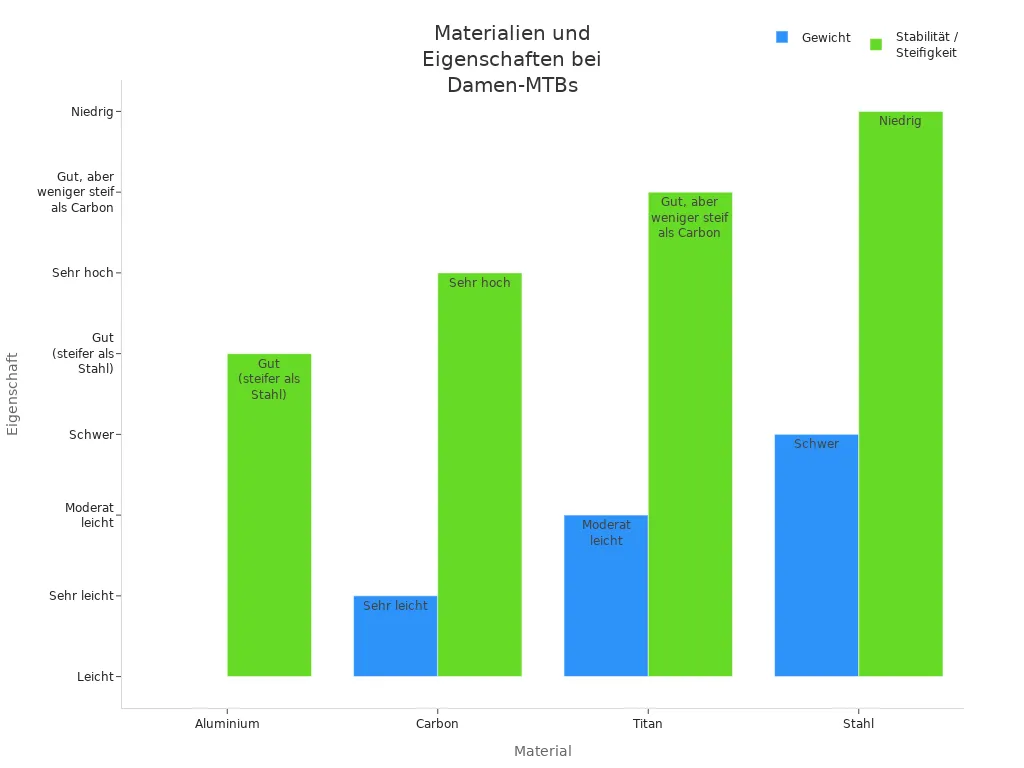
The material of your bike affects weight, stability, and handling feel. Aluminum is lightweight, robust, and inexpensive. Many women's mountain bikes are made of aluminum because it offers a good compromise. Carbon is even lighter and very stiff. It ensures particularly agile handling but costs more. Titanium is durable and light but expensive. Steel is robust but heavier and less stiff.
Material |
Weight |
Stability / Stiffness |
Advantages |
Disadvantages |
|---|---|---|---|---|
Aluminum |
Light |
Good |
Inexpensive, robust, stiff |
Less stiff than carbon |
Carbon |
Very light |
Very high |
Highest stiffness, very light |
Expensive, sensitive to impacts |
Titanium |
Moderate |
Good |
Durable, corrosion-resistant, good damping |
Very expensive, rare |
Steel |
Heavy |
Low |
Robust, durable |
Heavy, rusts, high maintenance |
Wheel size
The wheel size influences how your women's mountain bike handles. The most popular sizes are 27.5 inch and 29 inch.
The choice of wheel size depends on your height, riding style, and the terrain. Test different sizes to find the best ride feel.
Fit
Determining your size
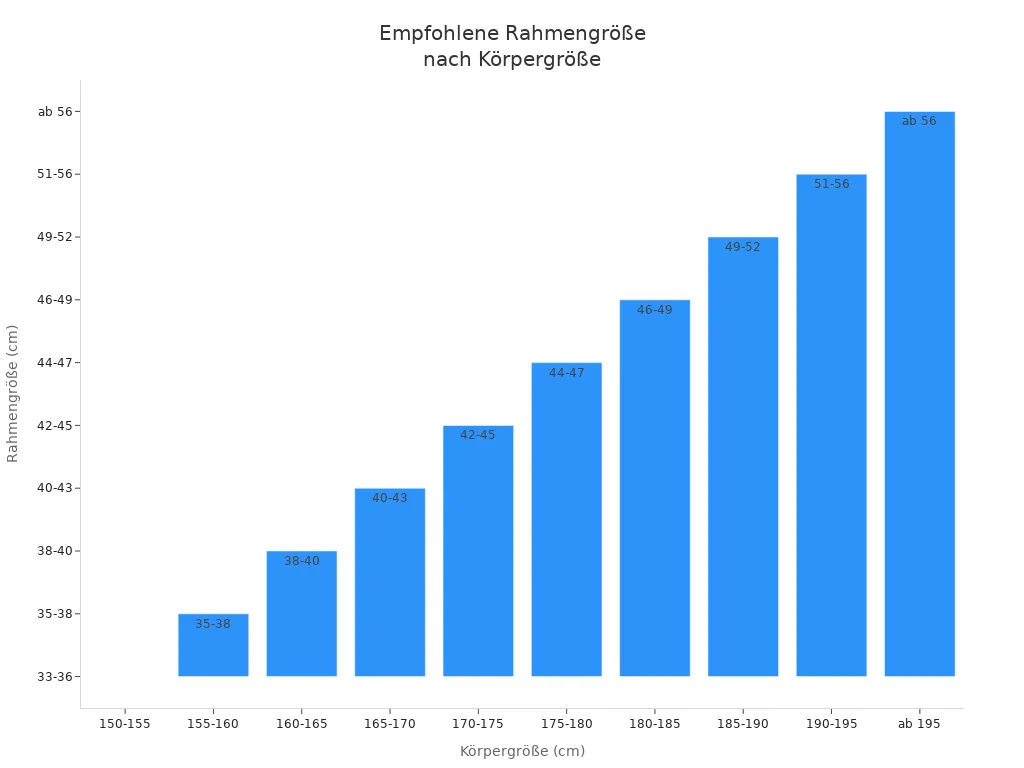
The right frame size is the most important step when choosing a women's mountain bike. You can determine the size using your body height and inseam. Measure your inseam by standing barefoot against a wall. Place a book between your legs and measure from the floor to the top of the book. This number is your inseam in centimeters.
You can find the appropriate frame size for your mountain bike using this formula:
If your value falls between two sizes, choose the smaller frame size for a sporty riding style and the larger frame size for more comfort.
Height (cm) |
Frame size (cm) |
Frame size (inches) |
|---|---|---|
150-155 |
33-36 |
13"-14" |
155-160 |
35-38 |
14"-15" |
160-165 |
38-40 |
15"-16" |
165-170 |
40-43 |
16"-17" |
170-175 |
42-45 |
16.5"-17.5" |
175-180 |
44-47 |
17.5"-18.5" |
180-185 |
46-49 |
18"-19" |
185-190 |
49-52 |
19"-20.5" |
190-195 |
51-56 |
20.5"-22" |
195+ |
56+ |
22"+ |
Tip: Frame size is usually measured from the center of the bottom bracket to the top edge of the seat tube. Always use both values—body height and inseam—for the best fit.
Seating position
The seating position determines how comfortable and efficient you are on your women's mountain bike. You should sit upright while still applying enough pressure to the front wheel. Your arms should be slightly bent, and your shoulders relaxed. You achieve the correct seat height when your leg is almost stretched at the lowest point, but the knee remains slightly bent.
A good seating position brings many benefits:
Make sure you feel comfortable on the bike. Small changes to the saddle or handlebars can make a big difference.
Cockpit adjustment
The cockpit includes the handlebars, grips, stem, and brake levers. Here, you can do a lot for your ergonomics and control. The handlebar width should match your shoulder width. Handlebars that are too wide or too narrow make riding unsafe. A backsweep of about 8 degrees ensures a natural hand position. An upsweep of about 5 degrees gives you a sporty arm position.
Important points for cockpit adjustment:
Good cockpit ergonomics reduce pain, numbness, and fatigue. You will have more control and fun on the trail.
Bike fitting
A professional bike fitting helps you get the most out of your women's mountain bike. Experts adjust the bike precisely to your body measurements and riding style. They set the saddle, handlebars, stem, and pedals individually.
Many benefits speak for a bike fitting:
You should have a bike fitting done once a year. After a fall or if you ride frequently, it is worth checking more often. Women benefit particularly because the fitting caters to their anatomy.
A professional bike fitting ensures that you feel completely comfortable on your bike and get the most out of every ride.
Performance & Equipment
Hardtail vs. Full-Suspension
You are often faced with the choice: hardtail or full-suspension? Both types have specific features that are important for women. Hardtail mountain bikes only have a suspension fork at the front. They are lighter, cheaper, and easier to maintain. Full-suspension bikes have suspension at both the front and rear. They offer more comfort and are easier on the back, especially on difficult trails.
Feature |
Hardtail Mountain Bike |
Full-Suspension Mountain Bike |
|---|---|---|
Suspension |
Front only (suspension fork) |
Front suspension fork and rear shock |
Weight |
Lighter (approx. 8–13 kg) |
Heavier (approx. 12–15 kg) |
Maintenance effort |
Lower |
Higher |
Price |
More affordable, starting from approx. 1,200 euros |
More expensive, starting from approx. 2,000 euros |
Area of use |
Long tours, cross-country |
Technical trails, downhill, bike parks |
Comfort |
Less comfortable |
More comfort, better traction |
Back-friendliness |
Less suitable |
Very suitable |
Tip: If you value comfort and back-friendliness, a full-suspension bike is often the better choice. For beginners and long tours on simple paths, a hardtail is usually sufficient.
Suspension
The suspension determines how comfortable and safe your ride is. Many mountain bikes for women have specially tuned suspension. It adapts to the average weight and height of women. This ensures optimal function and prevents the suspension from being too stiff or too soft.
Suspension system |
Comfort |
Control |
Special features |
|---|---|---|---|
Women-specific suspension |
Very high |
Very good |
Adapted to weight and size, optimal damping |
Full-suspension mountain bikes |
Very high |
Very good |
Dual suspension, ideal for technical descents |
Hardtails |
Good |
Good |
Suspension only at the front, lighter, more direct power transfer |
Very high |
Very good |
Electric support, full-suspension, especially comfortable |
Well-tuned suspension gives you more control and safety, especially on uneven terrain.
Area of use
You often use your mountain bike for training rides, nature tours, or daily life. For forest and dirt paths, a hardtail with a suspension fork is suitable. For demanding trails and alpine terrain, you need a full-suspension bike with strong damping and wide tires. The equipment adapts to your riding style:
Before purchasing, think about where you want to ride the most. This way, you will find the right bike for your area of use.
Ergonomics
Ergonomic components make riding more pleasant and increase your performance. Many mountain bikes for women have special saddles that are tuned to the female anatomy. You will often find saddles with a shortened nose or split seating areas. These prevent pressure points and increase comfort. Lowered top tubes make it easier for you to mount and dismount. Ergonomic brake levers and controls ensure that you can reach everything safely.
With ergonomic equipment, you can ride longer and tire less quickly. This increases your riding fun and safety.
Comparison: Women's vs. Men's MTB
Differences
You can often recognize the main differences between women's and men's mountain bikes at first glance. Women's models usually offer you smaller frame sizes such as XS or S. The geometry is specially tuned to your body. This means: You get a shorter reach, i.e., a smaller distance between the saddle and the handlebars. The top tube is often lowered so you can mount and dismount more easily.
Many women's bikes have wider and softer saddles that offer more comfort. The handlebars are narrower, and the grips and brake levers fit smaller hands better.
Men's models appear more athletic and often have more stable frames. They are built for taller and heavier riders. Many manufacturers now also offer unisex models that are suitable for both genders.
Overview of typical differences:
Feature |
Women's MTB |
Men's MTB |
|---|---|---|
Frame size |
XS, S, compact |
Larger, longer |
Geometry |
Shorter reach, lower top tube |
Longer, higher |
Saddle |
Wider, softer |
Narrower, harder |
Handlebars/Grips |
Narrower, ergonomic |
Wider, larger |
Brake levers |
Adapted for small hands |
For larger hands |
Suspension |
Tuned to lower weight |
Harder, for more weight |
Tip: Many women feel more comfortable on a women's model because it fits their anatomy better.
When to choose a women's model?
A specific women's model is particularly worthwhile if you are shorter than 1.65 m or weigh less than 60 kg. In these cases, you often won't find a suitable frame size in men's or unisex bikes. The suspension on men's bikes is usually designed for more weight. For you, this can mean that the bike's suspension is too stiff, and you have less comfort.
Women's models offer you shocks and forks that are tuned to your lower weight. The saddle, grips, and crank arms also fit your body better.
If you have a shorter torso, narrower shoulders, or smaller hands, you will benefit from these adjustments. Manufacturers like Liv or Juliana develop mountain bikes that are specifically tailored to women.
A women's model makes sense if you don't feel comfortable on a men's bike or can't find a suitable size.
Adjusting a men's model
You can adapt a men's mountain bike to your needs if you don't want or can't find a specific women's model. There are a few important points for this:
With these adjustments, you can also ride comfortably and safely on a men's model. You will get more comfort, a healthy riding position, and better control on the trail.
Even small changes make a big difference to your riding feel and your safety.
Purchase & Test Ride
Selection
When purchasing a mountain bike for women, you should pay attention to several important criteria. The choice of the right model depends on where you want to ride and what your requirements are. First, consider whether you need a hardtail or a full-suspension bike. Hardtails are suitable for simple paths and tours, while full-suspension bikes offer more comfort on demanding trails. Wheel size influences handling. Larger wheels roll over obstacles more easily, while smaller ones are more agile. The frame height must match your body height and inseam. The frame material determines weight, stability, and price. Your budget also plays a major role.
Tip: Don't just let design be your guide. Technology and fit are more important for your riding pleasure.
Test ride
A test ride helps you find the right mountain bike. You can experience comfort, ergonomics, and riding behavior directly. Here is how you proceed:
Pay particular attention to the fit of the saddle and handlebars. Weight and weight distribution influence handling. Only a longer test ride will show you whether the bike really suits you.
Note: A test ride is the best way to check for comfort and safety. You will feel immediately if the bike is right for you.
Consultation
A personal consultation in a specialist shop offers many advantages. You get help choosing the right frame size and geometry. The specialized staff will show you different frame materials, wheel sizes, and technical components. They will set up the bike individually for you and take care of the assembly. If you have questions about gears or brakes, you always have a contact person. Many women appreciate the possibility of taking a test ride on-site and testing the bike directly.
Tip: Take advantage of the consultation in a specialist shop to find the perfect bike for you. This way, you ride safer and more comfortably.
A mountain bike for women offers you many advantages if you pay attention to the most important features:
When purchasing, pay attention to quality, fit, and good consultation. Check the settings before every long tour and test the bike on a test ride. This way, you will find the right model for your requirements and enjoy riding for a long time.
FAQ
How do I find the right frame size for my mountain bike?
Measure your height and inseam. Use a size chart or an online calculator. Try out different models in a specialist shop. This ensures that the bike fits you and you ride comfortably.
Do I really need a special women's mountain bike as a woman?
You benefit from a women's model if you are shorter or have narrower shoulders. The geometry and components fit your body better. If you feel comfortable on a unisex or men's bike, you can use it with some adjustments.
What is particularly important for women's saddles?
Look for a wide, ergonomic saddle with a relief channel. This helps avoid pressure points and pain. Test different models until you feel comfortable. A suitable saddle increases your comfort on long tours.
What kind of clothing is suitable for mountain biking?
Wear breathable, form-fitting clothing. Wear padded cycling shorts for more comfort. A helmet protects your head. Gloves and glasses offer additional protection. Choose sturdy shoes with good grip.
How often should I have my mountain bike serviced?
Clean your bike after every ride. Regularly check the brakes, chain, and tires. Have it inspected by a specialist retailer once a year. This keeps your mountain bike safe and reliable.