
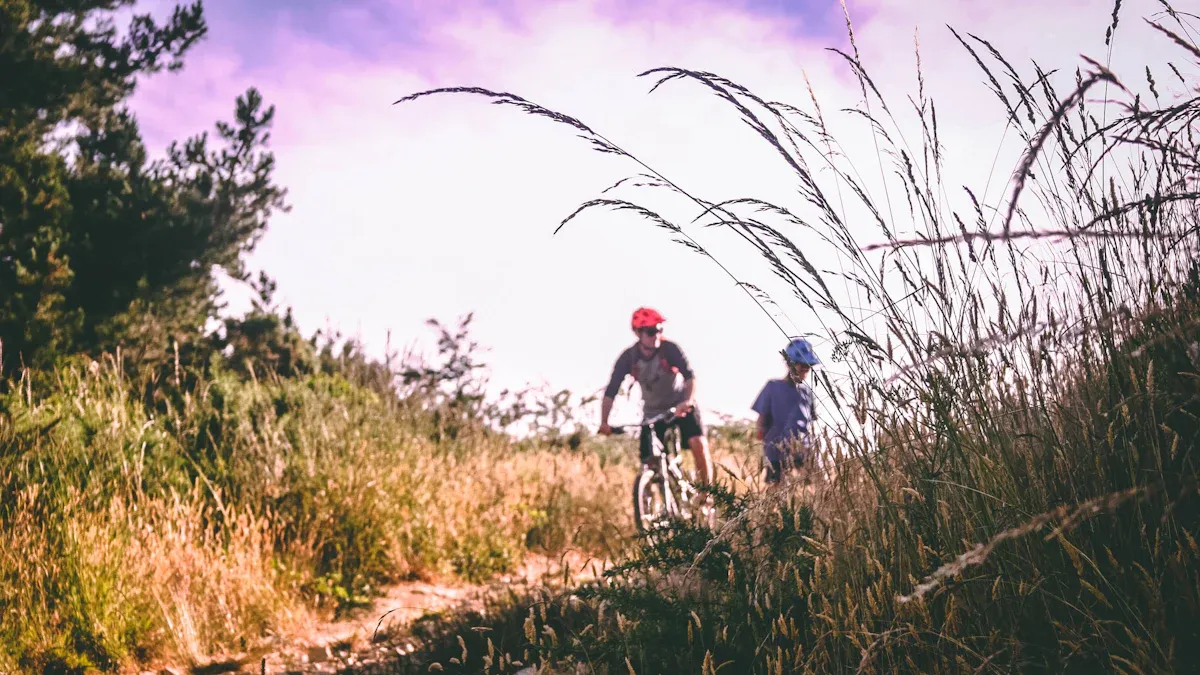
Do you want to ride safely and quickly off-road? A 29-inch mountain bike is a particularly good fit for you if you value a smooth ride. Large wheels roll more easily over roots and rocks. You will experience more comfort, get better traction, and benefit from high stability. This way, you maintain control even on difficult trails and have more fun while riding.
Key takeaways
Large 29-inch wheels provide more comfort, stability, and better traction on uneven terrain.
The right frame size is crucial for safe and comfortable riding; it is determined by your height.
Choose your mountain bike to match your riding style, intended use, and budget to experience maximum riding pleasure.
Look for high-quality equipment such as suspension, gears, and brakes to ensure a safe and efficient ride.
Test different models on a test ride to find the bike that best fits you and feels right.
Target audience

Body height
Your height plays an important role in choosing the right 29-inch mountain bike. Manufacturers recommend these bikes for people with a height of approximately 150 cm to 210 cm. The right frame size ensures that you ride safely and comfortably. In the following table, you will find an overview of which frame size fits your height:
Body height (cm) |
Recommended frame size (cm) |
Frame size (label) |
|---|---|---|
150 - 165 |
33 - 37 |
XS |
160 - 175 |
38 - 43 |
S |
170 - 185 |
43 - 47 |
M |
180 - 195 |
47 - 52 |
L |
190 - 205 |
51 - 56 |
XL |
200 - 210 |
53 - 60 |
XXL |
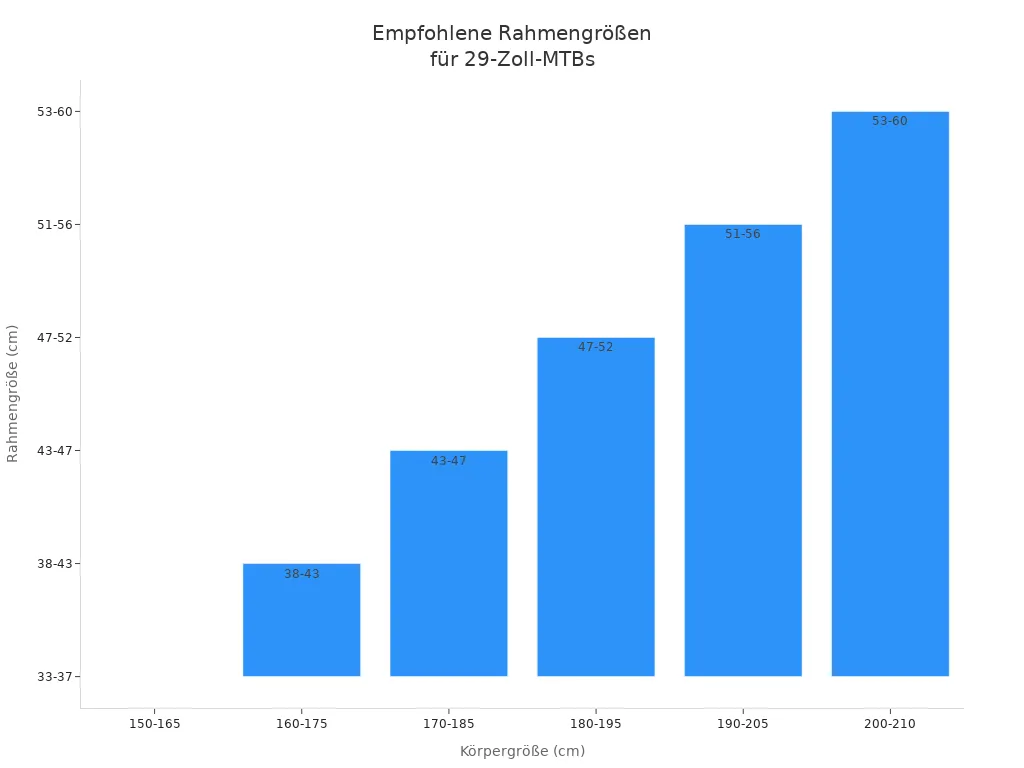
Make sure you feel comfortable on your bike. A frame that is too small or too large can negatively affect the handling and control.
Areas of use
A 29-inch mountain bike is suitable for many different areas of use. You will benefit especially if you enjoy touring or exploring demanding trails. The large wheels roll easily over roots and rocks. This gives you more comfort and safety, even when the terrain becomes difficult.
Tip: If you are a beginner, the large wheels offer a particularly safe riding feel. They help you overcome obstacles more easily and give you more stability.
Many experts recommend 29-inch mountain bikes for the following areas of use:
Off-road adventures and steep forest paths
Longer tours with changing terrain
Riding on wet or muddy ground
Touring riders and experienced bikers appreciate the smooth ride and high traction. You will stay safe and in control even on fast descents. However, if you value agility and very fast acceleration, you should also consider other wheel sizes.
Advantages of a 29-inch mountain bike
Roll-over capability
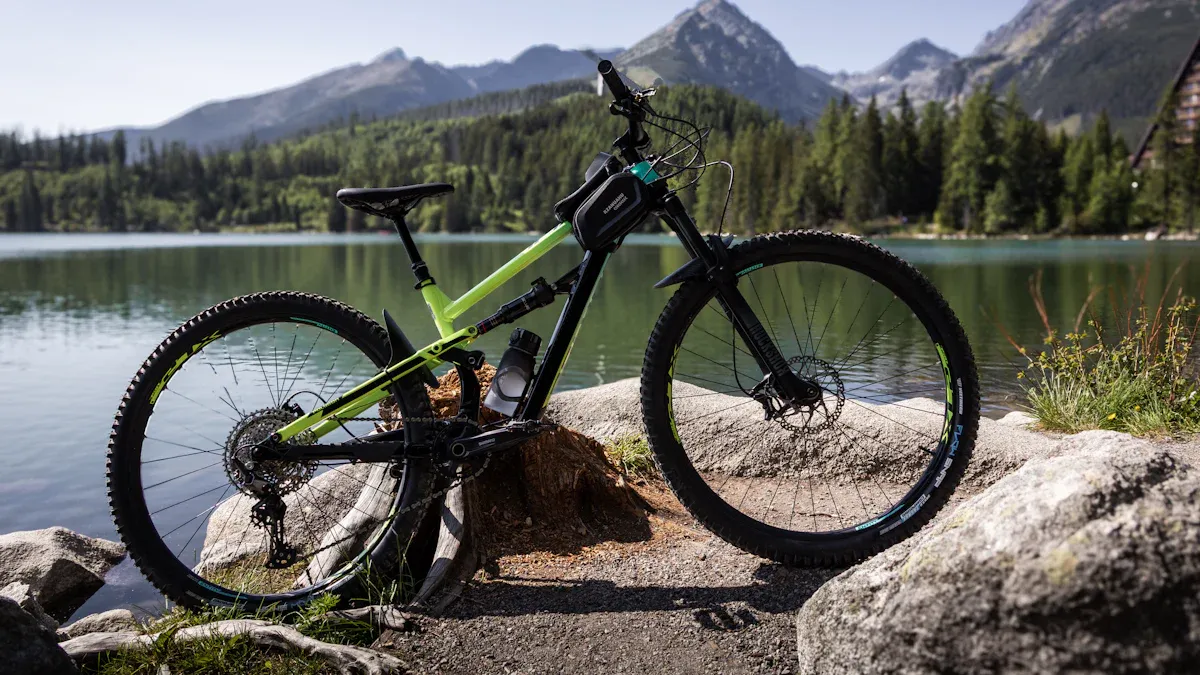
With a 29-inch mountain bike, you roll more easily over obstacles like rocks, roots, or small steps. The large wheels reduce the intensity of impacts when you ride on uneven ground. You feel fewer jolts and can better concentrate on the trail. Many riders report feeling "lowered" on a 29-inch bike. This gives you a feeling of safety, especially on rough routes.
Tip: The larger the wheel, the easier you overcome obstacles. This makes long tours and technical trails more enjoyable and less strenuous.
Traction
Traction is a decisive advantage of a 29-inch mountain bike. At the same air pressure, a 29-inch tire has a longer but narrower contact patch than a smaller wheel. This allows the tire to grip better and adapt to the ground. You have more grip, especially on loose or muddy soil. Studies show that 29-inch tires have about 8% lower rolling resistance than 26-inch tires. This means you ride more efficiently and safely, even when the terrain is difficult.
More traction on wet, loose, or rocky ground
Reduced risk of pinch flats at the same air pressure
Better grip uphill and downhill
Comfort
Comfort plays a major role in a 29-inch mountain bike. Larger wheels ensure a smoother ride and fewer vibrations. You can ride longer distances without your arms and legs tiring quickly. User surveys show that many riders perceive the comfort of 29-inch bikes as significantly better. The wheels roll faster and easier over obstacles, which makes the ride more pleasant. You benefit from this advantage especially on long tours or technical trails.
Better roll-over performance results in fewer impacts on rough trails.
The high smooth-running quality gives you more safety during fast descents.
The riding feel remains comfortable even on changing ground.
Stability
With a 29-inch mountain bike, you enjoy noticeably higher riding stability. The large wheels hold their speed more easily and ensure a steady riding feel, even at high speeds. You retain control even when the terrain becomes demanding. The 29er principle shows that larger wheels roll over obstacles better and convey more safety. Many riders appreciate the stable line choice and secure handling, especially on fast descents or long tours.
Note: The higher rolling inertia of 29-inch wheels makes the bike slightly more sluggish when accelerating, but you benefit from more smoothness and stability.
Features of a 29-inch mountain bike
Frame material
The frame material determines the weight, stiffness, and feel of your 29-inch mountain bike. You will mostly find aluminum, carbon, or, less frequently, steel and titanium.
Aluminum is lightweight, robust, and inexpensive. It is well-suited for beginners and sporty riders.
Carbon offers the best ratio of weight and stiffness. You benefit from a very light bike that dampens vibrations well.
Steel is durable and comfortable, but heavier.
Titanium combines lightness and comfort but remains expensive and rare.
Tip: If you value low weight and sporty performance, you should consider carbon. Aluminum is suitable for an affordable and robust bike.
Suspension (Hardtail/Full-suspension)
The choice between hardtail and full-suspension strongly influences the handling of your 29-inch mountain bike.
A hardtail has only a suspension fork at the front. You benefit from a lower weight and simpler technology. On smooth or moderate paths, you ride efficiently and directly.
A full-suspension bike also offers rear suspension. This provides more comfort and control on demanding trails. The rear wheel stays on the ground better, which increases traction. You can brake later and ride through corners more safely. Modern full-suspension bikes can be efficiently locked when riding uphill so that no energy is lost.
Hardtails are cheaper and lighter but offer less comfort on rough terrain. Full-suspension bikes absorb impacts better and reduce fatigue, especially on long tours. The decision depends on your riding style, budget, and area of use.
Gears & brakes
The gears of your 29-inch mountain bike determine how easily you master steep climbs or fast descents. Modern bikes usually rely on 1x12 drivetrains. You have only one chainring in the front and many gears in the back. This simplifies operation and reduces weight.
As for brakes, you will almost always find hydraulic disc brakes. They offer powerful braking force and function reliably even in wet conditions. Mechanical disc brakes are cheaper but less powerful.
Make sure that the gears and brakes match your riding style. For demanding trails, you need precise and reliable technology.
Tires & tire pressure
Tire width and tire pressure strongly influence the performance of your 29-inch mountain bike off-road. Wide tires (2.5" to 2.6") offer you plenty of grip and comfort. The large contact patch ensures good roll-over properties, especially on trails.
The correct tire pressure depends on your weight and the terrain. For a rider weight of 90 kg, we recommend about 1.8 bar in the front and 1.9 bar in the back. The front tire should have slightly less pressure so you get optimal grip.
A lower pressure improves traction and damping because the tire absorbs obstacles better. However, too little pressure increases the risk of pinch flats and unstable handling. On soft surfaces like mud, lower pressure helps; on hard ground, you should increase pressure to reduce rolling resistance.
Use a pressure gauge to set the pressure accurately. Adjust it according to the terrain.
Weight
The weight of your 29-inch mountain bike influences how easily you accelerate and ride uphill. A typical hardtail weighs about 18 kg. Lighter models made of carbon can weigh less, while full-suspension bikes are often heavier due to the additional suspension.
A low weight makes handling easier and makes the bike more agile. For touring riders and sporty bikers, a lighter model is worth the investment.
Tip: Think about how important low weight is to you. For everyday use or relaxed tours, it plays a smaller role than for sporty applications.
Geometry
The geometry determines the riding behavior of your 29-inch mountain bike. Wheelbase and steering angle are particularly important here.
Manufacturers often adapt the wheelbase through shorter chainstays and a steeper steering angle. This keeps the handling agile and controllable despite the large wheels. A steeper steering angle prevents nervous riding behavior and provides stability.
The longer fork and shorter head tube compensate for the higher center of gravity. You benefit from more smoothness, better traction, and a secure riding feel, even at high speeds.
Modern geometries make the 29-inch mountain bike versatile: you ride safely downhill and climb efficiently uphill.
Selection
Riding style
Your riding style decides which 29-inch mountain bike is right for you. If you like riding long distances and love speed, a cross-country bike is suitable. These models are light, have about 100 mm of suspension travel, and roll fast on forest paths. For varied trails with roots and rocks, choose a trail bike. It offers 120-150 mm of travel and a balanced geometry. Enduro bikes are perfect if you prefer steep descents and technical passages. They have up to 180 mm of suspension travel and wide, robust tires.
Tip: Choose the tire width and tread to match your riding style. Narrower tires roll faster; wider ones offer more grip.
Budget
Your budget influences the equipment and quality of your bike. Entry-level models start at about €300. For a solid e-mountain bike, you should plan for at least €1,200. High-quality models often cost over €1,500.
Model name |
Price (approx.) |
Description |
|---|---|---|
KS Cycling Fully Mountainbike Scrawler 29 inch |
Affordable entry-level model |
|
Tretwerk Commander E-Bike Mountainbike 29 inch |
€1,249 |
Mid-range e-mountain bike |
BE COOL Mountain E-Bike Pro1 eMTB-Pro1 |
€1,599 |
High-quality e-mountain bike |
Note: Do not skimp on safety-related parts such as brakes. Quality pays off in terms of riding pleasure and safety.
Frame size
The right frame size ensures comfort and control. Measure your inseam and compare it with the manufacturer's table.
Body height (cm) |
Frame height (cm) |
Frame height (inches) |
Wheel size (inches) |
|
|---|---|---|---|---|
74-79 |
170-175 |
42-45 |
16.5-17.5 |
27.5 / 29 |
77-83 |
175-180 |
44-47 |
17.5-18.5 |
27.5 / 29 |
81-86 |
180-185 |
46-49 |
18-19 |
27.5 / 29 |
86-91 |
185-190 |
49-52 |
19-20.5 |
29 |
91-98 |
190-195 |
51-56 |
20.5-22 |
29 |
For intermediate sizes, choose the smaller frame size for sporty riding, or the larger one for touring.
Test Ride
A test ride is always important. You will immediately feel whether a 29-inch mountain bike is right for you. Test different models and frame sizes. Pay attention to seating position, handling, and comfort. This is the only way to find the perfect bike for you.
Tip: Try out the bike on different surfaces. This will show you how it behaves in corners, when braking, and on trails.
Accessories
The right accessories increase your performance. Experts recommend high-quality tires with a coarse tread pattern and reinforced sidewalls. Tubeless tires offer fewer punctures and a better ride feel. Brands like Schwalbe, Continental, or Maxxis offer suitable models for every riding style. Complement your bike with a good pump, rim tape, and a small bag for tools and a spare tube.
Note: Tire choice has the biggest impact on your ride feel. Invest in quality here to experience more fun and safety.
A 29-inch mountain bike offers you comfort, stability, and strong traction on any surface. Experts advise paying attention to solid workmanship, good equipment, and a fair price-performance ratio. Check the frame and wheels carefully, as these are difficult to upgrade later. Test different models and find out which bike suits your riding style. Your personal requirements will determine which model brings the most joy. 🚴♂️
FAQ
How do you properly maintain a 29-inch mountain bike?
You should clean your bike after every ride. Check the chain regularly and oil it. Check the brakes and tire pressure. Watch out for loose screws. This will keep your mountain bike in good condition for a long time.
Who is a 29-inch mountain bike particularly suitable for?
Are you tall or do you like going on long tours? Then a 29-inch mountain bike is right for you. The large wheels offer you more comfort and stability. Beginners also benefit from the confident ride feel.
What is the ideal tire width for 29-inch mountain bikes?
Many riders choose tires between 2.2 and 2.6 inches wide. Wider tires offer more grip and comfort. Narrower tires roll faster. Choose the width that suits your riding style and the terrain.
How do you set the correct tire pressure?
Tip: Use a pressure gauge for accurate readings.
You should choose the pressure based on your weight and the surface. 1.8 to 2.2 bar is usually sufficient. Lower pressure provides more grip, while higher pressure ensures easier rolling.
Can you also use a 29-inch mountain bike for everyday tasks?
Yes, you can also use the bike for commuting to school or work. The large wheels roll easily over curbs. With mudguards and lights, your mountain bike becomes suitable for everyday use.