
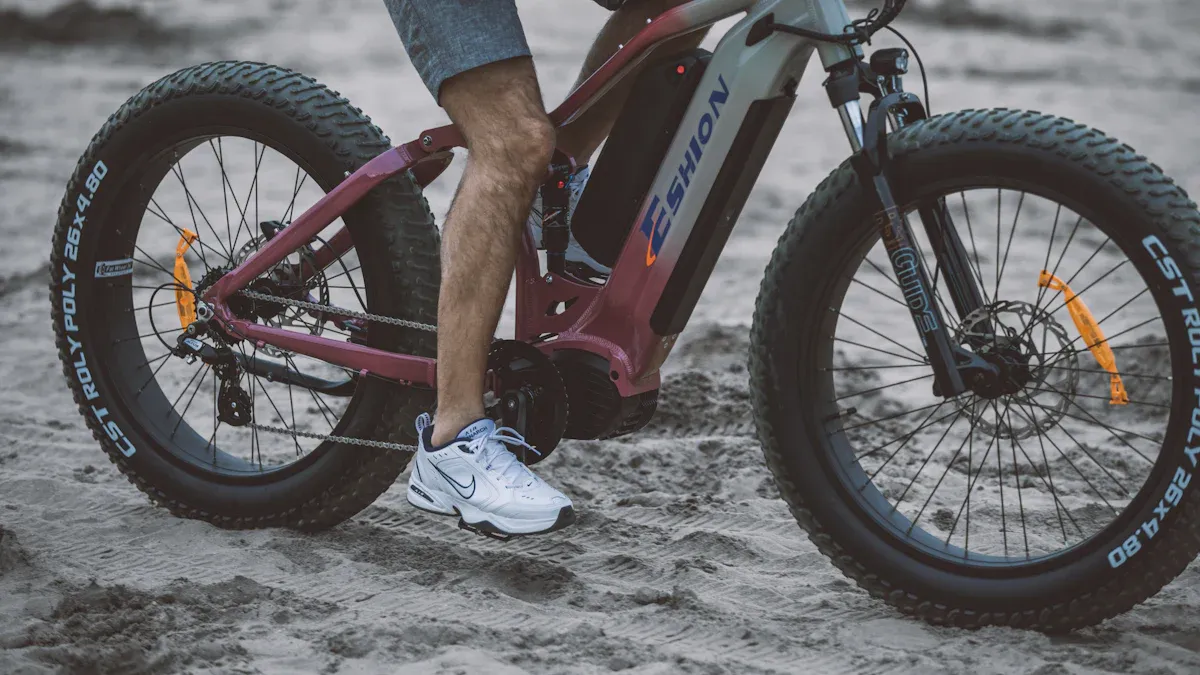
The range of your e-bike depends heavily on its battery. A higher-capacity battery allows for longer rides and more flexibility. Your riding style and chosen assistance level directly affect efficiency. If you want to maximize your e-bike battery range, you can achieve big differences through small adjustments.
Key takeaways
Look ahead and plan your route to save energy. Avoid sudden braking and ride on flat paths.
Switch to Eco mode to protect the battery. Higher levels consume more energy and are only necessary at times.
Ride steadily to go further. Rapid acceleration and braking damage the battery.
Optimizing riding behavior to maximize e-bike battery range
Anticipatory riding and tour planning
Anticipatory riding helps you save energy and increase your e-bike's range. Avoid abrupt braking maneuvers and use momentum, especially on descents. Plan your route in advance to avoid unnecessary stops and steep climbs.
Tip: Choose flat routes whenever possible and maintain a constant cadence. This protects the battery and ensures even energy consumption.
Gentle starting and moderate acceleration are also crucial. Stop-and-go riding places heavy strain on the battery and reduces range.
Using assistance levels efficiently
Choosing the right assistance level significantly affects range. Use Eco mode (economy mode) as often as possible, as it provides only about 25% assistance and saves the battery.
Note: Higher assistance levels like Turbo mode consume significantly more energy. Only use them when necessary, e.g., on steep climbs.
Switching between levels, adapted to the terrain, can improve efficiency. On flat stretches or slight descents, you can reduce assistance and pedal more yourself.
Keeping speed constant
A steady pace is the key to maximizing e-bike battery range. Frequent acceleration and braking requires more energy and puts stress on the battery.
Tip: Try to maintain a constant speed, especially on long rides. This saves energy and extends your range.
Riding fast might be tempting, but it significantly shortens your range. A moderate tempo is not only more efficient but also safer.
Technical aspects of maximizing e-bike battery range
Optimizing tire pressure and rolling resistance
Correct tire pressure plays a decisive role if you want to maximize e-bike battery range. Optimal pressure reduces rolling resistance and ensures a more efficient ride. Check the pressure regularly, especially before longer tours.
Tip: For tires with a width of 1 to 3 centimeters, the ideal pressure is between 4 and 5.5 bar. The maximum pressure is indicated on the tire sidewall.
The following table shows recommended values for different types of bikes:
Bike type |
Recommended pressure |
|---|---|
Front wheel |
0.6 bar (8.7 psi) |
Rear wheel |
0.7 bar (10 psi) |
With tube |
+0.2 bar (3 psi) |
Pressure that is too low increases energy consumption and strains the battery. Keep the pressure within the recommended range to increase efficiency.
Pay attention to efficient shifting and cadence
The right shifting technique and cadence can significantly influence your e-bike's range. A cadence of 60 to 80 revolutions per minute is considered optimal. It protects the battery and reduces wear.
Avoid low cadences in heavy gears. This increases energy consumption.
Use a derailleur system if possible. It has a higher efficiency than a hub gear system.
Adapt gears to the terrain to pedal smoothly.
A steady pedal stroke saves energy and extends the life of your battery.
Reducing weight for more efficiency
A lighter e-bike requires less energy to cover the same distance. You can increase efficiency by avoiding unnecessary luggage and choosing lightweight components.
Use carbon handlebars or tubeless wheels to save weight.
Prefer lightweight water bottles and reduce superfluous equipment.
Lower total weight relieves the battery and improves range. Small adjustments here can make a big difference.
Battery care and usage for longer range
Proper storage and temperature management
Correct storage of your e-bike battery is crucial to extend its lifespan and maintain efficiency. Store the battery in a dry place at a temperature between 10 and 15 degrees Celsius. Protect it from direct sunlight, humidity, and moisture.
Tip: Before storage, the battery should be charged to 30 to 60 percent. This prevents deep discharge and keeps the battery in optimal condition.
For additional safety, you can use special battery boxes or battery bags. These containers offer protection against external influences and minimize risks in case of fire.
Extreme temperatures, whether hot or cold, can impair battery performance. High temperatures accelerate wear, while low temperatures temporarily reduce efficiency.
Battery maintenance and optimal charging practices
Good charging practice contributes significantly to maximizing e-bike battery range. Do not charge the battery to 100% or discharge it completely. A charging range between 20 and 80 percent is ideal.
Always use the original charger to avoid damage.
Charge the battery at room temperature, as extreme temperatures can reduce charging efficiency.
Avoid leaving the battery on the charger for long periods.
Note: Check the condition of the battery regularly. Defective lithium batteries should be transported in special fireproof containers to minimize risks.
Seasonal adjustments, especially in winter
In winter, your battery requires special care. Cold temperatures reduce efficiency and decrease range. You can protect the battery by storing it in a garage or carport.
Use Eco mode to save energy.
Ride slowly and steadily to reduce energy consumption.
Mount winter tires with low rolling resistance for more efficiency.
Tip: Before charging, you can warm the battery up slightly to improve charging performance.
With these measures, you can maximize e-bike battery range even in the cold season and extend the life of your battery.
External factors influencing e-bike battery range
Weather conditions and temperature
Weather conditions significantly influence your e-bike's range. Headwinds increase air resistance and force the motor to expend more energy. Tailwinds, on the other hand, support you and save energy. Extreme temperatures, whether hot or cold, also negatively impact battery performance.
Headwinds increase resistance and require more energy.
Tailwinds help save energy.
Extreme temperatures impair battery efficiency.
Tip: Plan your rides during mild weather and avoid extreme conditions to maximize range.
Terrain and topography
The terrain you ride on plays a decisive role in energy efficiency. Mountainous terrain puts more strain on the battery because the motor must provide more power. On level surfaces, your e-bike consumes less energy. Unpaved roads increase rolling resistance and reduce range.
Mountainous terrain requires more energy from the motor.
Flat terrain is more efficient and easier on the battery.
Unpaved roads increase rolling resistance.
Note: Whenever possible, choose flat and paved paths to protect the battery.
Minimizing accessories and additional features
Additional equipment increases the total weight of your e-bike and strains the battery. Heavy items in the pannier or bulky accessories like child seats reduce range. Lighter components like carbon handlebars or tubeless wheels can help reduce weight.
Remove unnecessary items from the pannier.
Choose lightweight materials for your accessories.
Avoid unnecessary additional features like lights that are permanently switched on.
Tip: Keep your e-bike as light as possible to increase efficiency and extend range.
Maximizing the range of your e-bike starts with small adjustments. Optimize your riding behavior, maintain the battery, and consider external factors. Implement these tips to enjoy longer rides and extend the life of your battery. Efficient usage not only saves energy but also sustainably increases your riding pleasure. 🚴♂️
FAQ
How often should I check the tire pressure?
You should check the tire pressure at least once a week. Optimal pressure reduces rolling resistance and extends the range of your e-bike.
Can I charge my battery in any weather?
Only charge your battery at room temperature. Extreme temperatures, whether hot or cold, can reduce charging efficiency and negatively affect the battery's lifespan.
How do I know if my battery needs to be replaced?
A battery that discharges quickly or no longer reaches full capacity should be replaced. Check performance regularly to take timely action.
Tip: Store the battery in a dry, cool room to maximize its lifespan.