
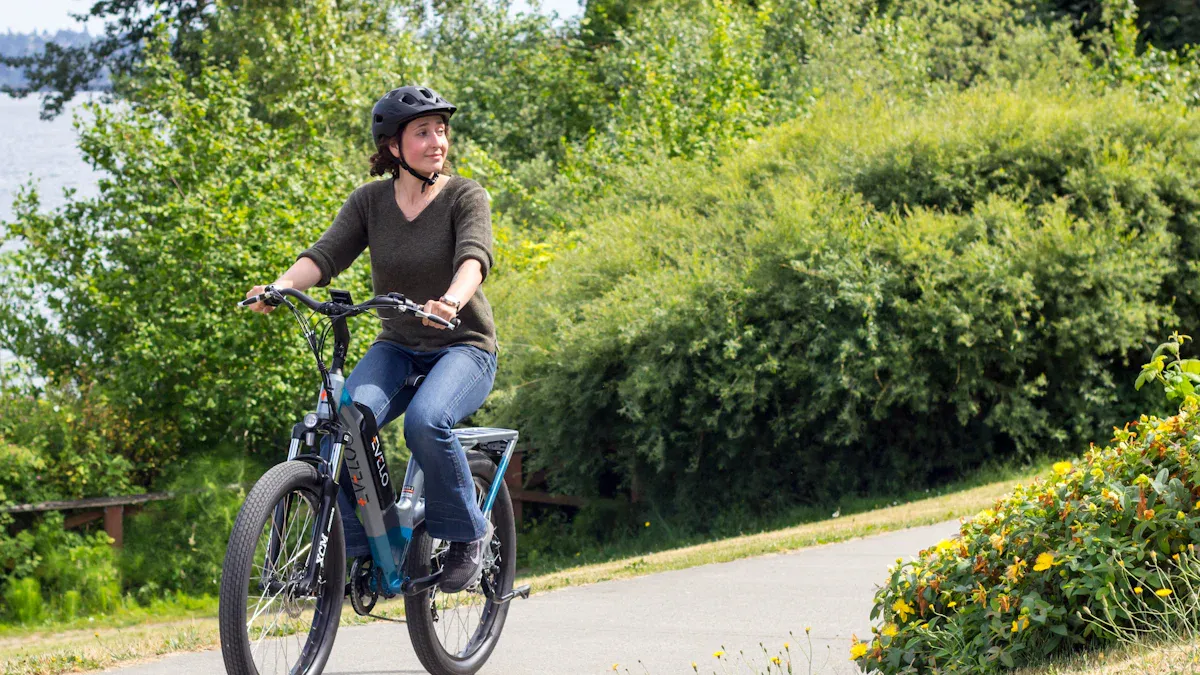
Light e-bikes offer you clear advantages in 2025. Thanks to modern technology, the lightest model weighs only 13.1 kg. You benefit from a long range, as models like the Lankeleisi MG600 Lite achieve about 102 km with a 720 Wh battery. The efficient technology ensures a consumption of just 4–4.2 Wh/km. You can feel the low weight when accelerating quickly and braking. With these features, light e-bikes make your everyday life easier and make longer distances comfortably possible.
Key Takeaways
Light e-bikes usually weigh under 20 kg, giving you easy handling and more mobility in daily life.
Modern batteries enable ranges of up to 200 km, allowing you to travel longer distances without frequent recharging.
Innovative motors are efficient, light, and adapt to your riding style, making the ride comfortable and natural.
Various models such as city, trekking, mountain, and compact e-bikes offer the right bike for every need.
Before purchasing, you should test the weight, battery, motor, and frame to find the e-bike that perfectly fits your daily routine.
Light E-Bikes 2025
Features
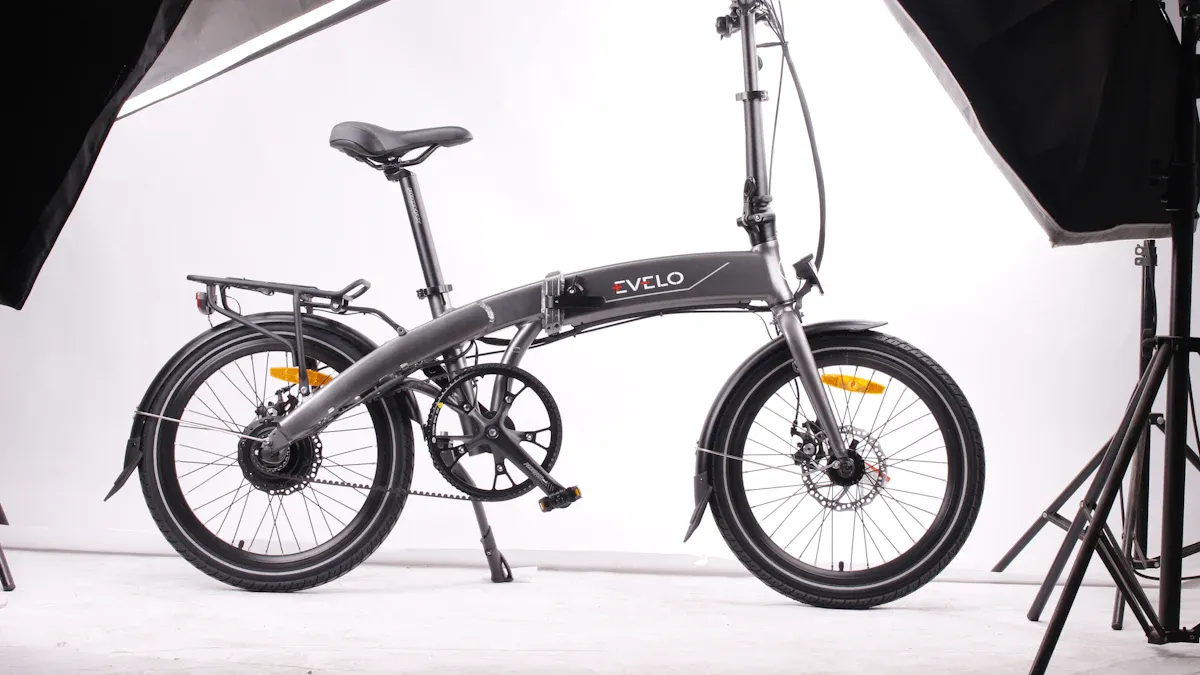
You can recognize light e-bikes immediately by their low weight. Most models weigh less than 20 kg. Manufacturers focus on compact motors and integrated batteries. Many batteries offer a maximum capacity of 400 Wh, which ensures a natural riding feel. You barely feel any motor resistance when riding without assistance. The ride dynamics are similar to those of a normal bicycle. Light e-bikes are easy to carry, for example, into an apartment or down to the basement. This is particularly practical if you live in the city or need to transport your bike often.
A study by the Fraunhofer Institute shows that e-bikes are cheaper and more environmentally friendly in everyday use than electric scooters. You benefit from low operating costs and a range of 50 to 100 kilometers per battery charge. This makes light e-bikes a sustainable choice for daily use.
Weight Classes
You can find light e-bikes in various weight classes. The lightest models start at about 13 kg. Many city and urban bikes weigh between 14 and 18 kg. Trekking and mountain bike variants are usually just under 20 kg. The low weight improves handling. You can lift, turn, or take the bike on the train more easily.
Tip: Choose a model that fits your daily life. For short trips in the city, a particularly light bike is often sufficient. For longer tours, a model with a slightly larger battery is recommended.
Current surveys show that more and more people are opting for light e-bikes. In Germany, around 2.1 million e-bikes were sold in 2024. The market is also growing strongly in France. This shows how popular these models have become in daily life.
Technology
Battery
In 2025, you benefit from batteries that are lighter and more powerful than ever before. New solid-state batteries offer ranges of over 150 km per charge. Many models can even achieve up to 200 km. Charging times are decreasing significantly, allowing you to use your e-bike again sooner. The following table shows typical values for modern batteries:
Battery Capacity (Wh) |
Estimated Range (km) |
Special Feature |
|---|---|---|
55 – 70 |
Ideal for the city |
|
800 |
Up to 130 |
For longer distances |
Over 150 |
Solid-state battery, fast charging function |
Manufacturers like Bosch, DJI, and Yadea are focusing on these new technologies. You can rely on high everyday suitability.
Motor
The motors in light e-bikes are becoming increasingly efficient. You feel the assistance immediately without the bike feeling heavy. New models like the Quark DM 1.2 weigh only 1.2 kg and still deliver 65 Nm of torque. This ensures a dynamic riding experience. Motors like the TQ HPR 50 and the Bosch SX consume very little electricity. They adapt to your riding style and the terrain. This way, you achieve a long range and a natural riding feel with your light e-bike.
Tip: Look for adaptive motors that automatically adjust to your needs. This makes every ride more enjoyable and saves energy.
Frame
Frames made of carbon or titanium make your e-bike particularly light and stable. Carbon frames are up to 25% lighter than aluminum frames. You benefit from a total weight between 10 and 15 kg. Carbon dampens vibrations and ensures more comfort. The frames can be shaped freely, giving you a bike that is aerodynamic and visually appealing. Particularly sporty riders and commuters enjoy the benefits: lightness, agility, and precise control.
The following table gives you an overview of key innovations:
Innovation / Trend |
Description |
Example / Manufacturer |
|---|---|---|
Motors with more power, less weight |
Urtopia, Bosch, TQ |
|
Solid-state batteries with fast charging |
Over 150 km range, short charging times |
Bosch, DJI, Yadea |
3D-printed titanium and carbon frames |
Very light, modular, high stability |
Urtopia, CUBE |
Smart connectivity and security |
App control, battery lock, ChatGPT integration |
Bosch, Urtopia |
Minimalist design |
Seamless integration of battery and motor, hard to distinguish from bicycles |
Cube, Bulls, Cannondale, Canyon |
With these technologies, light e-bikes in 2025 will become even more attractive for your daily life.
Advantages of Light E-Bikes
Handling
You feel the difference immediately when you step onto a light e-bike. The low weight makes handling particularly easy. You can effortlessly lift, turn, or carry your bike into a bicycle storage room. Many models can even be taken on buses and trains without any problems. This helps you if you live in the city or are often on the go.
Commuters benefit in particular. You can quickly place your e-bike in an elevator or carry it up stairs. Seniors experience more safety because the bike is easier to control. Children and teenagers also cope better with a light model.
Tip: Test the handling before purchasing. Lift the bike and check if you feel comfortable with it.
Range
Light e-bikes offer an impressive range. Modern batteries enable day trips of up to 150 kilometers. You don't have to constantly think about recharging, which gives you more freedom when planning your tours.
City riders benefit from high efficiency. You can complete many errands without charging the battery daily. For commuters, this means you can ride to work for several days before needing to recharge.
A long range also makes longer weekend trips possible. You can discover new routes without fear of an empty battery.
User Group |
Advantage of long range |
|---|---|
Commuters |
Fewer charging cycles, more flexibility |
Seniors |
More safety, no anxiety about charging |
City riders |
Everyday suitability, spontaneous trips |
Touring riders |
Long day trips without recharging |
Comfort
Comfort is a top priority for light e-bikes. The low weight ensures a pleasant ride. You feel fewer shocks because modern frames dampen vibrations. Ergonomic grips and saddles make longer rides more comfortable.
Many models offer an upright seating position, which is easier on your back and joints. Smart features such as integrated lighting or navigation aids further increase comfort.
For seniors and people with physical limitations, comfort is particularly important. You can mount and dismount more easily. Riding on uneven paths also feels safer.
Easy handling in everyday life
High mobility in the city
More comfort on long distances
Longer day trips without recharging
Note: Comfort doesn't just mean convenience. You ride more relaxed and safely when the bike fits you.
Top Models
City
City e-bikes help you in your daily life. They offer you an upright seating position and road-safe equipment. Many models have a hub gear, which makes shifting particularly easy. In this category, you will find models such as the Allegro Allcity, the Scott Passage 10 Belt, or the Riese & Müller Swing 4 Silent. These bikes often weigh under 20 kg and are perfect for short trips in the city.
Model |
Price (Euro) |
Special Features |
Rating |
|---|---|---|---|
Allegro Allcity |
2999 |
Hub gear, belt drive |
1.7 |
Scott Passage 10 Belt |
3499 |
Light frame, quiet motor |
1.8 |
Riese & Müller Swing 4 Silent |
4299 |
Comfort saddle, low entry |
1.6 |
BESV CT-B 1.1 LS |
3999 |
Integrated lighting |
1.9 |
You benefit from a range of up to 100 km and a charging time of about 4 hours. The motor power is usually 250 watts. Manufacturers like Riese & Müller or BESV focus on innovative technology and high safety.
Tip: Choose a city e-bike if you commute to work daily or are often on the go in the city. The models are low-maintenance and very comfortable.
Trekking
Trekking e-bikes accompany you on longer tours. They have a sturdy frame, a luggage rack, and a comfortable seating position. You can also transport luggage with these bikes. Models like the Cube Kathmandu Hybrid SLT 750 or the Haibike Trekking 7 are among the most popular in 2025.
Model |
Price (Euro) |
Special Features |
|---|---|---|
Cube Kathmandu Hybrid SLT 750 |
4499 |
750 Wh battery, up to 150 km range |
Haibike Trekking 7 |
3999 |
Strong motor, suspension fork |
KTM Macina Sport 710 |
4299 |
Light aluminum frame |
The motors produce between 250 and 500 watts. You achieve ranges of 120 to 150 km. The batteries can be fully charged in 4 to 6 hours. Manufacturers like Cube, Haibike, and KTM offer good value for money and modern technology.
Note: Trekking e-bikes are suitable for you if you enjoy riding longer distances or are planning trips with luggage. The comfortable seating position is easier on your back.
Mountain Bike
Mountain e-bikes support you on challenging trails. They feature powerful motors and robust frames. Models like the Bulls Sonic EVO AM 2 Carbon or the Cannondale Moterra Neo 3+ offer you a lot of performance at a low weight.
Model |
Price (Euro) |
Special features |
|---|---|---|
Bulls Sonic EVO AM 2 Carbon |
4999 |
Carbon frame, 85 Nm torque |
Cannondale Moterra Neo 3+ |
5299 |
625 Wh battery, 29-inch wheels |
Haibike AllMtn 7 |
5499 |
720 Wh battery, Bosch Performance CX |
You benefit from motors with up to 500 watts and ranges of 80 to 120 km. The batteries are often integrated into the frame. Manufacturers like Bulls, Cannondale, and Haibike rely on innovative technology and lightweight materials.
Tip: Mountain e-bikes are suitable for you if you enjoy riding off-road. The powerful assistance also helps you with steep climbs.
Compact
Compact e-bikes are particularly handy. They fit into small apartments and are easy to transport. Models like the GoCycle G4i or the Riese & Müller Tinker2 offer you plenty of flexibility in everyday life.
Model |
Price (Euro) |
Special features |
|---|---|---|
GoCycle G4i |
4499 |
Foldable, only 17 kg, belt drive |
Riese & Müller Tinker2 |
3999 |
Compact frame, powerful motor |
QiO EINS P-5 |
3699 |
Low step-through, 20-inch wheels |
These bikes often weigh under 20 kg. The range is between 60 and 100 km. Manufacturers like GoCycle and Riese & Müller focus on innovative solutions for urban environments.
Note: Compact e-bikes are suitable for you if you have limited space or want to take the bike with you frequently. They are lightweight, flexible, and easy to stow away.
With these top models, you will find the right lightweight e-bike for every purpose. Manufacturers focus on modern technology, long ranges, and low weight. You can rely on quality and innovation.
Buying guide
Weight
Weight plays a major role when choosing an e-bike. You should pay attention to the total weight, but also to individual components such as the motor (2–4 kg), battery (2.5–5 kg), and frame. A reinforced frame provides more stability but also adds extra weight. Many lightweight e-bikes weigh under 20 kg, making them easier to carry or place in a basement. The weight without the battery helps you better understand the weight distribution.
Tip: Take a test ride. This way, you can feel if the weight is comfortable for you, especially when climbing stairs or carrying the bike.
Battery & range
The capacity of the battery determines how far you can ride on a single charge. Manufacturers specify the capacity in watt-hours (Wh). For the city, 250 to 500 Wh are often sufficient; for longer tours, you need up to 800 Wh. The range depends on your riding style, the support level, and the terrain. A 300–400 Wh battery will take you about 55–70 km, while an 800 Wh battery can manage up to 130 km.
Note: Manufacturer specifications are guidelines. Your actual range may vary.
Motor & riding experience
A modern motor makes riding more enjoyable. New motors adapt to your riding style and react quickly. They operate quietly and efficiently. Tests show that motors like the TQ HPR 50 or Bosch Performance CX are particularly economical. They provide a natural riding feel and help you save energy. This improves the range and makes every ride more comfortable.
Frame & ergonomics
The frame influences how comfortably you sit on the bike. A lightweight frame made of carbon or aluminum makes the bike more agile. Ergonomics determine whether you can ride long distances without discomfort. Pay attention to the appropriate frame size and a comfortable riding position. Many models offer adjustable handlebars and saddles.
Tip: Try out different frame shapes to find the best riding experience for yourself.
User group |
What you should look out for |
|---|---|
Commuters |
Low weight, high range |
Seniors |
Lightweight frame, simple handling |
City riders |
Compact design, low-maintenance technology |
Touring riders |
Large battery, comfortable riding position |
Disadvantages
Stability
Lightweight e-bikes offer many advantages, but you should keep an eye on stability. Many models forgo comfort elements like suspension forks or suspension seat posts. This saves weight, but you will feel bumps on the road more strongly. The frames are stiff, but not as robust as those on heavier e-bikes. Especially during fast rides or on uneven paths, the bike may feel less stable.
Some manufacturers save additional weight by omitting gear systems. This means less technology for you, but also less flexibility while riding. Some models have non-removable batteries. This can make charging cumbersome in winter. Also, the axle attachment on the rear wheel is sometimes difficult to access, which makes changing tires or performing maintenance more complicated.
Typical limitations of lightweight e-bikes:
Less comfort due to lack of suspension
Reduced suitability for daily use due to minimalist equipment
More difficult maintenance with fixed components
Price
You often pay more for a lightweight e-bike than for a heavier model. Prices usually start at around 1,800 euros and reach over 5,000 euros. High-quality materials like carbon or titanium and modern technology drive up the costs.
A look at current models shows the price range:
Bike type |
Brand |
Model |
Weight (kg) |
Price (Euro) |
|---|---|---|---|---|
Trekking |
Poison |
E605 |
19.2 |
3539 |
Trekking |
Coboc |
Vesterbro |
15.9 |
4799 |
Trekking |
Simplon |
Spotlight Mahle XT |
17 |
5049 |
Urban bike |
Tenways |
CGO 600 Pro |
18 |
1799 |
Urban bike |
Voltaire |
Bellecour |
21.5 |
2290 |
Urban bike |
Bergamont |
E-Sweep Tour |
17.66 |
3599 |
Urban bike |
Canyon |
Commuter:ON 8 Ltd |
16.3 |
3799 |
Urban bike |
Riese & Müller |
UBN Seven Touring |
19.2 |
4899 |
Urban bike |
Urwahn |
Platzhirsch – Torquato Edition |
15.34 |
4999 |
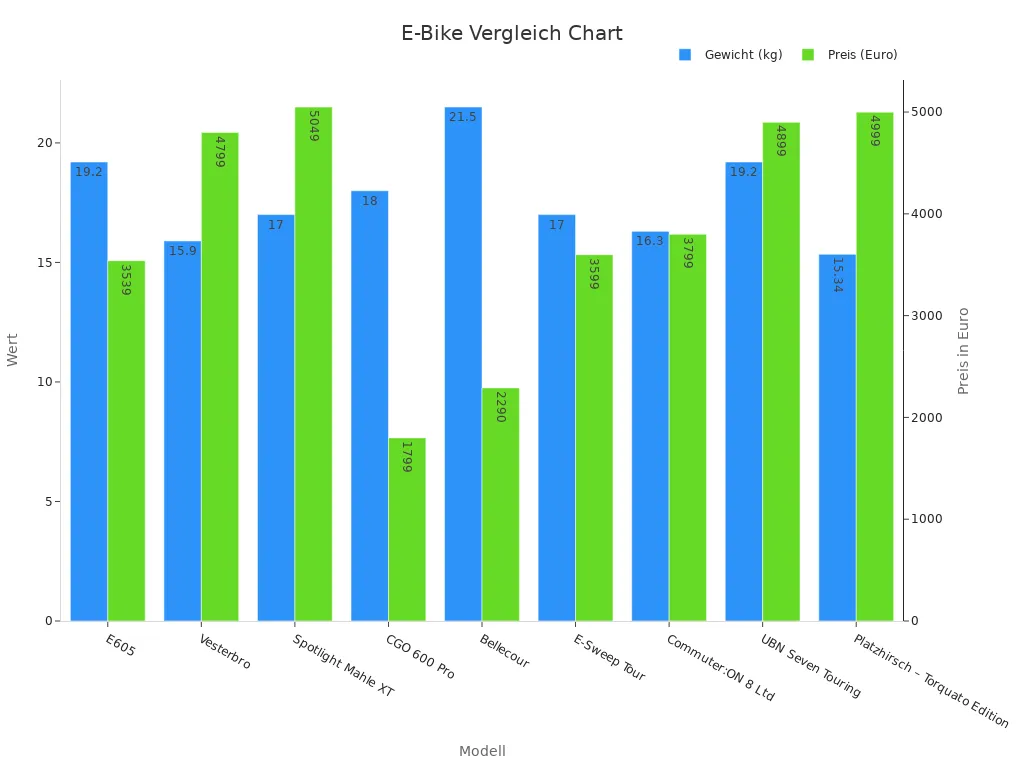
As you can see, the lighter the bike, the higher the price often is. For many users, the investment is worth it, but you should keep an eye on your budget.
Maintenance
Lightweight e-bikes sometimes present challenges regarding maintenance. Many models have special components that are not universally available. Spare parts like carbon frames or specific motors cost more than standard parts.
Some bikes have fixed batteries. You cannot simply remove them, which complicates maintenance. The axle nuts on the rear wheel are difficult to reach on some models. This makes changing a tire more complicated.
Before purchasing, you should check how easy it is to obtain spare parts and whether a workshop near you has experience with lightweight e-bikes.
Tip: Before you buy, find out about spare part availability and the ease of maintenance for your desired model.
Lightweight e-bikes offer you many advantages in 2025. You benefit from new batteries, compact motors, and a large selection of models. The range often reaches up to 200 km. Major manufacturers focus on mature systems and elegant integration. Experts recommend testing various models. This way, you will find the bike that fits your everyday life. You can rely on robust, user-friendly, and future-proof technology.
Tip: Arrange a test ride and compare the variety of lightweight e-bikes yourself!
FAQ
How do you properly maintain a lightweight e-bike?
You should clean your e-bike regularly. Check the chain and oil it if necessary. Check the tire pressure. Do not let the battery drain completely. Store the bike in a dry place.
Tip: A check-up at a specialized workshop is recommended once a year.
How long does the battery last in lightweight e-bikes?
Most batteries last for 500 to 1,000 charge cycles. This corresponds to about 3 to 5 years. You can extend the lifespan by not completely discharging the battery and storing it at room temperature.
Can you use lightweight e-bikes in winter?
Yes, you can also ride lightweight e-bikes in winter. Make sure the battery is charged and store it in a warm place.
Note: The range decreases in cold weather. You should bring the battery back into a warm environment after your ride.
What safety equipment do you need?
Your e-bike needs lights, reflectors, and a bell. Many models have disc brakes for increased safety.
Equipment |
Mandatory? |
|---|---|
Light |
✅ Yes |
Reflectors |
✅ Yes |
Bell |
✅ Yes |
Disc brakes |
❌ No |
Are there subsidies for lightweight e-bikes?
Many cities and municipalities offer subsidy programs for e-bikes. You can inquire at your local municipal administration.
Tip: Ask about grants or tax benefits for purchasing a lightweight e-bike.