
Extend the lifespan of your battery with three simple basic rules:
Only charge the battery at room temperature.
Ideally, always charge the battery between 20% and 80%.
For longer periods of non-use, store it with a charge level between 30% and 60%.
Proper care protects your wallet from expensive replacement purchases. In addition, you avoid dangerous everyday risks.
Improper Handling |
Resulting Safety Risks |
|---|---|
Extreme Heat (> 60 °C) |
Overheating and direct cell damage |
Charging in the Cold |
Lithium plating and permanent capacity loss |
Moisture Ingress |
Damage to electronics and risk of short circuit |
With the right level of care, you can ride your e-bike safely and economically at all times.
Proper Charging for Maximum Battery Lifespan
The optimal charging range of 20 to 80 percent
You can noticeably extend the lifespan of your e-bike battery by using the correct charging window. Charging within the range of 20 to 80 percent effectively protects the lithium-ion cells. In doing so, you avoid extreme states of charge in everyday life. A charge near 0 percent or keeping it at 100 percent capacity increases chemical wear. The range between 20 percent and 80 percent minimizes these electrochemical stresses. This significantly delays the aging of your energy storage unit.
💡 Tip for everyday use: The gentlest operating range for your battery is consistently between 40 and 85 percent capacity. Use the full 100 percent capacity only for very long tours.
The following overview shows you the effects of the charge level on the battery cells:
Charge Level |
Stress on Battery Cells |
Effect on Lifespan |
|---|---|---|
Constant Full Charge (100%) |
Higher strain on the cells |
Shortens lifespan / damages the battery |
Partial Charge (approx. 80%) |
Gentle cell treatment |
Keeps cells healthier and increases effective lifespan |
A constant charge level of 100 percent damages the battery just as much as complete discharge. Therefore, do not fully charge the battery every time after normal rides.
Important rules for charging routines
A safe charging routine protects you from expensive damage. Follow these clear guidelines for daily charging:
Use only the appropriate original charger from the manufacturer.
Avoid cheap aftermarket chargers without proper safety cut-offs.
Place the battery on a fireproof surface during the charging process.
Charge the battery in a room with a functional smoke detector.
Original power adapters match the charging voltage exactly to the battery management system (BMS). Incompatible devices often generate incorrect voltages, risking irreversible defects or overheating.
Dangers of deep discharge and continuous charging
Extreme states of charge destroy the internal structure of lithium-ion cells. With a deep discharge, unforeseen chemical reactions occur inside the lithium-ion cells. Such cellular damage typically manifests as significant heating or visible swelling of the energy storage unit. A swollen battery poses a high safety risk. Under no circumstances should you continue to use damaged batteries.
Continuous charging also harms the system. Do not leave the charger plugged in for days after the charging process is complete. Constant trickle charging unnecessarily stresses the control electronics. Disconnect the power adapter from the mains once it reaches 80 to 100 percent charge.
Protecting the E-Bike Battery from Heat and Cold
Optimal temperature range for charging and riding
Extreme weather stresses sensitive battery cells. It is best to charge and store your battery at comfortable temperatures between 10 and 20 °C in a dry place.
Cold noticeably changes the inside of the cell. The electrolyte becomes more viscous in freezing temperatures. As a result, the ions move more slowly between the poles. The internal resistance increases and reduces the available power.
Temperature (°C) |
Cell Type |
Measured Internal Resistance (mOhm) |
|---|---|---|
15 to 25 °C |
GA |
27 – 29 |
15 to 25 °C |
29E |
22 – 24 |
-10 °C |
GA |
approx. 45 |
This reduced capacity in winter does not cause permanent damage. After warming up to room temperature, the original energy is fully available to you again.
Protective measures for cold and wet conditions in winter
You can protect the battery during the cold season with simple means. A custom-fit neoprene protective cover offers excellent thermal insulation. The material keeps the operating temperature stable while riding.
⚠️ Important safety notice: It is essential to let an ice-cold battery warm up slowly to room temperature before charging. Charging directly at sub-zero temperatures triggers dangerous thermal runaway and causes fires.
Avoiding extreme heat and direct sunlight
Summer heat permanently damages the energy storage unit. Never park your e-bike in direct sunlight. Temperatures above 45 °C cause irreversible damage to important components within the cell casing.
Strong sunlight leads to the following damage:
Electrolyte decomposition: The liquid inside oxidizes and reduces power output.
SEI layer degradation: The protective anode layer breaks down above approx. 60 °C.
Permanent capacity loss: A few hot days can lastingly reduce the total capacity.
Thermal runaway: Extremely high temperatures trigger uncontrolled self-heating.
Remove the battery on hot days and store the device in a cool, shaded place.
Proper Storage and Winterization
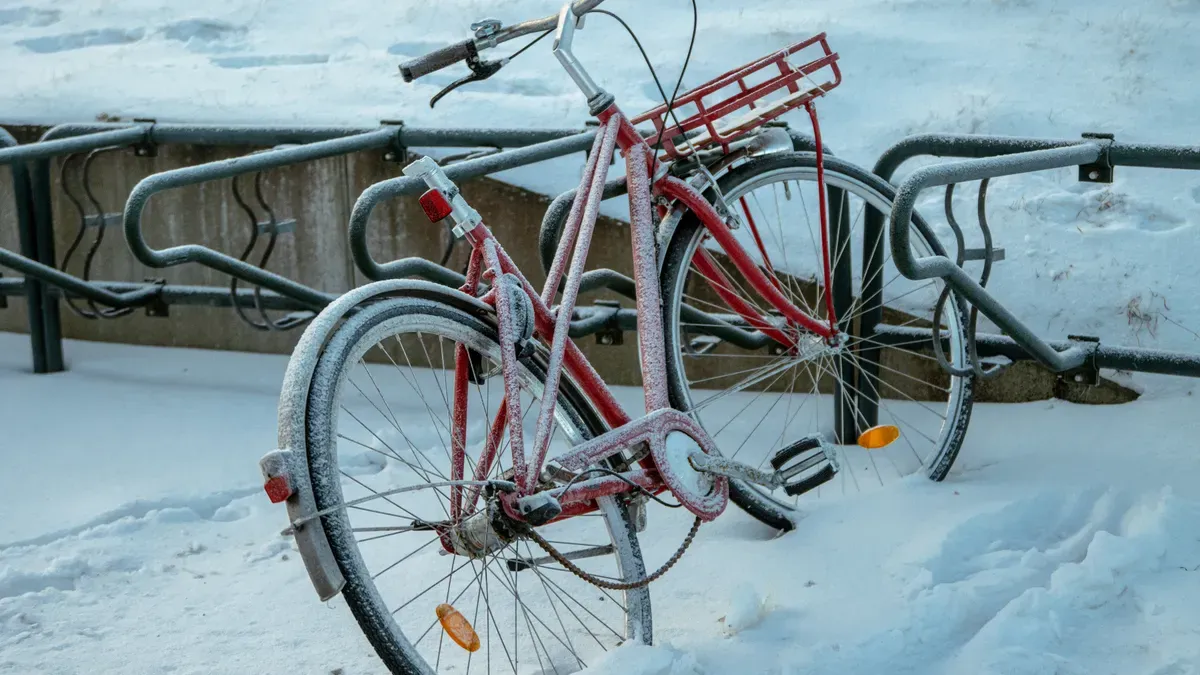
Do you ride your e-bike less often in winter or are you taking a longer break? Proper storage reliably protects the battery from aging and damage during this time.
The ideal charge level for long periods of non-use
A charge level between 30 and 60 percent is most effective for preserving the battery during months of storage. At this half-full state, you avoid extreme charge levels. Very high or very low values significantly accelerate the chemical aging of the cells.
Modern lithium-ion batteries for e-bikes exhibit extremely low self-discharge during storage. The monthly discharge rate is only 1 to 2 percent. The medium charge level perfectly buffers this natural self-discharge. The battery's emergency reserves remain untouched even during long periods of dormancy. This prevents harmful deep discharge and maximizes the lifespan of your energy storage unit.
💡 Note: Never store the battery completely empty or fully charged. Both states create unnecessary stress on the cells.
Requirements for the perfect storage location
Your choice of storage location significantly impacts the health of your battery. An unsuitable room accelerates wear or permanently damages the electronics.
When choosing a storage location, pay attention to the following characteristics:
Moisture conditions: Choose a dry and, if possible, well-ventilated room.
Temperature conditions: Keep the storage temperature constant between 10 °C and 20 °C.
Minimum temperature: Avoid values below 7 °C to ensure lasting protection against capacity loss and performance degradation.
Safety distance: Place the battery far away from flammable materials.
A cool basement room or a heated storage room is excellent for winterization. Unheated garages or damp garden sheds, however, can cause massive damage to the battery.
Regular check of the charge level
Long periods of dormancy require your occasional attention. Therefore, check the charge level of the stored e-bike battery at regular intervals.
Ideally, perform this check every two to three months. Also, observe the specific instructions from your manufacturer. Does the LED display show less than 30 percent capacity? In that case, give the battery a quick charge. Simply return the charge level to the optimal range of 30 to 60 percent. With this simple routine, you ensure full performance for the next e-bike season.
Battery-friendly E-bike Riding Habits
Your personal riding style directly affects the battery's range. With clever habits, you can noticeably preserve the battery on every tour.
Predictive starting and relieving the motor
Shift into a lower gear before every stop. Starting in a high gear consumes an extreme amount of energy. The motor requires maximum power from the battery cells at this moment. You can effectively relieve the entire system by shifting gears in anticipation.
Manually reduce motor assistance when stopping at red lights. This prevents high power spikes when rolling off again. Not only will you have a more relaxed ride, but you also protect the mechanical components.
The importance of optimal cadence
The correct pedal cadence protects your energy storage unit from rapid discharge. An electric motor works much more efficiently at faster pedaling speeds than at slow crank movements.
💡 The ideal rhythm: For optimal battery range, it is best to use a cadence of 60 to 80 revolutions per minute. A range of about 70 to 90 revolutions per minute also keeps power consumption very low and preserves the cells.
Pedaling too slowly under high load puts heavy strain on the drive. Therefore, shift down to an easier gear in a timely manner on inclines.
Efficient use of support levels
Always select the motor assistance level according to the terrain:
Support Level |
Ideal Range of Use |
Effect on Battery |
|---|---|---|
Eco Mode |
Flat routes and constant flow |
Minimal power consumption |
Tour Mode |
Light inclines and headwinds |
Balanced energy demand |
Turbo Mode |
Very steep climbs |
High power consumption |
You save valuable energy by purposefully reducing the support level on flat roads. An e-bike rewards your own muscle power with significantly longer ranges in everyday life.
Cleaning and physical maintenance
Physical maintenance protects your bike from bad weather and dirt. Clean the sensitive parts regularly to ensure a long service life.
Safe cleaning of the housing and slot
Remove the battery from the mount before every cleaning. Wipe the plastic housing only with a slightly damp cloth. The battery slot requires special attention. Dry the slot thoroughly with a soft rag. Carefully remove loose dust particles with a small brush. Aggressive cleaners permanently damage the seals. Therefore, use only simple water with a little dish soap.
Care of the contacts and protection against corrosion
Clean contact points ensure power transmission. Over time, moisture creates rust on the metallic connectors. You can effectively prevent damage with special care products.
Product |
Properties & Protective Effect |
Benefit for the Battery |
|---|---|---|
ATLANTIC Battery Terminal Spray |
Specialized spray forms a protective layer. It keeps moisture out and protects against oxidation. |
Optimizes energy flow and extends service life. |
Hanseline Terminal Grease |
Acid-protection grease made from refined hydrocarbons protects contacts and screws. |
Prevents corrosion and ensures maximum conductivity. |
Apply these agents sparingly to the metallic interfaces. This keeps conductivity preserved long-term.
Dangers from pressure washers and moisture
Completely avoid the use of high-pressure washers when cleaning. The hard jet of water forces liquid past the rubber seals and directly into the housing. Short circuits and destroyed circuit boards are the direct consequence.
⚠️ Attention: Never use a garden hose with high pressure. A gentle stream of water or a damp sponge is perfectly sufficient for safe cleaning.
After cleaning with moisture, let the e-bike dry completely in a shaded area. Do not reinsert the battery until all contacts are completely dry.
Safety, inspection, and defects
Batteries age naturally over time. You can recognize wear and defects early on by clear signs.
Warning signs of cell aging and defects
Your battery shows signs of aging through changed everyday behavior. Watch for the following warning signals:
The e-bike switches off suddenly on inclines.
The charger interrupts the charging process unexpectedly.
The energy storage unit heats up unusually during charging.
Do you notice these symptoms regularly? Then the battery cells have lost a large part of their capacity.
Correct behavior in case of falls and housing damage
After a fall, the housing often looks undamaged. However, dangerous damage can still occur inside. Mechanical forces easily damage the thin insulation layer between the poles.
⚠️ Attention: A fall can trigger a creeping internal short circuit. The battery heats up steadily. In the worst case, there is a risk of delayed fire hazard for many hours after the accident.
Do not continue to use a battery that has been dropped. Temporarily store the unit in a safe place outdoors. Take the battery to an expert immediately.
Advantage of software updates and specialist dealer checks
Regular service at a specialist dealer increases your safety. The expert will professionally read out the battery's error log. They check the exact cell voltage and detect creeping defects early.
Modern software updates also optimize the battery management system. The updates improve the control of the charging plugs and protect the cells while riding. An annual system check sustainably extends the service life of your energy storage unit.
FAQ
How long does an e-bike battery last on average?
A high-quality e-bike battery usually lasts three to five years. This corresponds to approximately 500 to 1,000 full charge cycles. Proper care and the appropriate charging window significantly extend this service life.
Should you charge the e-bike battery after every ride?
💡 Do not charge the battery to 100 percent immediately after every short ride.
It is best to keep the charge level between 20 and 80 percent in everyday use. Avoid constant full charges for maximum durability.
Can you leave the battery on the e-bike in winter?
Remove the battery if there is frost. Cold increases the internal resistance of the cells and reduces range. Store the energy storage unit at room temperature in a dry room during winter.
Are you allowed to use a universal charger?
Use only the original charger from the manufacturer. Replacement devices often provide incorrect charging voltages. You risk serious defects to the battery management system or dangerous overheating by doing so.