
You will find the perfect e-gravel bike by analyzing your personal goals and needs. Consider whether you are looking for adventure tours, daily commuting, or athletic challenges. Pay attention to the following features:
Powerful mid-mounted motors offer you reliable support.
A lightweight frame and wide, puncture-resistant tires increase comfort and safety.
With these tips, you will make a decision that fits your riding style and everyday life.
Key Takeaways
Analyze your goals and needs to find the right e-gravel bike for commuting, adventure, or athletic challenges.
Look for key features such as motor power, battery capacity, and frame material to maximize comfort and performance.
Test various models and settings to find out which geometry and components best suit your riding style.
Plan your routes while considering battery range and choose a bike with tires suitable for your preferred terrain.
Utilize the advice of specialist dealers and take a test ride to ensure the bike fits you well.
Area of Use
The choice of your e-gravel bike depends heavily on the intended area of use. You should first consider how and where you want to use the bike. Different usage scenarios place different demands on the bike. The following table shows you how the areas of use differ:
Area of Use |
E-Gravel Bikes |
Classic Gravel Bikes |
|---|---|---|
Daily commute |
Electric support for relaxed riding |
Lightweight, authentic riding feel |
Longer weekend tours |
More power and support |
Sporty, less suitable for long distances |
Multi-day bikepacking adventures |
Compensates for luggage weight, also for beginners |
For athletic challenges |
Mountainous regions |
Support makes riding easier |
Benefits less pronounced |
Flatter areas |
Electric benefits less noticeable |
Direct riding feel and low weight |
Riding Style
Your riding style influences the selection of the right model. Consider whether you prefer a leisurely ride or are looking for athletic challenges. Different components adapt to your style:
Frame geometry: A longer wheelbase ensures stability on uneven terrain.
Suspension systems: A suspension fork increases comfort and reduces vibrations.
Tire width: Wider tires offer more grip on gravel, narrower ones are faster on asphalt.
Disc brakes: They give you more control and safety.
Drivetrain: A wide gear range helps you adapt to different conditions.
Tip: Test different settings to find out what you enjoy the most.
Terrain
The terrain you want to ride on plays a major role. E-gravel bikes are suitable for many surfaces. The following table shows you the most important types of terrain:
Terrain Type |
Description |
|---|---|
Asphalt |
Ideal for fast rides and commuting. |
Gravel |
Stability and comfort on unpaved paths. |
Light trail terrain |
Off-road adventures possible. |
With an e-gravel bike, you can undertake long tours in low mountain ranges, commute in a relaxed manner, or simply cover more distance. Think about which routes you use most often and choose the suitable model.
E-Gravel Bike: Frame & Geometry
Frame Material
You are faced with the choice of the right frame material for your e-gravel bike. Each material offers its own advantages and disadvantages. The following table helps you identify the differences:
Frame Material |
Advantages |
Disadvantages |
|---|---|---|
Aluminum |
Lightweight, robust, affordable |
Less comfortable than steel |
Carbon |
Very light, high stiffness, good vibration damping |
More expensive, less robust than steel |
Steel |
Robust, durable, high ride comfort |
Heavier, more expensive than aluminum |
Steel frames are known for their durability and strength. Compared to aluminum frames, they are less prone to fatigue fractures and deformation. Steel absorbs vibrations better than aluminum and titanium, leading to a smoother riding experience.
You should consider whether weight, comfort, or price is most important to you. Aluminum is suitable for beginners and commuters. Carbon offers you a sporty riding feel and low weight. Steel ensures a smooth and comfortable riding experience, especially on long tours.
Tire Clearance
Tire clearance determines how wide the tires of your e-gravel bike can be. Wide tires increase comfort and off-road capability. You will find various options on current models:
Tire widths of 35-40 mm are suitable for fast rides on gravel roads.
Wider tires (40-50 mm) offer more comfort and grip in demanding terrain.
You can ride safely on unpaved paths with wide tires. Narrow tires roll faster on asphalt. The right tire clearance gives you flexibility for different surfaces.
Sporty Geometry
The frame geometry influences how you sit on your e-gravel bike and how the bike handles. Sporty geometries offer you advantages if you value speed and performance. The following table shows you the most important points:
Advantage |
Description |
|---|---|
Efficiency |
Sporty geometries allow for a more aggressive seating position, which increases speed. |
Sporty performance |
Offers better acceleration, ideal for fast gravel roads and race courses. |
Electric motor support |
Combines the benefits of sporty geometry with the support of an electric motor. |
You benefit from a sporty geometry if you like riding fast and dynamically. Comfort-oriented geometries are better suited for relaxed tours. The choice depends on your riding style.
The frame-fork set plays a central role in grip and comfort. The fork influences handling and safety. A suitable geometry ensures balanced riding behavior. You should ensure that the frame and fork are compatible. Flexible components such as flexible seat posts increase comfort but only change the handling slightly.
E-Gravel Bike: Motor & Battery
Motor Power
The motor power determines how much support you get while riding. You will find various motor types for e-gravel bikes. Each motor has its own strengths. The following table shows you the most important models and their properties:
Motor Type |
Power (Watts) |
Torque (Newton-meters) |
Special Features |
|---|---|---|---|
Mahle X20 |
250 |
23 |
Small, light, three support levels, battery usually 242 Wh |
TQ HPR 60 |
350 |
60 |
Small, light, powerful, quiet, 320 Wh battery |
Specialized SL 1.2 |
320 |
50 |
Harmonious riding feel, low noise development, 320 Wh battery |
Bosch Performance Line SX |
600 |
55 |
High power, 400 Wh battery, audible riding noise, higher weight (at least 13 kg) |
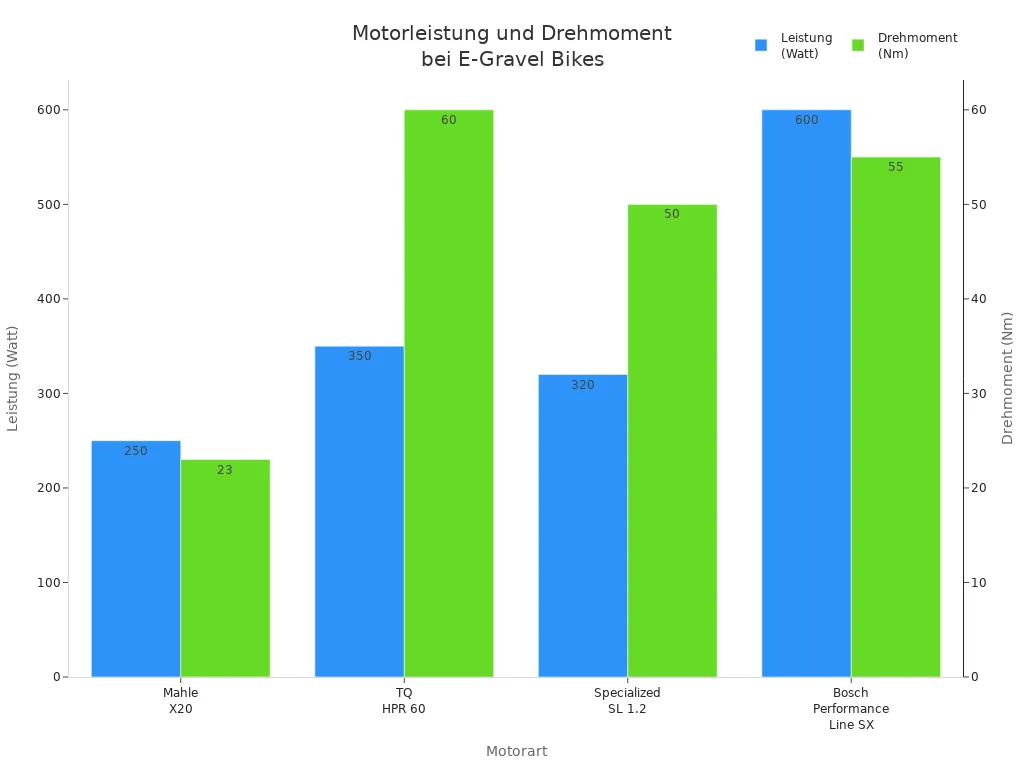
You should pay attention to the wattage. A motor with 250 to 600 watts offers you enough power for tours, commuting, or sporty rides. Lightweight motors like the Mahle X20 are suitable for riders seeking a natural riding feel. Stronger motors like the Bosch Performance Line SX help you particularly in mountainous terrain.
Tip: A mid-mounted motor ensures optimal weight distribution and a natural riding feel. This way, your e-gravel bike remains stable even on demanding routes.
Torque
The torque shows you how much power the motor provides when starting and on hills. For versatile applications, a torque between 65 and 75 Nm is recommended. This allows you to master steep climbs and heavy loads during bikepacking. The following table gives you an overview of different models and their torque:
Model |
Max. Torque |
|---|---|
Simplon Inissio PMax |
55 Nm |
Giant SyncDrive Pro |
85 Nm |
Giant SyncDrive Sport |
70 Nm |
Specialized 1.2 / 1.2S |
85 Nm |
Specialized 1.3 |
90 Nm |
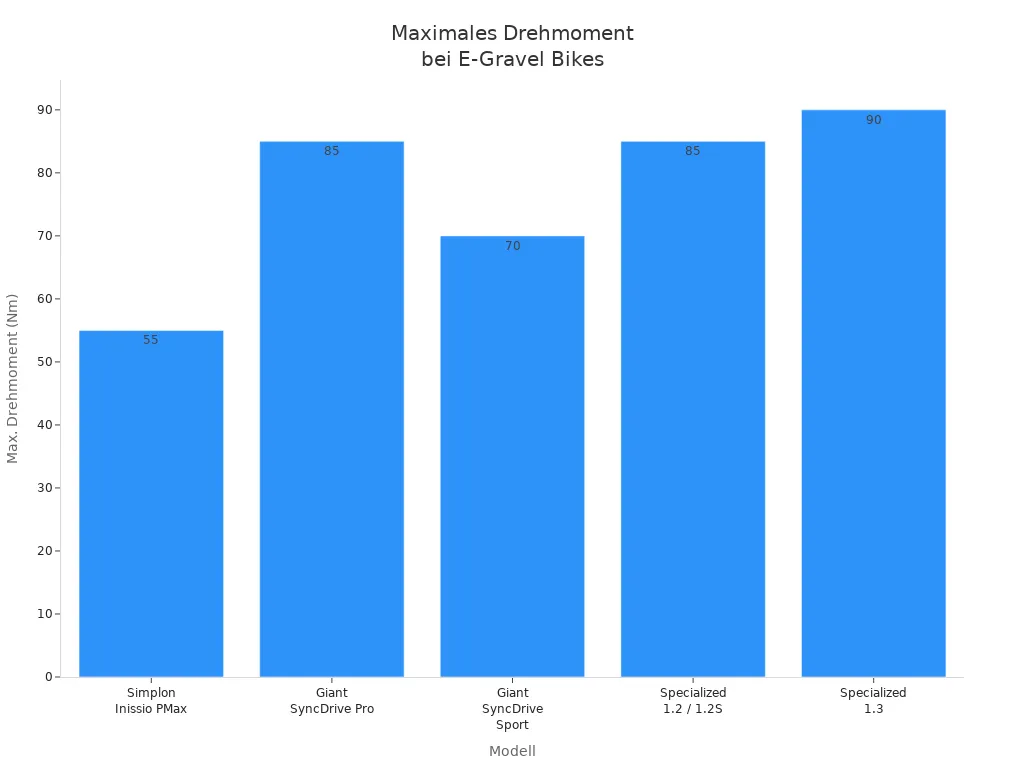
With high torque, you can start more easily on climbs. Especially in terrain or with a lot of luggage, you benefit from more power. A value of 60 Nm or more is sufficient for most tours. For athletic riders and heavy loads, a motor with 70 Nm or more is recommended.
Battery Integration
The integration of the battery influences the design and handling of your e-gravel bike. Many manufacturers focus on a battery inconspicuously installed in the frame. This ensures a sleek look and a harmonious riding feel. You can recognize high-quality models by seamless integration that optimally distributes the total weight.
Feature |
Advantage |
|---|---|
Integrated Battery |
Slim frame design, barely visible, protects against dirt and water |
Mid-drive motor |
Optimal balance, natural ride feel, center of gravity in the middle of the bike |
Torque 40-85 Nm |
Good climbing properties, versatile in use |
The range depends on the battery capacity, the assist level, the terrain, and your weight. In practical tests, current models usually achieve between 50 and 120 kilometers. The following table shows you some examples:
Model |
Range (km) |
Notes |
|---|---|---|
Stevens E-Getaway |
12 |
Insufficient assist power for R200 range measurement. |
Look |
N/A |
No result due to insufficient assist power. |
Canyon |
60 |
Best endurance in the test, decent value. |
General |
50 - 120 |
Depends on battery capacity, assist level, terrain, rider weight, and riding conditions. |
Note: Plan your tours so that you do not exceed the battery range. A spare battery or a charger in your luggage gives you extra peace of mind.
With a modern e-gravel bike, you enjoy a successful combination of performance, range, and design. The right choice of motor and battery makes your riding experience comfortable and flexible.
Gears & Drivetrain
Electronic vs. mechanical
You are faced with the choice between electronic and mechanical shifting. Both systems offer you different advantages and disadvantages. The following table helps you to recognize the most important differences:
Type of gear system |
Advantages |
Disadvantages |
|---|---|---|
Mechanical shifting |
Simple and cost-effective, easy to maintain, robust design |
Susceptible to wear, less precise shifting, limited gear range |
Electronic shifting |
Precise shifting, easy operation, low maintenance, no adjustment needed |
Dependence on battery and motor, higher purchase costs, conditionally water-resistant |
An electronic shifting system sends an electrical signal to the rear derailleur. A small motor then changes the gear. You do not need to readjust any cables. Mechanical shifting uses a Bowden cable. You feel directly how the gear changes. Mechanical systems are cheaper and easy to repair. Electronic shifting offers you more comfort and precision, especially on long tours.
Tip: Consider whether you value simple maintenance or modern technology. Electronic shifting is ideal for riders who prioritize comfort and fast gear changes.
Chain or belt drive
For the drivetrain, you have the choice between a chain and a belt. Both systems influence maintenance, durability, and ride feel. The following table shows you the most important differences:
Feature |
Belt drive |
Chain drive |
|---|---|---|
Maintenance |
Very low maintenance, no oil needed |
Regular lubrication & cleaning |
Durability |
15,000 – 30,000 km |
3,000 – 8,000 km depending on maintenance |
Noise level |
Virtually silent |
Depends on condition, often audible |
Weight |
Slightly lighter |
Slightly heavier |
Price |
Higher initial cost |
Cheaper |
Gear type |
Compatible only with hub gears |
Possible with derailleur and hub gears |
Off-road suitability |
Limited |
Very good for sporty terrain |
-
Advantages of the belt drive:
You don't need to do an oil change.
The belt lasts a long time and stays clean.
Riding is almost silent.
-
Disadvantages of the belt drive:
You can only use it with hub gears.
The purchase costs more.
-
Advantages of the chain drive:
You get a large selection of gear ratios.
The purchase is cheaper.
-
Disadvantages of the chain drive:
You must lubricate and clean it regularly.
The chain is susceptible to rust and wear.
If you often use your e-gravel bike off-road, the chain drive offers you more flexibility. For commuters and tourers, the belt drive is a clean and low-maintenance solution.
Brakes & Tires
Disc brakes
Disc brakes are particularly important for your e-gravel bike. You get more safety and control when traveling at high speeds. The additional weight of an e-bike requires strong braking performance. You can rely on disc brakes because they work reliably even in wet and dirty conditions.
Disc brakes react quickly and precisely.
They give you the ability to reduce speed in a controlled manner.
You benefit from more safety, especially on steep descents.
Braking force remains constant even on long tours.
Tip: Check the brake pads and the function of the brakes regularly. This keeps your bike safe.
Tire tread
The right tire tread determines how well you travel on different surfaces. You should choose a tread that suits your routes. Tires with a low or fine tread are suitable for asphalt and fine gravel. You can also use semi-slicks if you often ride on mixed terrain. For deep and soft ground, you need a coarser tread.
Fine tread: Good for asphalt and firm paths.
Semi-slicks: Versatile on mixed routes.
Coarse tread: Better for muddy or sandy ground.
You can ride safely and comfortably with the right tread. The choice depends on where you ride most.
Wheel size
The wheel size influences the handling of your e-gravel bike. You usually find two sizes: 700C and 650B. Each size has its own advantages.
700C wheels offer you less rolling resistance. You ride faster on smooth asphalt.
650B wheels allow wider tires with lower pressure. You get more comfort and better traction off-road.
Wheel size |
Advantages |
Recommended tire width |
|---|---|---|
700C |
Fast, efficient on asphalt |
|
650B |
Comfortable, lots of grip off-road |
Wider tires possible |
You can choose 650B if your frame offers little tire clearance. With 700C, you have the advantage on fast routes. Decide on the size that fits your riding style.
Comfort & Ergonomics
Handlebar shape
You will feel the difference immediately when you choose the right handlebar for your e-gravel bike. The shape influences how comfortably you sit and how safely you steer the bike. Different handlebar shapes offer you advantages for long rides and demanding terrain.
Aspect |
Description |
|---|---|
Flare |
The flare increases the handlebar leverage and improves bike control in the drops. |
Drop |
A shallow drop promotes bike control and allows for a better all-around view. |
Reach |
A shorter reach ensures a more comfortable hand/seating position, which increases riding comfort. |
Backsweep |
The backward bend of the handlebar is perceived as more comfortable and shortens the reach. |
Material |
Carbon handlebars absorb vibrations better, which reduces fatigue. |
Bar tape |
Thicker bar tape absorbs shocks and increases comfort on uneven paths. |
You enjoy a more pleasant grip and relieve your wrists.
Control on rough paths improves significantly.
Tip: Choose a handlebar with flare and thick bar tape if you often ride on gravel.
Saddle
The saddle determines how long you can ride comfortably. For e-gravel bikes, experts recommend special saddle types that support your seating position and increase comfort.
Saddle type |
Advantages for e-gravel bikes |
|---|---|
E-bike-specific |
Improves ergonomics when cycling, especially on steep ramps. |
MTB saddle |
Provides support on extreme climbs that are difficult to master with a normal bike. |
You benefit from an e-bike saddle when you ride uphill often. An MTB saddle helps you on long tours off-road. Both saddle types relieve your back and ensure a pleasant ride.
Note: Try out different saddle models to find the best fit for you.
Suspension
Suspension makes your e-gravel bike more comfortable. It protects you from shocks and vibrations, especially on uneven paths. There are various systems that improve riding comfort.
Suspension system |
Description |
Effects on riding comfort |
|---|---|---|
Suspension fork |
Improves the ratio of unsprung to sprung mass significantly. |
Effective for shock absorption, especially on rough terrain. |
Suspension stem |
Lightweight, easy to install, affordable price. |
Lower efficiency compared to a suspension fork, but still advantageous. |
Cannondale Kingpin |
Flexible seat tube that absorbs and transfers forces. |
Increases comfort through effective power transmission. |
Specialized Future Shock |
Suspension in the head tube that does not change the geometry. |
Optimized for road bike and gravel bike purposes. |
BMC Micro Travel Technology |
Damping system that reduces vibrations. |
Reduces annoying vibrations, improves riding comfort. |
You feel fewer jolts and can ride relaxed for longer. The choice of suspension system depends on how often you ride off-road and how much comfort you want.
Equipment & Accessories
Lighting
You benefit from good lighting when you are out and about in everyday life and on tours. Modern e-gravel bikes power their headlights and taillights directly from the battery. This increases visibility and simplifies handling. You can rely on the fact that the battery has enough reserves for at least two hours of light operation. Many models offer different lighting systems with different brightness levels and functions.
Model |
High beam function |
Light distribution |
|
|---|---|---|---|
Cube |
270 |
No |
Under-illumination left/right |
Supernova |
416 |
Yes |
Uniform illumination |
Lupine SLX |
691 |
Yes |
Very uniform light |
Lezyne |
691 |
No |
Inhomogeneous light pattern |
Supernova M99 |
1244 |
Yes |
Good width and height illumination |
Busch & Müller |
N/A |
Yes |
N/A |
Cheapest lamp |
691 |
No |
N/A |
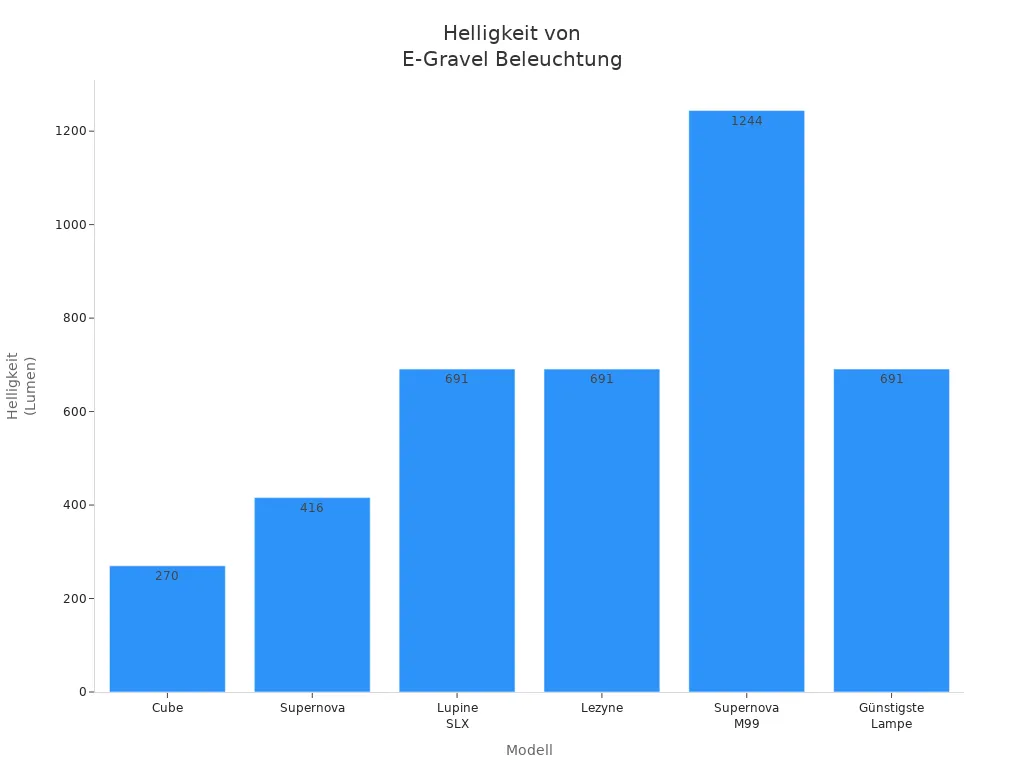
Tip: Choose a model with a high beam function if you often ride in the dark. This keeps you visible from early until late.
Mudguards
Mudguards protect you from splash water and dirt. They are particularly useful for staying dry in the city or during bad weather. Many e-gravel bikes have mudguard eyelets, which allow for easy assembly. You can choose mountable mudguards if you need additional protection. Pannier rack eyelets increase the versatility of your bike.
Mudguard option |
Advantages |
|---|---|
Mountable mudguards |
Additional protection in rain and mud |
Pannier rack eyelets |
Allow the mounting of pannier racks for more functionality |
The Domane+ AL 5 offers you mudguard eyelets for quick assembly.
You stay dry even in the rain.
The option to mount pannier racks makes your bike suitable for everyday use.
Bikepacking
You can equip your e-gravel bike for multi-day adventures. Bikepacking bags are suitable for longer tours and offer plenty of storage space. Seat packs are aerodynamic and can hold larger gear. Fork bags carry heavy equipment but have less impact on aerodynamics. Canyon bikes offer special loading adapters for the RIFT gravel suspension fork.
Bikepacking bags help you transport everything important.
Seat packs are ideal for a tent, sleeping bag, or clothing.
Fork bags are suitable for tools or provisions.
Note: Those who combine everything get a sporty everyday gravel bike suitable for various conditions.
Price-Performance & Budget
The choice of your e-gravel bike depends heavily on the relationship between price and performance. You want to ensure that you get the best quality for your money. Many models differ not only in price but also in equipment and comfort. A close look at the most important quality features helps you recognize a good deal.
Quality features
When buying, pay attention to these decisive features. They determine how much you will enjoy your bike and how long it will last:
Quality feature |
Description |
|---|---|
Frame |
Light and robust. Materials like carbon, aluminum, or steel offer different advantages. |
Geometry |
Influences handling. You choose between agile or stable geometry, depending on your intended use. |
Gears and brakes |
Precise shifting and effective brakes ensure safety and riding enjoyment. |
Comfort |
Good suspension, a comfortable seating position, appropriate tire width, handlebars, and saddle increase comfort. |
Tip: A high-quality frame and reliable brakes pay off in the long run. Don't skimp on the wrong places if you ride regularly.
Cost comparison
Prices for e-gravel bikes vary greatly. Equipment and brand play a major role. You can find inexpensive models, but also very expensive versions with special features. The price range for sporty pedelecs starts at about 50 percent higher than for classic bicycles.
The most expensive bike in the test costs €10,999.
The cheapest model costs only one-fifth of that.
Consider whether the extra cost is worth it for you.
A comparison of different models shows you the differences:
Model |
Price (Euro) |
Features |
|---|---|---|
Centurion |
3,799 |
Aluminum frame, 400 Wh battery, high system weights, comfortable seating position |
Bulls |
4,199 |
Bosch SX lightweight motor, upgradable equipment, high power reserves |
Other models |
13,000 |
Different orientations, from comfort to sportiness, varying strengths |
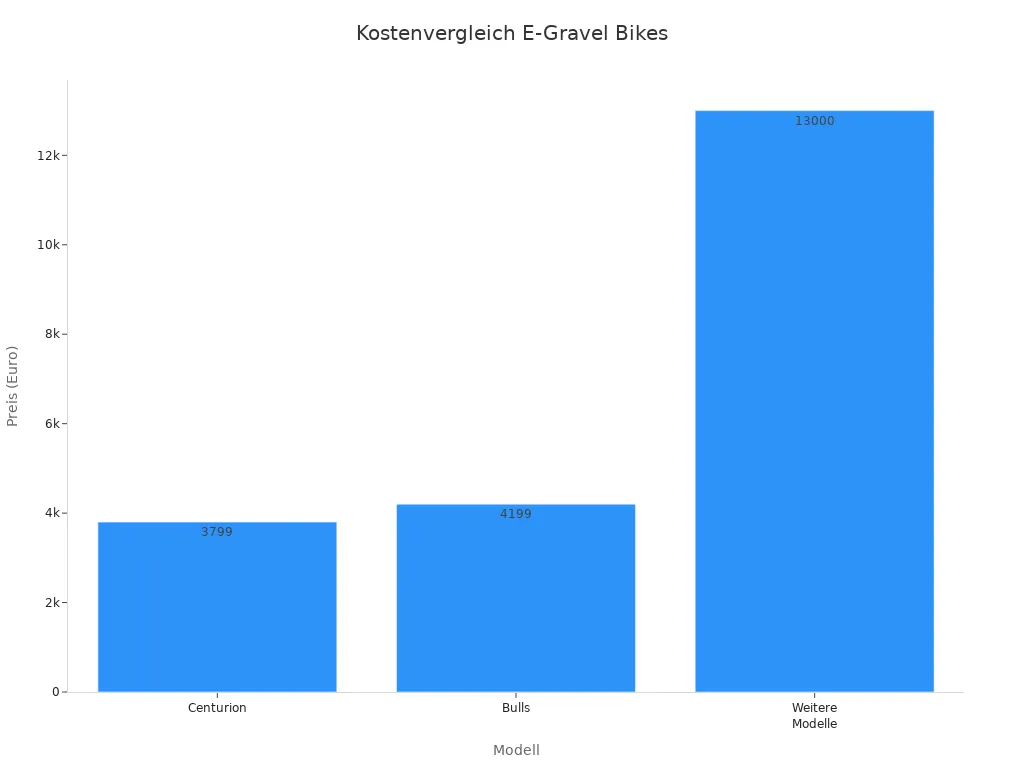
You shouldn't just look at the price. Check which equipment you really need. A cheaper bike can be enough for getting started. High-end models offer you more comfort and technology but cost significantly more. This way, you will find the best price-performance ratio for your requirements.
Test Ride & Testing
Test criteria
You should definitely take a test ride before buying. This way, you can find out if the e-gravel bike really suits you. During your test ride, pay attention to the most important criteria:
Seating position: You usually sit more upright on a gravel bike. This gives you more comfort, especially on long tours. Check if you can ride in a relaxed manner without pressure on your hands or back.
Head tube angle and wheelbase: A slacker head tube angle and a longer wheelbase ensure stability. You will feel safe and secure, even at higher speeds or on uneven surfaces.
Brakes: Test the braking power. A fully loaded bikepacking bike needs strong and reliable brakes. Disc brakes are standard and work reliably even in rain or mud.
Gears: Manufacturers like Shimano and Sram offer special gravel groupsets. Try out different gear ratios, for example 2x11 or 1x drivetrains. You should be able to shift gears easily.
Tip: Ride the bike on different surfaces. This way you will notice how it behaves on asphalt, gravel, and light trails.
Criterion |
What to look for? |
|---|---|
Seating position |
|
Brakes |
Reliability, braking power |
Gears |
Easy operation, suitable gears |
Handling |
Stability, safety |
Dealer advice
You benefit from good advice from a dealer. An experienced dealer knows the differences between the models. They show you how to set up the bike correctly. You can ask questions and get tips on care and maintenance.
Many dealers offer test rides directly on-site. They help you find the right frame size. You will receive information on accessories such as mudguards, lighting, or bikepacking bags.
Note: Make an appointment for a detailed consultation. This gives you enough time to test different models and get to know all the functions.
A personal conversation with the dealer gives you security. You make a better decision and find the perfect e-gravel bike for your needs.
Maintenance & Ongoing Costs
Service intervals
You should maintain your e-gravel bike regularly. Most manufacturers recommend an inspection once a year. With intensive use, a check every six months is worthwhile. Maintenance includes checking the brakes, gears, and motor. You will detect wear early and avoid expensive repairs.
An annual inspection costs up to 130 euros. Cleaning plays an important role. A special e-bike cleaner costs between 10 and 20 euros. You can get a good brush set from 10 euros. You can also clean your bike at a car wash. A wash costs about 5 to 10 euros.
Tip: Clean your bike after every ride off-road. This keeps the technology reliable and extends the lifespan.
Electricity costs for charging the battery are low. A full charge of a 400 to 500 Wh battery costs about 13 to 15 cents. With frequent charging, the costs add up but remain manageable.
Cost overview per year:
Cleaning: approx. 30–60 euros
Inspection: up to 130 euros
Electricity: approx. 20–30 euros
Spare parts
You should replace spare parts in time. Wear parts such as brake pads, chains, and tires wear out quickly. Prices vary depending on quality and manufacturer. Brake pads usually cost 15 to 30 euros per set. You can get a new chain from 25 euros. Tires cost between 30 and 60 euros each.
Spare part |
Average price (Euro) |
|---|---|
Brake pads |
15 – 30 |
Chain |
25 – 50 |
Tires |
30 – 60 |
You save money if you do small repairs yourself. For complex work, it is recommended to visit a specialist workshop. This keeps your e-gravel bike safe and reliable.
You will find the perfect e-gravel bike if you follow these steps:
Determine your area of use and riding style.
Choose the frame, motor, and battery that match your requirements.
Pay attention to comfort, equipment, and your budget.
Test different models and get expert advice.
Start your search now! With these tips, you will make a safe and suitable choice for your next adventure. 🚴♂️
FAQ
How do you best maintain your e-gravel bike?
You should clean your bike regularly with water and a mild detergent. Check the chain, brakes, and tires after every ride. Have an inspection carried out by a specialist dealer once a year.
Tip: A clean bike lasts longer and is safer to ride.
How far can you go on one battery charge?
The range depends on the terrain, riding style, and battery capacity. You can usually manage between 50 and 120 kilometers. You can increase the range if you ride in Eco mode and carry little weight.
Battery capacity |
Range (km) |
|---|---|
250 Wh |
50 – 70 |
400 Wh |
80 – 120 |
Which tires are suitable for gravel and asphalt?
Choose tires with a width of 40 to 50 mm for gravel. For asphalt, narrower tires with a fine tread are suitable. You can use hybrid tires if you often ride on mixed routes.
Gravel: Wide, coarse tread
Asphalt: Narrow, smooth tread
Do you need special insurance for your e-gravel bike?
You should secure your e-gravel bike with bicycle insurance. The insurance protects you against theft and damage. Check if your household insurance covers the bike. Special e-bike insurance often offers more services.
Note: A high-quality bike deserves good protection.