
Model |
Type |
Price (€) |
Rating (1-5) |
|---|---|---|---|
Himiway D7 Cobra |
E-Fatbike |
2,399 |
4.8 |
Mokwheel Obsidian |
E-Fatbike |
2,199 |
4.7 |
Himiway D3 Cruiser Step-Thru |
E-Fatbike |
1,999 |
4.6 |
Cyrusher Rover |
E-Fatbike |
2,299 |
4.6 |
Vakole Y20 Pro |
E-Fatbike |
1,199 |
4.5 |
RadRhino 6 Plus |
E-Fatbike |
1,899 |
4.5 |
Moma FAT PRO 20 |
Fatbike |
999 |
4.4 |
KTM Fat Bike |
Fatbike |
1,499 |
4.4 |
Kalkhoff Fat Bike |
E-Fatbike |
2,099 |
4.3 |
E-Fatbike |
1,349 |
4.3 |
In this list, you will find models that stand out due to innovation, powerful motors, high-quality batteries, and modern sensors. Top manufacturers are investing in high-performance technology and ensuring good value for money. When purchasing, factors such as the battery, motor, gearing, weight, and comfort play a major role. Prices for a fat bike in 2025 often start at €899 and increase depending on the equipment. You will receive all the essential information here to help you find the right model for you.
Key Findings
Fat bikes in 2025 offer powerful motors, wide tires, and modern technology for increased comfort and safety.
E-fatbikes provide pedal assistance, especially on long distances and challenging terrain, though they are heavier than traditional fat bikes.
Important purchasing criteria include motor power, battery capacity, gearing, brakes, and the intended use of the bike.
Foldable fat bikes are practical for transport and storage, though they are usually better suited for longer tours than for daily use.
Be aware of road-legal regulations in Germany: motor power up to 250 watts, assistance up to 25 km/h, and appropriate equipment are mandatory.
Top 10 Fat Bikes 2025
Overview
In 2025, you will find a large selection of fat bikes designed for various purposes. The top 10 models offer you modern technology, powerful motors, and long ranges. Many manufacturers focus on innovative features such as foldable frames, high-performance batteries, and wide tires for maximum comfort. The following table shows which models particularly impressed in independent tests:
Model |
Special Feature |
Motor Power |
Range |
Area of Use |
|---|---|---|---|---|
Engwe EP-2 Boost |
Foldable, Power-Boost, 20x4.0 inch tires |
250 Watts, 55 Nm |
City, Off-road, Long-distance |
|
Himiway Cruiser/Zebra |
Long-distance fat tire e-bike, large batteries |
Not specified |
Extremely high |
Long-distance, Leisure |
Rad Power Bikes RadRhino |
Robust, simple, durable |
Not specified |
Not specified |
Daily use, Beginners |
Cube Nutrail Hybrid |
Performance-oriented, Bosch/Shimano parts |
Not specified |
Not specified |
Sport, difficult terrain |
ADO A Dece Oasis |
Versatile, foldable, good value for money |
Not specified |
Not specified |
City, light terrain |
Selection Criteria
When selecting a fat bike, you should pay attention to several important points. Motor power determines how powerfully your bike performs. A strong battery ensures a long range, allowing you to enjoy long tours. Gearing and brakes influence the ride feel and safety. Wide tires provide good grip on any surface. Many models offer extras like a suspension fork or a foldable frame. Consider whether you intend to use the bike more in the city, off-road, or on long distances. This will help you find the model that best suits your needs.
Models in Detail
Himiway D7 Cobra
The Himiway D7 Cobra is one of the most powerful e-fatbikes of 2025. You benefit from a 48V 20Ah battery, which allows for a range of up to 110 km. The 250W brushless motor delivers an impressive 86 Nm of torque. The soft-tail suspension with a rear air shock and the 26" x 4.8" tires ensure maximum comfort, even on rough terrain.
Feature |
Value / Specialty |
|---|---|
Battery |
48V 20Ah, 960 Wh, up to 110 km range |
Motor |
250W, 86 Nm, brushless, geared hub motor |
Suspension |
Soft-tail system, air suspension fork (80 mm), air shock |
Tires |
26" x 4.8" Kenda fat tires |
Brakes |
Hydraulic disc brakes from Tektro |
Gearing |
Shimano 7-speed Altus |
Weight |
approx. 40 kg |
Payload |
max. 180 kg |
Price |
approx. 2,399 € |
Rating |
Pros:
Very wide tires provide strong grip and comfort.
Powerful motor for rapid acceleration.
Hydraulic disc brakes ensure safety.
Large battery for long tours.
High payload capacity, robust construction.
Cons:
Only 7-speed gearing, not optimal for steep mountains.
Mudguards and height-adjustable stem are not included in the delivery.
Less agile than narrower bikes.
Without mudguards, you will get wet quickly in mud.
Tip: The Himiway D7 Cobra is particularly suitable for off-road fans who value comfort and range.
Mokwheel Obsidian
The Mokwheel Obsidian impresses with a powerful motor and high-quality suspension. You get up to 1300 W peak power and 105 Nm of torque. The adjustable suspension fork (130 mm) and air shock (50 mm) offer you plenty of comfort on any surface.
Criterion |
Description |
|---|---|
Motor |
Up to 1300 W, 105 Nm torque |
Suspension |
130 mm suspension fork, 50 mm air shock |
Tires |
26 x 4.0 inch fat bike tires |
Brakes |
Hydraulic disc brakes from Tektro |
Battery |
941 Wh, 100-130 km range, removable |
Gearing |
Shimano 8-speed |
Weight |
High, but well-balanced |
Price |
approx. 2,199 € |
Rating |
4.7/5 |
Pros:
Very strong motor, ideal for inclines.
High-quality suspension for off-road and city.
Long range, battery easily removable.
Good value for money.
Cons:
Plastic mudguards feel cheap.
High weight, but acceptable due to good balance.
The Mokwheel Obsidian is suitable for you if you are looking for a powerful and comfortable fat bike for long distances.
Himiway D3 Cruiser Step-Thru
The Himiway D3 Cruiser Step-Thru offers you a low entry and plenty of comfort. The 750W motor (1200W peak) ensures powerful propulsion. The 15Ah battery allows for a range of up to 97 km. The 7-speed Shimano gearing and the 95 mm suspension fork make the bike versatile.
Feature |
Specification |
|---|---|
Motor |
750W base, 1200W peak, 80 Nm |
Battery |
15Ah (48V), 720Wh, Samsung/LG |
Range |
Up to 97 km |
Weight |
33 kg |
Gearing |
7-speed Shimano Altus |
Brakes |
Mechanical disc brakes, 180 mm |
Suspension fork |
95 mm, lockout |
Price |
approx. 2,064 € |
Rating |
4.6/5 |
Pros:
Powerful motor, high payload capacity (up to 160 kg).
Comfortable saddle, upright seating position.
Good display with USB port.
Step-thru frame for easy mounting.
Cons:
Cable management looks messy.
Simple gearing, not ideal for steep mountains.
The Himiway D3 Cruiser Step-Thru is suitable for you if you are looking for comfort and an easy entry.
Cyrusher Rover
The Cyrusher Rover scores points with a 250W rear motor and a 15.6Ah battery for a range of up to 100 km. The full suspension and hydraulic disc brakes ensure safety and comfort. Users praise the quality and riding comfort, but criticize the adaptation to German laws.
Technical Data:
Motor: 250W, 52V, brushless
Battery: 15.6Ah, up to 100 km
Suspension: Adjustable suspension fork front, air shock rear
Brakes: Hydraulic, 180 mm
Tires: 26" x 4.0"
Gears: Shimano 7-speed
Payload: 150 kg
Price: approx. €2,299
Rating: 4.6/5
Pros:
Very comfortable thanks to full suspension.
Good brakes and stable construction.
LCD display with USB port.
Cons:
Speed may be too high for German roads.
Accessories such as luggage racks are sometimes hard to find.
Mudguards are a bit short.
You should choose the Cyrusher Rover if you value comfort and technology and often ride off-road.
Vakole Y20 Pro
The Vakole Y20 Pro is a foldable e-fatbike with impressive features. You get a powerful motor, high battery capacity, and plenty of comfort. The range and riding enjoyment are convincing, though the weight is high.
Technical Data:
Motor: powerful, exact wattage varies
Battery: high capacity, range up to 100 km
Weight: 36.8 kg
Folded dimensions: large, therefore less suitable for commuters
Price: €1,100–€1,400
Rating: 4.5/5
Pros:
Very good equipment for the price.
High range, lots of comfort.
Foldable, ideal for traveling.
Cons:
Folded size is large, less practical for everyday use.
The Vakole Y20 Pro is suitable for you if you are looking for a versatile fat bike for longer tours.
RadRhino 6 Plus
The RadRhino 6 Plus offers you a powerful 250W rear motor and a 672 Wh battery. The wide Kenda tires and hydraulic disc brakes make the bike off-road capable and safe.
Component |
Specification / Feature |
|---|---|
Motor |
250W rear hub motor |
Battery |
48V, 672 Wh, semi-integrated |
Range |
40–72 km |
Tires |
26" x 4" Kenda fat bike tires |
Brakes |
Hydraulic, Tektro, 180 mm |
Gears |
Shimano 7-speed Altus |
Weight |
33.3 kg |
Payload |
125 kg |
Price |
approx. €1,899 |
Rating |
4.5/5 |
Pros:
Strong brakes, good range.
Affordable price for the equipment.
Cons:
High weight.
Cable routing on the handlebars is cluttered.
Customer service has room for improvement.
The RadRhino 6 Plus is ideal for you if you are looking for a reliable and versatile bike for adventures.
Moma FAT PRO 20
The Moma FAT PRO 20 is a foldable e-fatbike in the mid-to-high price segment. You get a 70 Nm hub motor, 8-speed Shimano gears, and hydraulic disc brakes. The range is up to 120 km.
Technical Data:
Motor: 70 Nm hub motor
Gears: 8-speed Shimano
Brakes: Hydraulic
Travel: 75 mm
Range: up to 120 km
Price: €1,365–€1,850
Rating: 4.4/5
Pros:
Good equipment for a foldable model.
High range, powerful motor.
Compact for transport and storage.
Cons:
Price higher than simpler models.
Weight and folded size can be annoying.
The Moma FAT PRO 20 suits you if you are looking for a foldable, high-performance fat bike.
KTM Fat Bike
The KTM Fat Bike stands for quality and sportiness. You get a light aluminum frame, wide tires, and reliable Shimano gears. The bike is suitable for off-road terrain and snow.
Technical Data:
Frame: Aluminum
Tires: 26" x 4.0"
Gears: Shimano 10-speed
Brakes: Hydraulic
Weight: approx. 15 kg
Price: approx. €1,499
Rating: 4.4/5
Pros:
Very light for a fat bike.
Sporty ride feel, good components.
Versatile usage.
Cons:
No motor, therefore not suitable for everyone.
Less comfort on long distances.
The KTM Fat Bike is ideal if you are looking for a sporty, classic fat bike without a motor.
Kalkhoff Fat Bike
The Kalkhoff Fat Bike combines German engineering with modern e-bike technology. You get a powerful motor, a long-lasting battery, and a comfortable seating position.
Technical Data:
Motor: Mid-drive, 250W
Battery: 500 Wh, removable
Range: up to 100 km
Gears: Shimano 9-speed
Brakes: Hydraulic
Weight: approx. 23 kg
Price: approx. €2,099
Rating: 4.3/5
Pros:
Reliable motor, high range.
Comfortable seating position, good build quality.
Durable components.
Cons:
Price is in the upper range.
Weight higher than classic bikes.
The Kalkhoff Fat Bike is suitable for you if you value quality and comfort.
ENGWE EP-2 Pro (Additional model)
The ENGWE EP-2 Pro stands out due to its low weight and the combination of aluminum and plastic. You can fold the bike and transport it easily. The equipment with Shimano 7-speed gears and good brakes convinces many users.
Feature |
ENGWE EP-2 Pro |
|---|---|
Material |
Aluminum, plastic |
Weight |
14 kg |
Load capacity |
46 kg |
Foldable |
Yes |
Brakes |
Mechanical |
Gears |
Shimano 7-speed |
Price |
approx. €1,199 |
Rating |
4.3/5 |
Pros:
Very light and compact.
Good build quality, comfortable saddle.
Recommended for rough terrain.
Cons:
No street legality in Germany.
Cable management and fixation in folded state could be improved.
The ENGWE EP-2 Pro is a good choice if you are looking for a light, foldable bike for adventures.
Fat Bike Comparison 2025
Comparison Table
You want to know how the most important models and types differ in 2025. The following table shows you the key characteristics of e-fatbikes and classic fatbikes. This way, you can directly compare which bike fits your everyday life better.
Feature |
E-Fatbike |
Classic Fatbike |
|---|---|---|
Drive |
Electric motor with battery for assistance, especially on inclines and difficult surfaces |
No electric motor, purely mechanical drive |
Weight |
Higher due to motor and battery |
Lighter |
Tire width |
Wide tires (4-5 inches) for good grip on snow, sand, slush, mud |
Same wide tires, but without assistance |
Brakes |
Standard with good disc brakes to safely brake higher mass |
Mostly mechanical brakes, as weight is lower |
Frame material |
Carbon or aluminum (carbon lighter, more expensive, more difficult to repair) |
Mostly aluminum or steel, less focus on weight |
Suspension |
Available as hardtail or fully (with suspension front and rear) |
Mostly hardtail, rarely fully |
Area of use |
Commuters, leisure riders on varied surfaces, including asphalt |
Off-road and trail riding without electrical assistance |
Battery types |
Frame battery or integrated intube battery with different charging properties |
Not present |
Riding comfort |
Electric assistance compensates for rolling resistance and weight, better traction and grip |
Higher inertia and rolling resistance must be overcome mechanically |
As you can see, e-fatbikes offer you more comfort and assistance, especially on long distances or off-road. Classic fat bikes are lighter and easier to maintain. Both types have wide tires that give you a lot of safety on snow and sand.
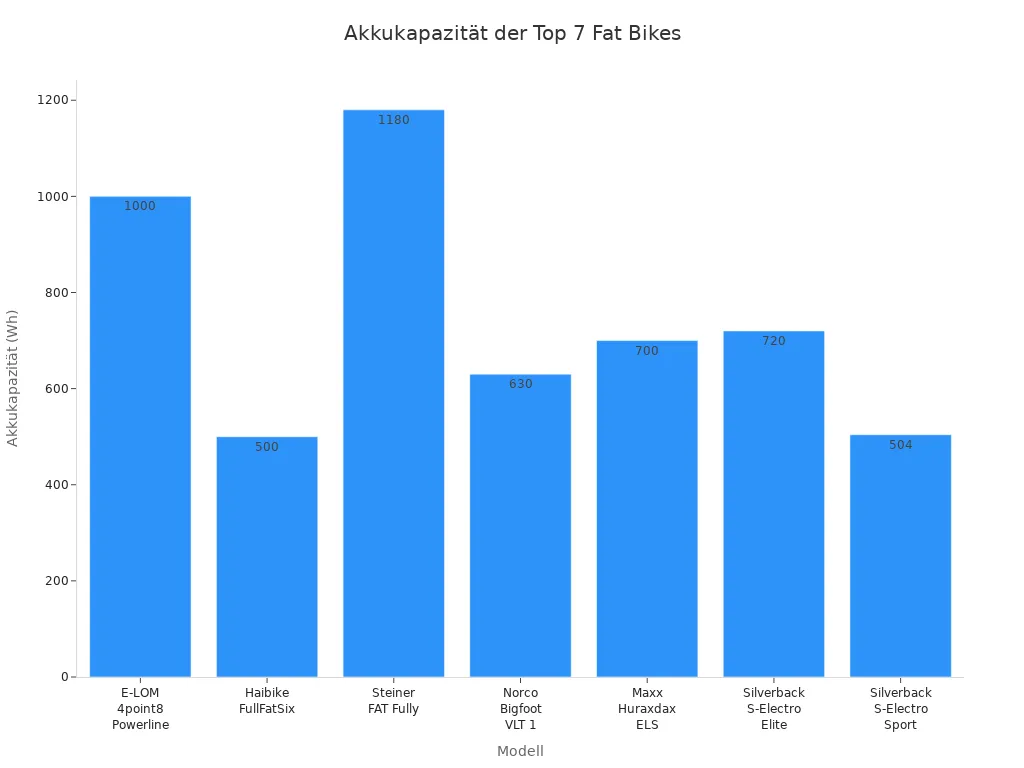
If you want to compare the top models directly, the following overview will help. It shows you the differences in motor power, battery capacity, and weight. This way, you can quickly find out which fat bike fits your riding style.
Model |
Motor power |
Battery capacity (Wh) |
Weight (kg) / Notes on weight |
|---|---|---|---|
E-LOM 4point8 Powerline |
high motor power (not exactly specified) |
1000 |
High-quality equipment, presumably low weight |
Haibike FullFatSix |
Yamaha PW-X2, 80 Nm |
500 |
Rockshox suspension, well-tuned |
Steiner FAT Fully |
1 kW (1000 W), 120 Nm |
1180 (+ 450 auxiliary battery) |
Focus on high power and speed |
Norco Bigfoot VLT 1 |
Shimano STEPS E8000 |
630 |
100mm travel, trail setup |
Maxx Huraxdax ELS |
Shimano EP8, 250 W, 85 Nm |
over 700 |
Complete Manitou suspension, high-quality equipment |
Silverback S-Electro Elite |
Shimano EP8 (motor power not exactly specified) |
720 |
Aluminum frame, different equipment |
Silverback S-Electro Sport |
Shimano EP7000 (motor power not exactly specified) |
504 |
Weight not stated
Maxx Jagamoasta ELS
Shimano EP8, 250 W, 85 Nm
not explicitly stated
Transport and cargo bike
Differences
You may be wondering whether an e-fat bike or a classic fat bike is a better fit for you. The differences are clear. E-fat bikes feature an electric motor and a battery. You get assistance while pedaling, especially on inclines or difficult terrain. They are heavier because the motor and battery are built in. The brakes are stronger so that you can stop safely even at high speeds.
Classic fat bikes are lighter. You have to provide all the power yourself. Maintenance is easier because there is less technology involved. You benefit from a robust frame and mechanical brakes. These bikes are particularly suitable for off-road riding and athletic challenges.
The equipment plays a major role. E-fat bikes often offer a suspension fork and sometimes even full suspension. You can choose between different types of batteries. The range depends on the battery. Modern models reach up to 120 km on a single charge. Classic fat bikes do without a battery and motor. You are independent of charging stations and can use the bike anywhere.
If you ride in the city a lot, you benefit from an e-fat bike. You reach your destination faster and have to exert less effort. For adventures off-road or in the snow, a classic fat bike is often the better choice. You have more control and can feel every movement directly.
Value for money also differs. E-fat bikes cost more but offer many extras. Classic models are cheaper and durable. You should consider how you want to use your bike. If you want comfort and technology, choose an e-fat bike. If you are looking for sport and a challenge, a classic fat bike suits you better.
Tip: Test both types before you decide. This way, you will find out which riding experience you enjoy the most.
Fat Bike Buying Guide
Types
You will find different types of fat bikes. E-fat bikes have an electric motor and support you while pedaling. Classic fat bikes do not have motors and rely on muscle power. Foldable models with fat bike tires offer you flexibility if you want to transport or store the bike. Consider how you want to use your bike: for long tours, athletic challenges, or your daily commute to work.
Equipment
Pay attention to the most important components. A stable frame ensures safety. The gear system determines how easily you climb hills. Disc brakes are standard and offer you reliable stopping power in any weather. Hydraulic brakes increase safety, especially in wet conditions. Wide tires provide good grip on snow, sand, and mud. A suspension fork or full suspension improves comfort on uneven paths.
Motor and Battery
For e-fat bikes, the motor plays a central role. A high torque (from 50 Nm) ensures powerful acceleration. A torque sensor offers you smooth assistance. The battery capacity determines the range. A removable battery makes charging easier. Plan enough capacity for your routes.
Road Legality
Clear rules apply for road legality in Germany in 2025:
Motor assistance only while pedaling, no throttles.
Assistance ends at 25 km/h.
Equipment according to StVZO (German Road Traffic Licensing Regulation): LED lighting, reflectors, bell, disc brakes.
No driver's license or insurance necessary if the bike meets these requirements.
Models that do not meet these requirements are not approved for public road traffic.
Buying Tips
Set a realistic budget and include accessories like a helmet and lock in your planning.
Choose the right model for your intended use – city, off-road, or touring.
Look for reliable customer service and good warranty conditions.
Test the bike before buying if possible. Check whether the frame and ergonomics fit you well.
Invest in high-quality brakes and a powerful battery for more safety and riding fun.
Tip: A fat bike with a torque sensor and hydraulic brakes offers you more comfort and control, especially on long routes.
You now have an overview of the best models and the most important selection criteria. For beginners, affordable and robust bikes are suitable. Advanced riders benefit from models with strong motor power and good suspension. Price-conscious buyers can also find solid quality in the mid-price segment. Take a look at test reports and comparisons to learn even more details. Share your experiences or ask questions in the comments below. 🚲
FAQ
How do you properly maintain a fat bike?
You should clean your fat bike regularly. Check the chain and oil it. Inspect the tires for damage. Tighten the brakes. Store the bike in a dry place. This will keep your fat bike in good condition for a long time.
How far can you go with an e-fat bike?
The range depends on the battery, terrain, and your riding style. Many models can manage 60 to 120 kilometers. Use Eco mode to ride further. Always charge the battery fully.
Do you need a driver's license for an e-fat bike?
You do not need a driver's license if the e-fat bike has a maximum motor power of 250 watts and provides assistance up to 25 km/h. Ensure it has StVZO-compliant equipment. This allows you to ride legally on public roads.
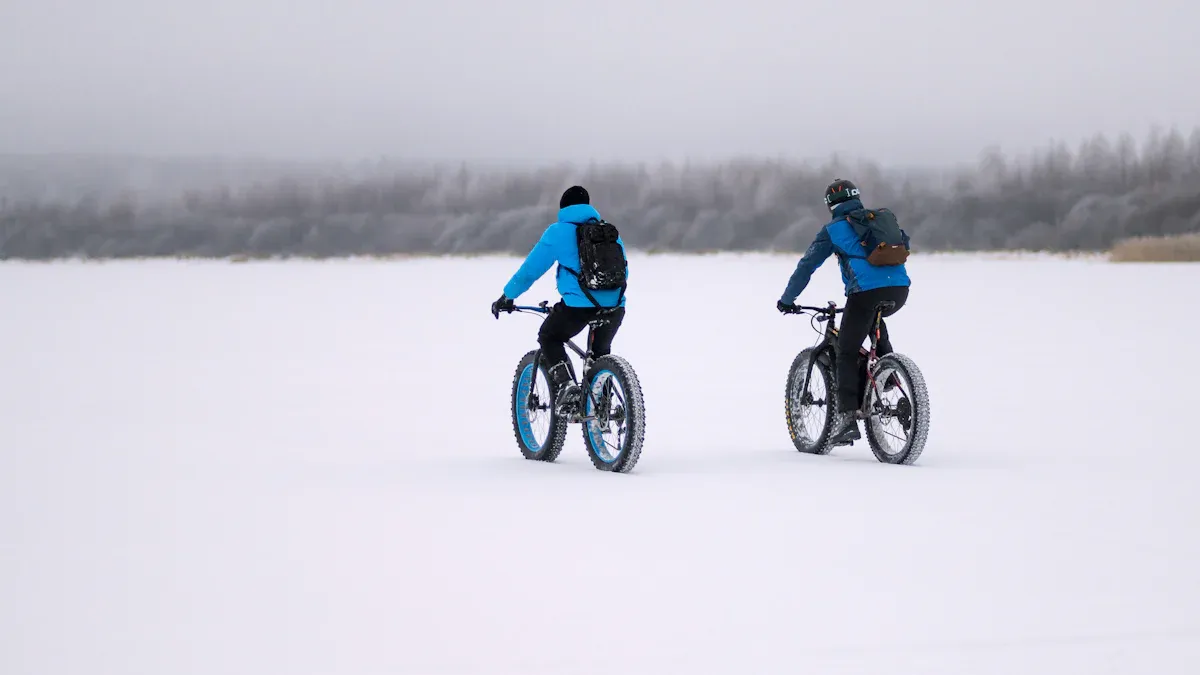
Can you use a fat bike in winter?
Yes, you can ride a fat bike in winter. The wide tires provide plenty of grip on snow and ice. Wear warm clothing. Check the brakes before every ride. This keeps you safe on the road.
How heavy is a fat bike?
A classic fat bike usually weighs 15 to 20 kilograms. E-fat bikes are heavier and often weigh 25 to 35 kilograms. The higher weight is due to the motor and battery.