
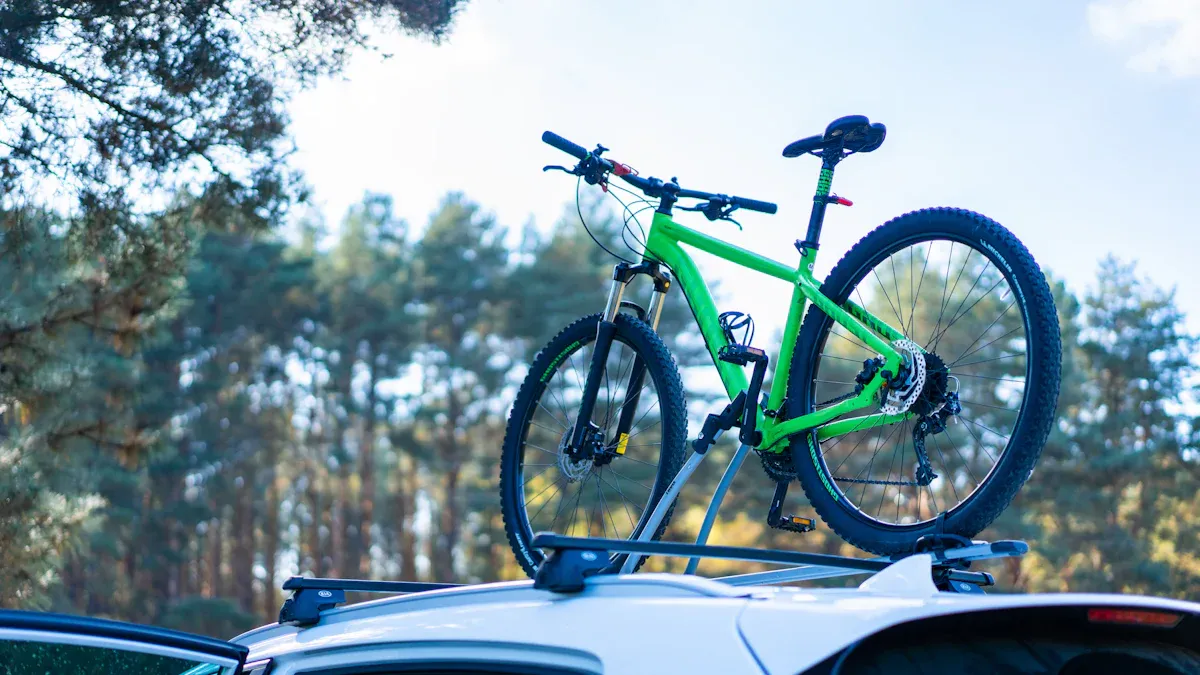
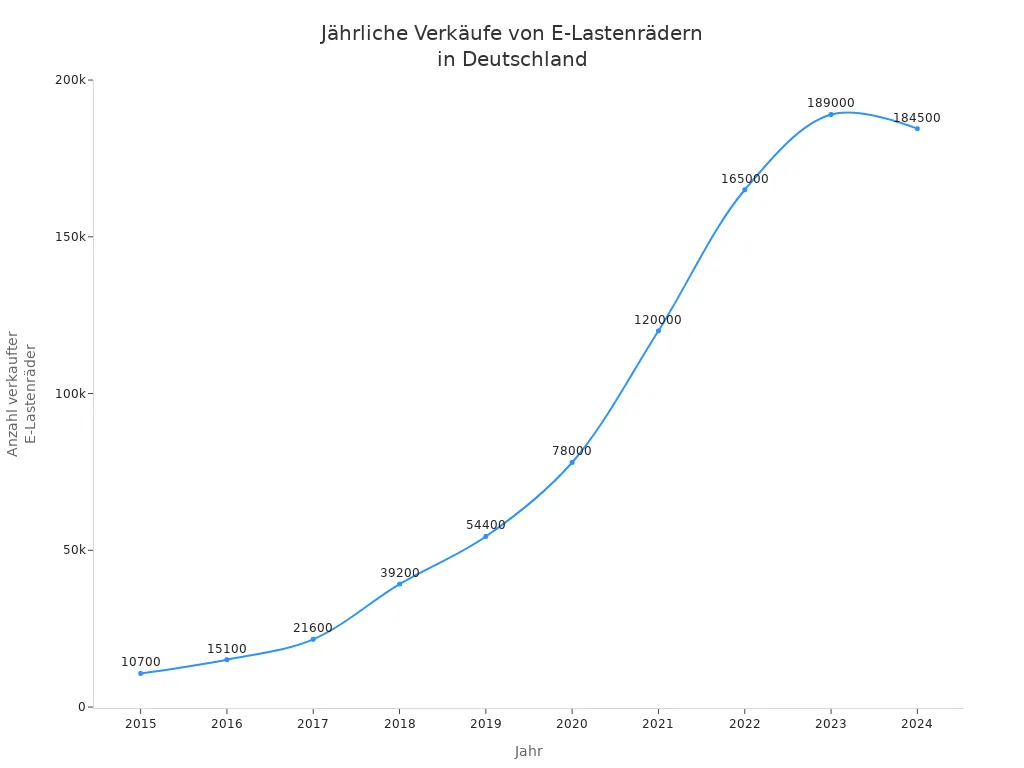
You will transport your e-bike safely and in compliance with the law in 2025 if you choose a suitable e-bike rack. The high weight and dimensions of modern e-bikes present special requirements. Your car's nose weight, current regulations, and strong anti-theft protection play a decisive role. In Germany, the number of e-bikes being transported is increasing significantly every year, as the following chart shows:
With the right carrier and by following the rules, you protect your bike and avoid trouble. Here you will find tips to make your daily life easier.
Key takeaways
E-bikes are heavier and larger than normal bicycles. Choose a bike rack that safely supports the weight and dimensions of your e-bike.
Hitch-mounted racks are the best choice for regular e-bike transport. They offer high load capacity, easy installation, and good safety features.
Remove the battery and display before every trip. This protects the technology and reduces the weight for safe transport.
Observe your car's permissible nose weight and the maximum load capacity of the rack. Do not exceed these values to avoid damage and accidents.
Pay attention to regulations such as additional license plates and lighting. This way, you stay compliant and safe on the road.
Differences between e-bikes and bicycles
Weight and dimensions
You will quickly notice that e-bikes are heavier and often larger than conventional bicycles. The motor and battery add significant weight. An average e-bike weighs about 20 to 30 kilograms. A standard bicycle usually only weighs 10 to 20 kilograms. Particularly light road bikes even weigh less than 10 kilograms. An e-bike battery weighs between 2.5 and 5 kilograms. The motor adds about another 3 kilograms. Handling remains easy thanks to the motor assistance, but you will clearly feel the extra weight when carrying or loading it.
Feature |
E-bikes (Average) |
Conventional bikes (Average) |
|---|---|---|
Weight |
20 - 30 kg (approx. 25 kg) |
10 - 20 kg (road bikes often < 10 kg) |
Size |
Larger, more stable frame, wider tires |
Usually smaller and lighter |
Additional weight |
5 - 10 kg due to battery and motor |
None |
E-bike frames are also often larger and more stable. Wider tires provide more safety and comfort. The right frame size depends on your height. The following table will help you with your selection:
Height (cm) |
Recommended frame size (cm) |
|---|---|
150 – 160 |
42 – 47 |
160 – 170 |
47 – 52 |
170 – 175 |
52 – 54 |
175 – 180 |
54 – 56 |
180 – 185 |
56 – 58 |
185 – 190 |
58 – 60 |
190 – 195 |
60 – 63 |
Tip: Always check the weight and dimensions of your e-bike before buying a bike rack to ensure everything fits.
Technology and sensitivity
E-bikes have many technical peculiarities. They feature electric motors, usually located in the bottom bracket or the hub. Batteries are often built into the frame or on the hub. These components are sensitive to shocks and improper handling. The additional weight of the motor and battery makes transport more difficult. Some e-mountain bikes have carbon frames. These are light but sensitive to falls or high pressure.
Many e-bikes have suspension forks and shocks. These components require maintenance and are more sensitive than simple rigid forks. On some urban bikes, the battery cannot be removed. This makes handling more difficult during transport. Electronic components and the specific design require more caution during transport than with normal bicycles.
Carbon frames are sensitive to pressure and falls.
Suspension forks and shocks require special care.
Non-removable batteries make handling more difficult.
Electronic components require more care.
Note: Always handle your e-bike with extra care during transport. This protects the technology and extends the life of your bike.
E-bike racks: Types
If you want to transport an e-bike, you have several options. Not every rack type is equally suitable. The weight and dimensions of your e-bike play a major role in your choice. Here you will learn about the available systems and what you should look out for.
Hitch-mounted racks
Hitch-mounted racks are the most common e-bike racks in 2025. You mount them on your car's trailer hitch. These racks offer many advantages:
You can easily load heavy e-bikes because the loading height is low.
Most models have a high load capacity. Many hitch-mounted racks can handle up to 60 kg, some even 75 kg.
A tilt mechanism ensures that you can reach the trunk even with the bikes mounted.
Modern hitch-mounted racks such as the Thule E-Bike Carrier XL 955, the EAL Premium TG, or the Hapro Atlas Premium 2 offer you safety and comfort.
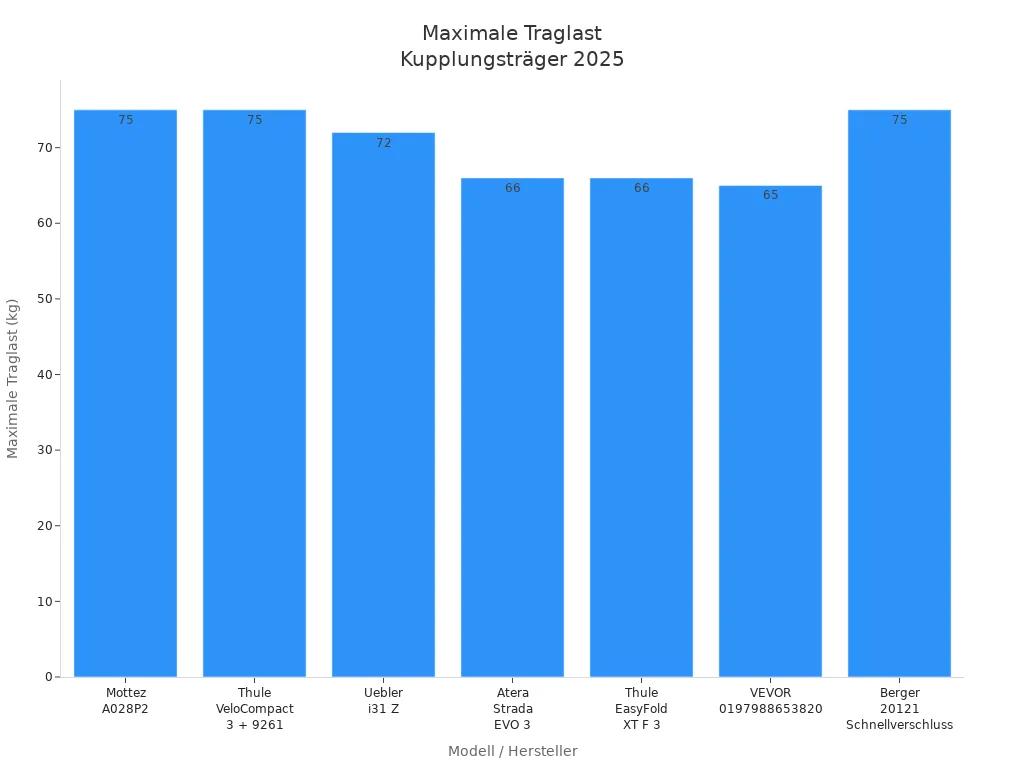
The following table shows the maximum load capacity of some popular models:
Model / Manufacturer |
Max. Load Capacity (kg) |
Number of bikes |
Note |
|---|---|---|---|
Mottez A028P2 |
75 |
2 |
Highest capacity for 2 bikes |
Thule VeloCompact 3 + 9261 |
75 |
3 + extension |
Highest capacity for 3 bikes |
Uebler i31 Z |
72 |
3 |
Designed only for 3 bikes |
Atera Strada EVO 3 |
66 |
3 |
Example from Idealo data |
Thule EasyFold XT F 3 |
66 |
3 |
Example from Idealo data |
VEVOR 0197988653820 |
65 |
2 |
Example from Idealo data |
Berger 20121 Quick release |
75 |
Accessory |
Accessory with 75 kg capacity |
Tip: If you want to transport multiple e-bikes, always check the maximum load capacity of the rack and the nose weight of your car. Remove the batteries to reduce the weight.
Hitch-mounted racks offer you many safety features:
Robust materials and reinforced support arms
Stable frame holders and ratchet straps
Lockable systems for theft protection
Reflective elements and illuminated license plate holders
Easy installation with quick-release fasteners
Integrated lighting units
Special adapters for step-through frames
Instructions on correct weight distribution and maximum speed
Many users choose hitch-mounted racks because they offer comfort, safety, and high load capacity. For the regular transport of e-bikes, they are the best choice.
Rear-mounted racks
Rear-mounted racks attach to the trunk/hatch of your car. They are particularly interesting for vehicles without a trailer hitch. You benefit from a low price and a lightweight design. Assembly is usually quick.
Pros:
No trailer hitch required
Compact and lightweight
Suitable for many vehicle types
Easier loading than with roof racks
Cons:
Lower load capacity, often insufficient for heavy e-bikes
Trunk usually not usable when the rack is mounted
Risk of paint damage due to abrasion
Less stable at high speeds
Limited rear view
Note: Rear-mounted racks are better suited for the occasional transport of one or two light bicycles. They are usually not stable enough for heavy e-bikes.
Roof racks
Use roof racks if you do not have a trailer hitch. However, they are rarely suitable for e-bikes. Most roof racks have a maximum load capacity of about 20 kilograms. Many e-bikes weigh more than that. Lifting a heavy e-bike onto the car roof is very strenuous and can be dangerous.
The Allianz Center for Technology advises against roof transport of pedelecs. In an accident, heavy e-bikes can break loose from the mount. You also must not exceed your car's permissible roof load. If this limit is exceeded, secure attachment is no longer guaranteed.
Attention: Roof racks are generally unsuitable for transporting e-bikes. Always remove the battery if you do use a roof rack, to reduce the weight.
Interior transport
You can also transport your e-bike inside your car. To do this, you usually need to remove the front wheel and fold down the rear seats. This method protects your bike from weather and theft. However, it is only suitable if your car has enough space and you can secure the bike safely.
No risk of theft during the trip
No impact on aerodynamic drag or vehicle height
No issues with nose weight or load capacity
Tip: Always secure your e-bike inside the car with tension straps so it does not shift during emergency braking.
With this information, you will find the right e-bike rack that fits your car and your needs.
Selection criteria
Nose weight
The nose weight (or tongue weight) is a decisive factor when transporting e-bikes. It indicates how much weight may act on your car's trailer hitch. You can find the permissible nose weight in several places:
In the vehicle registration document (Registration Certificate Part I, point 13)
Directly on the trailer hitch (plaque or embossing)
In your vehicle or trailer's manual
On the trailer's type plate
You must always observe the lowest value among these specifications. The actual nose weight must not exceed this value. A nose weight scale helps you measure the weight. Alternatively, use a bathroom scale and a squared timber as a lever. German road traffic regulations (StVZO § 44 Paragraph 3) prohibit exceeding the technically permissible nose weight. This is the only way to keep your transport safe.
Tip: Check the nose weight before every trip. An overloaded rack can cause damage to the vehicle and endangers safety.
Load capacity
The load capacity describes how much weight the bike rack is allowed to carry. For e-bikes, you need a rack with high load capacity. Many roof racks are unsuitable for e-bikes because they usually only carry 20 kg. Rear racks and hitch-mounted racks often manage up to 60 kg. The exact load capacity is in the rack's instruction manual and your vehicle's operating permit.
Special racks for e-bikes often offer a load capacity of at least 60 kg.
The maximum overhang of the bicycles must not exceed 40 cm beyond the tail light.
The EU type approval mark indicates that the carrier meets legal requirements.
Always remove the battery and the display before transport. This reduces the weight and protects the technology from damage.
Number of E-Bikes
The number of e-bikes you can transport depends on the carrier type and the load capacity. The following table gives you a quick overview:
Carrier Type |
Maximum Number of E-Bikes |
Notes |
|---|---|---|
Standard Bicycle Carrier |
2 |
Expandable with modules or rails |
Towbar Carrier |
Up to 4 |
Weight per e-bike up to 30 kg, note vertical load limit |
Tailgate Carrier |
2 (up to 4 with adapters) |
Max. bicycle weight approx. 15 kg, not ideal for heavy e-bikes |
Roof Carrier |
1 to 2 |
Max. roof load and weight limit the number, usually max. 20 kg/bicycle |
Special E-Bike Carrier |
Variable |
Load capacity often at least 60 kg, more stable and suitable for wide tires |

You can usually safely transport two e-bikes on an average carrier. High-quality towbar carriers can handle up to four e-bikes, provided you observe the vertical load and payload limits.
Installation
The installation of the carrier affects both comfort and safety. Different systems offer different advantages:
Mounting System |
Advantages |
Disadvantages |
|---|---|---|
Easy installation, multiple e-bikes, often tiltable |
Higher price for high-quality models |
|
Tailgate Carrier |
No mounting hardware needed, up to two e-bikes |
Higher lifting required, less comfortable, visibility restricted |
Roof Carrier |
No restriction on the tailgate |
Roof mounting requires roof rails, heavy lifting |
You can usually install a towbar carrier quickly and securely. Many models can be tilted so you can still access the trunk. Tailgate carriers are cheaper but less comfortable. Roof carriers are rarely suitable for e-bikes because lifting them is difficult.
When installing, ensure that all fasteners are tight. Check the attachment before every trip.
Safety
Safety is the top priority when transporting e-bikes. You protect your bike and other road users by observing these points:
Remove the battery, display, and loose accessories such as bags or pumps.
Secure the e-bike with tension straps or holding devices.
Straighten the handlebar and fix it in place.
Protect sensitive parts such as the motor, battery mount, and display from rain and dirt.
Ensure that the e-bike does not protrude beyond the permissible vehicle width.
Check the total height for roof carriers to avoid damage.
Slightly increase the tire pressure to cushion vibrations.
Avoid protective covers during the trip, as they can inflate and impair handling.
Note: A high-quality e-bike carrier often offers additional anti-theft protection and stable holding arms. This keeps your e-bike secure even on longer trips.
Regulations
License Plate
If you use a towbar or platform carrier, your car's rear license plate may be obscured. In this case, you need an additional license plate on the bicycle carrier.
The additional license plate must look exactly like the original, but without the TÜV or inspection sticker.
It must be officially embossed, reflective, and manufactured according to DIN 74069.
You are not allowed to use a self-printed or improvised sign.
The rear license plate must always remain on the car, even if it is obscured.
The installation must be secure, horizontal, and clearly visible, preferably centered.
The additional plate usually costs between 10 and 50 euros.
If the additional license plate is missing, you face a fine starting at 60 euros. If you manipulate it, you risk penalty points or even a criminal fine.
Tip: Order the additional license plate from an official plate service. This way, you are on the safe side.
Lighting
Lighting on the bicycle carrier is mandatory if the rear lights or turn signals of your car are covered by the bicycles. Modern carriers usually have their own light bar with tail lights, brake lights, and turn signals.
Ensure that all lamps are working before you set off. Also, regularly check the plug connection to the car. Defective lights can lead to dangerous situations and are punishable by a fine during police checks.
Overhang
When transporting e-bikes in Germany, your bicycle carrier may protrude a maximum of 20 centimeters per side beyond the car. The total width of the car and bicycles must not exceed 2.55 meters.
To the rear, the carrier, including the bicycles, may protrude a maximum of 150 centimeters.
You do not need a warning sign for this lateral overhang.
No sharp or pointed parts may protrude.
If the license plate is covered by the bicycle, you must repeat it on the carrier.
Note: Measure the width of your car with the e-bikes mounted before starting the trip. This avoids trouble during a police check.
Speed
In Germany, there is no fixed speed limit for cars with bicycle carriers. However, most manufacturers recommend not driving faster than 120 km/h. Some towbar carriers can withstand up to 130 km/h.
If you stick to the manufacturer's specifications, you are safe on the road and maintain your insurance coverage. Driving too fast can loosen the carrier and increase the risk of an accident.
Also, ensure that the vehicle width with bicycles does not exceed 2.55 meters and that the bicycles do not protrude more than 20 centimeters laterally.
Abroad
In other European countries, different rules often apply to the transport of e-bikes. In particular, lithium-ion batteries are classified as Class 9 dangerous goods.
There are special regulations for packaging and labeling when transporting by train, ship, or plane.
Many transport companies regulate whether and how you can take e-bikes with you.
When shipping by mail or plane, battery transport is often severely restricted.
Inform yourself about the exact rules from your provider before the trip.
Sometimes it is easier to rent an e-bike on-site.
Tip: Check the regulations of your destination country and your means of transport before taking your e-bike with you. This way, you avoid unpleasant surprises.
Transport Tips
Remove Battery and Display
You should always remove the battery of your e-bike before transport. This protects it from moisture, rain, and airflow. A battery can easily be damaged when wet or even cause a short circuit.
Follow these tips:
Stow the battery safely inside the car so that it does not slide.
Protect the contacts with a cover cap or special adhesive tape.
Do not continue to transport damaged batteries; dispose of them properly.
Also, remove the display and store it in a dry place.
Tip: A safely stowed battery stays functional longer and protects you from expensive repairs.
Anti-Theft Protection
E-bikes are valuable and often targeted by thieves. You can better protect your bike with simple measures:
Use high-quality bicycle locks from well-known brands.
Secure the frame and wheel to a fixed object.
Remove the battery and display to deter thieves.
Use a hidden GPS tracker for location tracking.
Engrave an individual code or register your e-bike.
Choose well-lit and visible parking spaces.
Cover the bike with a tarp so that it is less noticeable.
A second lock or insurance offers additional protection.
Weather Conditions
Rain, wind, and dirt can take a toll on your e-bike on the carrier. Although bicycles are built for the outdoors, sensitive parts need protection.
You protect your e-bike best by doing the following:
Remove the battery and stow it in a transport bag.
Protect the battery contacts with a neoprene cover or protective cap.
Use neoprene protective covers for the display, motor, and control elements.
“However, on the bicycle carrier in the air turbulence, rain hits the bike almost like a pressure washer. In that case, protection makes sense.”
Loading
When loading the bicycle carrier, safety and comfort are key.
Observe these points:
Remove the battery, display, and loose parts before loading.
Read your carrier's operating manual and check the maximum load capacity.
Use loading ramps to make loading heavy e-bikes easier.
Secure the e-bike with long ratchet straps and wide rails.
Check that all fasteners are secure and lockable.
Check the visibility of rear lights and license plate.
Perform a quick shake test before you start driving.
With these tips, you can transport your e-bike safely and without stress.
Recommendations
Models
In 2025, you will find many models developed specifically for the safe transport of e-bikes. Especially towbar carriers and tiltable tailgate carriers offer high load capacities and easy handling. The following table shows popular models and their most important features:
Model |
Type |
Maximum Load Capacity |
Features |
|---|---|---|---|
Thule EasyFold XT 2 |
Towbar carrier |
Foldable, for e-bikes and MTBs, trunk access |
|
Eufab Luke 4 |
Towbar carrier |
70 kg (total) |
Robust, 4 bikes, adjustable mounts, tiltable |
Eufab Poker-F Towbar |
Towbar carrier |
60 kg (total) |
Foldable, quick assembly, tiltable |
Thule VeloCompact 3 |
Tailgate carrier |
25 kg/bicycle |
For 3 bikes, compact, tiltable |
Tip: Choose a model that fits your vehicle and the number of your e-bikes. Always pay attention to the maximum load capacity.
Brands
You can rely on well-known brands when looking for an e-bike carrier. Thule offers many innovative solutions, such as the EasyFold XT or the VeloCompact. Eufab impresses with robust models like the Luke 4 and the Poker-F Towbar. Both brands rely on secure frame mounts, stable straps, and practical tilt functions. Atera and Fischer are also known for their reliability. These manufacturers prioritize easy installation and high safety.
Price-Performance
You can often get good quality in the mid-price segment. Entry-level models start at around 250 euros. High-quality towbar carriers cost between 400 and 800 euros. They offer you more comfort, higher load capacity, and durable materials. Before purchasing, check whether the carrier fits your car and how many e-bikes you want to transport. A cheap carrier is only worth it if it meets your requirements and is safe.
Look for quality seals and customer reviews. They help you find a model with a good price-performance ratio.
You are making the right choice if you pay attention to these key factors when buying a bike rack for e-bikes:
Load capacity for the higher weight of e-bikes
Compatibility with your e-bike
Secure fastening options
Compliance with all regulations
Prioritize safety and check the following before every trip:
Remove loose parts
Check the fasteners
Never exceed the permissible vertical load
This way, you can transport your e-bike safely and in compliance with the law.
FAQ
How many e-bikes can I transport on a bike rack?
Most tow-bar mounted racks carry two e-bikes. Some models can handle three or four. Always check the maximum load capacity and the vertical load of your car. Remove heavy batteries to reduce weight.
Do I have to remove the battery during transport?
Yes, you should always remove the battery. This protects it from moisture and vibrations. Transport the battery safely inside the car. This extends its service life and prevents damage.
Do I need an additional license plate for the bike rack?
If the rack covers the rear license plate, you need a second plate on the rack. It must be officially embossed. You can get one from a license plate service.
Are all bike racks suitable for e-bikes?
No, not every rack is suitable. E-bikes are heavier than regular bicycles. Choose a rack with a high load capacity and sturdy mounts. Tow-bar mounted racks are usually the best choice.
How do I protect my e-bike from theft during a break?
Use a sturdy lock and secure the e-bike to the rack. Remove the battery and display. Park the car in well-lit areas. A GPS tracker will help you locate the bike in an emergency.