
You want to find the perfect trail bike, but you're faced with the question: Where is the best mountain bike shop and what should you look for when buying? Take a look at what's currently moving the market:
Bikepacking is becoming increasingly popular and is no short-lived trend.
Manufacturers are growing, and new models are being released regularly.
Conflicts in nature are increasing, and new rules and laws are on the horizon.
With these developments in mind, you will find it easier to find the right bike and shop for you.
Key Findings
Choose a mountain bike shop with good advice and service that addresses your needs and offers a test ride.
When buying a trail bike, pay attention to the appropriate size, frame geometry, and 120 to 150 mm of travel for versatile riding fun.
Test various models and frame sizes during a test ride to find the best handling and comfort.
Opt for high-quality components like strong brakes, suitable tires, and a modern drivetrain for increased safety and control.
It is best to buy your trail bike at the start of the season in spring to benefit from a wide selection, discounts, and good advice.
Mountain Bike Shop: Selection
Advice and Service
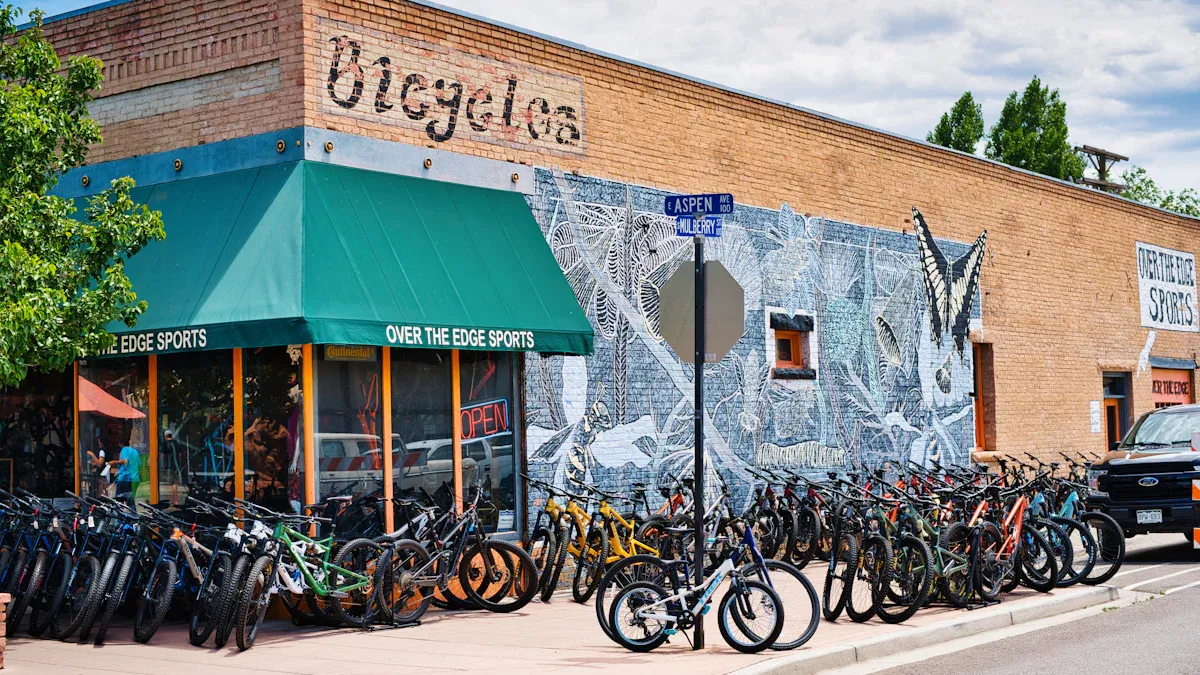
Do you want to find a mountain bike shop that really suits you? Then first pay attention to the advice. A good shop takes time for you. The staff will ask about your riding style and intended use. They will explain which bike suits your needs. In specialized mountain bike shops, you often get a bike fitting. This means your bicycle is precisely adjusted to you, which helps to avoid pain or seating problems.
A mountain bike shop also offers special services. These include a workshop, inspections, spare parts, and warranty handling. Many specialist shops perform a free initial inspection after about 200 kilometers. During this, they check bolts, adjust the gears and brakes, and lubricate the chain. This gives you peace of mind and ensures long-lasting enjoyment of your bike.
Tip: A specialized mountain bike shop is particularly knowledgeable about complex models like e-bikes and offers you detailed advice.
Assortment and Brands
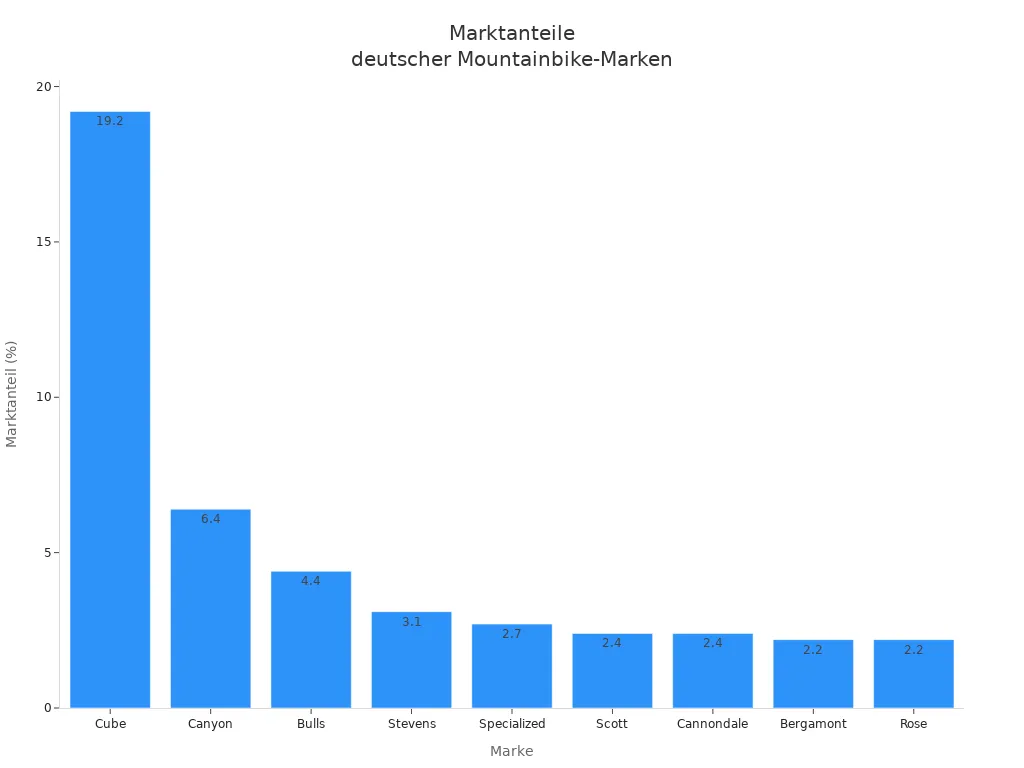
The selection of brands is an important point. In a mountain bike shop, you will often find top brands like Cube, Canyon, Bulls, or Specialized. Take a look at the following table to get an overview:
Brand |
Market Share (%) |
Customer Rating / Special Features |
|---|---|---|
Cube |
19.2 |
Very good price-performance ratio, wide range of models |
Canyon |
6.4 |
Design awards, good test results, sponsorship of a World Tour team |
Bulls |
4.4 |
Regularly "very good" and "good" in trade magazines, know-how from professional sports |
Stevens |
3.1 |
Most attractive brand in Germany, top rankings in purchase intention |
Specialized |
2.7 |
Demanding customers, professional sports teams |
Scott |
2.4 |
Innovative, pioneer in mountain biking |
Cannondale |
2.4 |
Excellent workmanship, tested in professional sports |
Bergamont |
2.2 |
Solid everyday bikes, good price-performance ratio |
Rose |
2.2 |
Large spectrum of models, well-known bicycle catalog |
Test Ride
You should always take a test ride before you decide. Most mountain bike shops offer you this possibility. This way, you can test the riding feel and find out if the bike really suits you. Many dealers will show you at least two different models, which helps you feel the differences and make the best choice.
Customers find test rides very important.
Often, they are only short and possible in the courtyard.
Ask for longer test rides or look for other owners for a real trail ride.
Customer reviews and testimonials will help you find the right mountain bike shop. They show you how satisfied others were with the advice, service, and test ride. Many buyers rely on local specialist dealers because they have had good experiences there.
Buying a Trail Bike: What to Look For
Category and Intended Use
Before you decide on a trail bike, you should consider where and how you want to ride. There are different mountain bike categories that differ in travel, geometry, and intended use. The following table will help you keep an overview:
Travel (mm) |
Characteristics |
Typical use cases |
Target group |
|
|---|---|---|---|---|
Cross Country (XC) |
80 - 120 |
Light, efficient, sporty sitting position, 29" wheels |
Long tours, racing, fast climbs |
Sporty riders, marathon |
Trail (All-Mountain) |
120 - 140 |
Versatile, balanced sitting position, hardtail or full-suspension |
Varied trails, bike parks, uphill and downhill |
Beginners & advanced riders |
Enduro |
150 - 170 |
Robust construction, flat geometry, wide gear range |
Demanding trails, steep climbs, jumps |
Tech fans, downhill lovers |
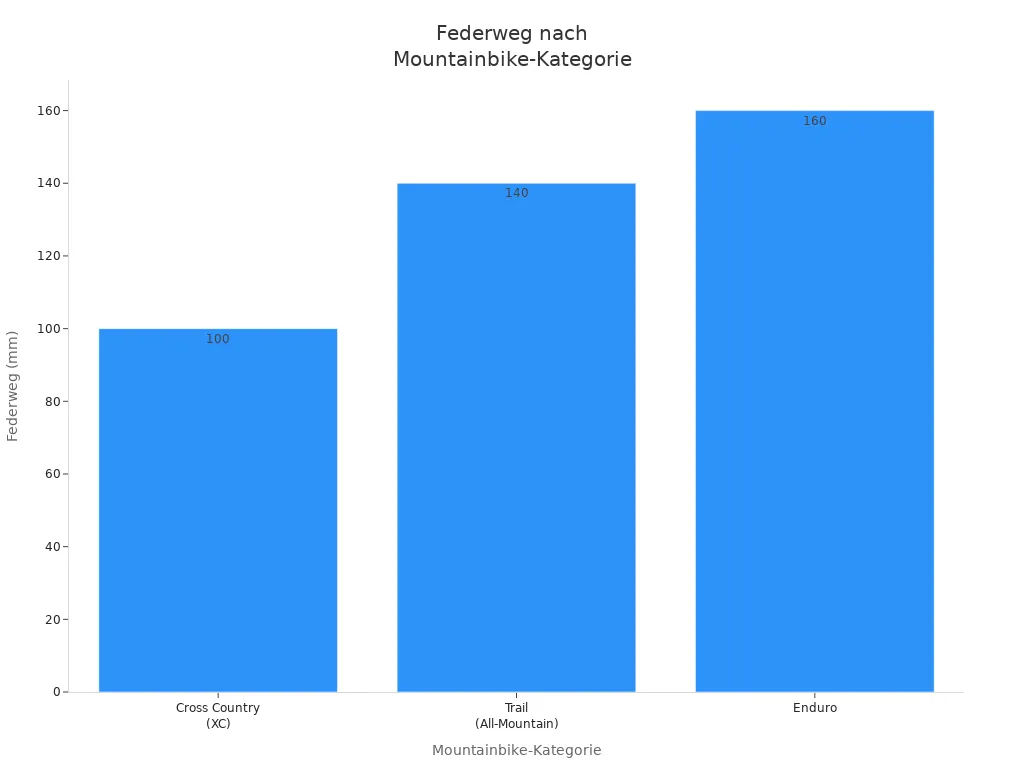
Tip: Trail bikes are true all-rounders. They are suitable for local rounds, bike parks, and even alpine adventures. If you ride in a versatile way, a trail bike is usually the right choice for you.
Frame and Geometry
The frame is the heart of your bike. There are significant differences in material and geometry here. Aluminum frames are robust and offer a good price-performance ratio. Carbon frames are lighter and stiffer but often more expensive. The geometry influences how your bike rides:
Geometry parameters |
Influence on riding behavior |
|---|---|
Slacker angle = more stability on descents |
|
Chainstays (approx. 431 mm) |
Shorter = more agility and playfulness |
Reach (410-500 mm) |
Longer = better control on the trail |
Stack (614-655 mm) |
Influences sitting position and comfort |
A bike with a slack head angle and short rear end rides safely and agilely. Models like the Trek Roscoe 9 or Specialized Stumpjumper EVO show how modern geometry ensures more riding fun.
Suspension and Travel
The suspension determines how comfortable and safe you are on the trail. There are two main types:
Full-suspension (Fully): Suspension in the front and back. More comfort, control, and traction on rough trails. Ideal for technical descents but heavier and more expensive.
Hardtail: Suspension only on the fork. Lighter, cheaper, and lower maintenance. Perfect for easy terrain and fast climbs.
Trade magazines recommend a travel of about 130 mm on the fork and 120–130 mm at the rear for trail bikes. This makes you flexible for tours and descents. Enduro bikes offer more travel (up to 170 mm) but are heavier and less efficient when climbing.
Note: Fullies are really fun on demanding trails; hardtails are top for beginners and easier routes.
Tires and Wheels
The choice of tires and wheels influences grip, comfort, and control. For trail bikes, the following applies:
Tire width: 2.3 to 2.4 inches is optimal. This gives you enough grip without the bike becoming too heavy.
Tread pattern: Coarse knobs in the front (e.g., Nobby Nic) for cornering grip, finer tread in the back (e.g., Wicked Will) for less rolling resistance.
Air pressure: In the field, approx. 1.2 bar in the front, 1.4 bar in the back – this ensures comfort and traction.
Puncture protection: Lightweight casings like EXO (Maxxis) or SuperGround (Schwalbe) protect without increasing weight.
MTB type |
Recommended tire width (inches) |
Recommended tire width (mm) |
|---|---|---|
Cross Country |
2.1 to 2.3 |
51 to 54 |
All Mountain |
2.1 to 2.4 |
54 to 61 |
Enduro |
2.35 to 2.6 |
58 to 64 |
For wheels, you have the choice between 27.5 and 29 inches. 29-inch wheels roll over obstacles more easily and offer more stability. 27.5-inch wheels are more agile and easier to accelerate. For most trail bikers, 29-inch wheels are the best choice, especially on longer or rougher routes.
Wheel size |
Advantages |
Disadvantages |
|---|---|---|
Agile, lighter, more grip |
Less smoothness |
|
29 inch |
Better rollover, stable |
Heavier, less agile |
Drivetrain and Brakes
A good drivetrain makes riding easier. Modern trail bikes mostly rely on 12-speed derailleur gears like Shimano Deore XT or SRAM GX Eagle. These offer a wide range and are ideal for varying terrain. Hub gears are rarer, but they are low-maintenance.
For brakes, you should look for powerful four-piston disc brakes. They offer a lot of braking power and are easy to modulate. Models like Shimano XTR, Sram Code, or Magura MT7 perform particularly well in tests. Cheaper brakes are sufficient for beginners, but on demanding trails, an upgrade is worth it.
Tip: Good brakes are a real safety plus – don't skimp at the wrong end here!
Weight and Size
The weight of your bike influences how easily you climb and how safely you descend. Trail bikes usually weigh between 12 and 14 kilograms. That is a good compromise of stability and efficiency. Hardtails are often a bit lighter, full-suspension bikes offer more comfort.
The right frame size is crucial for comfort and riding fun. Here is how you find it:
Measure your inseam without shoes.
Use a size chart or an online calculator for the correct frame height.
Consider your height, leg and arm length, as well as your riding style.
Test ride the bike before buying – it’s the only way to know if it really fits.
A properly sized frame prevents pain and ensures more control and fun on the trail.
Price-Performance Ratio
Trail bikes come in many price ranges. Entry-level hardtails start at about 700 euros, and solid full-suspension bikes are available from around 1,800 euros. For a good trail bike with modern equipment, you should budget at least 2,000 to 2,500 euros. High-end models cost 3,000 euros and up.
Category |
Price Range (Euro) |
Features / Equipment |
|---|---|---|
Entry-level Hardtail |
700 - 1,200 |
Basic suspension fork, mechanical disc brakes, basic drivetrain, suitable for light trails |
Mid-range Hardtail |
1,200 - 2,000 |
Better components, hydraulic disc brakes, higher-quality suspension forks |
Entry-level Full-suspension |
1,800 - 2,500 |
Front and rear suspension, solid equipment, for more difficult terrain |
High-end Hardtails/Full-suspension |
from 3,000 |
Carbon frames, high-end suspension, electronic shifting, for demanding trails |
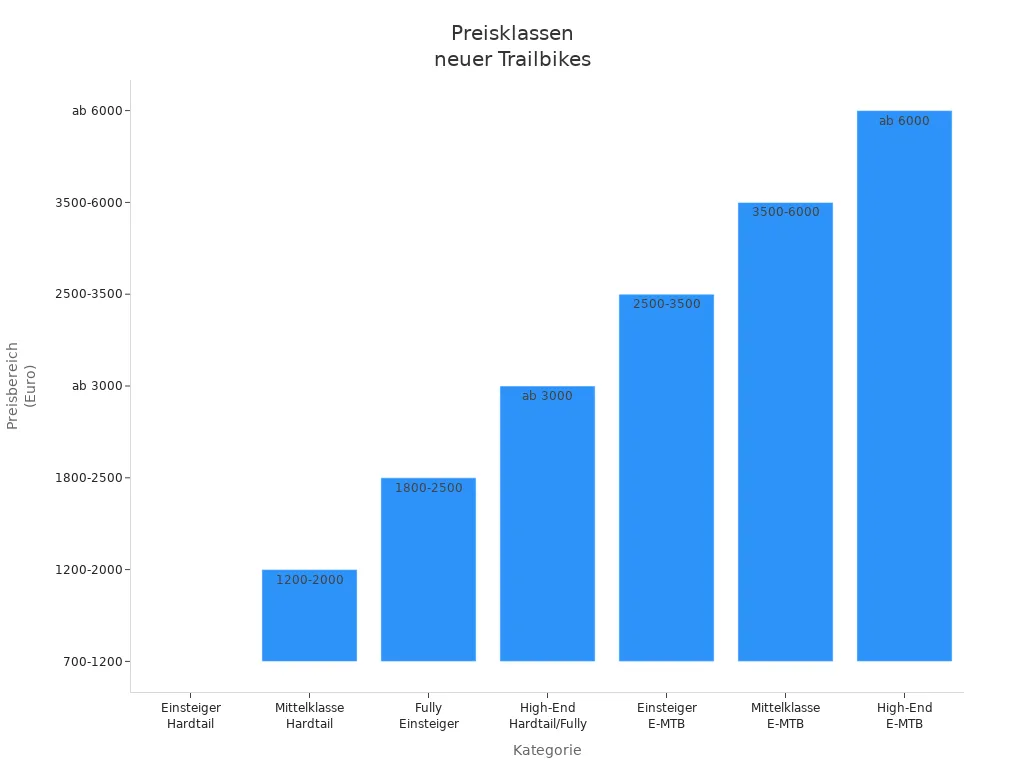
When buying, look for features like reliable brakes, robust tires, internal cable routing, and frame protection. Models like the Canyon Spectral 5 or Radon Slide Trail 8 offer a lot of bike for a fair price.
Tip: A good price-performance ratio is characterized by sensible equipment, not by expensive individual parts. It is better to have a solid overall package than a bike with just one expensive component!
Test Ride and Consultation
Testing the Riding Feel
Found your dream bike? Now comes the most important step: the test ride. Only by trying out different models and sizes will you realize which bike really suits you. Sit on the bike, check the seating position, and pay attention to the handling. Does the bike feel stable? Are you comfortable with the handlebars and brakes?
Many mountain bike shops offer the option to test the bike in their courtyard or even on a short loop outside. Take this opportunity! Try out different frame sizes as well. A bike that is too big or too small is not fun to ride and can even lead to pain.
Tip: Test the bike with your own gear, such as your helmet and, if applicable, your backpack. This gives you a real feel for the handling.
Asking Questions
Good advice is worth its weight in gold. In a mountain bike shop, don't be afraid to ask plenty of questions. This is the best way to find out which trail bike suits you best. Here are some important questions you can ask:
What is the intended use for this trail bike?
How much suspension travel do I need for my routes?
Which wheel size suits my riding style?
What is the geometry like, for example, the head tube angle?
Is a hardtail or full-suspension bike better for me?
Which equipment is important, such as brakes or tire width?
What is my budget and what do I get for it?
What is more important to me: comfort or performance?
Can I also use this bike to participate in races?
What axle system is installed?
How important are weight and stability for my riding style?
Note down your most important points before the consultation. This way, you won't forget anything and will get exactly the information you need.
With these tips, you will find the perfect trail bike for you in a mountain bike shop.
Tips on When to Buy
Best Season
Wondering when is the best time to buy your new trail bike? The answer is quite clear: the start of the season, i.e., spring and early summer, is the best time for you. During these months, dealer warehouses are full. You will find a large selection of current models with modern components. Prices are often lower than later in the year. Many dealers offer attractive promotions or discounts at this time to clear space for new stock.
Industry experts say that you have particularly good chances of finding a bargain at the beginning of the season or in the summer. After the price increases of recent years, prices are currently stable or even falling slightly. However, this can change quickly if demand rises again.
Here are a few tips on how to get the most out of your timing:
Look for outgoing models: Many dealers reduce prices for last year's models. These bikes are often technically up to date and offer a super price-performance ratio.
Keep an eye out for seasonal offers: In spring and summer, there are often promotions where you can get accessories like helmets or locks at a lower price.
Compare different dealers: Not every shop has the same offers. A price comparison is always worth it.
Take advantage of expert advice: Especially at the beginning of the season, staff take more time for you. You can test different models and get honest recommendations.
If you are flexible, you can save the most money. Don't wait too long, as popular sizes and models sell out quickly. With the right timing, you can secure your dream trail bike at the best price! 🚴♂️
You will find the perfect trail bike if you pay attention to the most important points. Choose a mountain bike shop that offers honest advice and test rides. When buying, pay attention to:
Suitable size and geometry
High-quality, adjustable components
Good price-performance ratio
Avoid typical mistakes:
Do not buy a bike that does not suit your intended use.
Stay relaxed – your riding enjoyment counts for more than the most expensive model! 🚵♀️
FAQ
How do I find the right frame size for my mountain bike?
You measure your inseam and use a size chart from the manufacturer. Many shops also offer advice or a bike fitting. Try out different sizes. This way, you will quickly notice which bike suits you best.
Do I need to have my new trail bike serviced before using it for the first time?
Yes, that is a good idea! Have your bike checked by a specialist dealer after the first 200 kilometers. Bolts, the drivetrain, and brakes often need readjustment. This keeps your bike safe and running smoothly.
What is better: Hardtail or full-suspension for beginners?
Hardtail |
Full-suspension |
|---|---|
Lighter, cheaper, less maintenance |
More comfort, better control on trails |
Do you mostly ride on easy paths? Then a hardtail is sufficient. For more comfort on rough trails, choose a full-suspension bike.
Can I also buy a mountain bike online?
You can buy online, but a test ride is often missing. In the store, you get advice, service, and adjustments. Online you sometimes find better prices. Consider what is more important to you: personal service or a lower price.