
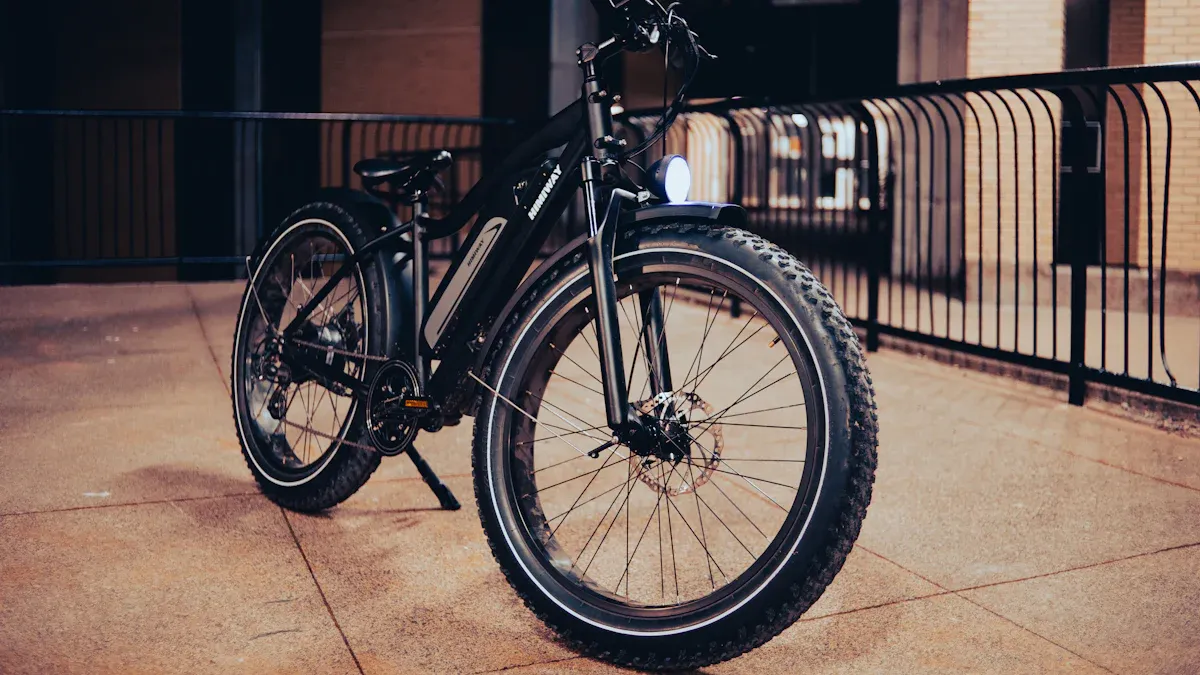
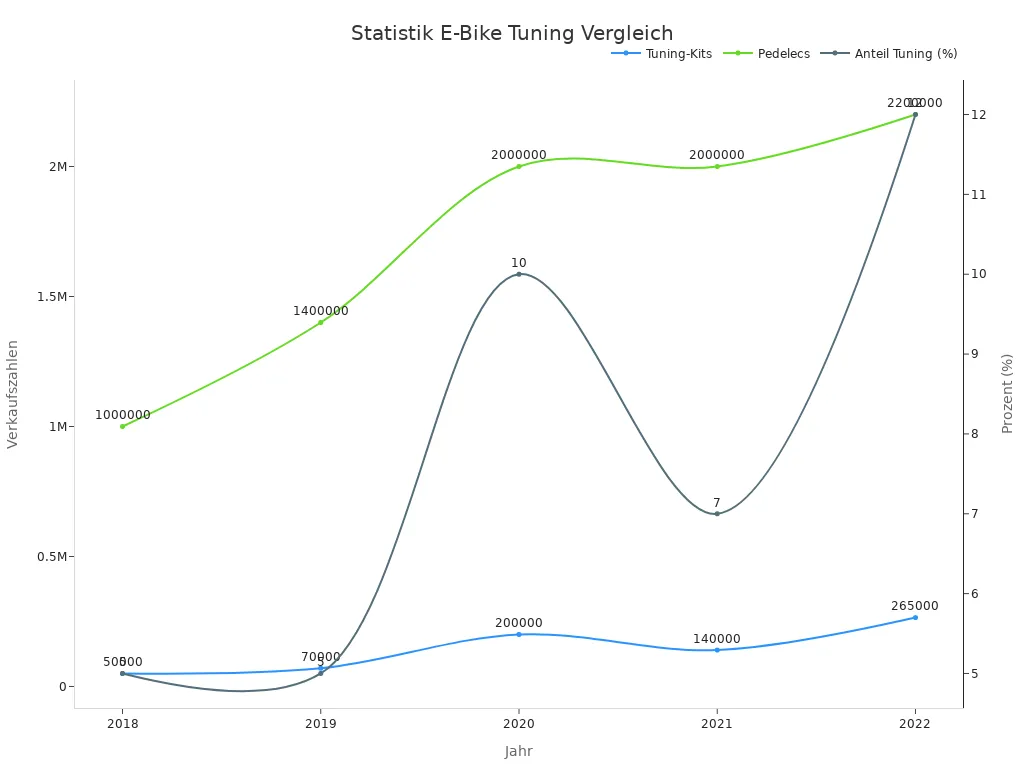
E-bike tuning changes the performance of your electric bicycle. You can bypass the speed limit and improve handling. In Germany, statistics show growing popularity:
2018: 50,000 tuning kits with 1.0 million pedelecs sold.
2022: 265,000 tuning kits with 2.2 million pedelecs.
Ernst Brust, an expert, calls this development alarming. You should be fully aware of the consequences before you decide to tune your e-bike.
Key Findings
E-bike tuning can make your bike faster and more fun. However, there are legal issues. A tuned e-bike counts as a motor vehicle. You will then need insurance and a driver's license.
Before tuning your e-bike, find out which motor it has. Choose a tuning solution that fits your e-bike. It must be compatible with your bike.
There are also legal ways to improve your e-bike. You can adjust the tire pressure or change the chainring. These tricks improve your bike without breaking the law.
What does E-bike tuning mean?
Definition and goals
E-bike tuning means changing the performance of your electric bicycle. This often involves removing the motor's speed limit. The goal is to ride faster or improve motor assistance. Many tuning solutions manipulate the software or hardware of your e-bike. This allows you to increase the maximum speed, which is normally limited to 25 km/h.
Another goal of tuning is to optimize the riding experience. You might want to climb steeper hills more easily or cover longer distances with less effort. Some riders also just want more fun and a sportier feel while riding.
Why do people choose tuning?
People tune their e-bikes for various reasons. One of the most common is the desire for more speed. You might want to get to work faster or keep up with other cyclists. A tuned e-bike can also help you save time, especially on long distances.
Another reason is adapting to personal needs. If you live in a mountainous region, a more powerful motor can make your life easier. Some riders also see tuning as a way to customize their e-bike. It is often about getting the most out of your e-bike and adapting it to your riding style.
Step-by-step guide for E-bike tuning
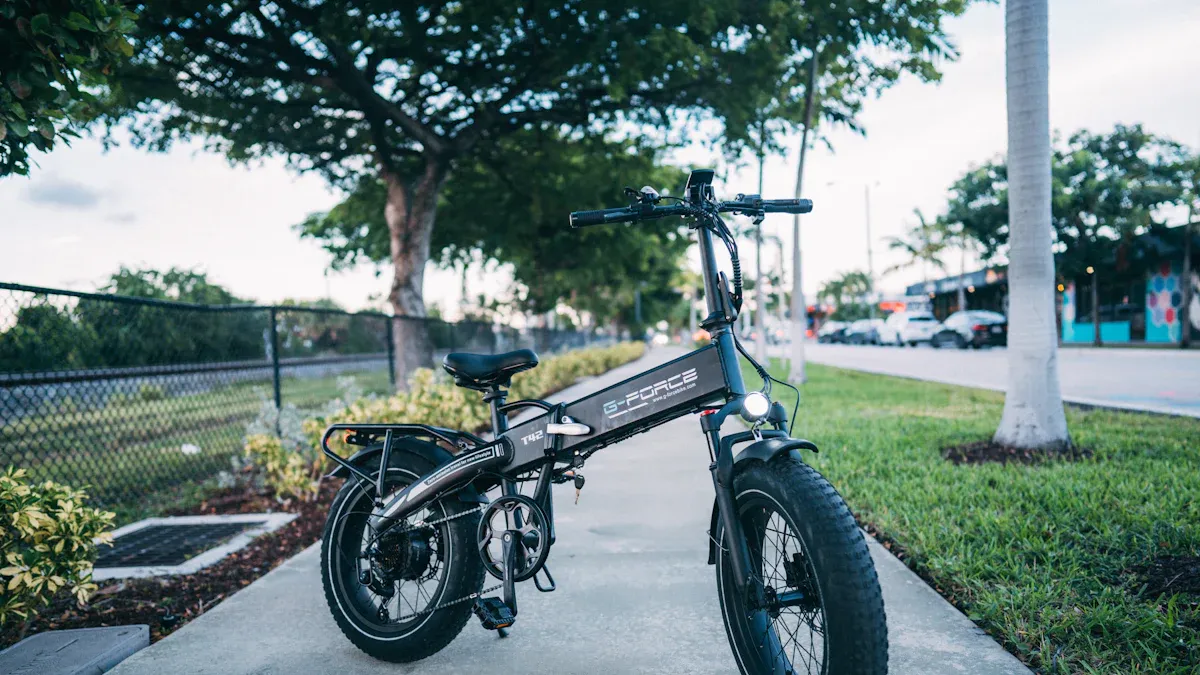
Identification of the e-bike motor
Before you begin tuning, you must identify your e-bike's motor. Different manufacturers like Bosch, Shimano, or Yamaha use different systems. The motors have specific characteristics that influence the choice of the tuning solution. You can often find this information on the motor itself or in your e-bike's manual.
A close look at the technical data will help you avoid mistakes. If you are unsure, you can check the serial number of the motor and look for further details online. Motor identification is the first step to ensure the tuning can be performed successfully.
Choosing the right tuning solution
The choice of the right tuning solution depends on your motor and your goals. There are various types of tuning kits, including hardware modules and software solutions. Hardware modules are installed directly on the motor, while software solutions change the motor's settings via an app or computer program.
A detailed guide will help you find the right solution:
The guide supports you in choosing the appropriate products.
It ensures you follow the correct steps.
The complexity of the process requires special tools and knowledge.
Compare the available options and make sure the solution is compatible with your e-bike. Read customer reviews and technical specifications to make an informed decision.
Tools required for tuning
For tuning, you will need some basic tools. A screwdriver set, a torque wrench, and a laptop or smartphone are often required. Some tuning kits already include the necessary tools, while others require additional equipment.
A well-equipped workspace makes your job easier. Keep all tools within reach before you start the installation. If you are unsure which tools you need, you can consult the tuning kit's manual.
Installation and activation of the tuning solution
Installing the tuning solution requires precision. Follow the steps in the tuning kit's manual exactly. Remove the motor cover, install the module, or connect your e-bike to the software. Make sure all cables are securely connected.
After installation, activate the tuning solution. With software solutions, this is often done via an app that allows you to adjust the settings. Hardware modules usually activate automatically as soon as they are installed correctly. Check all connections before closing the motor again.
Testing and verifying the changes
After installation, you must test the changes. Ride your e-bike on a safe track and check whether the tuning solution is working as expected. Pay attention to motor performance and speed. If problems occur, check the installation and the settings.
Technical studies recommend various test methods to verify the changes:
Test Method |
Description |
|---|---|
Load tests |
Temporarily conducted tests to optimize metrics such as response times and throughput. |
User stress tests |
Regression tests on a pre-live system to compare metrics between releases. |
These tests help you evaluate your e-bike's performance and ensure the tuning was successful. If you are satisfied, you can enjoy your tuned e-bike.
Additional optimization options for your e-bike
Smartphone mount and apps
A smartphone mount makes your e-bike more versatile. You can securely attach your phone and use it while riding. With navigation apps like Komoot or Google Maps, you can find the best routes. Fitness apps help you monitor your performance. Some apps even offer special features for e-bikes, such as controlling the motor or checking battery status.
Tip: Choose a mount that is sturdy and weather-resistant. This keeps your smartphone protected even in the rain.
Adjusting the chainring
The chainring affects the gearing of your e-bike. A larger chainring increases speed, while a smaller one reduces the effort required for pedaling. You can adapt the chainring to your riding habits. A smaller chainring is suitable for mountainous routes. On flat roads, you benefit from a larger chainring.
Adjustment requires some technical skill. You will need tools like a crank puller and a torque wrench. Follow your e-bike's manual to avoid mistakes.
Optimizing tire pressure
The correct tire pressure improves your e-bike's efficiency. Pressure that is too low increases rolling resistance and consumes more energy. Pressure that is too high reduces grip and makes riding unsafe. Check the pressure regularly with a pressure gauge.
Note: The ideal pressure depends on your weight and the type of terrain. For road riding, 3 to 4 bar is common. On uneven terrain, you can slightly reduce the pressure.
With these optimizations, you can tune your e-bike without exceeding legal limits. You improve performance and the riding experience in a safe way.
Warnings and consequences of e-bike tuning
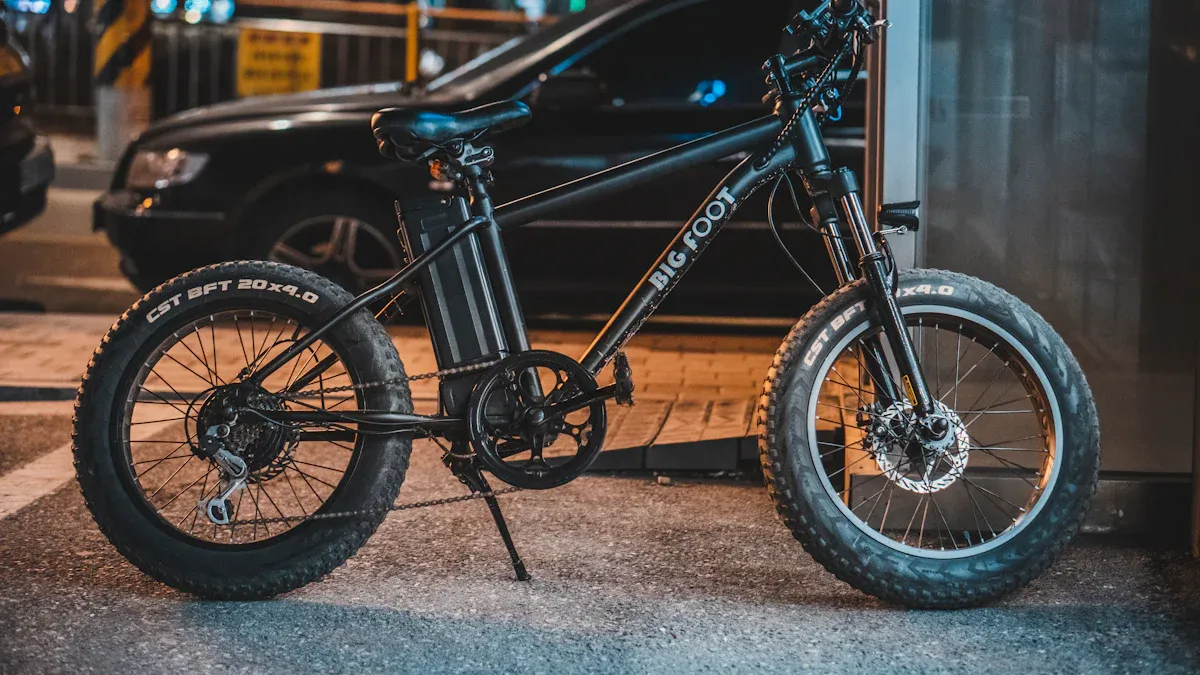
Legal risks and penalties
Tuning an e-bike has significant legal consequences. As soon as you remove your e-bike's speed limit, it is legally classified as a motor vehicle. This classification brings new requirements, such as mandatory insurance and the need for a driver's license. Without these requirements, you face penalties according to Section 21 Para. 1 of the Road Traffic Act (StVG).
Accidents involving tuned e-bikes increase liability. Under Section 7 StVG, you are liable for damages caused by your vehicle. Insurance companies often refuse to cover such damages because tuning invalidates the e-bike's original registration. You must bear the costs for repairs and medical treatments yourself.
Statistics show that accidents with tuned pedelecs are more likely to be fatal than those with unmodified models. The following table illustrates the growing share of tuning kits compared to pedelecs sold:
Year |
Tuning Kit Sales |
Pedelec Sales |
Share of Tuning Kits (%) |
|---|---|---|---|
2018 |
50,000 |
1,000,000 |
5 |
2019 |
70,000 |
1,400,000 |
5 |
2020 |
200,000 |
2,000,000 |
10 |
2021 |
140,000 |
2,000,000 |
7 |
2022 |
2,200,000 |
12 |
Technical risks and potential damage
Tuning your e-bike can lead to serious technical problems. The motors and batteries are designed for specific performance limits. If you exceed these limits, you risk overheating and premature wear. Cables and electronic components can be damaged by the increased load.
Another problem is the compatibility of the tuning solutions. Not all kits are suitable for every e-bike. Faulty installations often lead to malfunctions that require expensive repairs. You should always check your e-bike's technical specifications before installing a tuning kit.
Note: Manufacturers refuse warranty claims if damage was caused by tuning. You lose the right to free repairs or spare parts.
Safety risks due to increased speed
A tuned e-bike increases speed, which significantly raises the risk of accidents. The brakes and tires are often not designed for higher speeds. You can lose control, especially during sudden braking maneuvers or on uneven terrain.
Increased speed also makes reaction time more difficult. Pedestrians and other road users may not perceive your e-bike in time. The risk of collisions increases. Statistics show that accidents with tuned e-bikes are more likely to cause serious injuries.
Tip: Always ride defensively and regularly check your e-bike's brakes and tires to ensure safety.
Impact on warranty and insurance
Tuning your e-bike has direct effects on the warranty and insurance. Manufacturers guarantee the functionality of their products only within the intended specifications. As soon as you tune your e-bike, the warranty is void. You must pay for repairs and spare parts yourself.
Insurance companies do not cover damages caused by tuning. Even if you have liability insurance, insurers will refuse to pay. You are responsible for all costs arising from accidents or technical problems.
Warning: Think carefully about whether you want to tune your e-bike. The financial and legal consequences can be significant.
Tuning an e-bike offers exciting possibilities but also carries significant risks. You should only consider it if you fully understand the legal and technical consequences.
Tip: Legally optimize your e-bike by adjusting tire pressure, changing the chainring, or using apps. These alternatives improve performance and safety without voiding the warranty.
FAQ
What happens if I use my e-bike in public after tuning?
Riding a tuned e-bike on public roads is illegal. You risk fines, loss of insurance coverage, and possible criminal consequences.
Can I reverse my e-bike tuning?
Yes, you can reverse the tuning by removing the tuning solution. Follow the manufacturer's instructions to ensure your e-bike returns to its original state.
Tip: Document the removal if you wish to make warranty claims.
Are there legal alternatives to tuning?
Yes, you can make legal optimizations. Adjust the tire pressure, change the chainring, or use apps to increase efficiency. These methods improve performance without legal risks.
Note: Adhere to the manufacturer's specifications to avoid damage.