
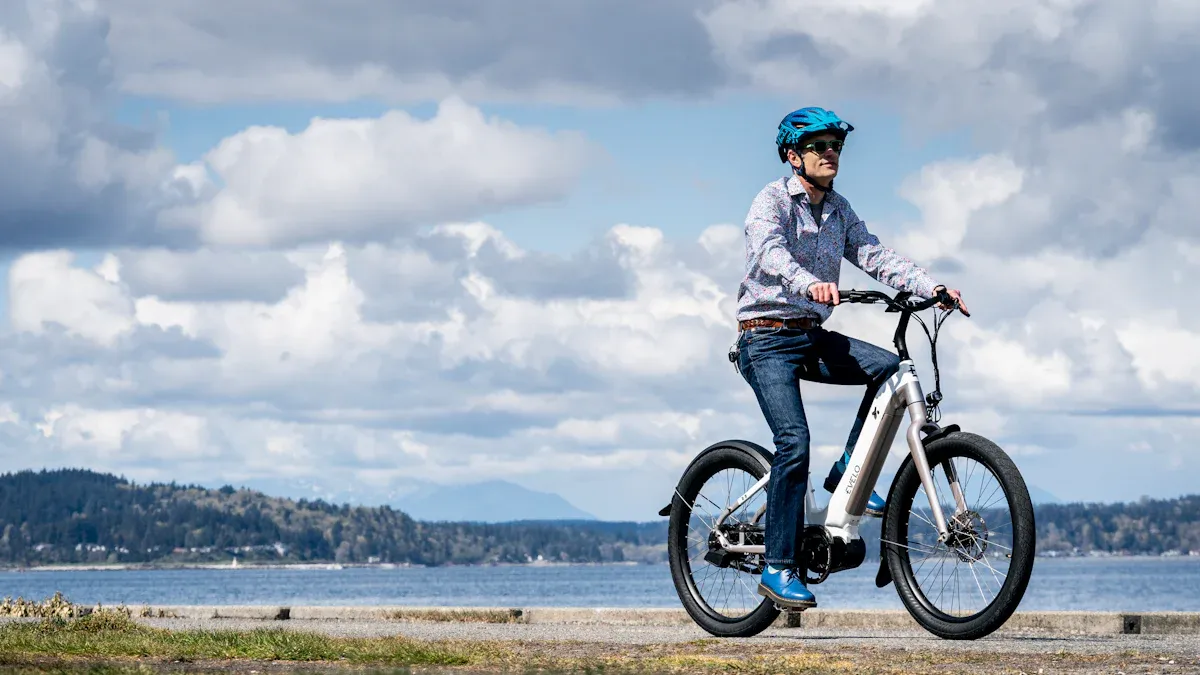
E-bike tests play a crucial role when it comes to choosing the right model. In Germany, over 2 million e-bikes were sold in 2023, more than conventional bicycles. Despite a slight decline in unit sales, e-bike revenue remains strong, which underscores the importance of tests and test reports. Consumers benefit from detailed information, as fewer models stay on the market longer and offer better availability of spare parts.
During e-bike testing, safety, environmental, and quality standards are examined. These tests help you better understand a bike's motor power, battery capacity, and handling. When buying, ensure the model meets your needs, whether for daily use, sports, or longer tours.
Key Insights
E-bike tests help check safety and quality. Take a close look at the brakes and lights.
Choose an e-bike that fits your daily routine. There are models for sports, work, or long rides.
The motor and battery are important. A 250-watt motor and a 500 Wh battery provide good support.
Go for a test ride. This is how you find an e-bike that is comfortable and suits you well.
Check the warranty and service. A warranty protects you from high costs and makes your e-bike safer.
Standards in E-Bike Testing
Safety Standards
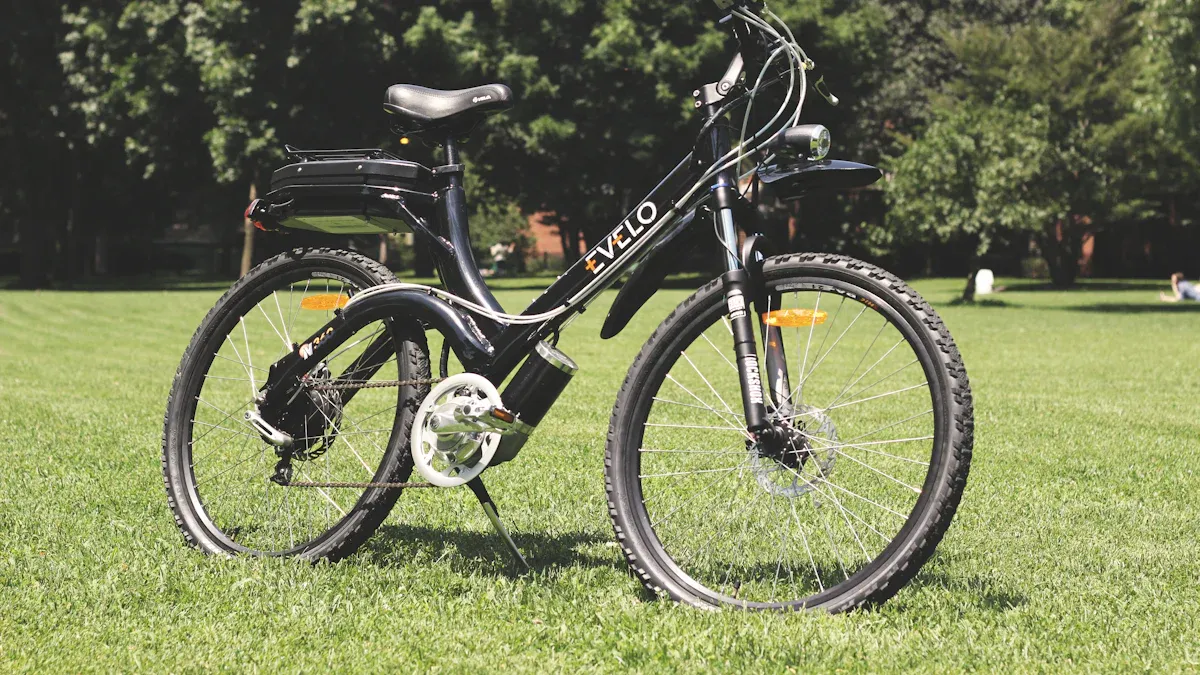
Safety standards are a central component of every e-bike test. They ensure that you feel safe on your e-bike, whether you are riding in the city or on uneven terrain. During e-bike testing, brakes, lighting, and frame stability are checked closely. Checking braking performance under different weather conditions is particularly important. A good e-bike should brake reliably even in rain or snow.
Another aspect is electrical safety. The wiring and battery must be designed to prevent overheating or short circuits. Ensure that the e-bike carries a CE mark. This indicates that the model complies with European safety standards.
Environmental Standards
E-bikes are considered an environmentally friendly alternative to cars. However, there are differences here as well. Environmental standards in e-bike testing evaluate how sustainably a model is produced. The materials of the frame and the recyclability of the battery play a major role in this.
An environmentally friendly e-bike uses recyclable materials and a long-lasting battery. Some manufacturers use eco-friendly packaging to reduce their ecological footprint. Look for e-bikes awarded with environmental certifications such as the "Blue Angel" (Blauer Engel).
Quality Standards
Quality standards ensure that your e-bike is durable and reliable. During e-bike testing, various criteria are evaluated, including workmanship, material quality, and customer reviews. A high-quality e-bike should be robust and function perfectly even after years of use.
The following table shows what quality assessments in a test procedure might look like:
Main Categories |
Score Achieved* |
|---|---|
Packaging, sustainability, labels |
80 |
First impression, odor, quality, utility, injury risk |
85.59 |
Customer opinions, ratings, product promises, price-performance |
100 |
88.53 |
An example of an excellent product is the rear carrier for 2 e-bikes from the brand Grundig Automotive. This model achieved a final grade of 1.4 in the test and fully met the quality standards of the QS standard.
Good quality management ensures that you receive an e-bike that meets your expectations. Pay attention to certifications and independent test results to make an informed decision.
Methods of E-Bike Testing
Test Procedures for Motor Power and Torque
The motor power and torque of an e-bike determine how powerfully and efficiently it rides. During e-bike testing, these values are measured under various conditions to ensure that the e-bike performs well both in the city and on demanding routes.
Torque: This value is indicated in Newton meters (Nm). Higher torque ensures better power delivery, especially when starting off or climbing steep hills.
Power: Motor power is measured in watts (W). According to EU regulations, continuous power must not exceed 250 W. Many motors, however, can reach higher values for short periods, which is helpful during overtaking or on steep passages.
Efficiency: The efficiency of a motor depends on electrical and mechanical power. This is tested at different pedaling frequencies to ensure that the motor works optimally even at varying speeds.
A good test procedure simulates real-world riding conditions. This way, you can be sure that your e-bike's motor functions reliably in every situation.
Battery Tests: Range, Charging Time, Lifespan
The battery is the heart of an e-bike. Battery tests during e-bike testing evaluate how far you can ride on a single charge, how long it takes to charge, and how long the battery lasts.
Range: A higher battery capacity does not automatically guarantee a longer range. Factors like riding style, terrain, and weather affect the actual range. A 500 watt-hour (Wh) battery, for example, allows for about 85 kilometers in Eco mode on flat terrain, while it only manages around 20 kilometers uphill with maximum support.
Charging Time: Batteries with higher capacity generally take longer to charge. A 400 Wh battery can, under ideal conditions, enable about two hours of riding at 200 watts of motor power.
Lifespan: Lithium-ion batteries, which are used in most e-bikes, lose capacity over time. Their lifespan depends on the number of charging cycles and the outside temperature.
Ensure that your e-bike's battery is not only powerful but also durable. A high-quality battery saves you costs in the long term and ensures a reliable riding experience.
Ride Tests: Comfort, Handling, Off-Road Capability
An e-bike must not only ride well but also be adapted to your needs. Ride tests during e-bike testing evaluate how comfortable and safe an e-bike is in various situations.
Comfort: Seating position, suspension, and the ergonomics of the grips play a major role. A comfortable e-bike reduces fatigue and ensures a pleasant riding experience, even on longer stretches.
Handling: Good handling means you can control the e-bike easily. This is verified by tests in tight turns, during sudden braking maneuvers, and on slippery surfaces.
Off-Road Capability: For off-road fans, suitability for rough terrain is crucial. Ride tests on gravel paths, forest trails, and steep climbs show whether the e-bike is suitable for challenging routes.
A comprehensive ride test gives you the confidence that your e-bike will perform well in any situation. Try out various models to find the perfect e-bike for you.
Stress Tests: Maximum Payload, Long-Term Tests
Stress tests play a decisive role in evaluating the durability and reliability of an e-bike. These tests check how well an e-bike handles different loads and give you peace of mind that your model will withstand demanding conditions.
Maximum Payload
The maximum payload of an e-bike describes how much weight it can safely transport. This includes your own weight, luggage, and possibly a child seat. During e-bike testing, the payload is tested under realistic conditions. Manufacturers often specify a maximum load of 120 to 150 kilograms. However, not every model holds up to these values in practice.
A stress test simulates different scenarios, such as riding with heavy luggage or crossing curbs. This checks whether the frame remains stable and whether components like wheels, brakes, and suspension function reliably. Ensure that your chosen e-bike offers a payload that suits your daily life. If you frequently transport heavy loads, a model with a reinforced frame or special racks might be the better choice.
Long-Term Tests
Long-term tests evaluate how well an e-bike functions over an extended period. These tests simulate months or even years of riding within just a few weeks. Wear-and-tear parts like brake pads, chains, and tires are examined very closely during this process.
An important aspect is the consistency of the battery. Long-term tests show whether battery capacity remains stable after many charge cycles or drops significantly. Motor performance is also tested over an extended period to ensure it does not fade.
A good e-bike should remain reliable even after intensive use. Long-term tests help you find models that impress not just at the start, but offer good performance even after years.
Tip: Choose an e-bike that has performed well in independent long-term tests. This way, you can be sure you are getting a durable and robust model.
Stress tests provide the assurance that your e-bike is up to the challenges of everyday life. They are an indispensable part of assessing the quality and safety of a model.
What to Look for When Buying an E-Bike
The Right E-Bike Type
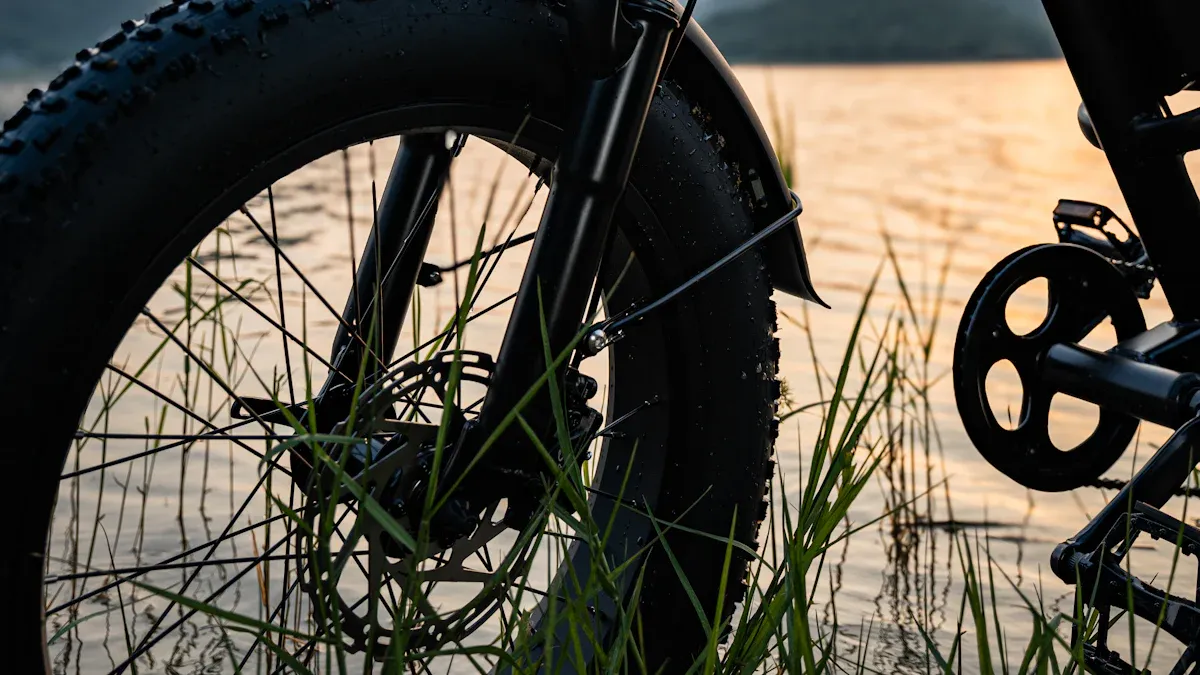
The choice of the right e-bike type depends on your individual needs. Think about how and where you want to use the e-bike. For everyday city use, e-city bikes are suitable, scoring points with a comfortable seat and an upright riding position. If you plan longer routes or tours, a trekking e-bike is ideal. According to a survey, 38% of buyers prefer this type.
For athletic riders, e-mountain bikes (e-MTBs) are the best choice. They are robust and suitable for uneven terrain. The market share of e-MTBs rose to 39% in 2023. If you want to transport heavy loads, you should consider an electric cargo bike. These models are particularly popular with families and recorded a sales increase of 14.5% compared to the previous year.
Motor and Battery Performance
Motor and battery performance significantly influence the performance of your e-bike. A motor with a torque of 50 to 85 Nm provides strong support, especially on hills. Motor power is limited to 250 watts to comply with legal requirements for pedelecs.
The battery determines how far you can travel on one charge. Higher capacity means a longer range. A 500 Wh battery enables up to 85 kilometers in Eco mode. Note, however, that factors like terrain and riding style influence the range. Lithium-ion batteries are the best choice as they are durable and powerful.
Category |
Details |
|---|---|
E-bike motor: Power |
Motor power is stated in watts, with a limit of 250 watts for pedelecs. |
E-bike motor: Torque |
Torque between 50 and 85 Nm, important for support while pedaling. |
E-bike battery: Weight |
Depending on capacity, batteries weigh between 2.5 kg and 5 kg, which influences total weight. |
E-bike battery: Range |
Higher battery capacity leads to greater range, crucial for e-bike usage. |
E-bike battery: Charging time |
Lithium-ion batteries are powerful and durable, which influences their selection. |
Weight and Transport Options
The weight of an e-bike plays an important role, especially if you have to carry or transport it often. An average e-bike weighs between 20 and 25 kilograms. Models with powerful batteries and motors can be heavier. If you want to take your e-bike on public transport, look for low weight and foldable models.
Special bike carriers are required for transport by car. Ensure that the carrier can support the weight of your e-bike. Some models offer removable batteries, which reduce the weight when carrying them.
Tip: Try out different models to find the right weight and best transport options for your daily routine.
Technical Equipment
The technical equipment of an e-bike determines how well it meets your requirements. Different components like the motor, battery, and gear system play a decisive role.
Motor Types and Their Characteristics
E-bikes use different motor types, each offering advantages and disadvantages. The following table shows you what options are available:
Drive Type |
Advantages |
Disadvantages |
|---|---|---|
Front motor/hub motor |
- Coaster brake possible |
- Steering behavior can be affected |
Rear motor/hub motor |
- Very quiet |
- no coaster brake |
Mid-motor/bottom bracket motor |
- Good center of gravity |
- Chain suffers faster wear |
A mid-drive motor offers you a balanced center of gravity and is particularly suitable for demanding routes. A rear-wheel motor provides a quiet riding experience, while a front-wheel motor scores points with its compact design.
Further technical details
Motor power: The power of an e-bike is a maximum of 250 watts to comply with legal requirements. This limit distinguishes pedelecs from S-pedelecs, which reach higher speeds.
Battery power: A battery with at least 350 Wh allows you a range of over 50 kilometers. This is ideal for longer tours or your daily commute.
Make sure the technical equipment matches your riding style. A powerful motor and a long-lasting battery not only increase comfort but also the reliability of your e-bike.
Price-performance ratio and maintenance costs
A good price-performance ratio is crucial when you buy an e-bike. You should consider not only the purchase price but also the long-term costs.
Acquisition costs
E-bikes generally cost between 1,500 and 5,000 euros. High-quality models with powerful motors and long-lasting batteries are often in the upper price segment. Consider which features are indispensable for you in order to avoid unnecessary expenses.
Maintenance costs
The maintenance costs of an e-bike are made up of several factors:
Battery replacement: A new battery costs between 300 and 800 euros. The service life depends on usage and care.
Maintenance: Regular inspections cost about 50 to 100 euros per year.
Wear parts: Brake pads, tires, and chains must be replaced depending on usage.
Tip: Invest in a model with high-quality components. This reduces maintenance costs and extends the service life of your e-bike.
A cheap e-bike can seem tempting at first glance, but quality and follow-up costs should always factor into your decision. Choose a model that meets your requirements and remains economical in the long term.
Additional tips for buying an e-bike
Take a test ride
A test ride is essential to find the right e-bike. You can check whether the model meets your expectations and is comfortable to ride. Pay attention to the seating position, suspension, and brakes. Hydraulic disc brakes offer you safety, especially during sudden stops. The saddle also plays an important role. A comfortable saddle improves the riding feel and should be tested during the test ride.
According to surveys, 8 out of 10 buyers place great importance on a test ride. Local specialist dealers are the preferred point of contact for purchasing, as they offer you the opportunity to try out different models. The following table shows how important test rides and expert advice are for buyers:
Result |
Description |
|---|---|
80% of respondents |
Prefer the local specialist dealer for the purchase. |
Importance of test ride |
8 out of 10 respondents value a test ride. |
Information sources |
75% get information in a specialist shop, 79% read test reports. |
Tip: Try out several models to find the perfect e-bike for your needs.
Check warranty and service offers
Warranty and service benefits are crucial for long-term enjoyment of your e-bike. Many manufacturers offer a two-year liability for defects, which covers the entire bicycle and its attachments. However, wear parts such as brake pads and tires are often excluded. Regular inspections are necessary to maintain the warranty. During these, safety-relevant parts such as the battery, motor, and electronics are checked.
The following table shows typical warranty conditions:
Warranty |
Coverage |
Exceptions |
|---|---|---|
Entire bike and attachments |
Accidental damage, improper use, assembly errors |
|
12-month warranty |
Frame, fork, handlebars, seat post |
Wear parts like brake pads, tires, battery |
Over 135,000 satisfied customers confirm the quality of the service provided. Inspections according to manufacturer specifications are necessary to ensure the safety of your e-bike.
Note: Check the warranty conditions carefully and choose a model with comprehensive service offerings.
Consider insurance options
Special e-bike insurance offers you comprehensive protection. Many owners rely on their household insurance, which often only covers theft and comes with limitations. Technical problems, accidents, and repair costs are usually not covered. E-bike insurance, on the other hand, covers theft, repairs, and damage caused by accidents.
The most common causes of damage to e-bikes are technical problems, accidents, and theft. Repair costs can quickly become expensive, especially with motor or battery damage. With e-bike insurance, you are on the safe side and don't have to worry about unexpected costs.
Tip: Inform yourself about different insurance options and choose one that meets your needs. Comprehensive protection gives you peace of mind and ensures a worry-free riding experience.
E-bike tests provide you with clear guidance. They evaluate important criteria such as battery capacity, motor power, and drive type. A model with 500 Wh battery capacity, 250-watt motor power, and pedal assistance, for example, received a grade of 1.7 at a price of €2,576.00.
Feature |
Values |
|---|---|
Battery capacity |
500 Wh |
Motor power |
250 watts |
Drive type |
Pedal assistance |
Grade |
1.7 |
Price |
€2,576.00 |
Test results help you understand the strengths and weaknesses of a model. Categories such as price-performance, recommendations, and test procedures facilitate the selection.
Category |
Description |
|---|---|
Price-performance |
Award evaluating the best price-performance ratio. |
Recommendation |
Award recommending models positively rated by the specialist press. |
Test categories |
E-bikes are divided into Tour/Trekking, City/Urban, Cargo/Family, and Sport/Performance. |
Test procedure |
Comprehensive test process with detailed analyses of the strengths and weaknesses of e-bikes. |
Take your time to find the right e-bike. A well-informed decision ensures long-term satisfaction and an optimal riding experience.
FAQ
What is the difference between a pedelec and an e-bike?
A pedelec only assists you when you pedal. It has a maximum motor power of 250 watts and a top speed of 25 km/h. An e-bike, on the other hand, can also ride without pedaling and often reaches higher speeds.
How do I properly maintain my e-bike battery?
Charge the battery at room temperature and avoid extreme temperatures. Store it half-charged if you are not going to use the e-bike for a long period. Clean the contacts regularly and use only the original charger.
Can I ride an e-bike in the rain?
Yes, most e-bikes are weatherproof. Ensure that the battery and electronics are well-sealed. After riding in the rain, you should dry the e-bike to avoid corrosion.
How long does an e-bike battery last?
A lithium-ion battery typically lasts 500 to 1,000 charging cycles. This corresponds to about 3 to 5 years, depending on usage. The service life depends on care and charging habits.
Do I need insurance for my e-bike?
For pedelecs, household insurance is often sufficient to cover theft. For S-pedelecs or expensive models, special e-bike insurance is recommended. It also protects you in the event of accidents and technical damage.
Tip: Inquire with your insurer about the best options for your e-bike.