
You want to know how far your e-bike actually travels. On average, you can count on 40 to 120 kilometers. According to current data, many models like the KTM Macina Cross SX manage about 52 kilometers per battery charge. The range depends heavily on your riding style, the terrain, and the weather. Every battery reacts differently to inclines and headwinds. With the right tips, you can get more out of every ride.
Key takeaways
-
The range of your e-bike depends on the battery size. Larger batteries allow for longer rides.
-
Riding style and mode affect the range. Choose the Eco mode for maximum efficiency.
-
The weight of the rider and luggage reduces the range. Lighter rides take you further.
-
Weather conditions, especially cold, reduce battery performance. Plan for less range in cold weather.
-
Use online calculators to estimate the range realistically. These tools help you plan your tour.
Typical e-bike range
Average values and recommended battery sizes
You want to know how far you can really get with your e-bike. The range primarily depends on the battery size. The larger the battery, the further you can ride. The following table shows you how different battery capacities affect the average range:
|
Average range (km) |
|
|---|---|
|
400 Wh |
40–80 |
|
500 Wh |
50–90 |
|
625 Wh |
60–110 |
|
750 Wh |
75–130 |
Experts recommend different battery sizes for different e-bike types. Here is an overview:
|
E-bike type |
Recommended battery size (Wh) |
|---|---|
|
City e-bikes |
400–500 |
|
E-trekking and e-city bikes |
500–800 |
|
Trekking e-bikes |
Up to 800 |
|
Sporty e-mountain bikes |
Up to 800 |
Tip:
For regular tours, you should plan for a range of at least 80 kilometers. Commuters usually get by with 50 to 70 kilometers. If you carry a lot of luggage or ride in the mountains, it is better to calculate with 100 kilometers.
Manufacturer specifications vs. reality
Many manufacturers claim high ranges. These values are often created under optimal laboratory conditions. In practice, things look different. You rarely ride on flat terrain in perfect weather. Many factors influence how far you really get. These include your weight, the weight of the e-bike, the route, the assistance mode, and the weather.
|
Influence on range |
|
|---|---|
|
Battery performance in watt-hours |
High |
|
Total weight of rider and e-bike |
High |
|
Route topography |
High |
|
Assistance mode setting |
Medium |
|
Riding in inappropriate gears |
Medium |
|
General riding behavior |
High |
|
Outside temperature |
Medium |
|
Headwind or tailwind |
High |
|
Charging habits |
Medium |
|
Tire choice and tire pressure |
Medium |
|
Cadence |
Medium |
Many users report that the actual range is often below the manufacturer specifications. This is because laboratory values rarely reflect real conditions. You should therefore not rely solely on the information in the brochure. Use your own experiences and independent tests to better estimate the range.
Note:
The range in everyday life is usually up to 70 kilometers. For longer tours, you can expect 70 to 100 kilometers. Only under optimal conditions and with a large battery will you reach over 100 kilometers.
Factors for the range
Battery and motor
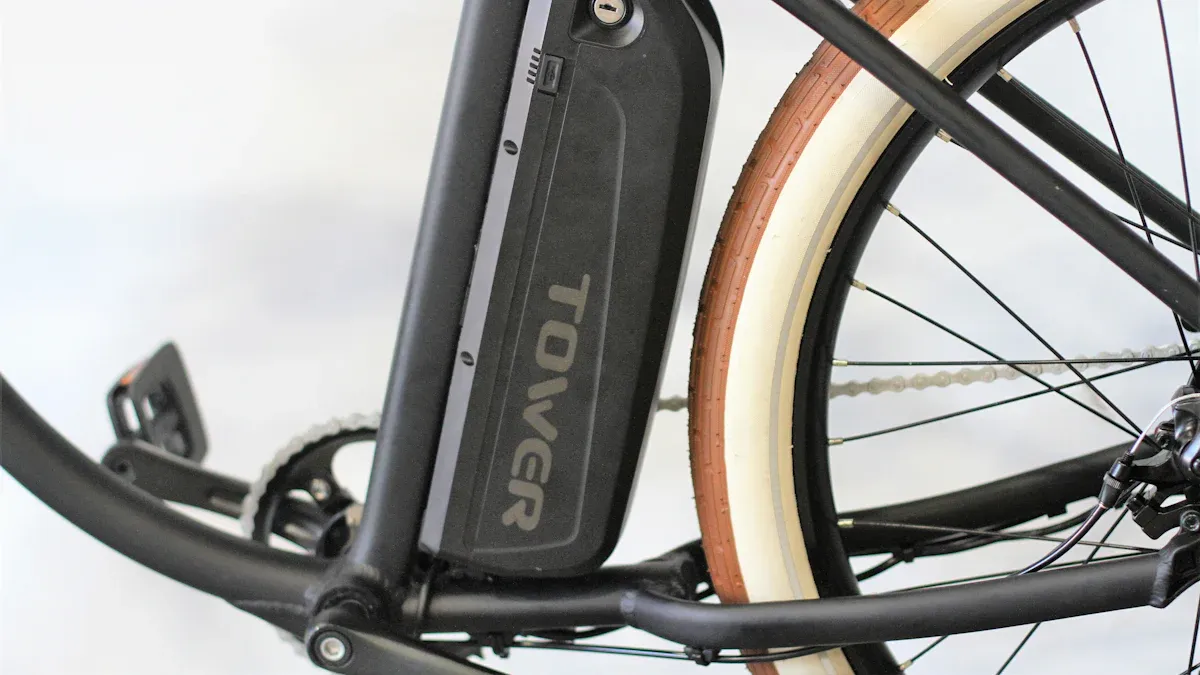
The battery and the motor determine how far you get with your e-bike. A larger battery capacity in watt-hours (Wh) ensures longer rides. You calculate the capacity from voltage (volts) and charge (ampere-hours). The efficiency of the motor also plays an important role. An efficient motor consumes less energy and takes you further. Mid-motor systems usually run more economically than hub motors. With good maintenance, you can increase the efficiency of your e-bike by up to 10%.
-
A higher battery capacity in Wh enables longer distances.
-
The motor efficiency influences energy consumption.
-
Battery capacity is determined by Volts × Ampere-hours.
The choice of motor also affects the range. Some motors, such as the Bosch CX, provide full power until the end. Other models reduce the assistance when the battery is almost empty. Differences in efficiency and range can influence your buying decision.
Riding style and mode
Your riding style has a great influence on the range. If you ride consistently and anticipate traffic, you save energy. Frequent acceleration and abrupt braking consume more power. Even small adjustments can get you several kilometers extra. Reduce your speed slightly to travel further. Pedaling steadily helps conserve the battery.
The selected riding mode also determines how far you get. The following table shows how the different modes affect the range:
|
Riding mode |
Assistance (%) |
Influence on range |
|---|---|---|
|
Eco / Eco+ |
30% – 50% |
Maximum range |
|
Tour |
60% – 100% |
Balanced compromise |
|
Sport / eMTB |
120% – 200% |
Significantly higher consumption |
|
Auto / Smart |
up to 340% |
Automatic adjustment |
|
Turbo / Boost |
up to 400% |
Highest energy consumption |
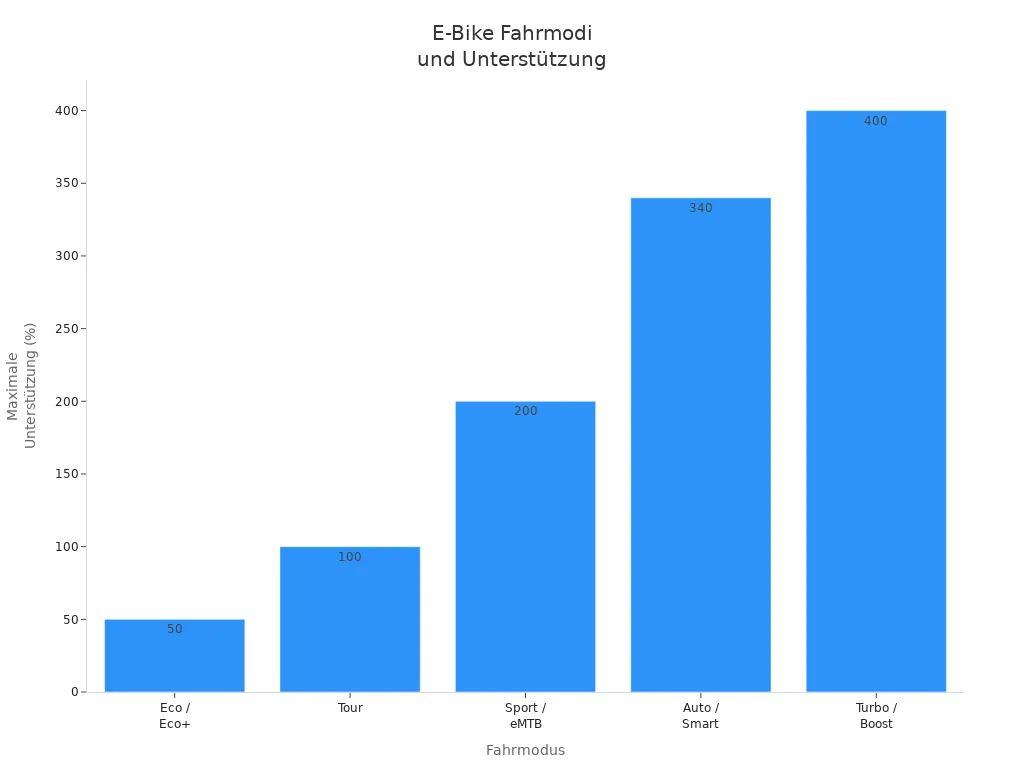
Select the Eco mode for maximum range. In Turbo mode, you consume the most energy.
Route and terrain
The route profile and terrain influence how far you get with one battery charge. On smooth asphalt with the correct tire pressure, you achieve the highest range. Unpaved paths, many hills, or stop-and-go in the city cost more energy. Off-road rides significantly reduce the range. Long, open routes without many interruptions are ideal.
|
Terrain |
Range (km) |
Battery (Wh) |
|---|---|---|
|
Flat |
80 |
500 |
|
Hilly |
40-50 |
500 |
The road surface and rolling resistance also play a role. The more resistance, the more energy your e-bike needs.
Weight and weather
The weight of the rider and luggage directly affects the range. A higher total weight means the motor has to work harder. A 50 kg rider can travel up to 100 km, while a 100 kg rider often only manages 80 km. The weather also influences how far you get. In cold temperatures, the battery capacity drops. Temperatures below 10°C noticeably reduce the range. In winter, you often lose 10 to 30% of range because the internal resistance of the battery cells increases.
|
Factor |
Influence on range |
|---|---|
|
Weather conditions |
The colder it is, the shorter the distance. |
|
Rider weight |
Higher total weight leads to lower range. |
Tip:
Always plan for a lower range in cold weather and with heavy luggage. Check tire pressure regularly and keep your e-bike clean to increase efficiency.
Calculating and estimating range
Online calculators and apps
You want to know how far your e-bike really goes. There are practical online calculators and apps for this. These tools help you better estimate the range of your e-bike. They consider important factors such as riding behavior, terrain, and wind. The Bosch e-bike range calculator and the e-bike range assistant are particularly popular. Both offer you a simple way to simulate different scenarios.
|
Tool/App |
Description |
|---|---|
|
E-bike range calculator |
A calculator from Bosch that takes into account various criteria such as riding behavior, terrain type, and wind conditions to calculate the range. |
|
E-bike range assistant |
Helps calculate the range for an e-bike tour, taking the mentioned criteria into account. |
With these tools, you can, for example, set how much you weigh, what the weather is like, and which riding mode you are using. The result shows you approximately how far you can get with one battery charge.
Practical Assessment
Many users report that online calculators and apps are often closer to real-world experiences than the official manufacturer specifications. These tools provide realistic values because they are based on actual experience. You can rely on the results when planning your trip.
-
Online calculators and apps offer realistic assessments that are often closer to the actual experiences of users than the official WLTP figures.
-
User reviews show that these tools are helpful for calculating range under realistic conditions.
-
The results are based on authentic experience and are therefore often more realistic than WLTP figures.
If you are planning a longer trip, you should always include a small safety margin. The tools provide good guidance, but you should also rely on your own intuition and past experience. This way, you can avoid surprises and enjoy your ride in a relaxed manner.
Tips for greater range
Optimize your riding style
You can achieve a lot with small changes to your riding style. Here are important tips to help you ride further:
-
Use the assistance levels consciously. Select high assistance only when you really need it.
-
Adjust your speed. Ride a little slower to save energy.
-
Check your tire pressure regularly. Low air pressure increases rolling resistance.
-
Reduce unnecessary luggage. Every kilo counts.
-
Take advantage of tailwinds and downhill slopes to move forward without using much energy.
-
Keep your e-bike clean and well-maintained. This makes everything run more smoothly.
Tip: Plan your route to minimize headwinds and inclines. This saves battery power and helps you go further.
Battery and care
A well-maintained battery lasts longer and takes you further. Pay attention to these notes:
-
Store the battery at room temperature, ideally between 15 and 20 °C.
-
Avoid extreme cold. At temperatures below 5 °C, capacity can drop by up to 40 %.
-
Keep the charge level between 20 % and 80 %. This protects the battery from damage.
-
Use your e-bike regularly. Long periods of inactivity damage the battery.
Note: Modern lithium-ion batteries work best at temperatures between 15 and 25 °C.
Maintenance and technology
Regular maintenance ensures better range and more riding pleasure. The following table shows which measures are important:
|
Effect on range |
Recommended frequency |
|
|---|---|---|
|
Clean and oil the chain |
Reduces friction, saves energy |
every 200–300 km |
|
Check tire pressure |
Prevents increased rolling resistance |
before every ride |
|
Clean contacts |
Ensures optimal energy transfer |
monthly |
|
Dealer inspection |
Extends total service life |
annually |
With these tips, you will get the most out of your e-bike and noticeably increase your range.
Common misconceptions and questions about range
Lower range than expected
Wondering why your e-bike sometimes doesn't go as far as you thought? Many factors can shorten the distance. Common causes include:
-
The motor does not always operate at the same efficiency.
-
Your riding behavior, for example, frequent use of high assistance levels, consumes more energy.
-
Your weight and the weight of your luggage, as well as tire pressure, play a major role.
By paying attention to these points, you can better estimate the actual range and avoid surprises.
Avoiding range anxiety
Many e-bike riders are afraid of suddenly running out of power on the road. This concern is called range anxiety. You can easily reduce it by:
-
Planning your trip with a small safety margin.
-
Using online calculators or apps to realistically estimate the distance.
-
Charging your battery regularly and keeping it in good condition.
-
Paying attention to your riding behavior and choosing energy-saving assistance levels.
With good preparation and a bit of experience, you will quickly lose your fear of empty batteries.
Myths about the battery
There are many myths surrounding e-bike batteries. Here are the most important misconceptions and the truth about them:
-
Many believe you should always fully discharge the battery before recharging it. This is not true. Modern lithium-ion batteries do not have a memory effect.
-
Some think you must always charge the battery to 100%. That is wrong. A charge level between 80 and 90% is better for its service life.
-
There is a rumor that you shouldn't charge until the battery is completely empty. That is also incorrect. It is better to charge sooner.
Scientific studies show that batteries today are more robust than they used to be. Annual degradation is now only about 1.8 %. Frequent use or irregular charging does not harm the battery. On the contrary: alternating charging and resting phases can actually extend its service life. Many batteries will last 20 years or longer if you don't subject them to extreme conditions.
You can realistically estimate your e-bike's range by considering important factors like the battery, riding style, and route. Use digital tools for planning and adapt your riding style. Experts recommend:
-
Check before every trip if your battery has enough capacity.
-
Take into account inclines, headwinds, and total weight.
-
Select the appropriate assistance level for your route.
Maximize your range with these tips:
-
Plan flat routes and reduce unnecessary luggage.
-
Keep the battery charged between 20 % and 80 %.
-
Use Eco mode and pay attention to proper tire pressure.
Check your settings regularly and adapt them to your needs. This way, you can ride more relaxedly and go further.
FAQ
How can I quickly estimate my e-bike's range?
You can use online calculators such as the Bosch range assistant. Enter your weight, the route, and the riding mode. The tool will show you a realistic range.
What happens if the battery runs out on the road?
You can continue riding, but without motor assistance. The e-bike will function like a regular bicycle. You should check beforehand if you have enough battery for your route.
Do I always have to charge the battery completely?
You do not always have to fully charge the battery. A charge level between 20 % and 80 % protects the battery. This extends its service life and provides better range.
How does cold weather affect range?
Cold reduces battery performance. You can expect up to 30 % less range. Store the battery at room temperature and charge it before your trip.