
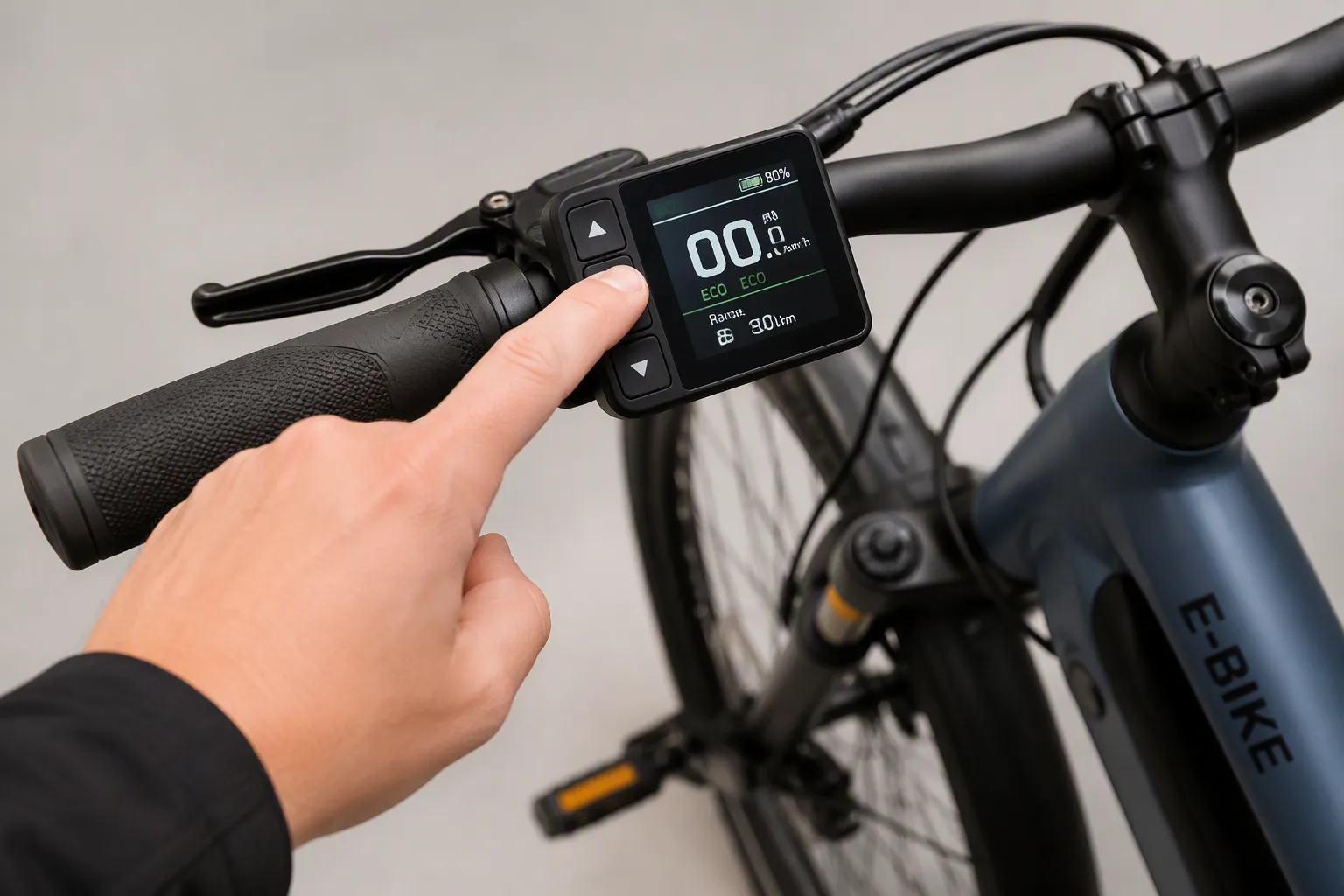
An e-bike is a bicycle with an electric motor that assists you as you pedal. You pedal, and the motor gives you an extra boost. But how exactly does it work, and what goes into one? You may have heard that 2.1 million e-bikes were sold in Germany in 2023. It’s time to take a closer look at the technology. We’ll explain how the motor, battery, and sensors work together and how e-bikes differ from regular bicycles.
Key takeaways
An e-bike assists your pedaling power but doesn’t replace it.
Pedelecs are legally classified as bicycles, while true e-bikes are motor vehicles.
The motor, battery, sensor, and controller work together to provide assistance.
An e-bike is heavier and more expensive, but tackles hills with ease.
E-bikes are ideal for commuters and older adults.
What is an e-bike?
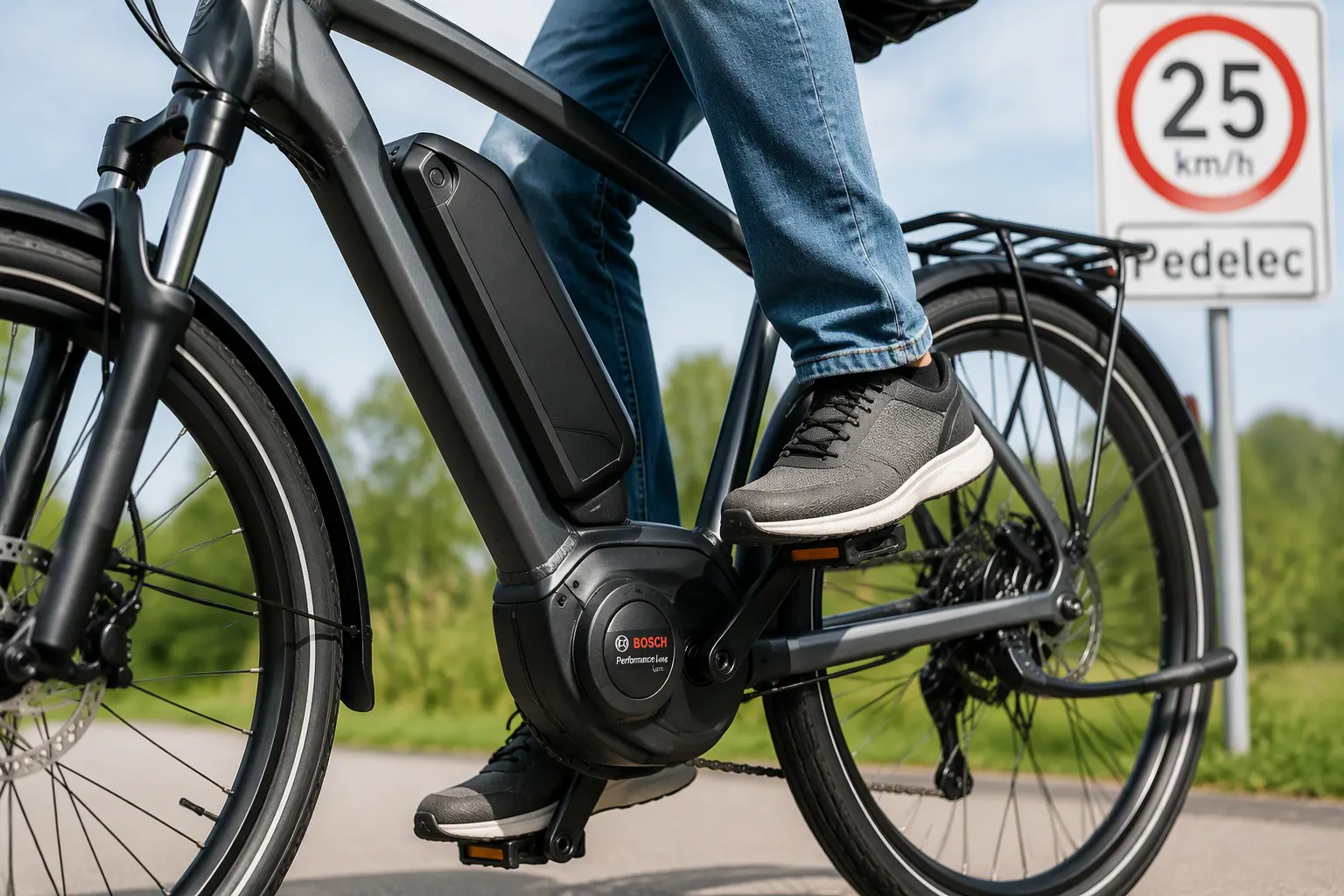
An e-bike is essentially a bicycle with an electric drive. The motor boosts your pedaling power; it doesn’t replace it. You set the pace, and the motor gives you the right amount of assistance. This basic principle distinguishes an e-bike from a moped or motorcycle. The bike won’t move without your muscle power—at least with most models.
Pedelec vs. e-bike: The legal difference
The terms Pedelec and e-bike are often used interchangeably. Legally, however, there’s a clear distinction. A Pedelec only provides motor assistance when you pedal. That’s why most Pedelecs are legally classified as bicycles. Typical features include a maximum continuous rated power of 250 watts and automatic cut-off of assistance at 25 km/h. A starting or walk-assist function up to 6 km/h is permitted.
The Road Traffic Act defines these vehicles precisely:
“Not motor vehicles within the meaning of this Act are land vehicles propelled by muscle power and equipped with an auxiliary electric motor with a maximum continuous rated power of 0.25 kW, whose assistance progressively decreases as the vehicle’s speed increases and is cut off when a speed of 25 km/h is reached, or earlier if the rider stops pedaling.”
A true e-bike, on the other hand, can also ride without you pedaling. It has a throttle or a button to operate the motor. These models are classified as motor vehicles. You need an operating permit, an insurance plate, and, depending on the class, a driver’s license. The following table shows the key differences:
Feature |
Pedelec |
(true) e-bike |
|---|---|---|
Motor assistance |
Only while pedaling |
Also without pedaling |
Maximum speed |
25 km/h |
45 km/h |
Driver’s license required |
No |
Yes |
Insurance required |
No |
Yes |
Helmet required |
No |
Yes (depending on model) |
For most everyday riders, a Pedelec is the right choice. It remains legally classified as a bicycle, so you don’t need a driver’s license or insurance. The term e-bike has nevertheless become the common name for all electrically assisted bikes—even though that’s not entirely accurate from a legal perspective.
The key components at a glance
A modern e-bike consists of four main components that need to work together seamlessly.
The motor is the heart of the system. There are three common types:
Mid-drive motor: Located at the bottom bracket, this is considered the most technically advanced option. It’s the first choice for challenging trails or tours with steep climbs.
Rear hub motor: Often found on city e-bikes and entry-level models. It offers solid motor power at an affordable price and is well suited to flat terrain.
Front hub motor: The simplest option. It pushes the bike from the front, requires little maintenance, and is inexpensive, but is less common and offers a less dynamic riding experience.
The battery stores the energy for your ride. Typical capacities range from 500 to 750 watt-hours. Range depends greatly on your riding style:
Battery capacity |
Approximate range |
|---|---|
500 Wh |
50–100 km |
625 Wh |
60–120 km |
750 Wh |
75–150 km |
These figures are estimates. Terrain, rider weight, assistance level, and riding style all have a significant effect on the actual range. A 500 Wh battery is often enough for short everyday rides, while 625 or 750 Wh is recommended for longer trips.
The sensor detects your pedaling motion and power. It measures how hard you push on the pedals and how fast you pedal. It sends this information to the controller.
The controller is the brain of the system. It processes the sensor signals and controls the motor accordingly. You select the desired assistance mode on the display, and the controller adjusts the motor output to match.
All four components work together with every pedal stroke. You pedal, the sensor measures, the controller calculates, and the motor provides assistance. This interaction makes riding feel so natural and comfortable.
How e-bike technology works
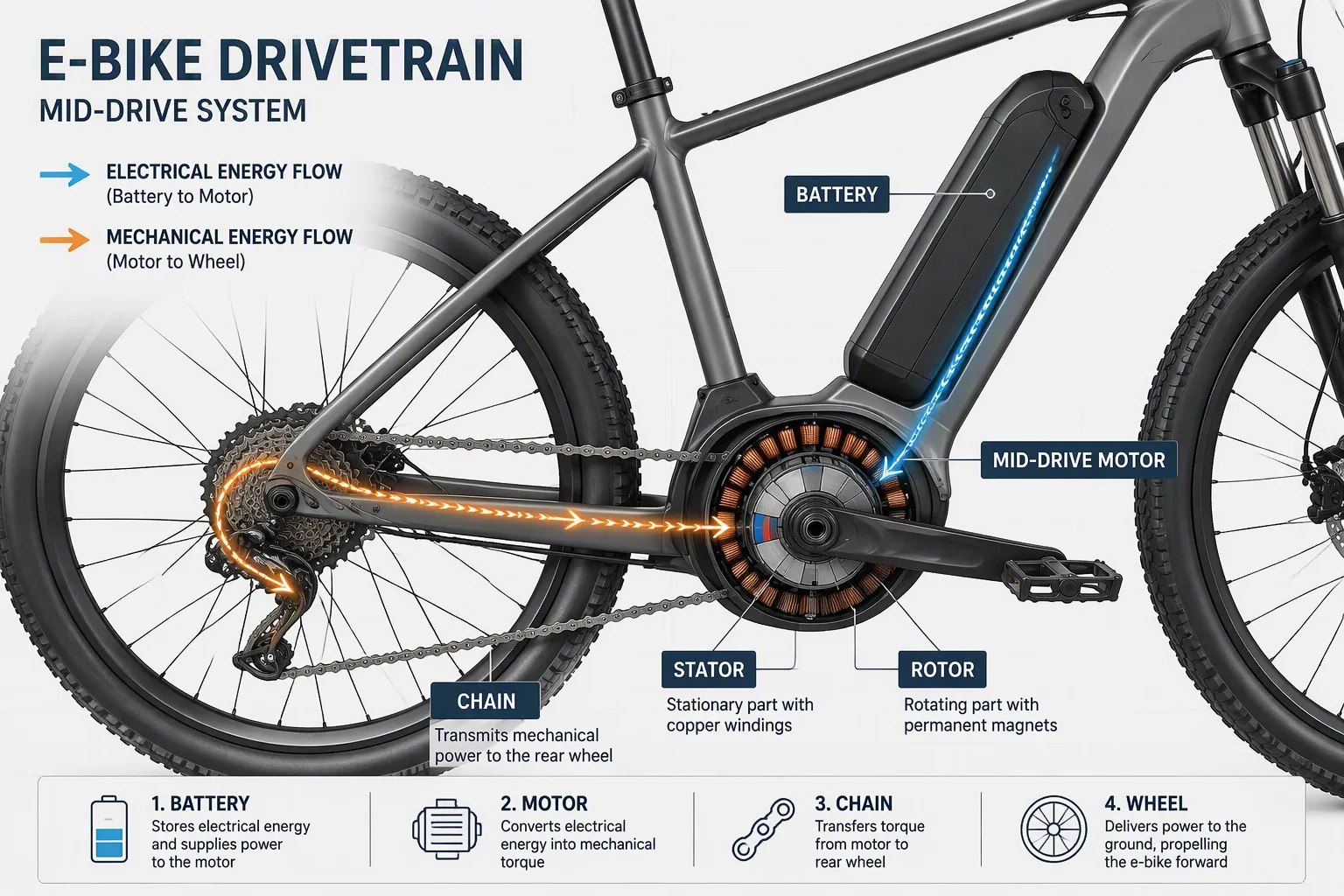
The motor: Design and function
An electric motor converts electrical energy into mechanical motion. The underlying principle is electromagnetic induction. Every motor has two main parts: the stationary stator and the rotating rotor. The stator contains a coil of copper wire. When current flows through this coil, it creates a rotating magnetic field. This rotating field induces a current in the rotor, which in turn creates its own magnetic field. The alternating forces of attraction and repulsion cause the rotor to follow the stator’s rotating field. This produces the rotary motion that drives your rear wheel.
The specifications of a typical mid-drive motor show what modern technology can do:
Component |
Value |
|---|---|
Max. torque |
120 Nm |
Max. pedal assistance |
400% or 600% |
Max. power at 70 rpm |
730 W |
Continuous rated power |
250 W |
Maximum power |
750 W |
Most e-bike motors have an efficiency of between 77 and 79 percent. That means nearly four-fifths of the battery’s energy is actually converted into forward motion. Only a small amount is lost as heat.
There are two basic types. The mid-drive motor is located at the bottom bracket and transmits its power through the gears. It works most efficiently at a cadence of 70 to 90 revolutions per minute. The hub motor is located directly in the rear wheel. It operates independently of your cadence, which makes it feel more natural. Modern hub motors use the same high-tech sensors as mid-drive motors. The right choice depends on how you’ll use it: a mid-drive motor is better for steep hills and sporty rides, while a hub motor is well suited to relaxed city riding.
The battery: Range and charging
The battery supplies power to your motor. The most common technology is the lithium-ion battery, which you may also know from smartphones. It’s lightweight, long-lasting, and widely available. Researchers are already working on solid-state batteries with solid electrolytes. They’re safer, have a higher energy density, and charge faster. However, they’re still expensive and rarely available.
Charging time depends on battery capacity:
Battery capacity |
Charging time |
|---|---|
400 Wh |
2 to 3 hours |
500–625 Wh |
3 to 4.5 hours |
700–750 Wh |
4 to 6 hours |
The actual range depends on many factors. The combined weight of the rider and luggage plays a major role. An additional load of 10 kg can reduce the range by 10 percent. Tire pressure matters too: underinflated tires increase rolling resistance and force the motor to work harder. Hilly terrain, headwinds, and temperatures below 20 degrees also reduce range. As a rule of thumb, battery capacity decreases by 1 percent for every degree below 20°C. Your assistance level has the biggest impact. Riding in Eco mode and pedaling hard yourself will get you much farther than using Turbo mode.
The controller: The brain of the system
The controller coordinates your e-bike’s entire drive system. It evaluates signals from the pedal force, torque, and speed sensors. Based on this information, it regulates the motor’s power output. At the same time, it monitors the flow of energy and protects the battery from overloading, overheating, and deep discharge. It communicates with you through the display, showing your speed, battery level, and assistance mode. If it detects a malfunction, such as a faulty sensor or overcurrent, it partially or completely shuts off the motor. Only when all the components—the motor, battery, sensor, and controller—work together perfectly can an e-bike deliver the natural riding feel that makes it special.
How the sensor and motor work together
Sensors bridge the gap between your muscle power and the motor. They detect your pedaling and tell the controller how much assistance you need. Without this precise measurement, the motor would provide either too little or too much power.
How the sensor detects your pedaling power
Modern e-bikes use two types of sensors. The torque sensor measures the force you apply to the pedals. It’s located in the bottom bracket and works on the principle of magnetostriction: forces change the magnetic field of a component. This change is measured and converted into torque. Motor assistance is proportional to your muscle power—pedal harder uphill, and the motor delivers more power.
The cadence sensor, by contrast, measures only the crank’s revolutions, not how hard you pedal. It provides a constant level of assistance, regardless of how much force you apply. This feels less natural and responds with a delay—it can take about half a revolution for the motor to kick in.
Feature |
Cadence sensor |
Torque sensor |
|---|---|---|
What it measures |
Cadence |
Pedaling force |
Assistance |
Constant |
Proportional to force |
Riding feel |
Less natural |
Natural, smooth |
Response time |
Delayed |
Instant |
Cost |
Less expensive |
More expensive |
In modern systems, communication between the sensor and motor takes place via Bluetooth. The Secure Cycling Speed Sensor sends data wirelessly to the motor. This makes the system more tamper-proof than conventional magnetic sensors.
The different assistance modes
Your e-bike offers several levels of assistance, which you select via the display. Typical modes are Eco, Tour, Sport and Turbo—the names vary by manufacturer. Each level directly affects the ride feel and range.
Assistance mode |
Range (as % of baseline) |
|---|---|
ECO |
100 % |
Trail |
78 % |
Boost |
58 % |
Eco mode provides the least assistance and preserves the battery the most. Boost mode delivers maximum power but drains the battery much faster. For everyday riding, it’s best to choose a medium setting and switch to a higher one only on hills or into a headwind.
On a pedelec, assistance automatically cuts out at 25 km/h. An S-pedelec assists you up to 45 km/h, but is then classified as a motor vehicle and requires insurance. Below these limits, the controller continuously adjusts motor power to match your pedaling force—creating the natural ride feel that makes a good e-bike.
E-bikes in everyday life: pros and cons
Differences from a regular bike
The most obvious difference is weight. A conventional bike weighs 8 to 17 kilos, while an e-bike weighs 20 to 28 kilos. You’ll notice this especially when you have to push the bike or carry it down to the basement. You’ll also feel the extra weight when riding without motor assistance—for example, when the battery is empty.
Maintenance is different, too. Basic tasks such as adjusting the brakes or oiling the chain apply to both types of bike. However, e-bikes come with some additional costs. Replacing the battery after three to five years costs €400 to €900. Motor maintenance and firmware updates cost €50 to €200 periodically. In addition, the chain, cassette and brakes wear out faster because the greater weight and higher speed put them under more strain.
Cost item |
E-bike |
Regular bike |
|---|---|---|
Battery replacement (3–5 years) |
€400–900 |
– |
Motor maintenance/firmware updates |
€50–200 periodically |
– |
Wear parts |
Faster wear |
€50–200/year |
Annual checkup |
– |
€50–120 |
In return, an e-bike offers significant advantages in everyday life. Commuters arrive at the office without sweaty clothes. Parents with cargo bikes can transport children and groceries more easily. People with physical limitations can get back to cycling regularly. In hilly areas, motor assistance makes cycling practical for everyday use in the first place.
The 2022 MHH study reveals another surprising effect: riding an e-bike puts almost as much strain on the cardiovascular system as riding a conventional bike. The average heart rate was only five beats per minute lower. E-bike riders spent an average of 135 minutes per week cycling, reaching two-thirds of the WHO’s physical activity target. This reduces the risk of a heart attack by over 40 percent.
While a bicycle without electric motor assistance can weigh up to 15 kilos, an e-bike can weigh up to 30 kilos.
Who can benefit from an e-bike?
Buyer statistics show that e-bikes appeal to a broad audience. According to the 2020 Fahrrad XXL study, 25 percent of purchases are made by people aged 30 to 39, 24.8 percent by those aged 50 to 59, and 23.5 percent by those aged 40 to 49. Among older riders aged 60 and over, 67 percent cite health-related reasons as their main motivation. Younger riders aged 18 to 39 are more likely to be looking for a sporting challenge or ways to save money—48 percent are interested in used or refurbished e-bikes.
An e-bike is especially worthwhile for commuters who ride several kilometers to work every day. Motor assistance makes hills easy, so you arrive relaxed. E-bikes are also ideal for older people or those with joint problems such as osteoarthritis: continuous pedaling strengthens the leg muscles while being gentle on the joints. Dutch studies also confirm that people who switch from a car to an e-bike find their commute more satisfying.
Who might not benefit from an e-bike? If you only ride occasionally and cover short distances on flat terrain, a regular bike is the more economical choice. The higher purchase price and the battery’s need for care—it doesn’t like heat or cold and should be stored at room temperature—are only worthwhile if you use it regularly.
An e-bike boosts your pedaling power but doesn’t replace it. The motor, battery, sensor and controller work together to provide exactly the assistance you need. The biggest differences from a regular bike are weight and price—but in return, you can tackle hills effortlessly and arrive without sweaty clothes.
An e-bike is especially worthwhile for commuters, older people and anyone with limited stamina. You can ride farther while still taking it easy. The technology may sound complex, but it’s simple to use: choose a mode and start pedaling.
Don’t let the technology put you off—an e-bike is easier to use than you think and simply a lot of fun!
FAQ
Do I need a driver’s license for my e-bike?
You don’t need a driver’s license for a pedelec. Legally, it is classified as a bicycle. A true e-bike with assistance up to 45 km/h requires a driver’s license and an insurance plate.
How far can the battery take me?
The range depends on how you ride. A 500 Wh battery will take you 50 to 100 kilometers. With 750 Wh, you can cover 75 to 150 kilometers. Terrain, temperature and assistance mode have a major impact on range.
Is an e-bike much heavier than a regular bike?
Yes, considerably. A regular bike weighs 8 to 17 kilos. An e-bike weighs 20 to 28 kilos. You’ll notice the difference when pushing or carrying it.
How does the motor detect how hard I’m pedaling?
A torque sensor measures how hard you press on the pedals. The controller processes this signal and tells the motor what level of assistance to provide. It feels very natural.
How much does a new battery cost?
Replacing the battery after three to five years costs €400 to €900. The exact cost depends on the capacity and manufacturer.