
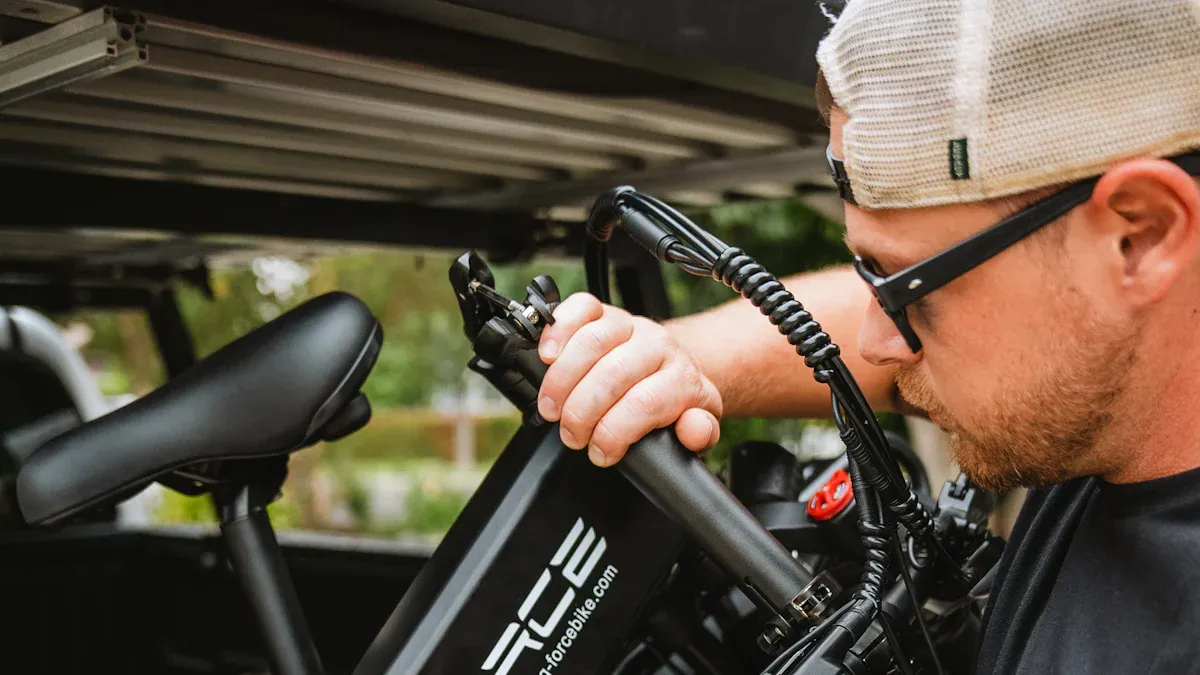
Choosing the right charger for your e-bike affects not only performance but also your safety. A suitable e-bike charger is crucial, as improper use of chargers poses a high fire hazard. Many manufacturers use unique plug designs to ensure the use of original chargers. The Institute for Loss Prevention and Damage Research (IFS) also warns of risks associated with improper handling of batteries.
Key Insights
Check if your charger fits your e-bike battery. Pay attention to the correct plug and the right voltage.
Choose a charger that suits your usage. Standard chargers are good for everyday use. Fast chargers help on long trips.
Charge your battery frequently and avoid overcharging. This helps your battery last longer.
Types of e-bike chargers
Standard chargers
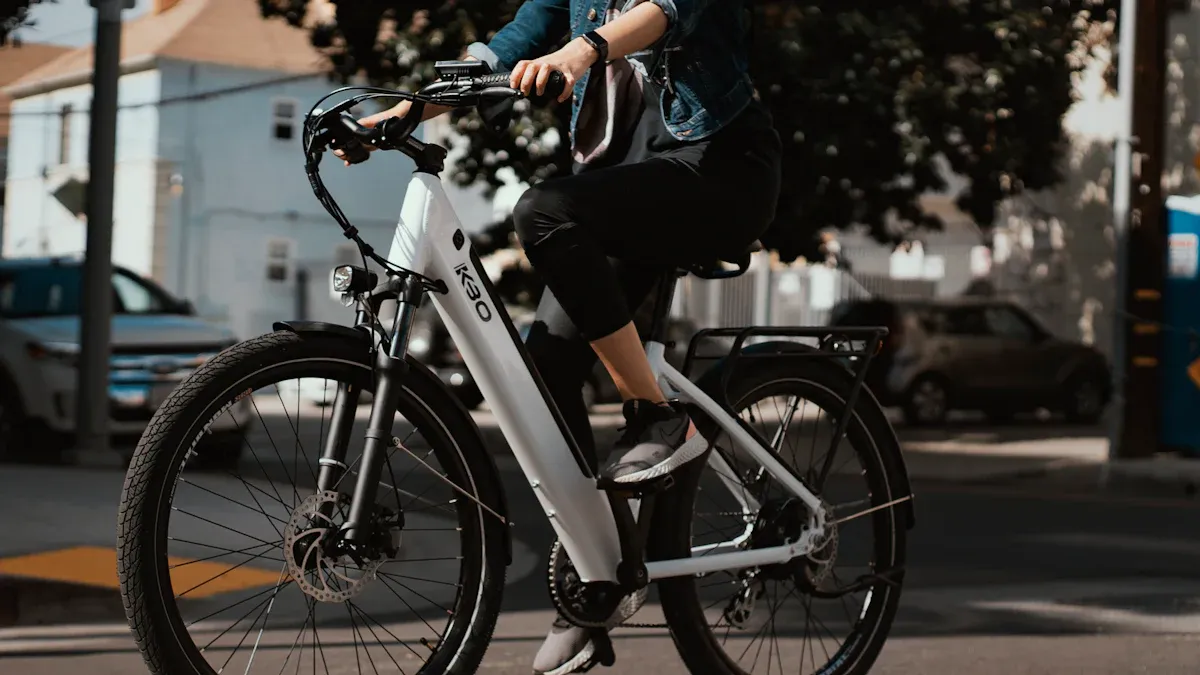
Standard chargers are the most commonly used models for e-bikes. They offer a reliable and safe way to charge the battery. These chargers operate at a moderate current, which extends the life of the battery. You can use them easily at home, as they are compatible with most wall outlets. Charging time is usually several hours, depending on the capacity of your battery. This option is especially suitable if you want to charge your e-bike overnight or during long breaks.
Fast chargers
Fast chargers are ideal if you are short on time. They fully charge your e-bike battery in less than an hour. In comparison, standard chargers often require several hours. These devices provide a charging current of up to ten amperes, which significantly reduces charging time. Thanks to modern technologies like KIT technology, you can charge your e-bike efficiently and quickly. Fast chargers are particularly useful for frequent users or longer tours where a quick charging time is critical.
Smart chargers
Smart chargers offer you additional features that go beyond simple charging. They monitor the charging process and automatically adjust the current to prevent overcharging. Some models analyze the state of the battery and optimize the charging process accordingly. These chargers are a good choice if you want to maximize the life of your battery. They are often more expensive but offer long-term benefits due to their efficiency and safety.
Compatibility of e-bike chargers
Mechanical compatibility: plugs and connectors
The mechanical compatibility of a charger plays a crucial role. You must ensure that the charger plug matches the connection on your e-bike. Different manufacturers often use specific plug types to ensure compatibility with their batteries. An incorrect plug can not only prevent charging but also cause damage.
Here are some important parameters you should consider:
Parameter |
Value |
|---|---|
Battery voltage |
|
Recommended motor power |
250W |
Battery dimensions |
36.7 x 9 x 11.1 cm |
Battery connector type |
EC5 |
If your e-bike uses an EC5 connection, for example, you need a charger with the same plug type. Check the technical specifications of your battery before purchasing an e-bike charger.
Electrical compatibility: voltage and charging current
Electrical compatibility is just as important as mechanical. You should ensure that the charger's voltage and charging current match your battery's specifications. Incorrect voltage can damage the battery or even cause dangerous situations.
Most e-bike batteries operate at a voltage of 36V or 48V. If your battery has a voltage of 48V, you need a charger that provides exactly that voltage. The charging current affects the charging time. A higher current charges the battery faster but can shorten battery life. A charger with a moderate current is often the better choice for maximizing your battery's lifespan.
Manufacturer and model dependency
Many chargers are designed specifically for certain e-bike models or manufacturers. You should always check whether the charger is compatible with your e-bike model. Some manufacturers use proprietary connectors or specific charging protocols to ensure that only their chargers can be used.
If you are considering a third-party charger, carefully check the technical specifications and compatibility. An e-bike charger not designed for your model could void your battery warranty or even lead to damage.
Technical specifications of e-bike chargers
Charging time and current
The charging time of an e-bike battery depends on the battery's capacity and the charger's current. A charger with a higher current charges the battery faster but may affect the battery's lifespan. You should therefore choose a charger that offers the right balance between charging time and battery care.
Here are some examples of charging times for various battery types and chargers:
Battery Type |
Charger |
Charging time (full) |
Charging time (half) |
|---|---|---|---|
PowerPack 300 |
Standard charger |
2.5 hours |
1 hour |
PowerPack 400 |
Standard charger |
3.5 hours |
1.5 hours |
PowerPack 500 |
Standard charger |
4.5 hours |
2 hours |
PowerPack 300 |
Fast charger |
3 hours |
0.5 hours |
PowerPack 400 |
Fast charger |
3 hours |
1 hour |
PowerPack 500 |
Fast charger |
1.2 hours |
0.5 hours |
Fast chargers offer a significantly shorter charging time, which is particularly practical if you use your e-bike frequently. Standard chargers, on the other hand, are gentler on the battery and are suitable for daily use.
Voltage and power
A charger's voltage directly affects your e-bike's performance. Higher voltages allow for greater energy output, resulting in better range and higher speeds. You should ensure that the charger's voltage matches that of your battery.
Here is an overview of common voltages and their applications:
Voltage (V) |
Power (W) |
Application |
|---|---|---|
12 V |
250 W |
Flat terrain |
24 V |
250 W |
City e-bikes |
36 V |
750 W |
Mountain roads |
48 V |
1000 W |
High-end e-bikes |
A 48 V e-bike charger is particularly suitable for high-performance mountain bikes. For city e-bikes, a 24 V charger is often sufficient.
Design and weight
The design and weight of a charger influence its handling and portability. Compact chargers are lighter and easier to transport, making them ideal for on-the-go use. Larger models often offer more power but are less mobile.
Here are some tips for choosing the right charger based on design and weight:
For daily use: Choose a light and compact charger that is easy to store.
For longer tours: Opt for a robust model with higher power, even if it is a bit heavier.
For frequent users: Smart chargers offer additional features like temperature monitoring and automatic shut-off.
An e-bike charger should not only be powerful but also practical. Ensure it fits your lifestyle and requirements.
Choosing the right charger for your e-bike
Choosing a charger based on the e-bike model
The choice of the right charger depends heavily on your e-bike model. Manufacturers like Bosch or Shimano often use specific charging protocols and plug types. You should ensure that the charger is mechanically and electrically compatible. Mechanical compatibility means that the charger's plug fits perfectly into your battery's connection. Electrical compatibility covers voltage and charging current.
Description |
|
|---|---|
Mechanical compatibility |
Verification of the correct plug connection. |
System compatibility |
Ensuring the charger is compatible with the battery (e.g., Bosch vs. Shimano). |
Nominal voltage |
The voltage in volts, which can be read on the original charger and battery. |
Charging current |
Measured in amperes, affects charging time; important for choosing the charger. |
Fast charger |
Higher charging current for faster charging times, ideal for frequent use. |
Standard charger |
Slow charging speed, protects the battery, ideal for everyday use. |
An e-bike charger developed specifically for your model offers the best performance and safety.
Battery type and capacity
The type and capacity of your battery influence the choice of charger. Modern e-bikes mostly use lithium-ion batteries. These are characterized by high energy density and low weight. The capacity of such batteries is often between 500 Wh and 750 Wh.
Lithium-ion cells are the most common battery type.
A 48 V 1500 W battery offers high performance and a long lifespan.
For long trips, a battery with high range is recommended.
A charger with a higher charging current is suitable for larger batteries because it shortens charging time. For everyday use, however, a standard charger is better because it is gentler on the battery.
Recommendations for different usage scenarios
Your usage habits determine which charger is best for you.
Daily use: A standard charger is ideal. It charges the battery gently and extends its service life.
Longer tours: Fast chargers are the best choice here. They significantly reduce charging time and allow you to get back on the road faster.
Occasional riders: A compact charger is sufficient. It is easy to transport and simple to use.
Choose a charger that matches your riding style and requirements. This ensures your battery is charged efficiently and safely.
Maintenance and optimal use of chargers and batteries
Tips for extending battery life
Proper maintenance of your e-bike battery can significantly extend its service life. Here are some proven tips:
Prefer partial charges: Charge the battery when the charge level is between 30% and 80%. Frequent partial charges are gentler than infrequent full charges.
Avoid 100% charging: For everyday use, 80% to 90% capacity is sufficient. Constant charging to 100% can shorten service life.
Use gentle chargers: Chargers with special modes, such as "Eco-mode," reduce stress on the cells and extend service life.
Regenerative braking: If your e-bike offers this feature, use it to recover energy and relieve the battery.
Long-term studies show that a battery can reach up to 2,000 charging cycles with careful use. This corresponds to a range of 600 to 800 thousand kilometers.
Proper storage of charger and battery
Storage significantly affects the functionality and safety of your battery. Note the following points:
Factor |
Impact on battery lifespan |
|---|
Charging current
High charging current accelerates battery aging.
Temperature
Avoid charging at temperatures below 0 °C.
State of charge
Store the battery at approximately 50% charge to prevent deep discharge.
Storage
Keep the battery dry and protected from dust to prevent self-discharge.
A "hibernation mode" in many chargers helps keep the battery in optimal condition during longer storage periods.
Avoiding overcharging and deep discharge
Overcharging and deep discharge are among the most common causes of battery damage. Modern batteries are equipped with a Battery Management System (BMS) that monitors the charging and discharging process. It ensures that the battery remains within safe voltage and current limits.
Here are some important measures:
Avoid fully discharging the battery.
Do not always charge the battery to its maximum capacity.
Use chargers that automatically stop the charging process as soon as the battery is full.
Slower charging processes are also gentler on the battery and slow down its aging. With these measures, you can significantly extend the life of your battery and charger.
Mobile chargers and alternative solutions
Power banks for e-bikes
Power banks offer you a practical way to charge your e-bike on the go. They are compact and lightweight, making them ideal for travel or longer tours. However, they deliver less current than standard chargers, resulting in longer charging times. Some models, such as the Anker Zolo 20k, impress with a good price-performance ratio. Others, like the Ugreen Nexode with 12,000 mAh, offer powerful 100-watt performance for around 50 euros.
Here are some technologies that make power banks more efficient:
Qualcomm Quick Charge: Charges devices from 0 to 80% in just 35 minutes.
USB Power Delivery (USB-PD): Supports flexible charging with up to 100 watts.
Qi charging function: Wireless charging, though less efficient.
Power banks are lighter than standard chargers.
They extend the range of your e-bike by up to 50%.
They are particularly suitable for occasional riders.
Solar chargers
Solar chargers use solar energy to charge your battery. This environmentally friendly option is especially suitable for outdoor enthusiasts. However, their efficiency depends heavily on weather conditions. Modern models offer foldable designs and integrated USB ports that make charging easier.
A solar charger is ideal for you if you want to remain independent of electrical outlets. It may take longer, however, to fully charge your battery.
Portable chargers for on the go
Portable chargers combine mobility with high performance. Models like the Green Cell wallbox or the Wissenergy wallbox offer charging capacities of up to 11 kW. They are lightweight, waterproof, and often controllable via apps.
Model |
Charging capacity |
Features |
|---|---|---|
Green Cell wallbox |
11 kW |
Flexible, app for monitoring, single-phase and three-phase, requires CEE 16A socket. |
Absina mobile wallbox |
3.7 kW |
Adjustable charging current, OLED display, single-phase, waterproof (IP67). |
Portable wallbox by K.H.O.N.S |
11 kW |
Three-phase charging, app-controllable, compatible with almost all European electric vehicles. |
Wissenergy wallbox |
11 kW |
Automatic charging process, IP66 protection rating, portable. |
Edvance wallbox |
11 kW |
3-phase power connection, 7.8 m cable, lightweight and portable. |
Portable chargers offer you a flexible solution for charging your e-bike efficiently, no matter where you are.
Choosing the right charger for your e-bike is crucial. It influences the safety, efficiency, and lifespan of your battery.
Key points summarized:
Check compatibility: Pay attention to mechanical and electrical matching.
Observe technical specifications: Voltage, amperage, and design are decisive.
💡 Tip: Use a charger specifically developed for your e-bike model.
Proper care and usage will extend the life of your battery. Charge it regularly and avoid overcharging. A well-chosen charger makes your e-bike more reliable and safer.
FAQ
What happens if I use the wrong charger for my e-bike?
An incorrect charger can damage the battery or increase the charging time. It also increases the risk of overheating and reduces the battery's lifespan.
Can I charge my e-bike with a solar charger?
Yes, solar chargers are suitable for e-bikes. However, they charge more slowly than standard chargers and require sufficient sunlight for efficient performance.
How often should I check my e-bike charger?
Check your charger regularly for damage or wear. An annual inspection is often sufficient to ensure safety and efficiency.