
Many women are looking for an e-mountain bike that can carry them safely and powerfully over trails. The selection of models is vast. Which features really count when you want a bike that performs well on difficult paths? Knowing your own requirements makes it easier to find the right bike. Comfort, performance, and control play a major role.
Key takeaways
A powerful motor and a battery with at least 600 Wh ensure plenty of riding fun and good range on demanding trails.
Specially adapted frame geometry, narrower handlebars, and women-specific saddles increase comfort and control while riding.
Full-suspension models offer more travel and comfort on difficult routes, while hardtails are lighter and require less maintenance.
Hydraulic disc brakes and grippy tires significantly improve safety and control on the trail.
Test rides help you find the right e-mountain bike and evaluate the riding feel under real conditions.
E-mountain bike for women: features
Motor & battery
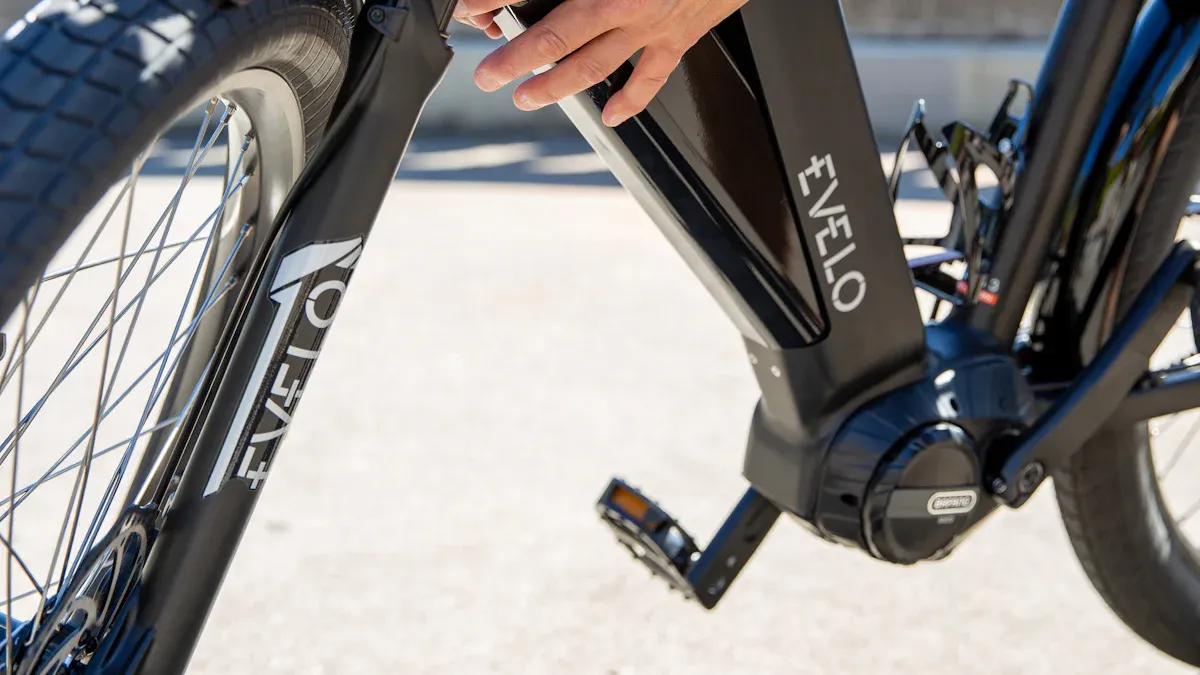
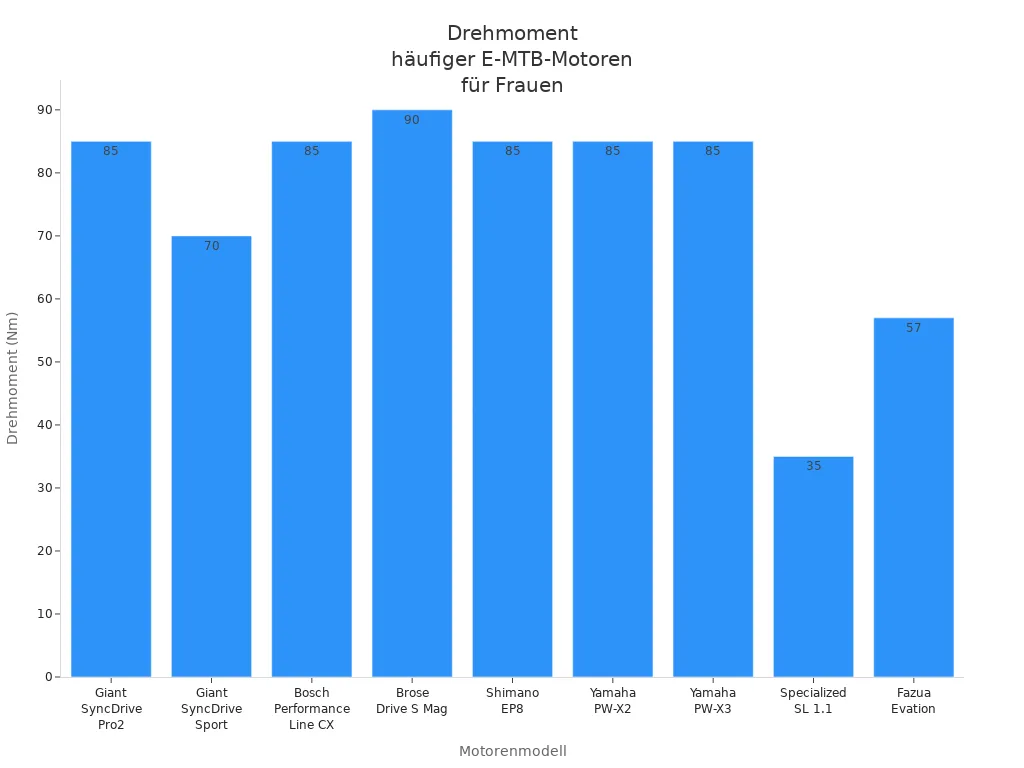
A strong motor is the heart of a good e-mountain bike for women. Especially on challenging trails, a powerful drive ensures more riding enjoyment and safety. Many manufacturers rely on motors such as the Bosch Performance Line CX, Giant SyncDrive Pro2, or Shimano EP8. These motors offer a torque of 70 to 90 Nm and various assistance levels, allowing riders to choose according to terrain and power requirements.
Motor |
Torque (Nm) |
Assistance levels |
Battery capacity (Wh) |
Weight (kg) |
Features / area of use |
|---|---|---|---|---|---|
Giant SyncDrive Pro2 |
85 |
Eco, Basic, Active, Sport, Power |
400, 500, 625 |
2.7 |
Exclusive to Liv, specially for demanding routes |
Giant SyncDrive Sport |
70 |
Eco, Eco+, Normal, Sport, Sport+ |
400, 500, 625 |
3.48 |
Light and balanced, optimized for women's E-MTBs |
Bosch Performance Line CX Gen 4 |
85 |
Eco, Tour, Sport, Turbo, e-MTB mode |
300, 400, 500, 625, 1250 |
2.9 |
Very powerful, versatile, with dual battery system |
Brose Drive S Mag |
90 |
Eco, Eco+, Sport, Boost |
varies by manufacturer |
2.9 |
Quiet, high performance for off-road |
Shimano EP8 |
85 |
Eco, Trail, Boost |
378, 500, 630 |
2.6 |
Efficient, quiet, for off-road fun |
Yamaha PW-X2 |
85 |
Eco, Eco+, Standard, High, Extra Power |
500, 630 |
3.1 |
Automatic assistance, tuned for female E-MTB riders |
Yamaha PW-X3 |
85 |
Eco, Eco+, Standard, High, Extra Power |
630, 750 |
2.75 |
Newer version with improved battery options |
Specialized SL 1.1 |
35 |
Eco, Trail, Turbo |
320 |
1.9 |
Light, moderate assistance, for beginners |
Fazua Evation |
approx. 55-60 |
Light assistance |
very light, battery removable |
very light |
Very light, subtle assistance, ideal for sporty riders |
A battery with 600 to 625 Wh is the current standard for e-mountain bikes for women on the trail. This capacity is usually enough for 50 to 80 kilometers in mixed terrain. For those climbing many meters in elevation, a 625 Wh battery can cover about 1750 to 1900 meters of vertical gain. Actual range depends on the terrain, the assistance level, and your personal riding style.
Tip: If you are planning longer tours, look for a model with a dual battery system. This allows you to significantly increase your range.
Geometry & comfort
Manufacturers adapt frame geometry specifically to the needs of women. Many e-mountain bikes for women are available in smaller frame sizes. Narrower handlebars and shorter cranks ensure better ergonomics and control. A low step-through frame makes mounting and dismounting easier, especially on technical trails.
Specially adapted frame sizes for shorter heights
Shorter cranks for shorter legs
Women's bicycle saddles with a wider and lowered saddle nose
Adapted seat tube lengths and appropriate suspension for more comfort
A women's saddle differs significantly from unisex models. It is wider in the middle section and relieves the sensitive perineal area. The correct saddle width can be determined by measuring sit bones. Shorter stems and narrower handlebars improve control and handling.
Feature |
Women's E-MTBs |
Unisex models |
|---|---|---|
Saddle |
Wider, lowered, padded |
Sit bone distance, less specific |
Handlebar width |
Narrower (e.g., 760 mm) |
Wider (e.g., 780 mm) |
Stem length |
Shorter |
Longer |
Frame geometry |
Shorter reach, flatter stack |
Universal frame |
These adjustments increase comfort and safety on the trail. They allow for a relaxed riding position and more control, especially on long tours or technical sections.
Weight & handling
Weight plays a major role for every e-mountain bike for women. The motor and battery make the bike heavier than a classic mountain bike. Many models weigh over 20 kilograms. Nevertheless, a central and low center of gravity ensures good control off-road. A lightweight carbon or aluminum frame improves agility and handling.
Aluminum offers a good balance between weight and stability.
Carbon is particularly light and stiff, but more expensive.
Steel is heavier, but very robust.
Titanium combines lightness and strength, but is rare and expensive.
A well-tuned suspension system and robust components help compensate for the extra weight. Especially on steep climbs and technical descents, riders benefit from stable geometry and a stiff suspension fork. Once you get used to the higher weight, you will experience plenty of riding fun and safety on the trail.
Note: Before your first long tour, it is recommended to practice handling on simple paths. This way, you can better estimate and control the extra weight.
Trail use
Hardtail vs. fully
E-mountain bikes for women are available as hardtails or full-suspension ("fully") models. Hardtail models only have suspension in the front. They are lighter and transfer power very directly to the ground. This makes them particularly efficient when climbing and on flat paths. Many riders appreciate the low weight and easy maintenance. Hardtails are well-suited for flowing trails without many obstacles. They encourage an active riding style and are often more affordable.
Full-suspension models additionally offer suspension in the rear. This design significantly increases riding comfort. Bumps are absorbed better, which reduces fatigue. Especially on long tours or technical trails, a "fully" provides more traction and control. Modern full-suspension bikes allow for the shock to be locked out to increase efficiency when climbing. They are, however, heavier and require more maintenance than hardtails. Full-suspension bikes dominate the market because they are versatile and perform better on challenging trails.
Tip: If you are often out on stony, root-filled, or steep trails, you will benefit from a full-suspension bike. For beginners and tours on easier paths, a hardtail is usually sufficient.
Travel & suspension system
Travel describes how effectively the suspension can compensate for bumps. For an e-mountain bike for women on challenging trails, experts recommend travel between 130 and 170 millimeters. More travel means more comfort and safety on rough routes. Less travel saves weight and ensures a more direct riding feel.
Trail type / model type |
Description |
|
|---|---|---|
Enduro / Downhill E-MTB |
from 170 |
For very demanding trails, allows for more extreme routes and riding styles, fully suspended. |
Touring full-suspension E-MTB |
120 - 150 |
For varied tours, handles blocked trails as well, though not all rocks. |
Women's E-mountain bikes (examples) |
130 - 160 |
Depending on model and area of use, e.g., Juliana Roubion (160/150), Juliana Joplin (130/120), Juliana Maverick (150/140), Canyon Spectral WMN (150). |
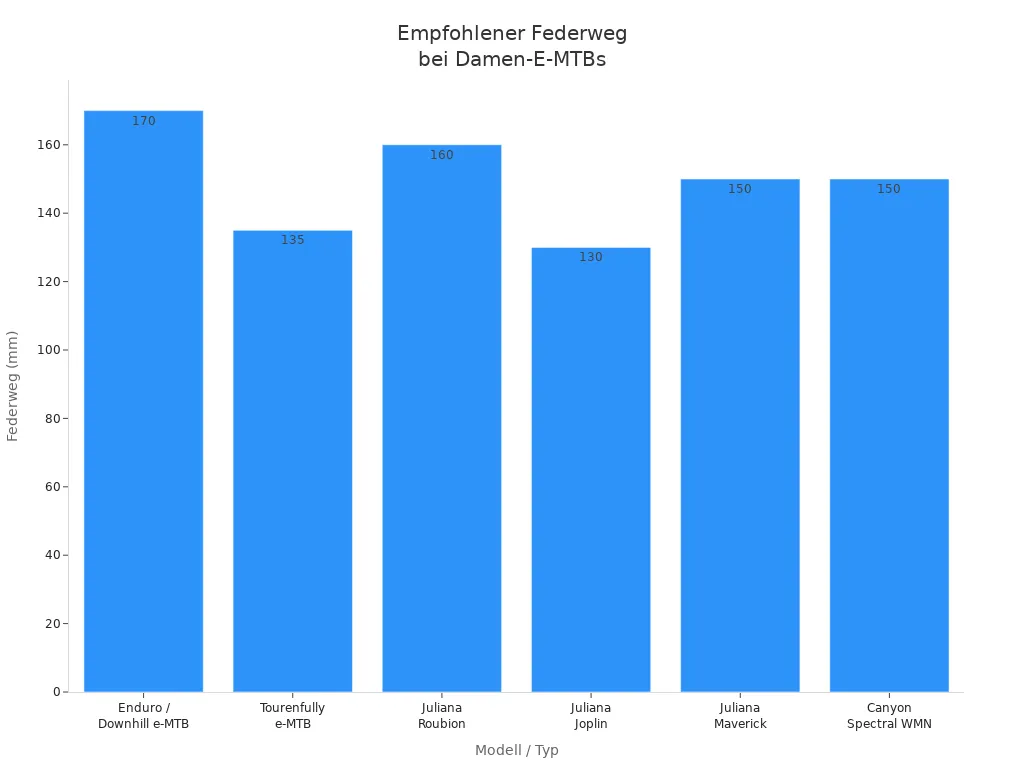
The suspension system strongly influences performance on the trail. A well-tuned suspension system ensures agility, safety, and efficiency. Many models offer a lockout lever on the handlebars. This allows the rider to stiffen the suspension and save energy. Platform dampers allow for an intermediate setting that maintains comfort and traction. Proper adjustment of travel, damping, and kinematics improves the riding experience and control on technical trails.
A higher spring rate makes the suspension harder and more lively.
A lower spring rate increases comfort.
The damping must be balanced so that the bike can track the ground well.
Flexible settings help adapt the bike to different conditions.
Safety & control
Safety is the top priority for every e-mountain bike for women. Powerful hydraulic disc brakes ensure reliable stopping power, even in wet conditions or at high speeds. A stable frame increases safety and stability off-road. Puncture-resistant tires reduce the risk of accidents caused by tire damage.
Important safety features at a glance:
Bright LED lighting for good visibility in the dark.
Rear lights with brake light function.
Hydraulic disc brakes for strong braking power.
Robust frame for stability.
Puncture-resistant tires.
Integrated lock for theft protection.
Optional GPS tracker for quick location.
Ergonomic adjustments such as adjustable handlebars and saddle.
Good traction is crucial for control and safety. Wide tires with a grippy tread provide hold on loose ground. The adaptability of the suspension helps to steer the bike safely through difficult passages. Those who check the suspension and brakes regularly ride more safely and have more fun on the trail.
Models
Overview
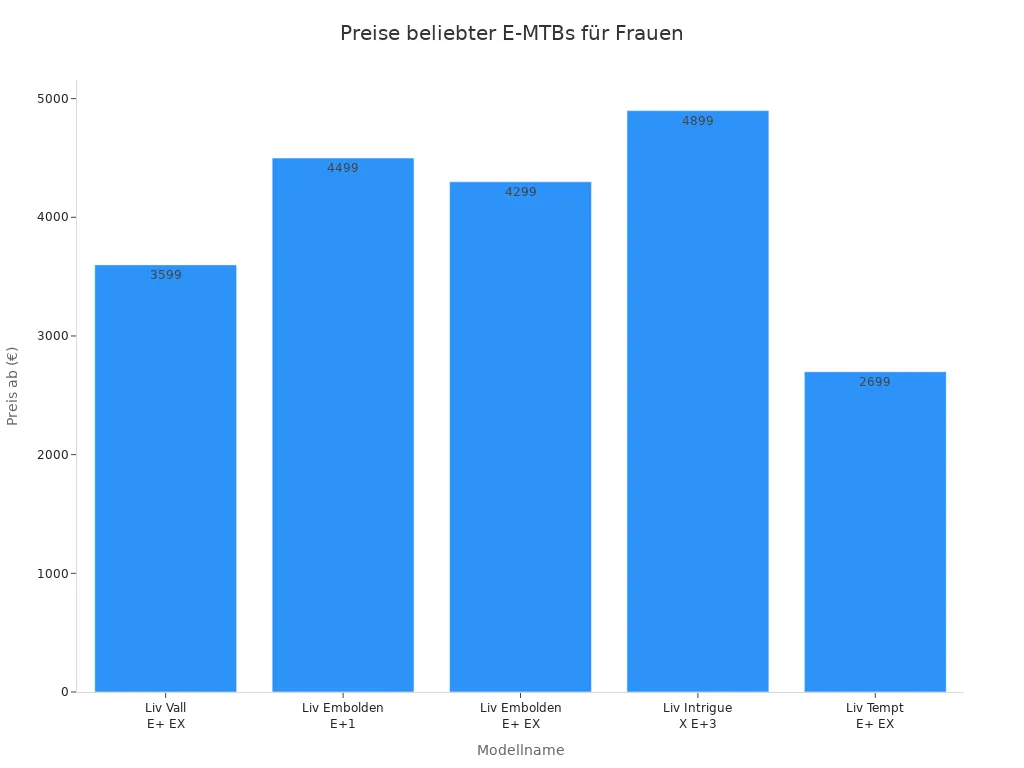
Many manufacturers offer special e-mountain bikes for women. Brands like Liv, Cube, Canyon, Haibike, Specialized, and Bergamont are particularly popular. These brands develop models tailored to the needs of women. The following table shows some of the best-selling models with their most important features:
Model name |
Motor |
Battery |
Gears |
Front travel |
Rear travel |
Price from (€) |
|---|---|---|---|---|---|---|
Liv Vall E+ EX |
SyncDrive Sport, 70 Nm |
625 Wh |
Shimano Deore, 10-speed |
120 mm |
- |
3,599 |
Liv Embolden E+1 |
SyncDrive Sport2, 75 Nm |
625 Wh |
Shimano Deore Linkglide, 10-speed |
140 mm |
125 mm |
4,499 |
Liv Intrigue X E+3 |
SyncDrive Pro, 80 Nm |
625 Wh |
Shimano Deore, 12-speed |
150 mm |
140 mm |
4,899 |
Canyon Spectral:On WMN 7.0 |
Shimano EP8, 85 Nm |
630 Wh |
Shimano XT, 12-speed |
150 mm |
150 mm |
5,299 |
Bergamont E-Trailster FMN 29 |
Bosch Performance CX, 85 Nm |
625 Wh |
Shimano Deore, 12-speed |
160 mm |
150 mm |
4,799 |
Strengths & Weaknesses
Each model has its own advantages and disadvantages. The following list gives a quick overview:
Hardtail models like the Liv Vall E+ EX are lighter and easier to maintain. They are well-suited for beginners and tours on simple paths.
Full-suspension models like the Liv Intrigue X E+3 or the Canyon Spectral:On WMN 7.0 offer more comfort and control on demanding trails. However, they are heavier and cost more.
Light-support models like the Specialized Turbo Levo SL or the Liv Intrigue X Advanced E+ are aimed at sporty riders. They often weigh under 18 kg and offer natural ride dynamics. The motor provides less assistance, but the bike remains agile and light.
Bosch motors deliver plenty of power and are considered reliable. Models with smaller batteries are lighter but offer a shorter range.
Tip: Those who value low weight and sporty riding should choose a light-support model.
Price-Performance
The price range for e-mountain bikes for women is large. Beginners can find solid hardtails starting at around 2,700 euros. For a full-suspension trail bike with high-end equipment, buyers usually pay between 4,000 and 6,000 euros. Light-support models with carbon frames and high-quality components often cost more but offer a particularly sporty riding experience.
The combination of motor power, battery capacity, and weight determines the ride feel. Manufacturers like Liv, Canyon, and Specialized offer models that provide good value for money and high trail performance.
Buying Guide
Selection
Selecting the right e-mountain bike depends on many factors. Women benefit from models that are specifically tuned to their body proportions. Manufacturers offer frames with an extended head tube, steeper seat angle, and narrower handlebars. These adjustments ensure comfort and control. Particularly small frame sizes for heights starting at 1.48 m also allow smaller riders to feel safe. Various frame shapes such as diamond, step-through, or low-step frames offer different mounting options and riding styles.
Important criteria for selection:
Exact frame size for comfort and safety
Appropriate suspension for body weight
Individually adjustable contact points like saddle and grips
Short cranks for more ground clearance
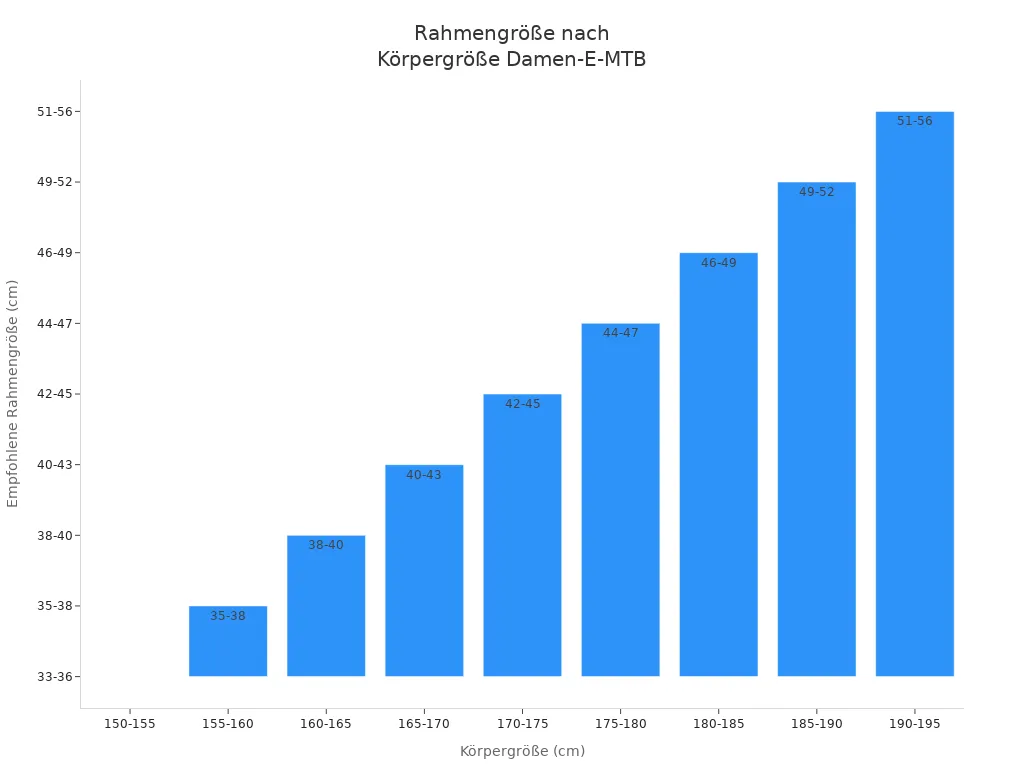
The optimal frame size can be determined by measuring the inseam. The following table gives an overview of recommended frame sizes:
Height (cm) |
Recommended frame size (cm) |
Frame size (inches) |
|---|---|---|
150-155 |
33-36 |
13"-14" |
155-160 |
35-38 |
14"-15" |
160-165 |
38-40 |
15"-16" |
165-170 |
40-43 |
16"-17" |
170-175 |
42-45 |
16.5"-17.5" |
175-180 |
44-47 |
17.5"-18.5" |
180-185 |
46-49 |
18"-19.5" |
185-190 |
49-52 |
19.5"-20.5" |
190-195 |
51-56 |
20.5"-22" |
from 195 |
from 56 |
from 22" |
Test Ride
A test ride is crucial to find the right bike. It shows how the bike behaves in everyday life and on the trail. Women should test different models to feel the differences in motor power, ergonomics, and comfort.
Important points during the test ride:
Check handling on inclines and uneven surfaces
Test seat comfort and handlebar position
Experience motor power and battery range
Try out the operation of gears and display
Compare multiple models to find the best feel
Tip: A test ride under realistic conditions helps to assess safety and riding fun.
Maintenance
Regular maintenance extends the lifespan of the e-mountain bike. Many tasks can be done yourself. It is advisable to remove coarse dirt after every ride. The chain should be cleaned and oiled regularly. Brakes must be checked and bled if necessary.
Recommended maintenance intervals:
Check tire pressure regularly
Perform software updates for the motor
Note: Avoid high-pressure cleaners to prevent damage to electronics and seals. After every cleaning, a short test ride is recommended to check functionality.
E-mountain bikes for women perform well in current tests with good ratings and offer a wide selection for every budget.
The choice between hardtail and full-suspension influences comfort, maintenance, and intended use.
Well-tuned suspension and hydraulic disc brakes increase safety and riding fun.
Test rides and individual advice help to find the right model.
Trying out different models leads to discovering new possibilities on the trail and increases the joy of e-mountain biking. A suitable bike motivates more exercise and ensures unforgettable experiences in nature. 🚴♀️
FAQ
How long does a battery last on an e-mountain bike for women?
The battery life depends on the terrain, the assist level, and the riding style. On average, a 625 Wh battery lasts for 50 to 80 kilometers. Steep inclines or high assist levels shorten the range.
Does an e-mountain bike for women require regular maintenance?
Yes, regular maintenance increases its lifespan. Riders should clean the chain, check tire pressure, and inspect the brakes. An inspection at a specialist dealer is recommended once a year.
Are there special e-mountain bikes for petite women?
Manufacturers like Liv, Cube, and Canyon offer models with small frame sizes starting at 13 inches. These bikes adapt to smaller heights and provide more comfort and safety.
How heavy is a typical e-mountain bike for women?
An e-mountain bike for women usually weighs between 20 and 25 kilograms. Light-support models can weigh under 18 kilograms. The weight depends on the frame material, motor, and battery.
Can you ride an e-mountain bike without the motor?
Yes, riding without motor assistance is possible. The bike then rides like a normal mountain bike, but the heavier weight makes pedaling more strenuous. If the battery is empty, the gears remain usable.