
The belt drive is revolutionizing the world of e-bikes. It impresses with its virtually maintenance-free design and impressive durability. Made from low-wear carbon composite material, it often lasts twice or even three times as long as conventional chains. You can ride up to 30,000 kilometers with a belt drive without having to worry about lubrication or complex cleaning. Additionally, the special nylon tooth profile ensures quiet operation, even in adverse weather conditions. These features make e-bikes with belt drives an ideal choice for daily use.
Key Findings
Belt drives require almost no maintenance and last up to 30,000 kilometers. This saves time and money.
E-bikes with belt drives are quiet and good for the city. They keep your clothes clean.
The belt is weather-resistant and hardly wears out. This makes it reliable in any weather.
Although they are more expensive, belt drives save money later on. They require less maintenance.
Belt drives are great for commuters and trekking cyclists. They appreciate long-lasting and low-maintenance solutions.
What is a belt drive and how does it work?
Design and materials
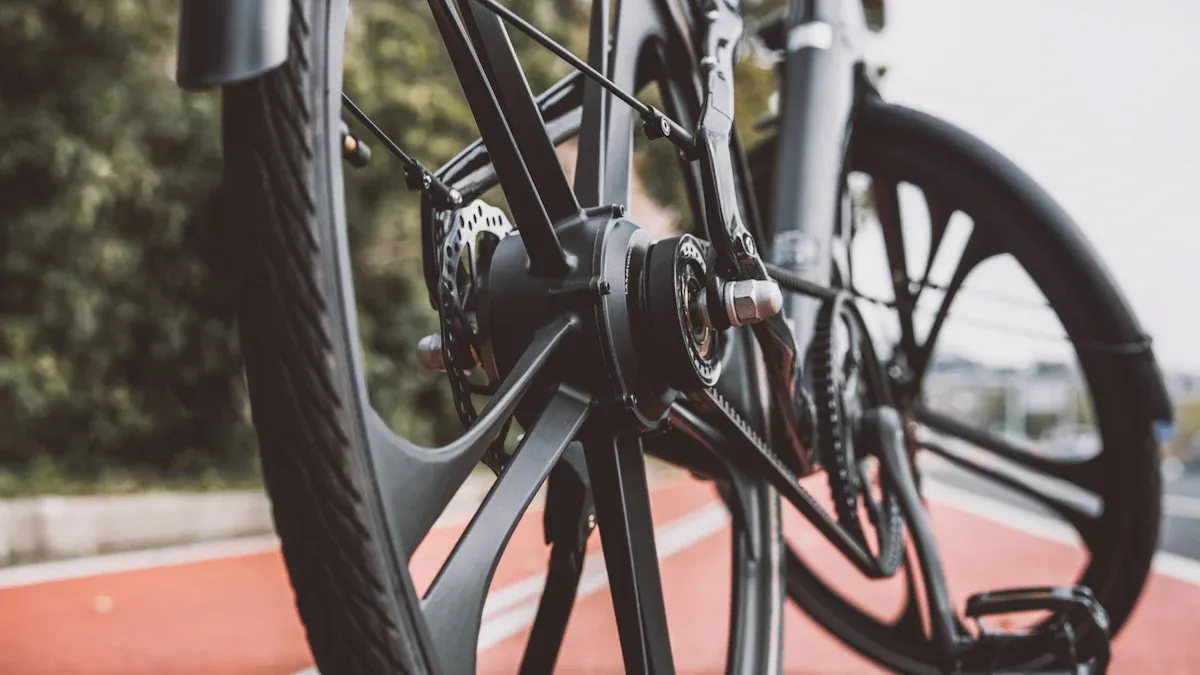
A belt drive consists of high-quality materials specifically developed for durability and efficiency. The belt itself is made of carbon fibers. This material is extremely robust and resistant to wear. The outer layer consists of polyurethane, which protects the belt from external influences such as water, dirt, or salt.
The belt is enclosed and runs over two pulleys. These pulleys are precisely manufactured to ensure an optimal connection with the teeth of the belt. This allows for smooth and reliable power transmission.
Tip: The combination of carbon and polyurethane makes the belt drive particularly durable and low-maintenance.
How it works
The functionality of a belt drive is simple and efficient. Power transmission occurs through the interlocking of the belt teeth with the pulleys. When you pedal, the teeth of the belt engage with the pulleys and transmit the force directly to the rear wheel.
For the belt drive to work optimally, precise alignment of the components is crucial. Even small deviations can impair efficiency or lead to increased wear. Therefore, it is important that the belt is correctly tensioned and aligned.
E-bikes with belt drives benefit from this technology because it enables smooth and quiet power transmission. You will feel the difference, especially in city traffic or on longer tours.
Advantages of e-bikes with belt drives
Low-maintenance and durable
E-bikes with belt drives are particularly easy to maintain. You do not need to lubricate the belt, as it does not use oil or grease. A simple cleaning with water is enough to keep it in perfect condition. This saves you time and effort compared to conventional chain drives.
The durability of the belt drive is impressive. While chains often need to be replaced after 5,000 to 10,000 kilometers, a belt lasts up to 30,000 kilometers. This long lifespan makes it a cost-effective choice for frequent riders.
Quiet and clean operation
Another advantage is the quiet operation. The belt drive works almost silently, which makes it ideal for city traffic. You can ride relaxed without hearing distracting noises.
Furthermore, your clothes stay clean. Since no chain oil is used, there is no risk of stains or smudges. This is especially practical if you use your e-bike for commuting to work or appointments.
Weather and wear resistant
The belt drive is extremely resistant to weather influences. Water, dirt, and salt do not affect its function. Even with intensive use, the belt shows minimal wear.
Tests show that the belt lasts on average two and a half times as long as a chain.
After two years, it often shows no signs of wear.
The belt tension can be conveniently checked via an app, which further simplifies maintenance.
These features make e-bikes with belt drives particularly suitable for everyday use and reliable, even in difficult weather conditions.
Efficient and lightweight
Efficient power transmission, especially under constant load
E-bikes with belt drives offer impressively efficient power transmission. The belt is made of carbon fibers or aramid fibers that do not stretch. As a result, power transmission remains constant and reliable. When you pedal steadily, you feel how efficiently the belt drive works.
Compared to chain drives, the belt drive shows a significantly longer service life. While a chain stretches and loses tension over time, the belt remains stable. This means less maintenance and consistently high performance. You only need to check the belt tension during normal maintenance.
Tip: A belt drive lasts up to three times longer than a chain and reaches a mileage of up to 30,000 kilometers.
Lower weight compared to chain drives
Another advantage of the belt drive is its low weight. The materials from which the belt is made, such as carbon composite material, are not only robust but also lightweight. This makes your e-bike lighter overall and easier to handle.
Chain drives, on the other hand, are made of metal and carry more weight. Additionally, they require lubrication, which further increases the total weight. The belt drive operates without lubrication, which not only reduces the weight but also minimizes maintenance efforts.
-
Summary of the advantages of the belt drive over chain drives:
No belt stretching thanks to rigid carbon fibers.
Less maintenance required, as no lubrication is necessary.
Lighter material that reduces the overall weight of the e-bike.
With a belt drive, you benefit from a combination of efficiency and lightness that noticeably improves your riding experience.
Disadvantages of e-bikes with belt drives
Higher initial costs
E-bikes with belt drives are more expensive than models with chain drives. Entry-level prices start at around €1,000, while retrofit kits cost between €150 and €300. Spare parts such as belts and pulleys are also more expensive.
The continuous improvement in bicycle quality, including the use of belt drives, has caused prices to rise in recent years. A market analysis shows how average prices have developed:
Year |
Average Price (€) |
|---|---|
2015 |
559 |
2018 |
735 |
2020 |
1,279 |
The higher quality and durability justify the costs, but this can be an obstacle for price-conscious buyers.
2015: E-bikes accounted for 12.4% of total sales.
2020: E-bikes accounted for 38.7% of total sales.
Limited compatibility
A belt drive only works with specific frames and hub gears. Conventional bicycle frames are often incompatible because the belt is closed and cannot be opened like a chain. You need a frame with a special opening to insert the belt.
This limitation makes the belt drive unsuitable for many bicycle types, especially sports e-bikes. Cyclists who rely on maximum efficiency and a wide range of gears often prefer chain drives.
Availability of spare parts
The availability of spare parts for belt drives varies greatly. In Germany, the supply is good, and replacement belts are easily available. Globally, however, it looks different:
Region |
Availability of spare parts |
Notes |
|---|---|---|
Germany |
High |
No major problem for replacement belts |
Worldwide |
Low |
Distribution is rather low |
Repairs often require specialist knowledge, as the installation of a belt must be precise. In remote regions, this can be problematic. You should consider this if you travel frequently in such areas.
Who are e-bikes with belt drives suitable for?
Target groups and areas of use
Ideal for city, commuter, and trekking e-bikes
E-bikes with belt drives are excellent for everyday use. If you are riding in the city, you benefit from the quiet and clean operation. Commuters who ride to work every day appreciate the lack of maintenance. You can rely on your e-bike without constantly thinking about lubrication or cleaning.
The belt drive is also ideal for trekking e-bikes. Long tours on various terrains pose no problem. The belt remains stable, even in rain or dirt. You can rely on reliable performance, regardless of whether you are riding on asphalt or forest paths.
Suitable for riders who value low maintenance and durability
If you have little time for maintenance, a belt drive is the perfect choice. You do not need to oil the belt or replace it regularly. Its durability makes it particularly attractive for frequent riders. With a service life of up to 30,000 kilometers, you save time and money in the long run.
Tip: If you are looking for a low-maintenance and durable system, a belt drive is exactly what you need.
Less suitable for
Sporty riders who rely on maximum efficiency and gear variety
Sporty riders who have high demands on efficiency and gear variety could reach their limits with a belt drive. Hub gears offer fewer gears than derailleur gears. If you often need to tackle steep climbs or want to reach high speeds, a chain drive might be the better choice.
Users who frequently ride in remote areas
If you often ride in remote regions, the availability of spare parts could be a problem. Replacing a belt requires special tools and technical knowledge. In rural or remote areas, it is often difficult to find the necessary parts or support.
Note: Before purchasing, consider whether you frequently ride in regions where spare parts are difficult to obtain.
Comparison: Belt drive vs. Chain drive
Durability and maintenance
Belt drives are more durable and require less maintenance.
Belt drives impress with their durability. The belt is made of materials like carbon fibers that do not stretch. You can ride up to 30,000 kilometers without having to replace it. Maintenance remains minimal. You only check the tension, which can even be done via an app.
Belts show less wear over time.
They are insensitive to environmental influences such as rain and dirt.
After two years, the belt often remains in perfect condition.
Chain drives require regular oiling and cleaning.
Chain drives require more care. You must regularly oil and clean them to extend their lifespan. On average, chains last about 10,000 kilometers. With intensive use, they wear out faster.
Chains are more susceptible to environmental influences.
Without maintenance, they lose efficiency.
Efficiency and performance
Chain drives offer slightly higher power transmission.
Chain drives have a higher efficiency, especially with good maintenance. They transmit energy more efficiently when lubricated. At lower power levels, they show better results.
At 50 watts: Chain 95.7% vs. Belt 94.2%.
At 100 watts: Chain 96.91% vs. Belt 96.75%.
Belt drives are more efficient under constant load.
Belt drives work efficiently at higher power levels. They offer constant power transmission when the tension is set correctly. At 200 watts, the belt outperforms the chain with an efficiency of 98.4%.
Costs and price-performance ratio
Belt drives are more expensive to purchase, but cost-efficient in the long run.
The purchase costs for e-bikes with belt drives are higher. However, you are investing in a low-maintenance system with a longer lifespan.
Aspect |
Belt drive |
Chain drive |
|---|---|---|
Purchase costs |
Higher |
Lower |
Maintenance costs |
Lower |
Higher |
Mileage |
Approx. 25,000 km (2.5 times longer) |
Approx. 10,000 km |
Maintenance effort |
Low maintenance |
Maintenance intensive |
Chain drives are cheaper, but come with higher maintenance costs.
Chain drives cost less to purchase. However, you pay more for regular maintenance and replacement. Their shorter lifespan makes them less cost-effective in the long run.
E-bikes with belt drives offer you numerous advantages. You benefit from a maintenance-free, long-lasting, and quiet technology that is particularly suitable for city riding and trekking tours. The higher purchase price pays off in the long run, as you have lower maintenance costs and benefit from a longer service life. However, if you are a sporty rider or need maximum gear variety, a chain drive might suit you better. Overall, the belt drive represents a modern, sustainable, and increasingly popular alternative that can revolutionize your riding experience.
FAQ
How much does a belt drive cost compared to a chain drive?
A belt drive costs more to purchase. You will pay about €1,000 for an e-bike with a belt drive. Retrofit kits cost between €150 and €300. In the long run, however, you save money through lower maintenance costs and the longer lifespan of the belt.
Can I convert my existing bike frame to a belt drive?
This is only possible if your frame has a special opening for the closed belt. Without this opening, you cannot mount the belt. Check your frame or ask a specialist dealer before you retrofit.
How do I maintain a belt drive?
Maintenance is simple. You do not need any lubrication. Occasionally clean the belt with water to remove dirt. Avoid aggressive cleaning agents. Regularly check the tension to ensure optimal performance.
Tip: An app can help you check the belt tension quickly and precisely.
Is a belt drive suitable for sporty riders?
For sporty riders seeking maximum gear variety and efficiency, a chain drive is often better. The belt drive works optimally with consistent loads and fewer gears. For steep climbs or high speeds, the chain offers more flexibility.
How long does a belt drive last?
A belt drive lasts up to 30,000 kilometers. That is about three times as long as a chain. The lifespan depends on usage and maintenance. With regular cleaning and correct tension, the belt remains reliable for years.
Note: Intensive use under extreme conditions can shorten the lifespan.