
E-bikes and pedelecs are among the most popular means of transportation in Germany. But what actually sets them apart? The main difference lies in how they provide assistance: a pedelec only assists the rider while they pedal, whereas an e-bike can also move without pedaling. These differences are significant not only technically, but legally as well.
Why is it important to know this? Germany now has 15.7 million e-bikes and pedelecs, and demand continues to rise. These distinctions affect which rules apply on the road, such as helmet and insurance requirements. E-bikes are also ridden an average of up to 2,000 kilometers per year—a sign of how intensively they are used. Knowing the differences can help you choose the right model for your needs.
Key Takeaways
E-bikes can move without pedaling; pedelecs only assist while you pedal.
Pedelecs are treated like regular bicycles; no driver's license is required.
E-bikes require regulations and approval if they exceed 25 km/h.
Choose an e-bike or pedelec based on your needs and intended use.
When buying a pedelec, look for the EN 15194 standard for safety.
E-Bikes and Pedelecs: Definitions and Technical Differences
What is an e-bike?
An e-bike is an electrically powered bicycle that can move independently of your pedaling. Its motor allows you to ride even without pedal assistance. This makes it especially practical for longer distances or steep climbs. According to current technical standards, e-bikes can have a motor output of up to 4,000 watts. Some models, known as S-pedelecs, provide assistance at speeds of up to 45 km/h.
In Germany, e-bikes require special approval if they can travel faster than 25 km/h. These models are subject to additional requirements, such as a driver's license, helmet, and insurance. In 2023, around 11 million e-bikes were registered in Germany, underscoring the growing popularity of these vehicles.
What is a pedelec?
A pedelec (Pedal Electric Cycle) assists you only when you pedal. The motor automatically switches off once you reach a speed of 25 km/h. With a maximum motor output of 250 watts, pedelecs are legally classified as regular bicycles. This means you don't need a driver's license or vehicle registration to ride one.
Pedelecs are ideal for everyday use, whether commuting to work or enjoying leisure activities. They offer an environmentally friendly alternative to cars and let you cover longer distances with less effort.
Note: A standard for pedelecs has been in force since July 2017, setting out mechanical and electrical requirements for components such as cables and connections, as well as safety standards.
Technical differences between e-bikes and pedelecs
The technical differences between e-bikes and pedelecs are key to choosing the right model for your needs. The following table summarizes the key specifications:
Specification |
Pedelec |
E-bike |
|---|---|---|
Motor assistance |
Assists only while pedaling |
Can operate independently of pedaling |
Maximum speed |
25 km/h |
Up to 45 km/h (S-pedelec) |
Motor output |
Maximum 250 watts |
Maximum 4,000 watts (S-pedelec) |
Legal classification |
Classified as a regular bicycle |
Classified as a light motorcycle (S-pedelec) |
Driver's license required |
No |
Yes (for S-pedelecs) |
Helmet required |
No |
Yes (for S-pedelecs) |
In addition to these differences, there are other technical features you should consider:
Battery: Pedelecs and e-bikes use batteries with a voltage of at least 36 volts. Capacity, measured in watt-hours (Wh), determines how long you can ride.
Starting assistance: E-bikes often offer a walk assist that allows speeds of up to 6 km/h without pedaling.
Lighting and brakes: Both types of vehicle must have legally required lights and effective brakes.
The choice between an e-bike and a pedelec depends on your individual needs. If you value higher speeds and motor assistance independent of pedaling, an e-bike is the right choice. For everyday trips and ease of use, however, a pedelec offers many advantages.
Legal Classifications of E-Bikes and Pedelecs
Legal requirements for pedelecs
In Germany, pedelecs are legally classified as bicycles. This means they are exempt from most regulations governing motor vehicles. You don't need a driver's license or vehicle registration to ride a pedelec. Helmets are not mandatory either. These rules make pedelecs particularly appealing for everyday use.
The legal basis for this classification is set out in the Road Traffic Act (StVG), which explicitly excludes pedelecs from the definition of a motor vehicle. EU Directive 2002/24/EC also governs the technical requirements for pedelecs. It is important that the pedelec's motor provides assistance only up to a speed of 25 km/h and has a maximum output of 250 watts. A vehicle that exceeds these limits is no longer classified as a pedelec.
Tip: When buying a pedelec, make sure it complies with the EN 15194 standard. This standard ensures that the vehicle meets European safety requirements.
Legal requirements for e-bikes
E-bikes are subject to stricter legal regulations than pedelecs. In Germany, they are classified as mopeds or light motorcycles, depending on their power and speed. For e-bikes that can travel faster than 25 km/h without pedaling, you need a road-use permit and an insurance plate. You also need a moped test certificate or a Class AM driver's license.
The legal basis for these requirements can be found in the Driving Licence Regulation (FeV) and the Vehicle Registration Regulation (FZV). EU Directive 168/2013/EC classifies e-bikes in subcategory L1e-A if they cannot travel faster than 25 km/h without pedal assistance. S-pedelecs, which can reach speeds of up to 45 km/h, belong to subcategory L1e-B and require additional safety measures, such as a helmet.
Vehicle type |
Regulations |
|---|---|
Pedelecs |
Treated like bicycles; no driver's license or registration required; no helmet required. |
S-pedelecs |
Classified as mopeds; require a driver's license and insurance plate, and are subject to a 0.5-per-mille blood alcohol limit. |
E-bikes |
Stricter regulations; require a road-use permit and moped test certificate if certain limits are exceeded. |
Differences in helmet and insurance requirements
The differences in helmet and insurance requirements for e-bikes and pedelecs are significant. Pedelecs with a top speed of 25 km/h are not subject to helmet or insurance requirements. You can use them like regular bicycles, without additional costs or bureaucratic hurdles.
E-bikes and S-pedelecs, by contrast, are subject to stricter regulations. S-pedelec riders must wear a helmet and have an insurance plate. These rules are intended to improve road safety, as S-pedelecs can reach higher speeds. According to accident statistics from 2017, there were 469 accidents involving e-bikes, a 17% increase over the previous year. The number of pedelec accidents was 4,600, an increase of 31%.
Note: If you ride an S-pedelec or a fast e-bike, always check the legal requirements. Violations can result in fines or other legal consequences.
Driver's license and registration requirements
Driver's license and registration requirements for e-bikes and pedelecs depend on their speed and motor output. You need to know which requirements apply to your vehicle to avoid legal problems.
You don't need a driver's license for pedelecs with a top speed of 25 km/h and a motor output of up to 250 watts. They are legally classified as bicycles. You can ride them without registration or an insurance plate. This makes pedelecs particularly appealing for everyday use.
E-bikes that can travel faster than 25 km/h or operate without pedal assistance are subject to stricter regulations. These vehicles require a road-use permit. You also need an insurance plate and either a moped test certificate or a Class AM driver's license. S-pedelecs, which can reach speeds of up to 45 km/h, are classified as mopeds. They require additional safety measures, such as a helmet.
The legal requirements for electric vehicles are clearly defined. The following table summarizes the key requirements:
Aspect |
Information |
|---|---|
Driver's license requirement |
No driver's license or moped test certificate is required. |
Minimum age |
|
Insurance requirement |
Electric micro-vehicles are subject to motor vehicle insurance requirements and need a small insurance sticker. |
If you ride a fast e-bike or S-pedelec, make sure you follow the regulations carefully. Violations of registration or driver's license requirements can result in fines. Find out about the legal requirements before buying so you can ride safely and legally.
Tip: Before using an e-bike or pedelec, check that it meets all legal requirements. That way, you can avoid unpleasant surprises and enjoy your vehicle with peace of mind.
Practical Differences in Everyday Use
Uses and applications
E-bikes and pedelecs offer versatile uses that can fit into your everyday life. Pedelecs are ideal for daily commutes, especially in urban areas. They are environmentally friendly and help you avoid traffic jams. E-bikes, on the other hand, are ideal for longer distances or steep climbs because they can move independently of your pedaling.
A look at the statistics shows how popular these vehicles are:
Electric bicycles accounted for more than 80% of bicycle industry sales in Germany in 2022.
However, you should also consider safety. The number of pedelec accidents resulting in personal injury has increased more than tenfold since 2014. Notably, in 2023, one-third of pedelec accident victims were under 45, compared with just 11% in 2014.
Range and speed
The range and speed of e-bikes and pedelecs depend on the motor assistance and battery capacity. Standard pedelecs assist you up to a speed of 25 km/h. S-pedelecs, by contrast, can reach up to 45 km/h, but are not allowed on bicycle paths.
Manufacturers often describe motor assistance as "twice your power" for lightweight e-bikes (180%) or "four times you" for powerful pedelecs (360%). Range is affected by factors such as terrain, assistance mode, and battery capacity. A standardized test shows how these parameters affect range:
Description |
|
|---|---|
Assistance level |
Highest possible assistance level during the test |
Speed |
Set to 20 ± 1 km/h |
Weight |
Bike + additional weight up to 100 kg |
Temperature |
Laboratory conditions at 23 ± 5 °C |
Result |
Standardized range R200 in kilometers |
Battery capacity |
Energy in watt-hours (Wh) that the battery can store |
Costs and maintenance
The costs of e-bikes and pedelecs vary widely. A pedelec generally costs between €1,500 and €3,000. E-bikes, especially S-pedelecs, can cost up to €6,000 or more. Maintenance costs depend on how much you use the bike and the quality of its components.
One advantage of pedelecs is that they are easy to maintain. They require fewer complex repairs because they are less technically sophisticated. E-bikes, on the other hand, have more powerful motors and batteries that require regular inspections. Make sure to store and charge the battery properly to extend its lifespan.
Tip: Invest in high-quality models and regular maintenance. This can help you save money in the long run and extend your vehicle’s lifespan.
Target groups: Who is each type suited to?
The choice between an e-bike and a pedelec depends largely on your individual needs and lifestyle. The two types of vehicles appeal to different target groups based on age, intended use, and preferences.
Pedelecs: Ideal for everyday use
Pedelecs are ideal for commuters who travel to work every day. In urban areas in particular, they offer an environmentally friendly alternative to cars. Seniors also benefit from their ease of use and pedal assistance. Families often use pedelecs for leisure activities or trips because they are safe and easy to handle.
E-bikes: Perfect for adventure seekers
E-bikes are the right choice if you want to tackle longer distances or steep climbs. They appeal to sporty riders who want to get around without relying on their pedaling power. Younger buyers who value speed and flexibility also often choose e-bikes.
Market analysis: Who buys what?
Market analysis shows that the share of e-bike sales varies significantly across Europe. In Germany, 70% of customers buy their e-bikes from brick-and-mortar retailers, while younger buyers are more likely to order online. The following table gives you an overview of sales figures in various countries:
Country |
Share of e-bike sales at brick-and-mortar retailers |
Younger buyers online |
Customer survey* |
|---|---|---|---|
Germany |
70% |
More often online |
1,000 respondents |
Belgium |
60% |
500 respondents |
|
The Netherlands |
75% |
2,000 respondents |
|
France |
50% |
500 respondents |
|
Italy |
30% |
500 respondents |
Number of respondents in each country.
The statistics show that e-bikes are particularly popular in the Netherlands and Germany. Younger buyers often prefer to buy online, while older target groups shop at brick-and-mortar retailers.
Tip: Before buying, think about how you plan to use your vehicle. This will help you find the model that’s a perfect fit for your lifestyle.
Advantages and disadvantages of e-bikes and pedelecs
Advantages of e-bikes
E-bikes offer numerous benefits that make them an attractive choice. They allow you to cover longer distances without much effort. You particularly benefit from motor assistance that works independently of your pedaling when climbing steep hills or riding into a headwind.
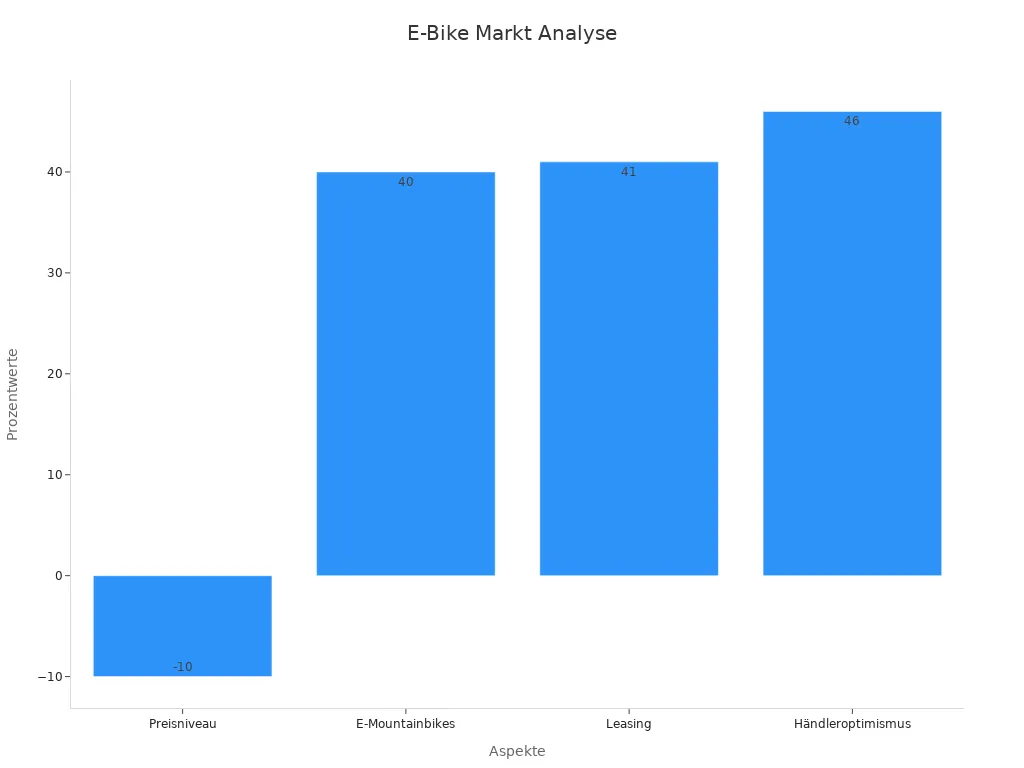
Speed is another advantage. S-pedelecs can reach speeds of up to 45 km/h, making them ideal for commuters who want to get to their destination quickly. According to market analyses, the average selling price of e-bikes has fallen by 10%, making them more affordable. The growing popularity of e-mountain bikes, which have a 40% market share, also shows that high-performance models are increasingly in demand.
Aspect |
Description |
|---|---|
Price level |
Average selling price fell by 10%. |
Demand |
Revenue in the bicycle market remains stable at €6.33 billion. |
E-mountain bikes |
40% market share; especially popular with sporty riders. |
Leasing |
Leasing models exceed traditional purchases by 41%. |
E-bikes are also environmentally friendly. More and more people are choosing them to reduce their carbon footprint. They offer a convenient alternative to cars, both for commuting and for leisure activities.
Advantages of pedelecs
Pedelecs are among the most widely used electric bicycles. Between 85 and 97 percent of all electric bicycles in Germany are pedelecs. They are easy to use and require neither a driver’s license nor registration.
One major advantage is their versatility. You can use them for your daily commute, shopping, or leisure activities. They are particularly suitable for seniors and families because they are safe and easy to operate. They are also legally classified as bicycles, so you don’t have to pay extra for insurance or comply with a helmet requirement.
Tip: When buying a pedelec, make sure it meets the EN 15194 standard. This standard guarantees safety and quality.
Disadvantages and limitations
Despite their advantages, e-bikes and pedelecs also have some drawbacks. E-bikes are often more expensive than pedelecs. Their more powerful motors and batteries require regular maintenance, which adds to the cost. They are also subject to stricter legal requirements, such as licensing and insurance obligations.
Pedelecs, on the other hand, offer less power. The motor only assists you up to 25 km/h, making them less appealing to sporty riders or for longer distances. Their range can also be limited with intensive use.
Another drawback of both types of vehicles is the risk of accidents. The number of accidents involving pedelecs and e-bikes has been rising for years. The risk of serious injury is particularly high at higher speeds.
Note: Always wear a helmet, even if it is not legally required. This can help minimize the risk of head injuries.
Summary of the differences and legal requirements
The differences between e-bikes and pedelecs are clearly defined, both technically and legally. The following table summarizes the key points:
Type |
Speed |
Pedal assistance |
Driver’s license |
Insurance plate |
Use of cycle paths |
|---|---|---|---|---|---|
Pedelec up to 25 km/h |
up to 25 km/h |
Yes |
No |
No |
Yes |
S-pedelec up to 45 km/h |
up to 45 km/h |
Yes |
Class AM |
Yes |
Roadway only |
E-bike up to 25 km/h |
up to 25 km/h |
No |
Moped test certificate |
Yes |
Yes outside built-up areas; within built-up areas only with an additional sign |
E-bike up to 45 km/h |
up to 45 km/h |
No |
Class AM |
Yes |
Roadway only |
Tips for choosing between an e-bike and a pedelec
The choice between an e-bike and a pedelec depends on your individual needs. Think about which requirements matter to you:
Pedelecs assist you only while pedaling, up to 25 km/h. They are suitable for commuting and recreational rides.
S-pedelecs and e-bikes offer higher speeds and are ideal for sporty riders or longer distances.
E-bikes support your health by making exercise in your everyday life more enjoyable.
To make the right decision, ask yourself the following questions:
Where do you want to ride: in the city, countryside, or mountains?
How do you plan to use it: commuting, leisure, or sport?
What physical factors might influence your choice?
Tip: Choose a model that suits your lifestyle and meets your needs. This will help you make the most of the benefits of e-bikes and pedelecs.
FAQ
1. What is the difference between a pedelec and an S-pedelec?
A pedelec assists you up to 25 km/h and is legally classified as a bicycle. An S-pedelec can reach speeds of up to 45 km/h and is classified as a light motorcycle. You need a driver’s license and an insurance plate to ride one.
2. Can I ride an e-bike without a driver’s license?
That depends on its speed. E-bikes that reach speeds of up to 25 km/h do not require a driver’s license. For faster models, such as S-pedelecs, you need at least a Class AM driver’s license.
3. How long does the battery of an e-bike or pedelec last?
A battery lasts about 500 to 1,000 charge cycles. Its range depends on its capacity, the terrain, and your riding style. Regular care extends its lifespan.
4. Can I ride an S-pedelec on cycle paths?
No, S-pedelecs may only be ridden on the roadway. They are legally classified as light motorcycles and are not allowed on cycle paths unless an appropriate additional sign permits it.
5. What maintenance does an e-bike need?
You should regularly check the brakes, battery, and electronics. An annual inspection by a specialist dealer helps maintain your e-bike’s safety and performance.