
Are you wondering whether an e-bike or a regular bicycle better fits your daily routine? In Germany, 10.78 million people now own an e-bike—and by the end of 2023, that number had already reached 11 million. The figure is growing as more and more people discover the benefits. The market share of e-bikes recently rose to 43%. Consider the distances you travel and the level of assistance you would like.
Key takeaways
E-bikes are suitable for many age groups, not just seniors. They offer flexibility and comfort for commuters and people with physical limitations.
E-bikes make longer distances possible with less effort. They are ideal for everyday use, helping you replace your car and save time.
The range of an e-bike depends on battery capacity and riding style. A larger battery enables longer trips, often over 100 kilometers.
E-bikes are heavier than regular bicycles, which makes transport more difficult. Before traveling, check how you can transport your e-bike.
The acquisition costs for e-bikes are higher, but they offer many everyday advantages. Inform yourself about subsidy options in your region.
Who is an e-bike worth it for?
Target groups at a glance
You will benefit from an e-bike if you have specific mobility and everyday needs. Many people believe that e-bikes are only intended for older individuals. This is not true. Buyers are spread across various age groups:
50- to 59-year-olds make up a large share.
14% of buyers are 18 to 29 years old.
Only 12% of buyers are over 60 years old.
As you can see, the e-bike appeals to many people. It is suitable for you if you:
as a commuter, value efficiency and flexibility,
as a senior, are looking for comfort and safety,
need easy handling due to physical limitations,
want to replace your car in everyday life.
An e-bike helps you avoid traffic stress. It offers you mobility and keeps you active, even if you have physical limitations. If you have back problems, it is best to choose a model with full suspension. Hydraulic brakes make riding easier if you have limited hand strength. A low-step frame is ideal if you have hip issues. Three-wheeled bikes with a motor provide extra stability and safety, especially on uneven roads.
A study by the Hannover Medical School shows that you achieve almost the same training effect with an e-bike as with a regular bicycle. Your heart rate remains only five beats per minute lower than that of cyclists without a motor. This helps boost your fitness and health.
Typical usage scenarios
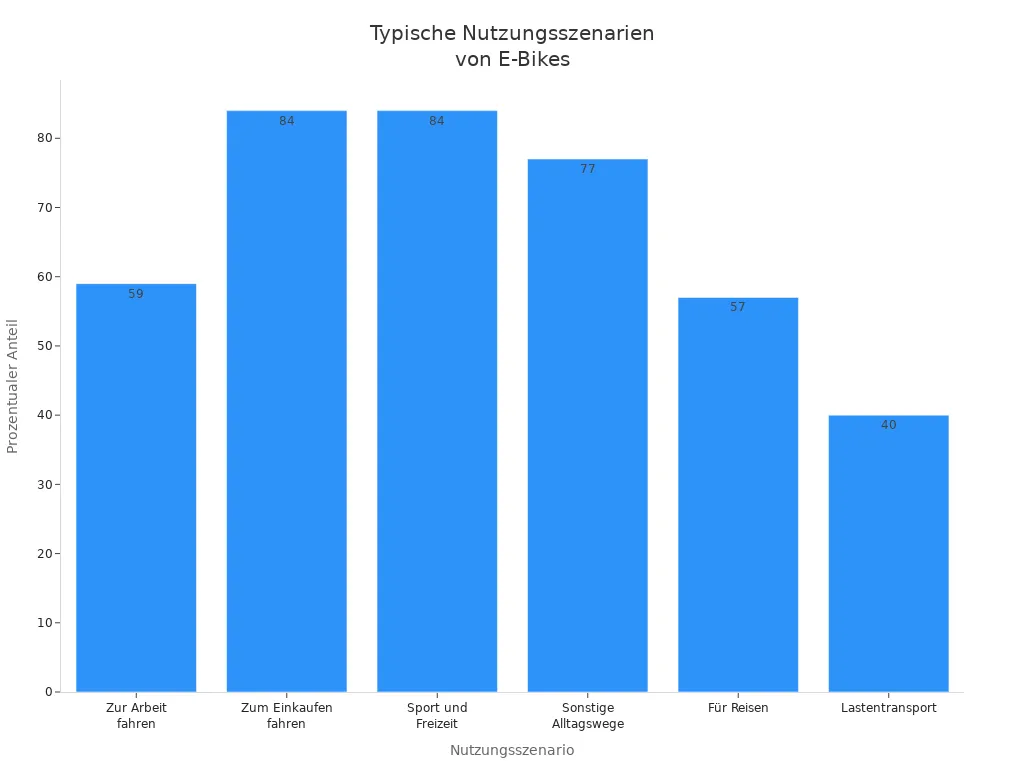
You can use an e-bike in many everyday situations. Scientific studies show that you use it not only for commuting to work, but also for shopping, leisure, and travel. The following table gives you an overview:
Usage scenario |
Percentage |
|---|---|
Commuting to work |
59% |
Going shopping |
84% |
For sports and leisure |
84% |
For other everyday trips |
77% |
For travel |
57% |
For transporting cargo |
40% |
You can often use the e-bike as a replacement for a car in everyday life. The German Federal Environment Agency has determined that about half of all car journeys are no longer than five kilometers. In cities, you are often faster with an e-bike than with a car because you avoid traffic jams and detours. This saves you time and protects the environment.
The e-bike is suitable for you if you want to be flexible and independent. You can do your shopping, ride to work, or enjoy your leisure time. The e-bike also offers you many possibilities for transporting loads or going on trips.
Differences between e-bikes and bicycles
Motor and technology
You can recognize the biggest difference between an e-bike and a regular bicycle by the motor. A regular bicycle has no drive system. You only move it with your own muscle power. The e-bike has an electric motor. This motor assists you while pedaling. Modern e-bikes use lithium-ion batteries. These batteries offer high capacity and ensure a long range.
The motor can feed energy back into the battery in recuperation mode. This increases the range.
The battery capacity determines how far you can ride.
Depending on the model and riding style, e-bikes can reach distances from less than 20 to over 100 kilometers.
The motor position influences the riding behavior. A front-wheel drive is suitable for the city. A mid-motor distributes the weight better and helps you on hilly terrain. Front-wheel drives are often cheaper and easier to operate. Mid-motors offer you more grip and safety, especially on challenging routes.
Riding feel and comfort
The riding experience on an e-bike is significantly different. The electric motor supports your pedaling movement. At first, this feels unfamiliar. After a short time, you will enjoy the assistance, especially on inclines or against headwind. Many users report that they would not want to miss the pleasant riding experience.
Tip: Use different assistance modes to adjust the motor power to your needs.
E-bikes offer you additional comfort features:
Regenerative braking saves energy and extends the range.
You can choose between multiple assistance modes.
Aspect |
E-Bike |
Conventional bicycle |
|---|---|---|
25 km/h |
15 km/h |
|
Range |
Greater |
Smaller |
Handling on inclines |
Easier due to motor assistance |
Arduous, even for fit riders |
Some cyclists prefer the natural riding feel of a regular bicycle. Others appreciate the higher speed and easier handling of the e-bike.
Range and battery
The range of an e-bike depends on several factors. The most important role is played by the battery capacity. A larger battery means you can ride further. With an economical riding style and a 500 Wh battery, you often reach more than 100 kilometers. High-quality models manage 50 to 80 kilometers under mixed usage. Some e-bikes even go up to 130 kilometers before the battery is empty.
E-bike range |
Conditions |
|---|---|
100 km and more |
Light, economical assistance with a 500 Wh battery |
50 to 80 km |
High-quality e-bikes with mixed riding style |
80 to 130 km |
Average ranges of battery-powered bikes |
Many factors influence the range:
Battery capacity
Assistance mode
Rider weight
Riding speed
Terrain
Wind
Tires and air pressure
A regular bicycle has no range limitation due to a battery. You are only dependent on your own stamina.
Weight and transport
Weight is an important difference. A regular bicycle weighs about 10 to 16 kilograms. An e-bike usually weighs between 20 and 25 kilograms. Pedelecs can even weigh up to 30 kilograms. The higher weight makes transport more difficult.
E-bikes are heavier and require special bicycle racks.
Regular bicycles are easier to carry and transport.
In public transport, there are often restrictions for e-bikes. You sometimes need an extra ticket. In some trains, transport is entirely prohibited.
You should check before a trip if and how you can take your e-bike with you. The weight remains high even if you remove the battery.
E-bike advantages and disadvantages
Advantages in everyday life
An e-bike brings you many benefits in daily life. You can cover longer distances with little effort. This is especially practical if you are often on the go or need physical support. Many users report that they can organize their everyday lives more flexibly with an e-bike.
You ride longer distances without getting tired quickly. This helps you stay mobile even as a senior or with physical limitations.
You replace your car or public transport for commuting to work. This way, you arrive at work relaxed and without sweating.
You enjoy more freedom and comfort. The e-bike makes you independent and saves time.
Tip: With an e-bike, you can handle inclines and longer distances more easily. You can ride more kilometers per week and reach your destination quickly, even in a headwind or with luggage.
A commute of almost five kilometers can be done in about twelve minutes. The strain on your joints remains low. The risk of injury decreases. You can also use the e-bike for shopping or leisure. Many people experience a better quality of life in their daily routine.
Disadvantages and limitations
Despite many advantages, there are also some disadvantages you should consider.
The acquisition costs are higher than for a regular bicycle.
You have to plan more time and money for maintenance and care. The battery needs regular charging, and the electronics must be in working order.
The weight is higher. This makes transport more difficult.
Handling can be cumbersome for repairs, such as with a flat tire.
You need stronger brakes and sometimes a special frame. Not every gear system fits a coaster brake.
The tires often have less grip, which can affect safety.
A German study shows that you are often less physically active with an e-bike than with a regular bicycle. Only 22 percent of e-bike users reach the WHO's recommended physical activity target, compared to 35 percent of conventional cyclists. Many people perceive the behavior of e-bike users in traffic as unsafe. This can make everyday use more difficult.
Cost comparison
Acquisition costs
When buying a bicycle or e-bike, you immediately see large price differences. You can get a regular bicycle for little money. An e-bike costs significantly more. The following table shows you the average prices:
Bicycle type |
|
|---|---|
E-Bikes |
2,500 € – 3,500 € |
Regular bicycles |
150 € – 250 € |
You therefore have to invest significantly more for an e-bike. In Germany, there is no nationwide subsidy for the private purchase of e-bikes. However, some cities or municipalities offer their own programs. Employers and some health insurance companies sometimes support you with the purchase, albeit to a limited extent. In federal states like Baden-Württemberg, Berlin, or North Rhine-Westphalia, you can find various subsidy options. It is worth asking in your city.
Tip: Compared to a car, you often save a lot of money on acquisition and maintenance with an e-bike.
Operation and maintenance
Running costs also differ. An e-bike requires electricity, regular maintenance, and sometimes specialized workshops. The cost per battery charge is about 13 to 15 cents. Parts like the chain and sprocket wear out faster and need to be replaced more often. A battery replacement costs between €400 and €900 after three to five years. For motor maintenance or software updates, you will regularly pay €50 to €200. You can often repair normal bicycles yourself. Maintenance is cheaper and easier.
Cost category |
E-bike |
Normal bicycle |
|---|---|---|
Maintenance costs |
Software updates, battery care necessary |
Usually DIY-friendly |
Workshop requirements |
Specialized workshops required |
Often DIY-repairable |
Battery replacement (3–5 years) |
€400–900 |
Not necessary |
Wear parts per year |
Higher costs |
€50–200 |
Depreciation
Depreciation plays a greater role with e-bikes. Prices drop most sharply in the first two years. A high original price, a new battery, and good condition increase the resale value. Well-known brands will fetch you more money when selling. Newer e-bikes with few signs of wear achieve better prices.
Factor |
Description |
|---|---|
Original price |
Higher initial purchase price = higher resale value |
Age |
Newer e-bikes have a higher residual value |
Battery performance |
A new or high-capacity battery increases the value |
General condition |
Fewer signs of wear increase the value |
Brand |
Well-known brands fetch better prices |
Note: A normal bicycle loses value more slowly and is cheaper to maintain. However, an e-bike can be worth it if you use it regularly and look into subsidies.
Areas of application for e-bikes and bicycles
Commuting and travel to work
Do you want to get to work quickly in the morning? Many commuters use a bicycle for their daily commute. An e-bike often gets you to your destination faster than a car, especially on routes up to 10 kilometers. The higher average speed in city traffic and no need to search for parking save you time. A 2024 mobility study shows: With an e-bike, you cover 4.8 kilometers in about 11 to 12 minutes. With a normal bicycle, you need significantly longer for the same distance. The e-bike replaces the car more frequently than a normal bicycle. You can ride longer distances and are less sensitive to inclines.
Comparison of usage |
E-bikes |
Normal bicycles |
|---|---|---|
Daily distance |
8 km |
5.3 km |
Time spent |
32.2 minutes |
30.3 minutes |
Replacement of cars |
Frequent |
Less frequent |
Sports and leisure
Do you want to exercise and have fun? Both bicycles and e-bikes are suitable for sports and leisure. With a normal bicycle, you train your endurance and strength. The e-bike makes longer tours possible, even if you are less athletic. Many older or overweight people are getting back on the bike thanks to motor support. You can go on trips with friends without overexerting yourself. Inclines and longer distances become easier. This motivates you to be active more often.
Tip: Plan a bike tour on the weekend. With an e-bike, you can discover new paths while remaining relaxed.
Health and mobility
Cycling promotes your health. Both types of bicycles strengthen the cardiovascular system. Studies show that the risk of a heart attack is reduced by over 40 percent through regular cycling. The e-bike challenges your cardiovascular system similarly to a normal bike, but with less stress on the joints. People with physical limitations benefit in particular. The electric support makes longer distances and inclines possible. You stay mobile and regain zest for life.
Health benefits |
E-bikes |
Normal bicycles |
|---|---|---|
Cardiovascular system |
Challenged similarly to a normal bicycle |
Lower load |
Heart attack risk |
Reduced by over 40 percent |
N/A |
Increase in activity |
Easier for older and overweight people |
N/A |
Selection and tips
Decision checklist
Do you want to know if an e-bike or a normal bicycle suits you better? Use this checklist to make your decision easier:
🚲 How long are your daily routes?
Do you often ride more than 5 kilometers at a time?🏞️ Are there many inclines on your route?
An e-bike helps you with hills and headwinds.⏰ How important is saving time to you?
With motor support, you reach your destination faster.💪 What is your physical fitness?
Do you have health limitations or do you want to move more?💸 What is your budget?
An e-bike costs more but often saves time and effort.🚗 Do you want to replace your car?
An e-bike is well-suited for short daily commutes.
Tip: Check all the points that apply to you. The more you check, the more worthwhile an e-bike is for you.
Tips for buying
When buying, you should pay attention to a few important things:
Test different models. Take a test ride. This way, you will feel the difference.
Pay attention to battery capacity. A larger battery takes you further.
Choose the right frame shape. Step-through frames make mounting and dismounting easier.
Inform yourself about service and warranty. Good dealers offer maintenance and advice.
Compare prices and subsidies. Ask about leasing or grants.
Criterion |
Why it is important? |
|---|---|
Test ride |
Test the ride feel |
Battery capacity |
Check the range |
Frame shape |
Comfort and safety |
Service |
Reliability in everyday life |
Price/Subsidies |
Saving money |
Use and care
Do you want to enjoy your bicycle for a long time? Observe these instructions:
Charge the battery regularly and store it in a dry place.
Check the brakes and tires before every ride.
Clean the bicycle after rain or exposure to dirt.
Have your e-bike serviced once a year.
Protect your bicycle with a high-quality lock.
Note: Proper care extends the lifespan of your bicycle and ensures more safety.
You have learned about the most important differences between an e-bike and a bicycle. An e-bike is suitable for you if you want to tackle long distances, inclines, or carry heavy loads. A normal bicycle fits you if you are looking for exercise and adventure. Experts recommend that you consider the following points:
Terrain and route profile
Effort versus comfort
Budget and maintenance
Physical limitations
Transport needs
Test various models and seek professional advice. This is how you will find the right bicycle for your daily routine.
FAQ
How long does an e-bike battery last?
You can usually ride with an e-bike battery for 3 to 5 years. The lifespan depends on maintenance and usage. Charge the battery regularly and store it in a dry place. This will extend its durability.
Do I still have to pedal on an e-bike?
Yes, you must always pedal. The motor only supports you while you are pedaling. You can adjust the level of support. Without pedaling, the e-bike will not move on its own.
Can I use an e-bike in the rain?
You can ride your e-bike in the rain. The electronics are protected against splashing water. Dry off the e-bike after your ride. This protects the technology.
How often does an e-bike need to be serviced?
You should have your e-bike serviced once a year. Check the brakes, tires, and battery regularly. Good maintenance ensures safety and a long service life.
Are there subsidies for buying an e-bike?
Some cities or federal states offer subsidies. Ask your local municipality. Employers and health insurance companies sometimes support the purchase. Check for current programs before you buy.