
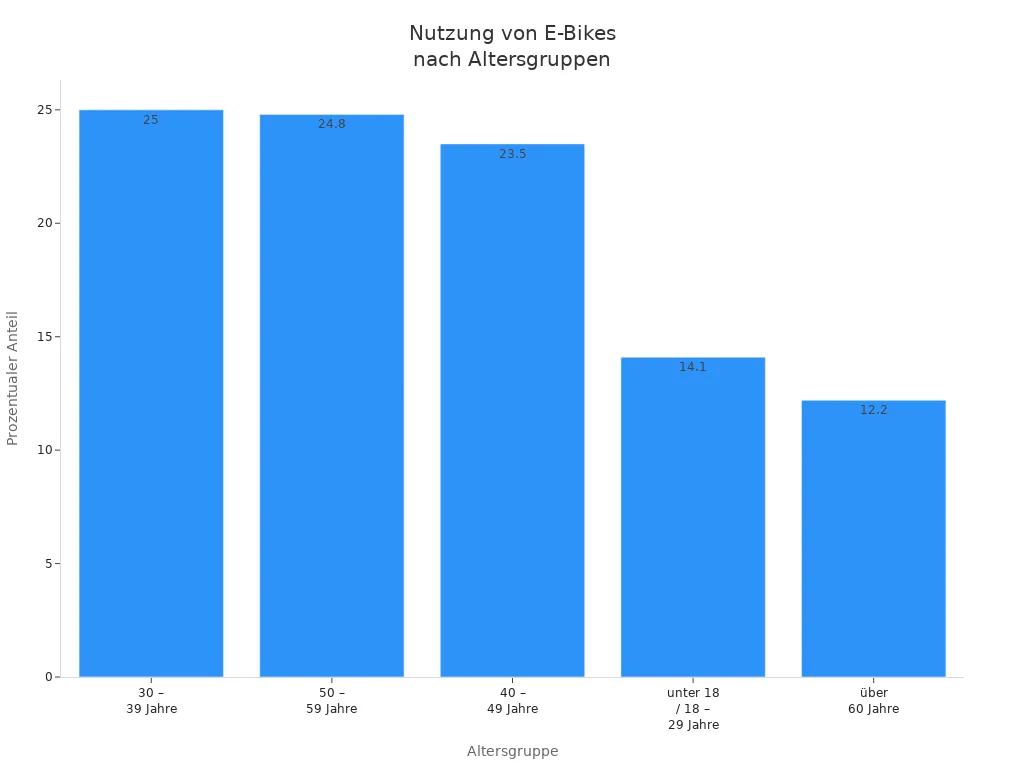
You are wondering whether an e-bike or a regular bicycle is a better fit for you. Your daily routine, budget, fitness level, and the environment all play a major role. Take a look at the age groups that cycle the most:
Age group |
Percentage |
|---|---|
30 – 39 years |
25 % |
50 – 59 years |
24.8 % |
40 – 49 years |
23.5 % |
under 18 years / 18 – 29 years |
14.1 % |
over 60 years |
12.2 % |
Key insights
E-bikes are ideal for longer distances and steep climbs. They provide assistance that makes riding easier and increases mobility.
Regular bicycles are lighter and more affordable. They are well-suited for short distances and promote fitness through increased physical exertion.
Consider your needs and intended use. A checklist will help you find the right bike for your daily life.
Who is which bike worth it for?
User profiles
You may belong to one of the many groups that enjoy cycling. Each group has its own wishes and requirements. Take a look at the following table to see which target groups in different countries prefer e-bikes:
Target group |
Germany (%) |
Great Britain (%) |
Netherlands (%) |
|---|---|---|---|
48 |
24 |
65 |
|
Environmentally conscious people |
43 |
53 |
42 |
Commuters |
39 |
53 |
37 |
Cost-conscious people |
22 |
32 |
22 |
Parents |
20 |
16 |
24 |
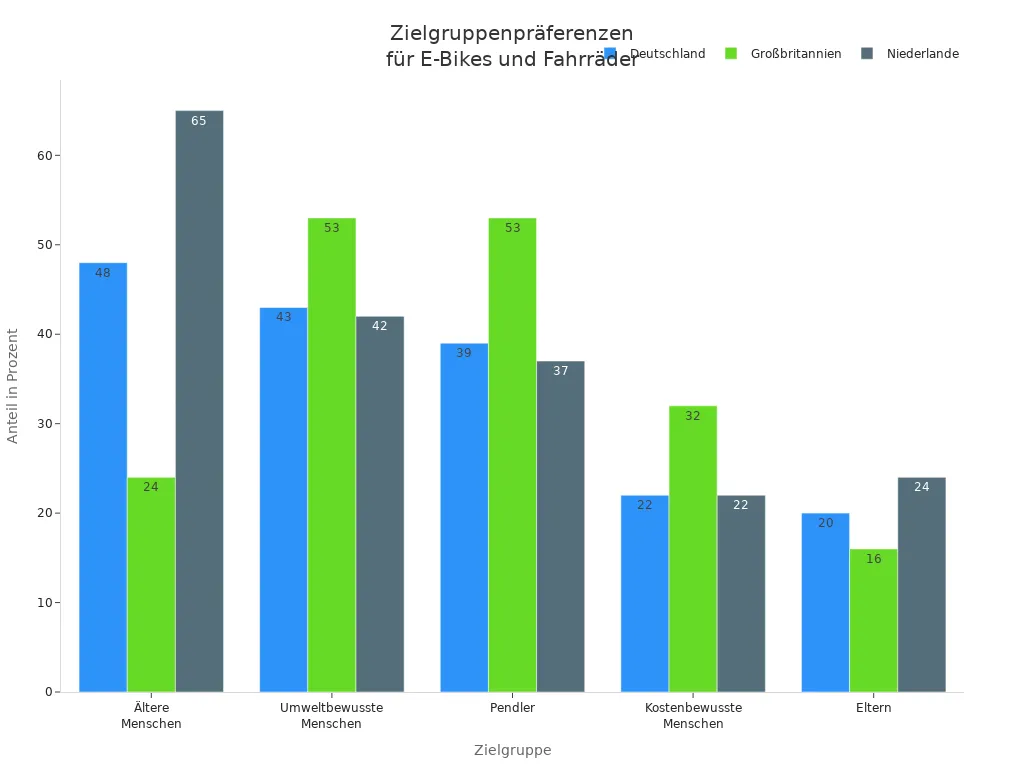
Many older people choose an e-bike because it makes getting around easier for them. Younger people often use it for commuting to work or for sports tours. If you are athletic and want to improve your fitness, you might prefer a regular bicycle. Environmentally conscious people and parents with children are also discovering the e-bike for themselves, as it simplifies everyday life and produces no exhaust fumes.
Tip: If you are less fit or want to cover longer distances, an e-bike can help you stay mobile regardless.
Everyday factors
In everyday life, how you use your bike counts. The most important factors are distance, terrain, transport, and comfort. The following table shows you how e-bikes and regular bicycles differ in everyday life:
Category |
E-bikes |
Regular bicycles |
|---|---|---|
Longer distances are easier, arrive relaxed, transport more load |
No battery, easier to carry, cheaper to service |
|
Leisure rides |
Longer tours, discover new paths, keep groups together |
Purist riding experience, ideal for fitness and racing |
With an e-bike, you can master steep climbs and long distances without much effort. This is particularly practical if you live in a hilly area or often pull a trailer. In the city, the e-bike helps you get through traffic quickly and safely. Parents benefit because they can transport children and groceries more easily.
Regular bicycles are lighter and easier to carry or store. They are well-suited for short distances and flat terrain. If you value sport and fitness, a regular bicycle gives you the pure riding experience.
Note: Consider how often you need to carry your bike or put it in the basement. A regular bicycle is often lighter and easier to handle.
Regardless of whether you live in the city or the countryside – your daily routes and lifestyle determine which bike suits you better.
Differences
Drive & Technology
You feel the support from the motor immediately on an e-bike. Different modes help you tackle inclines and long distances more easily. A regular bicycle relies entirely on your muscle power. The following table shows the most important technical differences:
Difference |
E-bike |
Regular bicycle |
|---|---|---|
Level of support |
Pedal assistance, various levels |
Muscle power only |
Battery life |
32–130 km per charge |
Not relevant |
Speed limit |
25 km/h or 45 km/h (depending on model) |
No limit |
Rider effort |
Less effort, especially on inclines |
More effort on inclines |
Costs
When buying an e-bike, you pay more than for a regular bicycle. Prices are usually between 1,000 and 5,000 euros. An everyday e-bike often costs 2,000 to 2,500 euros. Regular bicycles are cheaper. Running costs also differ:
Category |
Regular bicycle costs |
|
|---|---|---|
Battery replacement (3–5 years) |
400–900 € |
Not necessary |
Motor maintenance |
50–200 € |
Not necessary |
Wear parts |
Higher |
50–200 €/year |
Annual check |
Not necessary |
50–120 € |
Maintenance
An e-bike requires more care. You have to maintain the battery and sometimes perform software updates. For repairs, you often need a specialized workshop. You can usually repair a regular bicycle yourself.
Everyday life
In everyday life, the e-bike helps you particularly with commuting, long tours, or if you transport heavy loads. It is also suitable for older people who want to remain mobile. Regular bicycles are lighter and more flexible if you need to carry or store the bike often.
Health
With a regular bicycle, you train your endurance and burn more calories. The e-bike supports you if you are less fit or want to travel longer distances.
Bike type |
Heart rate |
|
|---|---|---|
Regular bicycle |
Higher |
Higher |
E-bike |
Lower |
Lower |
Environment
Both bikes are environmentally friendly. However, the production of the e-bike, especially the battery, causes more CO2. Over the entire lifespan, the footprint remains low nonetheless.
Bike type |
CO2 emissions (kg CO2e) |
Battery production share (kg CO2e) |
|---|---|---|
Regular bicycle |
100 - 150 |
Not relevant |
E-bike |
76 |
Tip: Think about how you want to use your bike. For long distances and inclines, the e-bike offers clear advantages. For short trips and fitness, a regular bicycle is often sufficient.
E-bike advantages & disadvantages
E-bike advantages
An e-bike offers you many advantages in everyday life. Especially as a commuter or for longer work commutes, you benefit from the motor assistance. You can master steep hills and long distances more easily. The following list shows you the most important plus points:
You receive assistance while pedaling, especially on steep sections.
You promote your health through exercise.
You protect the environment because you cause fewer emissions.
You save costs compared to a car or bus.
You are flexible in choosing your route.
An e-bike allows you to make your commute to work more efficient while doing something for your health and the environment at the same time.
In everyday life, you avoid traffic stress and searching for parking. You arrive at your destination relaxed and without sweating. Especially in mountainous regions or when riding against the wind, you will feel the difference. The motor assistance increases riding comfort and makes cycling on difficult terrain more pleasant.
Situation |
Advantage of e-bike |
|---|---|
Steep climbs |
Less effort |
Headwind |
More riding fun |
Long distances |
More endurance |
E-bike disadvantages
An e-bike also has some disadvantages that you should be aware of:
You have to plan for longer charging times for the battery.
The initial purchase is more expensive than for a regular bicycle.
The higher weight makes carrying it more difficult.
The range is limited, especially with high assistance.
For very long tours or significant elevation gain, it is not always ideal.
Prices for an e-bike are usually between 2,500 and 3,000 euros. Repairs and maintenance often cost more than for a standard bicycle. If the battery is empty, you have to exert more effort to keep riding.
Standard bicycle: Pros & Cons
Advantages
A standard bicycle offers you many advantages in everyday life and for sports. You can rely on your own strength and are independent of batteries or technology. Particularly sports-ambitious riders benefit from these features:
Trekking bikes have mudguards that protect you in bad weather.
Narrow, off-road capable 28-inch tires ensure a good riding feel on different surfaces.
The sporty seating position makes pedaling easier and increases your performance.
You remain flexible because the bike is suitable for everyday use and road-safe.
For bike trips, you can easily mount panniers.
A standard bicycle weighs less than an e-bike. This makes your everyday life easier:
You can carry your bike over stairs or into buses and trains without any problems.
In the city, you maneuver faster through traffic.
Beginners learn to ride more easily because the bike weighs less.
Tip: If you often have to carry or stow your bicycle, the low weight is a real advantage.
Disadvantages
With a standard bicycle, you always have to pedal yourself. You will notice this especially on long distances or on inclines:
Without motor assistance, the pedal resistance increases. You need more muscle power.
Long climbs can be strenuous, especially with luggage.
Good gears help you reduce the resistance, but you still have to stay fit.
For very long tours or if you often transport heavy loads, a standard bicycle can quickly reach its limits. You should consider how much strength and endurance you have.
E-bike target groups
For whom is it particularly suitable?
You benefit especially from an e-bike if you cover longer distances or often have to overcome inclines. Many people use an e-bike because it makes everyday life easier and promotes health. The following table shows you which groups benefit particularly and why:
Target group |
Advantages of the e-bike |
|---|---|
People with limited mobility |
Joint-friendly, enables longer distances and inclines without overexertion. |
Commuters |
Ideal for the commute to work, as you don't arrive sweaty. |
Families with children |
Offers more tractive power and less exertion while riding. |
Older people |
Joint-friendly and motivating for more exercise. |
Overweight people |
Low-threshold access to more exercise in everyday life. |
An e-bike is gentle on your joints and helps you become active again after an injury or operation. Doctors often recommend it as a rehabilitation measure, for example after knee operations or for osteoarthritis. You can easily integrate training into your everyday life and move around in the fresh air. This increases your well-being and reduces stress.
Tip: If you feel insecure or have avoided longer distances until now, an e-bike can make getting started easier for you.
When is an e-bike not worth it?
A standard bicycle suits you better if you ride short distances on flat terrain or are out for sport. You burn more calories and train your endurance more intensively. For simple routes, a classic bike is often enough. If you frequently have to carry your bike or take it on buses and trains, you benefit from the lower weight.
Standard bicycle is ideal for short, flat routes.
You burn more calories and increase your fitness.
The low weight makes carrying and stowing easier.
Sporty riders often prefer the classic bike because they are looking for the full physical challenge. An e-bike reduces the effort per kilometer and can burn fewer calories. It also requires more maintenance and causes additional costs due to the battery.
Note: Think about how you want to use your bike and what your goals are. For fitness and flexibility, the standard bicycle often remains the best choice.
Checklist & Decision
Self-assessment
Before you decide, you should check your own needs. A checklist will help you answer important questions. Consider the following:
What is your main goal when cycling? (e.g., commuting, fitness, adventure, racing)
What does the terrain on your routes look like? (flat, hilly, mixed)
Do you want to minimize exertion or train specifically?
What is your budget, including for maintenance?
Do you have physical limitations such as problems with joints, back, or heart?
Do you often have to transport loads, such as a child seat, luggage, or a laptop?
Is the use of e-bikes permitted in your region?
It is best to test different models. Rent an e-bike and ride your typical route. This way you will find out if a strong motor or a large battery makes sense for you. For short distances, a cheaper model with less motor power is often sufficient. In hilly regions, you benefit from more power.
Tip: Write down your answers. This way you will quickly see which bike fits your everyday life.
Decision table
The following table will help you make your decision. Compare the most important criteria and find out what suits you better:
Criterion |
E-bike |
Standard bicycle |
|---|---|---|
Route |
Long, hilly |
Short, flat |
Exertion |
Low, assistance from motor |
High, training effect |
Budget |
Higher, more maintenance |
Cheaper, less maintenance |
Transport of loads |
Easy, more tractive power |
Limited |
Fitness goal |
Exercise with assistance |
Maximum training |
Physical limitation |
Joint-friendly |
More strain |
Note which column matches your needs more often. That's how you find the right bike for you!
You have learned about the most important differences: technology, costs, health, and everyday life.
You decide which bike fits your life.
You benefit from exercise and fresh air, whether with an e-bike or a standard bicycle.
Cycling enriches your everyday life and strengthens your health. Choose the model that suits your needs.
FAQ
How far can I ride with an e-bike?
The range depends on the battery, terrain, and riding style. You usually achieve between 40 and 100 kilometers with one battery charge.
Do I still have to pedal with an e-bike?
Yes, you always have to pedal. The motor only supports you when you pedal yourself.
How heavy is an e-bike compared to a standard bicycle?
An e-bike often weighs 20 to 30 kilograms.
A standard bicycle usually weighs 12 to 16 kilograms.