
The perfect e-bike tire pressure depends on your weight, the weight of your e-bike, the tire width, and the terrain. Every rider has different requirements. You should adjust your tire pressure individually. Optimal pressure ensures safety and riding comfort. Check the air pressure regularly and adjust it if necessary. This will protect your tires and help you achieve better range.
Key Takeaways
The right tire pressure ensures more safety, better riding comfort, and a longer range for your e-bike.
Adjust the air pressure according to your weight, the e-bike weight, tire width, and the terrain to achieve optimal results.
Check the tire pressure regularly with an accurate pressure gauge, at least once a month or before long rides.
Increase the pressure when carrying a heavy load or riding on asphalt; decrease it for uneven terrain such as forest paths or snow.
Use the rule of thumb and manufacturer specifications as a guide, but fine-tune the pressure individually for more safety and riding pleasure.
Importance of Tire Pressure
Safety
The right tire pressure is crucial for your safety on an e-bike. Even small deviations can have major consequences. Studies show that underinflated tires make steering sluggish and reduce grip in corners. This increases the risk of you falling. The risk of so-called "snakebites," or punctures to the inner tube, also increases. If you ride with too much pressure, the tires lose their shock-absorbing effect. This makes riding on uneven paths less safe. You should always ensure that the air pressure is within the manufacturer's specified range and is appropriate for your weight and intended use.
Tip: Many e-bikers ride with too little air. This not only endangers safety but also the lifespan of your tires.
Here is an overview of the most important safety aspects:
Too low pressure: sluggish steering, less grip, increased risk of falling.
Increased risk of flats and rim damage.
Too high pressure: less comfort, indirectly more instability.
Optimal pressure: adjusted to weight and terrain, ensures a secure riding experience.
Comfort
Tire pressure affects how comfortable your ride on your e-bike is. If the pressure is too high, you will feel every bump in the road. The tires barely absorb shock, making the ride hard and restless. If the pressure is too low, the bike feels sluggish and you have to exert more effort. The tires also wear out faster.
Tire pressure |
Effects on riding comfort and safety |
|---|---|
Too high tire pressure |
- Little suspension, hard riding comfort |
Too low tire pressure |
- Faster wear |
You should check the pressure regularly to ensure you always ride comfortably and safely.
Range
Air pressure also affects how far you can go on a single battery charge. If the pressure is too low, rolling resistance increases. Your motor and you have to work harder to move the bike. This consumes energy and noticeably reduces the range. Many e-bike owners wonder why their battery runs out faster – it is often due to low tire pressure. Optimal pressure ensures less resistance and more kilometers per charge.
Manufacturers recommend checking tire pressure regularly. This not only extends the life of your tires but also gets the maximum out of your battery.
Influencing Factors
Rider Weight
Your weight plays a major role in determining the correct tire pressure. The more you weigh, the more air you should pump into the tires. This is because the total weight of the rider, e-bike, and luggage increases the pressure on the tires. Heavier riders need higher tire pressure to avoid flats and damage. Lighter riders can ride with less pressure. For e-bikes, it is recommended to set the pressure about 0.2 to 0.4 bar higher than on normal bicycles. Always follow the specifications on the tire. Too little air with high weight can lead to unsafe riding behavior and faster wear.
E-bike Weight
An e-bike weighs more than a regular bicycle due to the motor and battery. This additional weight directly affects the tire pressure. You should increase the pressure slightly to compensate for the extra weight. Many experts recommend selecting a generally higher pressure for e-bikes. This protects the tires and increases their longevity. Modern tire pressure sensors help you keep an eye on the pressure at all times.
Tip: Check the tire pressure regularly, as air escapes over time.
Tire Width
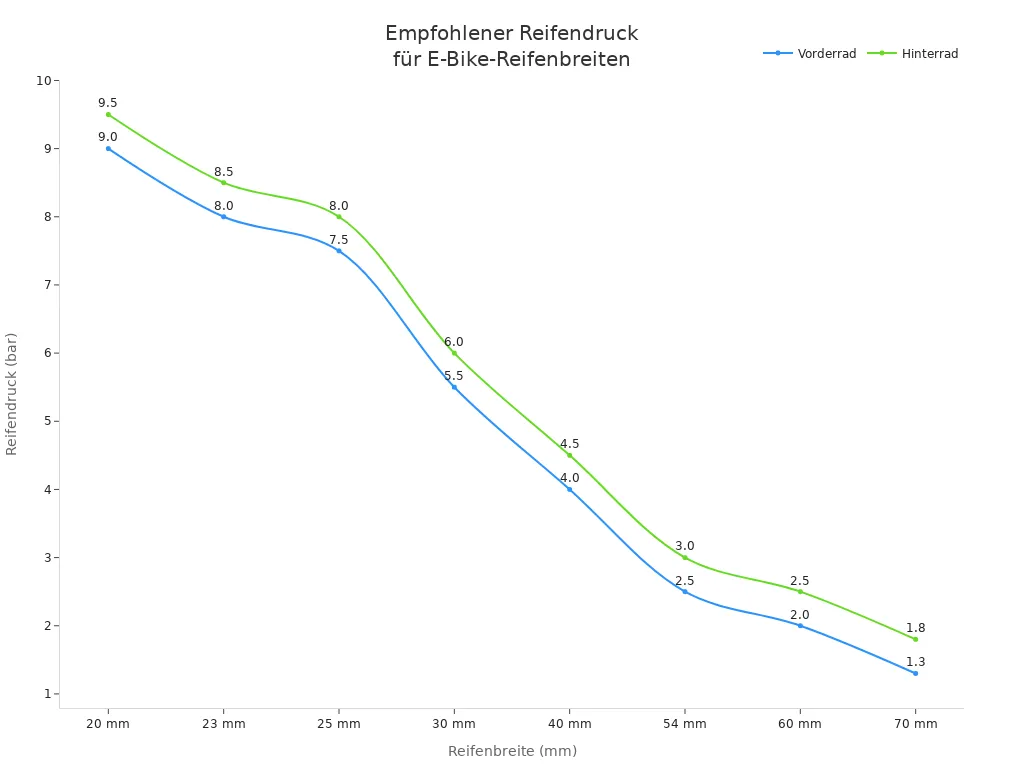
The width of your tires determines how much air they need. Narrow tires require more pressure, wide tires less. Here is an overview of the recommended values for different widths:
Tire width (mm) |
Front wheel (bar) |
Rear wheel (bar) |
|---|---|---|
20 |
9.0 |
9.5 |
23 |
8.0 |
8.5 |
25 |
7.5 |
8.0 |
30 |
5.5 |
6.0 |
40 |
4.0 |
4.5 |
54 |
2.5 |
3.0 |
60 |
2.0 |
2.5 |
70 |
1.3 |
1.8 |
These values apply to a rider weight of approximately 75 kg. For heavier riders, you should increase the pressure slightly.
Terrain
The surface significantly influences the optimal tire pressure. On asphalt, you should choose the pressure at the upper end of the recommendation. This reduces rolling resistance and saves energy. If you often ride on gravel, forest paths, or loose ground, lower the pressure slightly. This gives you more grip and comfort. Wider tires need less pressure on uneven terrain. Tubeless tires allow for even lower values because they are less prone to punctures.
On asphalt: high pressure for less resistance
On gravel or forest paths: lower pressure for more control
Technical trails: low pressure for better traction
Usually inflate the rear tire slightly higher than the front tire
Always adjust the pressure to your weight, tire width, and the terrain. This way, you ride safely and comfortably.
Calculate e-bike tire pressure
Manufacturer Specifications
Every tire manufacturer specifies a recommended pressure range for their tires. You will usually find these values directly on the tire sidewall. They serve as a starting point for calculating e-bike tire pressure. The specifications often refer to a rider weight of about 70 to 75 kg. For e-bikes, you should choose a slightly higher pressure because the motor and battery add extra weight. Experts recommend adding about 10% more pressure to the reference value from the table. This protects your tires and increases safety.
Here you can see typical reference values for various bicycle types and tire widths:
Bicycle type |
Tire width (mm) |
Tire pressure (bar) |
Tire pressure (psi) |
|---|---|---|---|
City E-bike |
30-50 |
3.0 – 5.0 |
44 – 73 |
Trekking E-bike |
35-50 |
3.5 – 5.5 |
51 – 80 |
Mountain E-bike |
54-70 |
1.5 – 2.8 |
22 – 41 |
E-road bike |
23-28 |
6.0 – 8.0 |
87 – 116 |
Tip: In case of heavy loading or a lot of luggage, you should increase the e-bike tire pressure further. On cobblestones or uneven terrain, you can lower the pressure slightly to get more comfort.
Example Calculation
You can calculate the optimal e-bike tire pressure with a simple rule of thumb. Divide your body weight by 10. This gives an initial reference value in bar. For e-bikes, add approximately 10% to this value to account for the extra weight of the motor and battery. For every kilogram over 75 kg, increase the pressure by 1%.
How to proceed:
Start with the table value for your tire width and bicycle type.
Calculate your body weight divided by 10 (e.g., 85 kg : 10 = 8.5 bar).
Add 10% for the e-bike (8.5 bar + 0.85 bar = 9.35 bar).
Adjust for extra weight: Increase by 1% for every kg over 75 kg.
Example:
You weigh 85 kg and ride a City E-bike with 40 mm tire width.
Table value: 4.0 bar
Body weight: 85 kg : 10 = 8.5 bar (Rule of thumb, but here the table value is the benchmark)
10% surcharge for e-bike: 4.0 bar + 0.4 bar = 4.4 bar
10 kg over 75 kg = 10% more: 4.4 bar + 0.44 bar = 4.84 bar
Recommended e-bike tire pressure: approx. 4.8 bar
Note: The rear wheel usually carries more weight. Pump it up about 0.2 bar more than the front wheel.
Adjustment for Terrain
The terrain significantly influences the optimal e-bike tire pressure. You should always adjust the pressure to improve safety and comfort.
Asphalt and summer: Choose a higher pressure. This saves energy and ensures a smooth roll.
Gravel, forest paths, cobblestones: Lower the pressure slightly. This gives you more grip and comfort.
Downhill and technical terrain: Increase the pressure to protect tires and rims from impact punctures.
Winter, snow, or mud: Reduce the pressure so that the tires get better grip.
Terrain |
Pressure adjustment |
Advantage |
|---|---|---|
Asphalt/Summer |
+0.2 to +0.4 bar |
Lower rolling resistance |
Gravel/Forest |
-0.2 to -0.4 bar |
More comfort and grip |
Downhill |
+0.3 to +0.5 bar |
Protection against punctures |
Winter/Snow |
-0.3 to -0.5 bar |
Better hold on soft ground |
Check the e-bike tire pressure regularly. Temperature and terrain can change the pressure. Continuously adjust it to your current route and your weight.
Control & Errors
Measuring Devices
You should always check tire pressure with a reliable measuring device. Many e-bikers use pumps with built-in pressure gauges. However, these often show inaccurate values. Experts recommend a floor pump with a digital display. With it, you measure the pressure more accurately. The thumb test might feel simple, but it does not provide reliable results. If you use different measuring devices, you will often get different values. Therefore, stick to one device that you know and trust.
Tip: It is best to check the tire pressure at room temperature and before riding. This will give you the most accurate readings.
Common mistakes
Many people repeatedly make the same mistakes when checking their e-bike tire pressure:
You inflate the tires to the maximum value without considering your weight or the terrain. This makes the ride harsh and unsafe.
You check the pressure only with your thumb or not at all. This often means you ride with too little air, increasing rolling resistance and the risk of punctures.
You forget to check it regularly. Pressure can drop quickly, especially in wide or tubeless tires.
You use different measuring devices, which leads to inaccurate results.
You rely on inaccurate pump gauges.
These mistakes can lead to poor handling, increased wear, and even damage to the rim and tire.
E-bike tire pressure tips
With a few simple tips, you can always keep your tire pressure in the optimal range:
Check the pressure at least once a month. For longer tours or varied terrain, it is better to check more often.
Use a floor pump with a pressure gauge for accurate readings.
Adjust the pressure to your weight, tire width, and the terrain. For e-bikes, calculate about 10% more than for regular bicycles.
Carry a small pump on longer rides so you can adjust the pressure on the go.
Always check the pressure before riding and at room temperature.
Document the condition of your tires regularly to detect wear early.
Modern Tire Pressure Monitoring Systems (TPMS) help you keep an eye on your pressure at all times.
Optimal e-bike tire pressure protects you from punctures, ensures a better riding experience, and extends the life of your tires. 🚲
You benefit from optimal e-bike tire pressure. Note these most important points:
Always choose a slightly higher pressure than for regular bicycles.
Follow the specifications on the tire sidewall.
Adjust the pressure to your weight and riding style.
Follow the manufacturer's instructions for e-mountain bikes.
Use tubeless tires for more grip at lower pressure.
Check the tire pressure regularly.
Check the air pressure before every ride. Adjust it to your weight and the terrain. This way, you ride safely and save energy. 🚲
FAQ
How often should you check the tire pressure on an e-bike?
You should check the tire pressure at least once a month. If you ride frequently or in changing weather, it is better to check every week. This allows you to detect pressure loss early and protect your tires.
What happens if you ride with tire pressure that is too low?
Too little air in the tire increases rolling resistance, requiring more effort to pedal. Tires wear out faster, and the risk of punctures increases. You lose safety and comfort.
Can you check tire pressure with your thumb?
The thumb test is not enough. You only get a rough feeling of whether there is air in the tire. A pressure gauge shows you the exact value, ensuring you always ride with the optimal pressure.
Which tire pressure is suitable for riding in winter?
Lower the pressure slightly in winter to gain more grip on snow and slush. Be careful not to go below the manufacturer's minimum value. Check the pressure regularly, as cold temperatures affect the reading.