
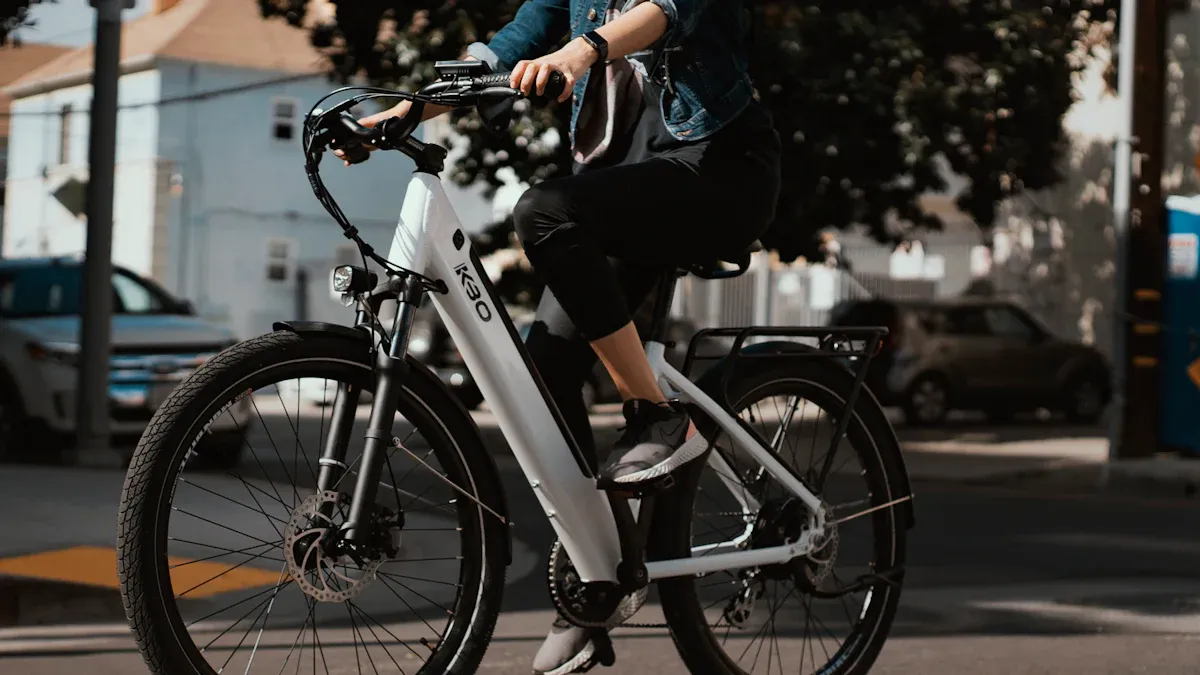
How far can you really ride with your e-bike? Many people expect a range of 40 to 120 kilometers, but the reality often looks different. The following table shows typical values for different battery sizes:
Battery (Wh) |
Manufacturer specification (km) |
Practical range (km) |
|---|---|---|
500 |
85 - 160 |
70 - 90 |
400 |
- |
50 - 70 |
Your riding style, the choice of assistance level, and battery maintenance play a major role in your actual range. Even small changes can be decisive and significantly extend your riding pleasure.
Key Findings
The actual range of your e-bike is often 60-70% of the manufacturer's specifications. Plan your tours accordingly.
The choice of assistance level strongly influences the range. Use the Eco mode for maximum efficiency.
Your riding style and weight have a major impact on the range. Riding at a steady pace saves energy.
Regular battery care extends its lifespan and range. Do not drain the battery completely and protect it from extreme temperatures.
Use digital tools such as range calculators and apps to better plan your tours and avoid surprises.
E-bike range in everyday life
Typical values and ranges
You want to know how far you can get with your e-bike in everyday life. The range depends on many factors. The battery capacity plays a major role. A battery with 500 Wh usually manages between 40 and 70 kilometers. A larger battery with 625 Wh often takes you 50 to 90 kilometers. With a 750 Wh battery, you can even reach 60 to 110 kilometers.
Battery capacity |
Realistic range (km) |
|---|---|
500 Wh |
40–70 |
625 Wh |
50–90 |
750 Wh |
60–110 |
You often ride different routes in everyday life. For regular tours, you should count on at least 80 kilometers. Commuters usually manage 50 to 70 kilometers. If you have luggage with you or are riding in mountainous terrain, you are more likely to reach 100 kilometers.
For regular tours: at least 80 km
For commuters: usually 50–70 km
With luggage or in mountainous terrain: closer to 100 km
The range fluctuates significantly. Outside temperature, riding style, and weight influence the distance you can cover with your e-bike. You can extend the range with an economical riding style and a low assistance level.
Why manufacturer specifications deviate
Manufacturers often state high ranges. These values are generated under laboratory conditions. The tests take place at 25 degrees on flat terrain. In everyday life, things look different. You ride in wind, rain, or on hilly routes. This significantly reduces the range.
Influencing factor |
Description |
|---|---|
Laboratory conditions |
Tests are carried out under ideal conditions (25 degrees, flat terrain, etc.) |
Realistic range |
Often only 50-80% of manufacturer specifications, depending on riding style and conditions |
Assistance levels |
Eco mode maximizes range, Turbo mode significantly shortens it |
Many factors influence the range of your e-bike:
Factor |
Impact on range |
|---|---|
High |
|
Terrain (flat vs. hilly) |
High |
Assistance level |
Medium |
Wind and weather |
Medium |
Tire pressure |
Low |
Route profile |
High |
Rule of thumb |
60-70% of manufacturer specification |
Tip: In everyday life, count on about 60 to 70 percent of the manufacturer's specification. This way, you avoid surprises and plan your tour safely.
As you can see, the range of your e-bike depends on many things. With a realistic assessment, you can better plan your rides.
Factors influencing the range
Many factors determine how far you get with your e-bike. You can know the most important influencing variables and control them specifically. This way you can plan your tours better and avoid nasty surprises.
Battery and consumption
The battery is the heart of your e-bike. The more energy it can store, the further you can ride. A battery with 625 Wh offers about 25% more energy than a 500 Wh battery. This means: You achieve a longer distance with a larger battery. A 625 Wh battery can manage up to 160 kilometers, while a 400 Wh battery often only lasts up to 100 kilometers.
Battery capacity |
Range (km) |
|---|---|
400 Wh |
40 – 100 |
500 Wh |
60 – 120 |
625 Wh |
60 – 160 |
750 Wh |
75 – 200 |
Dual-Battery |
120 – 250+ |
Consumption also depends on your riding style. On average, an e-bike consumes about 10 Wh per kilometer. If you ride economically, you can manage around 50 kilometers with a 500 Wh battery. If you use a lot of assistance or often ride uphill, the range drops significantly.
Tip: A larger battery is worth it if you are planning long routes or many meters in altitude.
Assistance levels
On most e-bikes, you can choose between different assistance levels. Each level influences energy consumption and thus the range.
Assistance level |
Energy consumption (Wh/km) |
Range (km) |
|---|---|---|
Eco mode |
8–12 |
40–60 |
Tour mode |
25–40 |
25–40 |
Turbo mode |
25–35 |
15–25 |
In Eco mode, you use minimal assistance and achieve the maximum range.
Tour mode offers a good compromise between comfort and range.
In Turbo mode, you get the most assistance, but the battery does not last long.
If you ride in Eco mode, you can manage over 1000 meters more in altitude than in Turbo mode. In Tour mode, it is still 415 meters more in altitude than in Sport mode. You see: The choice of assistance level makes a big difference.
Rider weight and payload
Your weight and the luggage strongly influence the range. The more you transport, the more energy the motor needs.
Additional payload such as saddlebags, child seats, or trailers can reduce the range by 5 to 15%.
Ten kilograms more weight means about 5 to 8% less range.
If you have a lot of luggage with you, you should plan your tours shorter or recharge more often.
Route and altitude
The nature of the route is crucial. Flat paths are ideal for long rides. Inclines and many meters of altitude are true range killers. If you often ride uphill, you need significantly more energy.
In mountainous terrain, the range often drops to half compared to flat routes.
E-mountain bikes consume much more energy off-road than on asphalt.
Frequent stop-and-go situations, such as in the city, also cost energy.
If you are planning a tour with many meters in altitude, you should expect a significantly lower range.
Weather and riding style
The weather also plays a major role. Headwind increases air resistance and costs energy. Tailwind helps you get further. Cold reduces the performance of the battery and limits the range.
At low temperatures, the electrical resistance in the battery increases.
Wind and rain increase energy consumption.
A steady, calm riding style saves energy and extends the range.
Remember: You can influence many factors yourself. Ride with foresight, pack only the essentials, and choose the appropriate assistance level. This way you get the maximum out of your battery.
Practice: E-bike range
City
In city traffic, you often have to stop and start again. This costs energy and reduces the range of your e-bike. Many traffic lights, stops, and short route sections ensure that the motor provides power peaks more frequently. Under optimal conditions, you can manage up to 94 kilometers. In everyday life in the city, you usually achieve less.
Frequent stopping and starting lowers the range.
Many traffic lights and intersections increase energy consumption.
On average, you reach 40 to 70 kilometers in the city.
Countryside
In the countryside, you benefit from long, even routes. You can often ride at a constant speed. There are fewer stops and the motor works more efficiently. The range increases significantly. You can often cover 70 to 100 kilometers with one battery charge.
Tip: Use the Eco mode in the countryside to get even further.
Mountains
In mountainous regions, things look different. Inclines demand the motor and consume a lot of energy. On hilly routes, you usually only reach half the distance compared to the lowlands. Even with a large battery, you rarely manage the same distance as on flat paths.
The terrain plays a major role. Many climbs lead to high power peaks. The range drops significantly when you often ride uphill.
Example calculations
To calculate the range, divide the battery capacity (Wh) by the consumption per kilometer (Wh/km). Consumption depends on riding style and route.
Battery capacity (Wh) |
Consumption (Wh/km) |
Range (km) |
|---|---|---|
625 |
10 |
62 |
625 |
7 |
89 |
625 |
15 |
42 |
You see: The more economically you ride, the further you get. Inclines, stops, and high assistance levels increase consumption and shorten the distance.
Optimize range
Gear selection and riding style
You can significantly increase the range of your e-bike if you pay attention to your riding style. Always choose a suitable gear so that the motor does not have to exert unnecessary force. A gentle riding style helps you save energy. Avoid rapid acceleration and brake with foresight. Use the electric drive only when you really need it. Plan your route so that you avoid inclines and strong headwinds as much as possible.
Gentle starting and a steady pace extend the range.
Riding with foresight saves energy.
Use the motor purposefully, not continuously.
Battery maintenance
A well-maintained battery lasts longer and takes you further. Ideally, charge your battery to 80 to 90 percent and avoid letting it drain completely. Protect the battery from extreme temperatures. Do not store it in direct sunlight or freezing conditions. If you accelerate gently and pedal actively on a regular basis, you will also extend the life of your battery.
Regular maintenance extends service life.
Avoid deep discharge and extreme heat or cold.
Luggage and Tire Pressure
Every extra kilo of luggage costs energy. Pack only the essentials. Pay attention to the correct tire pressure. Too little air increases rolling resistance and reduces range. Check the pressure regularly, especially if you have heavy luggage or a higher body weight. More weight requires slightly higher tire pressure to ensure you are traveling efficiently.
Optimal tire pressure ensures more range.
Correct pressure protects against punctures and wear.
Adjusting the Assist Level
The choice of assist level has a major impact on your range. In Eco mode, you use the motor sparingly and achieve the greatest range. Tour mode offers a good balance between assistance and battery conservation. In Sport mode, you get more boost for challenging routes. Use Turbo mode only for steep climbs, as it drains the battery quickly.
Tip: Choose Eco mode for relaxed tours and only switch to a higher mode when necessary.
Digital Tools for E-Bike Range
Digital aids help you better estimate your e-bike's range. Many tools provide a quick forecast and make planning your tour easier. This way, you can avoid surprises and plan your route safely.
Range Calculators
You can find range calculators on many manufacturer websites and from independent providers. You enter values such as rider weight, luggage, assist level, and route profile. The calculators then show you an estimated range. The accuracy of these forecasts varies. Independent tests show that the results are often between 60% and 85% of the actual range. The discrepancy can be especially large in extreme weather conditions. Headwinds sometimes double consumption, while tailwinds can reduce it by up to 20%.
Tip: Use the range calculator as a guide, but always include a safety margin.
The weighting of individual input values differs depending on the tool. Some calculators weigh rider weight more heavily, while others prioritize the assist level or route profile. Try out different calculators to get a feel for the differences.
Apps and Assistants
Many modern e-bikes offer you apps or digital assistants. These apps connect directly to your bike and show you the battery level, current range, and even your route progress. You can save and compare your tours. Apps often adjust the range forecast while you are riding. They take into account current data such as speed, incline, and weather. This gives you a more accurate estimate than simple calculators.
Some apps also offer tips on how to improve your range. For example, they might suggest changing the assist level or checking the tire pressure. With these digital helpers, you can plan your next tour even more safely and comfortably.
Planning and Safety
Planning a Buffer
You should always include a safety buffer in your tour. Your e-bike's range can change quickly on the road. Wind, inclines, or a heavy backpack cost more energy than you might think. Therefore, never plan based on the maximum range of your battery. It is better to calculate with 60 to 70 percent of the manufacturer's stated range. This keeps you flexible and avoids stress.
Tip: Fully charge your battery before every ride. Do not let it drain completely. A half-full battery can save you in an emergency.
If you are riding longer distances, look for potential charging stations in advance. Many cafés, restaurants, or bike stations offer charging facilities. Write down the addresses or save them on your phone. This allows you to react spontaneously if your battery drains faster than planned.
Tour Preparation
Good preparation makes your e-bike tour safe and relaxing. First, think about how many kilometers you want to cover in a day. Remain realistic and adapt the stage length to your fitness level and your battery's range. Plan enough breaks. This allows you to enjoy the landscape and recharge the battery if necessary.
Here you will find important tips for your tour preparation:
Adjust daily mileage to your fitness and battery range.
Plan regular breaks for resting and recharging.
Recharge the battery after every ride, but avoid completely draining it.
Charge the battery only to 80–90% if possible.
Always use the original charger.
Protect the battery from moisture and extreme temperatures.
Store the battery at 10 to 20 °C and not in the bike.
Do not charge the battery when it is cold. Wait until it reaches room temperature.
With good planning and a little reserve in the battery, you can enjoy every tour and reach your destination safely. This is how you make the most of your e-bike's range and are prepared for all situations.
You now have a clear overview of the real range of your e-bike. Use these tips and digital tools to better plan your tours. Every rider can test and improve their own range.
Plan with realistic values.
Adjust riding style and battery maintenance.
Try out apps and calculators.
Your next e-bike tour will be more relaxed and safer. Discover new paths and enjoy every ride!
FAQ
How can I best estimate the range of my e-bike?
You can estimate the range using a range calculator or an e-bike app. Pay attention to your riding style, terrain, and weather. Always include a safety buffer.
What do I do if my battery runs out while riding?
Look for a charging station nearby. Many cafés or bike stations offer charging options. You can also take a spare battery with you if you are planning longer tours.
How often should I charge my e-bike battery?
Charge the battery after every ride, but not always to 100%. A charging range of 20% to 90% is easier on the battery. Avoid deep discharge and extreme temperatures.
Which assist level is the most economical?
The Eco level consumes the least energy. You will travel the furthest with it. Use higher levels only when necessary, for example, on inclines or in headwinds.