
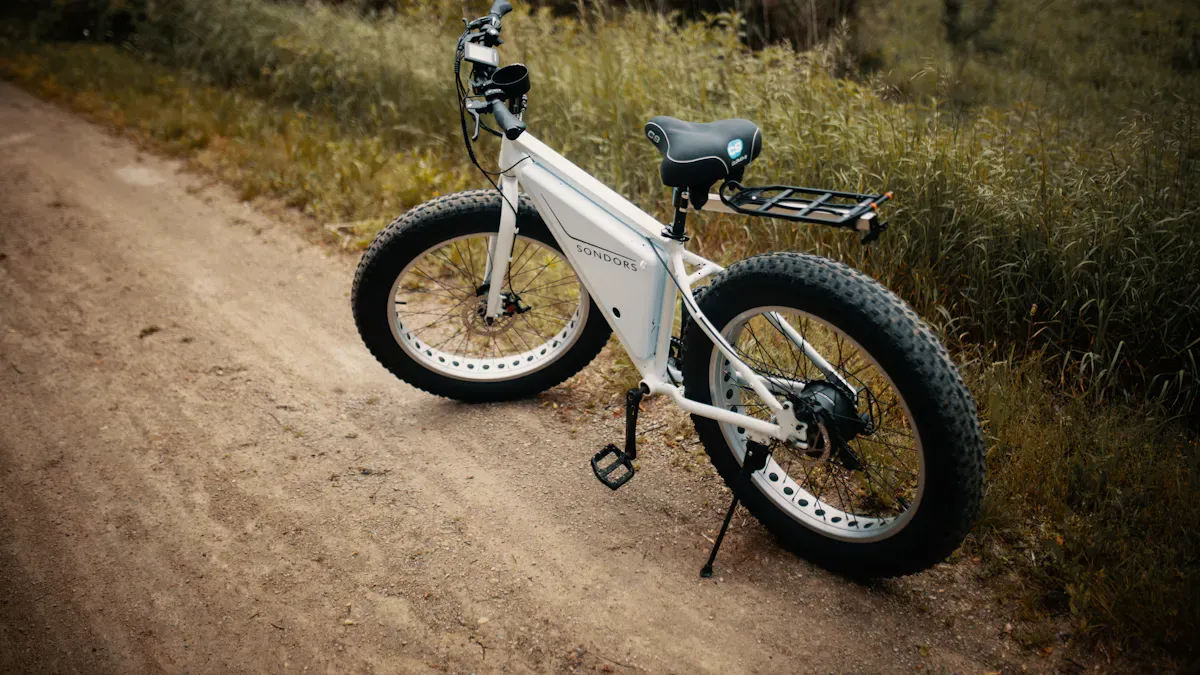
How far can I actually go with my e-bike? Many manufacturers promise high ranges, but the reality is often different. The actual distance depends on many factors. Everyday use shows that air resistance, riding mode, and battery quality influence the range. A comparison highlights the differences:
Manufacturer specification |
Realistic range |
|---|---|
70 km |
50 km |
60 km |
50 km |
You will receive practical tips and a simple rule of thumb so that you can better estimate your range.
Key Insights
The actual range of your e-bike depends on factors such as battery capacity, terrain, and riding style. Always plan for a 20% reserve.
Ride in Eco mode and choose your gears wisely to maximize range. Smooth acceleration helps save energy.
Regular maintenance, such as checking tire pressure and caring for the battery, increases range and ensures better handling.
Document your rides to identify patterns and better estimate your range. Use apps for planning and monitoring.
Consider weather conditions, as cold temperatures can reduce battery capacity by up to 40%. Store the battery in a warm place.
E-Bike Range in Everyday Life
What does range mean?
You want to know how far you can ride your e-bike before the battery is empty. Experts define range as the distance you cover with motor assistance until the battery provides no more energy. Many factors influence this distance. Here are the most important points:
Battery capacity determines how much energy is available.
Terrain plays a major role. Flat paths consume less power than steep climbs.
Wind conditions can strongly influence the range. Headwinds cost more energy.
Tire pressure decides how easily the bike rolls. Too little pressure increases resistance.
Your weight and the payload directly affect consumption.
The support mode determines how much help the motor provides. More support means less range.
You see: Range is not a fixed value. It changes with every outing.
Theory vs. Practice
Manufacturers often state high ranges. These values are generated under optimal conditions. In practice, you rarely achieve the maximum value. The differences are clear:
In Eco mode on a flat route, you achieve the greatest distance.
With full support and on steep paths, the range drops significantly.
In everyday use, you usually achieve 60 to 70 percent of the maximum value.
If you ride in Turbo mode, you consume a lot of energy and cover less distance.
Factors such as your weight, headwind, cold temperatures, and the selected mode can reduce the range by up to 55 to 65 percent of the manufacturer's specification.
-->
Tip: Record your rides and compare the values. This way you will see how different conditions affect the range.
With this information, you can better estimate manufacturer specifications and plan your tours more realistically.
Manufacturer Specifications and Reality
Manufacturer test conditions
You often see impressive numbers on packaging or in brochures. Manufacturers test the range of an e-bike under perfect conditions. You rarely find these conditions in everyday life. Tests usually work like this:
The lowest support level (Eco) is used.
The terrain remains flat and windless.
The test rider weighs exactly 75 kg and rides at a constant speed.
There is no additional ballast or luggage.
Manufacturers provide the maximum range achieved under these ideal conditions. You can view these values as a best-case scenario.
Why values often differ
In everyday life, you encounter many factors that influence the range. Reality looks different from the laboratory. You can find typical reasons for deviations in the following table:
Factor |
Impact on range |
|---|---|
Motor power |
Higher power consumes more energy |
Gearing |
Energy transfer efficiency varies |
Tire pressure |
Too little pressure increases rolling resistance |
Air and rolling resistance |
More resistance costs more battery |
Rider weight |
More weight requires more energy |
Temperature and weather |
Cold and rain reduce range |
You quickly realize: Manufacturer specifications are created under laboratory conditions that have little to do with your everyday life. In practice, you often only reach 50 to 80 percent of the stated kilometers. Sometimes the deviation is even 20 to 30 percent. An example: A manufacturer promises a range of up to 120 km. However, you only manage 60 to 80 km if you are traveling with luggage, in wind, or in winter.
Tip: Write down your own values after every ride. This way you can see how much the range deviates from the manufacturer's specifications and can better plan your tours.
Factors influencing e-bike range
Rider weight and payload
You directly influence your e-bike's range with your weight and the amount of luggage. The more weight you carry, the more energy the motor requires. Even a payload of 10 kg can reduce the range by up to 10%.
Weight increase |
Range reduction |
|---|---|
10 kg |
up to 10% |
The payload can reduce the range by 5–15%, depending on the type and amount of luggage. You should minimize the total weight of your e-bike and avoid unnecessary payload to maximize the range.
Minimize the total weight of your e-bike.
Avoid unnecessary payload to maximize range.
Tip: Pack only the essentials for your tour. Less weight means more kilometers.
Route profile and altitude
The terrain plays a major role in range. Climbs require significantly more energy than flat terrain. You can cover a long distance on flat city terrain with your e-bike, whereas the range is strongly reduced in mountainous terrain with high altitude changes.
Climbs are true battery killers. While you might manage 80 kilometers on a flat route with your e-bike, the range often reduces to half in hilly terrain.
Climbs require significantly more energy than flat terrain, which significantly reduces the range.
A long distance on flat city terrain can be covered with an e-bike, whereas the range is strongly reduced in mountainous terrain with high altitude changes.
Note: Plan your route carefully. Many meters of altitude mean less range.
Support level and riding style
Choosing the support level has the greatest influence on the range. In Eco mode, you can cover longer distances than the range indicator shows. A rider with a 625Wh battery reports that they can reach up to 100km by using different support levels, regardless of the displayed range. The range indicator is often unreliable.
High support levels increase energy demand.
An efficient cadence between 60 and 80 revolutions per minute can improve range.
Riding behavior in Eco mode can significantly increase range.
Choosing the right gear is crucial to lowering energy consumption.
Eco mode offers minimal support and maximizes range.
Sport and Turbo modes significantly increase energy consumption.
Smooth acceleration and constant cadence help optimize battery performance.
Avoiding frequent stopping and starting minimizes energy consumption.
Tip: Ride in Eco mode as much as possible and choose your gears cleverly. This way you get the maximum out of your battery.
Weather and temperature
The weather strongly influences your e-bike's range. Cold temperatures can reduce battery capacity by up to 40 percent. Especially on cold winter days, battery capacity can drop by up to 40 percent, which reduces the e-bike's range accordingly. The temperature of the battery at the start of the route has the greatest influence on autonomy. The colder it is, the shorter the battery life.
Cold temperatures can reduce battery capacity by up to 40 percent, which reduces the e-bike's range.
Especially on cold winter days, battery capacity can drop by up to 40 percent, which reduces the e-bike's range accordingly.
The temperature of the battery at the start of the route has the greatest influence on autonomy. The colder it is, the shorter the battery life.
Tip: Store your battery at room temperature and start the tour with a warm battery.
Tire pressure and maintenance
You can improve your e-bike's range through regular maintenance and correct tire pressure. Optimal tire pressure ensures that the e-bike rolls more efficiently and requires less energy. Low tire pressure leads to higher rolling resistance, which requires more effort and thus reduces the range.
Regular maintenance, including checking tire pressure, helps maximize range.
Too little tire pressure requires more effort to move the e-bike.
Tip: Check the tire pressure before every ride. A well-maintained e-bike rides further and more reliably.
E-Bike Battery: Size and Position
Battery capacity compared
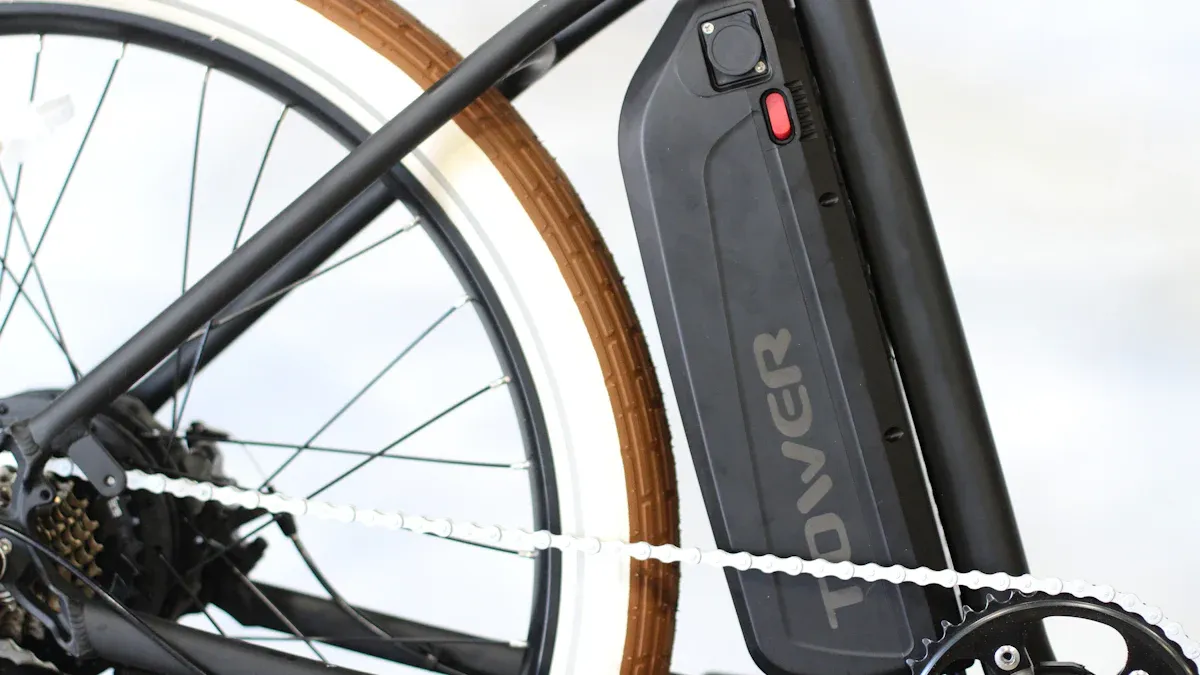
Battery capacity determines how far you can ride your e-bike. A larger battery offers more energy and enables longer distances. You will find different battery sizes on the market. The following table shows you how capacity affects range:
Battery capacity |
Range (km) |
|---|---|
400 Wh |
40–100 km |
500 Wh |
60–120 km |
625 Wh |
60–160 km |
750 Wh |
75–200 km |
Dual-Battery |
120–250+ km |
You see: With a 750 Wh battery, you can ride significantly further than with a 400 Wh battery. Dual-Battery technology even enables tours over 200 kilometers. However, the actual range also depends on your riding style, the terrain, and the support level.
Tip: Choose the battery capacity that suits your tours. A large battery is worth it for long distances.
Influence of battery position
The position of the battery influences the handling and range of your e-bike. There are different types:
Rear rack battery: The battery is located at the top rear. This makes the bike tail-heavy and can reduce stability.
Semi-integrated battery: The battery is partially built into the frame. This ensures balanced weight distribution and is well-suited for trekking e-bikes.
Fully integrated battery: The battery is completely hidden in the frame. This improves the low center of gravity and ensures better control.
Good weight distribution makes riding safer and more pleasant. A battery mounted low helps you steer the e-bike more easily and ride stably.
Practical examples for different battery types
You find different battery types for e-bikes. Lithium-ion batteries provide high currents and are suitable for long tours. Ni-MH batteries are less powerful and are mostly used in small devices. The '18650' type is widely used and offers flexibility in capacity and performance.
Ni-MH batteries provide low currents and are suitable for taillights.
Lithium-ion batteries are ideal for e-bikes as they provide high currents.
The battery configuration determines how much power your e-bike brings.
Note: A powerful battery ensures more range and better riding performance.
Realistically estimating range
Rule of thumb for calculation
Would you like to know how you can better estimate your e-bike's range in everyday life? A simple rule of thumb helps you: Always plan for a 20% reserve in addition to your desired route distance. For example, if you want to ride 40 kilometers, you should plan for at least 48 kilometers of range. This way you are on the safe side in case headwinds, climbs, or a heavy backpack affect your ride.
The range depends on the capacity of the battery. Common batteries offer between 400 and 750 Wh.
With a 400 Wh battery, you usually manage 70 to 100 kilometers, and with a 750 Wh battery even up to 130 kilometers.
Your riding style, terrain, weather, and your weight additionally influence the range.
Tip: Use the rule of thumb "route distance + 20%" to avoid surprises and reach your destination relaxed.
Documenting your own experiences
Every ride is different. You can best estimate your range by gathering and documenting your own experiences. Many e-bike riders report that recording their tours makes them enjoy riding more and allows them to plan their routes better.
Log your test rides to identify patterns.
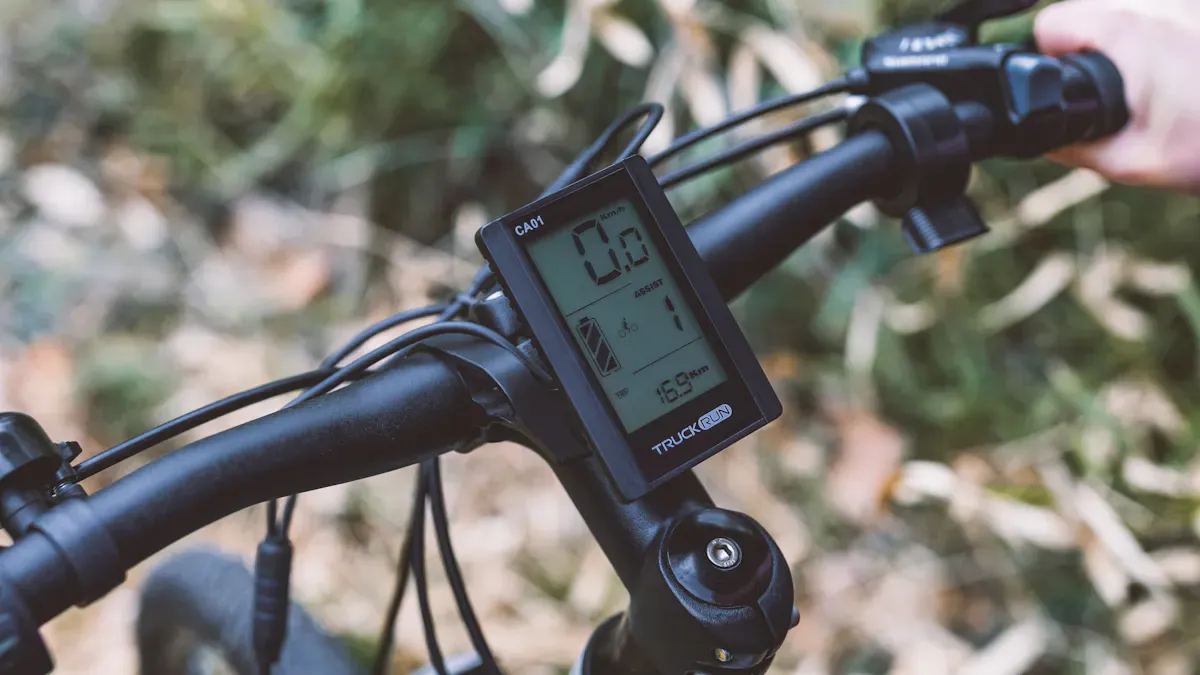
Use apps like Komoot or your bike computer to collect data.
Note the weather, route, assistance mode, and your weight.
Conduct range tests on various routes.
Compare your results and adjust your planning.
Note: The more data you collect, the more accurately you can estimate your range and optimally plan your tours.
You will notice that observing and documenting your rides not only helps to better understand your range but also increases motivation. Many users report that, thanks to the e-bike, they have become more active again and have more fun cycling.
Tips for range optimization
Adjust your riding style
Your riding style has a major influence on your range. If you ride with foresight and maintain a steady pace, your battery will last longer. Avoid sudden acceleration and hard braking. Choose an assistance level that suits your fitness and the terrain. Starting smoothly and coasting helps you save energy. Maintain a cadence of 75 to 80 revolutions per minute. This way, you optimally use the motor's power and go further.
Tip: Use the electric drive only when you really need it. Ride as constantly as possible and avoid stop-and-go.
Maintenance and care
A well-maintained e-bike rides more efficiently and travels further. Regularly check the tire pressure with a pressure gauge. Inflate the tires to the recommended level. A clean and oiled chain reduces friction and saves energy. Check the brakes to ensure they are not rubbing. Inspect the battery housing and contacts for damage or moisture.
Clean and lubricate the chain.
Check the brakes.
Inspect the battery for damage.
Note: Even small maintenance tasks can significantly increase your range.
Battery care
With proper care, your battery lasts longer and provides more energy. Charge the battery regularly, but avoid deep discharges. Partial charges between 30 and 80 percent extend its lifespan. Keep the battery clean and dry. Protect it from cold, as low temperatures reduce capacity.
Avoid deep discharge
Keep the battery clean and dry
Protect from cold
Tip: A well-maintained battery ensures more safety and a longer range.
Planning tours correctly
Good planning helps you make optimal use of your range. Choose routes with few traffic lights and little stop-and-go. Test your main route to ensure that one battery charge is sufficient. Plan tours so that you avoid steep climbs and headwinds as much as possible. Consider where you will take breaks to reduce unnecessary restarts.
Test the route beforehand
Avoid climbs and headwinds
Plan photo stops consciously
Note: With smart planning, you will reach your destination more relaxed and travel further.
Tools and apps for e-bike range
Online range calculators
Do you want to know how far you can go with your e-bike? Online range calculators help you get a realistic estimate. The Bosch range calculator in particular is considered very accurate. You enter your route, system, and weight there. The tool even uses artificial intelligence to calculate your range even better. The new "Range Control" feature takes into account the system weight, the elevation profile, and your riding behavior. This gives you a forecast that adapts to your personal conditions.
A recent study shows that almost half of all e-bike riders manage between 40 and 120 kilometers on one battery charge. With a good online calculator, you can better plan your tour and avoid surprises.
Tip: Use the range calculator before every longer trip. This way you know whether your battery is sufficient for the planned route.
Here you will find popular online range calculators:
Bosch Range Calculator
Specialized Turbo Range Calculator
Kalkhoff Range Calculator
Useful apps
Apps offer you many ways to monitor your range while on the go. Many apps show you the battery status, the remaining distance, and even nearby charging stations. However, users report that not all apps show all charging points. The range depends heavily on battery technology and charging conditions. Often, a full charge is only enough for about 70 kilometers. This sometimes makes planning difficult.
Popular apps for e-bike riders:
Komoot: Plans tours and shows elevation profiles.
Bosch eBike Connect: Connects directly to your e-bike and shows range and battery status.
Bike Energy: Finds charging stations in your vicinity.
Note: Test different apps and find out which one best suits your needs.
You have learned many ways to better estimate the range of your e-bike. You can find the most important findings from current studies here:
Finding |
Detail |
|---|---|
Satisfaction |
|
Longevity |
After five years, the range is 76.9 km. |
Consistency |
47.6% travel 41–120 km on a single charge. |
Desire for more range |
48.8% would like more than 100 km per charge. |
Disposal |
83% have never disposed of a battery. |
Test the rule of thumb and the tips in everyday life. This way you make optimal use of your e-bike. Experts recommend:
Always carry enough power with you.
Plan your route with a reserve.
Reflect on your goals and needs.
With knowledge and observation, you get the best out of your battery. 🚴♂️
FAQ
How can I increase the range of my e-bike?
You can increase the range if you ride in Eco mode. Keep tire pressure optimal. Maintain the battery regularly. Avoid unnecessary weight. Plan your route with few inclines.
What happens if the battery runs out on the way?
You can continue riding, but without motor assistance. The e-bike rides like a normal bicycle. You should check beforehand whether the route is feasible without a battery.
How often should I charge my e-bike battery?
You should charge the battery after every longer ride. Avoid deep discharge. Charge the battery when it is between 30 and 80 percent. This extends the service life.
Which apps help me with range planning?
Many apps show you the range and battery status. Komoot plans tours. Bosch eBike Connect connects to your e-bike. Bike Energy finds charging stations.
How does cold weather affect range?
Cold reduces battery capacity. You can have up to 40 percent less range. Store the battery in a warm place and start the trip with a charged battery.