
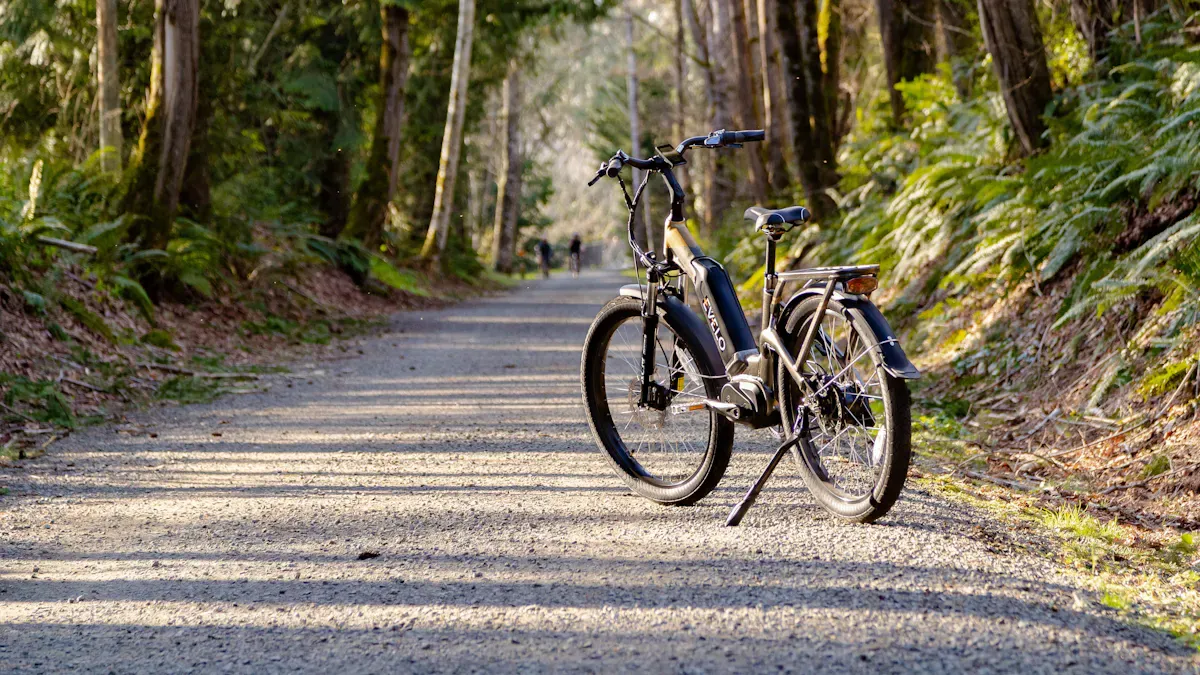
You want to know how far you can really go with your e-bike. Many users feel insecure because the display often fluctuates and terrain or riding style influence the range. Take a look at these current values:
Period |
|
|---|---|
1st year |
97.9 |
5th year |
76.9 |
Key Findings
The range of your e-bike depends on the battery capacity. A 400 Wh battery manages 35 to 65 km, while a 500 Wh battery can reach 45 to 80 km.
Factors such as riding style, weather, and terrain significantly influence the range. Always plan for a buffer of 20 to 40 percent to obtain realistic values.
Proper battery maintenance and care extend both lifespan and range. Charge the battery correctly and keep it clean for optimal performance.
E-Bike Range in Everyday Life
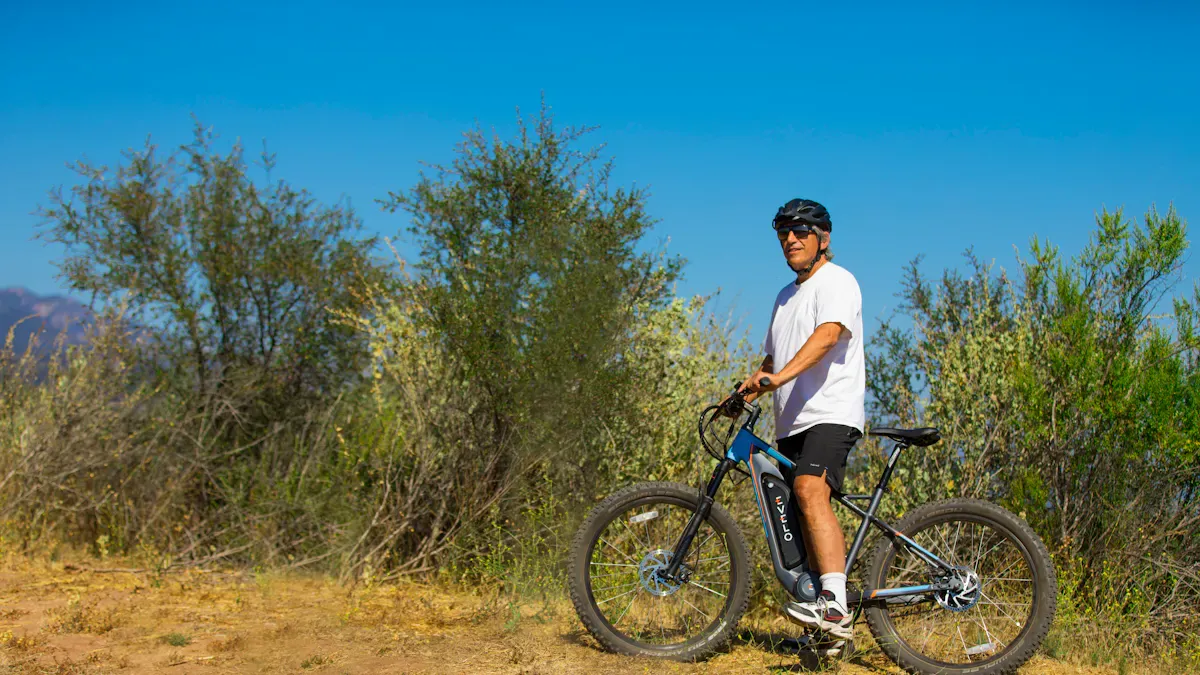
Average values
You want to know how far you can really ride with your e-bike in daily life. Battery capacity plays a major role. Many models have a battery with 400 to 500 Wh. The range depends on several factors, such as riding style, weather, and route profile. Here you will find typical values for different battery sizes:
With a 400 Wh battery, you can usually manage 35 to 65 kilometers, especially in city traffic or on short trips.
A 500 Wh battery often gets you 45 to 80 kilometers, ideal for commuters and everyday trips.
Under normal conditions, you can reach about 40 to 70 kilometers with a men's e-bike model and a 400-500 Wh battery.
The range can be between 40 and 100 kilometers for a 400 Wh battery, and even between 60 and 120 kilometers for a 500 Wh battery.
Trekking e-bikes are suitable for longer distances and roll efficiently. City e-bikes achieve high ranges in urban environments because they handle fewer inclines and consistent rides. SUV e-bikes offer a balanced platform for different surfaces. E-MTBs lose range quickly off-road, especially on steep trails and with high assistance.
When the trekking e-bike is the better choice: If you drive a mix of city, road, dirt tracks, or gravel roads, a trekking e-bike is usually the best choice. It combines good road equipment, a comfortable seating position, a sturdy luggage rack, and efficient rolling on many surfaces. Only if you are very athletic off-road is a mountain bike clearly the better option.
The range specifications are guidelines for mixed use (Eco to Sport) on flat to slightly hilly terrain. Headwinds, inclines, rider weight, tire pressure, and temperature significantly influence the range.
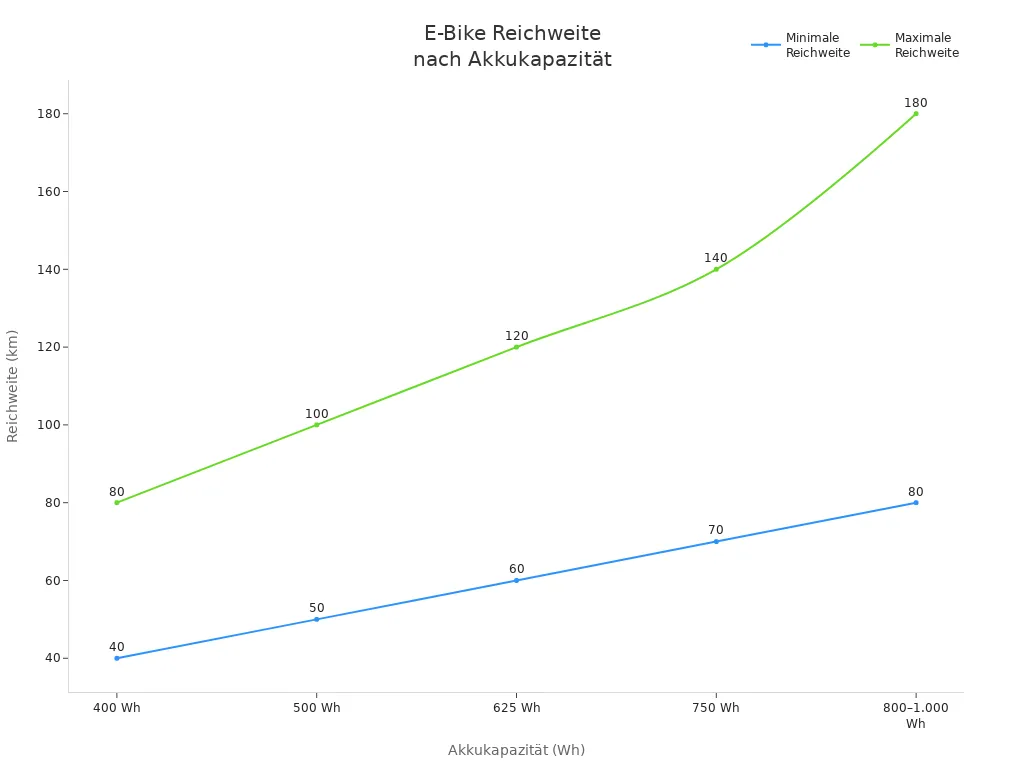
Capacity |
Ideal for |
|
|---|---|---|
400 Wh |
40–80 km |
Short-distance commuters, city trips |
500 Wh |
50–100 km |
Everyday riders, moderate tours |
625 Wh |
60–120 km |
Touring riders, hilly terrain |
750 Wh |
70–140 km |
High-mileage riders, demanding routes |
800–1,000 Wh |
80–180 km |
Long distance, E-MTB in the mountains |
Manufacturer specifications vs. reality
Many manufacturers claim very high ranges. You often see values like 120 or 140 kilometers on paper. In practice, you rarely reach these numbers. The realistic range is usually significantly lower. Here you will find a comparison:
Manufacturer spec |
Realistic range |
|---|---|
120 km |
60-80 km |
140 km |
70-100 km |
500 Wh battery |
Depending on riding style, weather, and route profile |
You can use a rule of thumb to better estimate the range:
Plan with 60 to 70 percent of the manufacturer's specified range.
For mountain bikes off-road, calculate with 50 to 65 percent.
Include a buffer of 30 to 40 percent when buying a battery.
Always plan for a buffer, especially on long tours or changeable weather.
If you know your usual route, just add 20 percent. This will give you a realistic estimate for your daily life. The range always depends on your riding style, the terrain, and external conditions. You cannot rely on the manufacturer specifications. Practice shows that with good planning and a suitable battery, you will arrive at your destination safely.
E-Bike Range: Influencing Factors
The range of your e-bike depends on many factors. You can often achieve big differences with small changes. Here you will learn which influences are particularly important and how you can recognize them in everyday life.
Battery and technology
The battery is the heart of your e-bike. Its capacity determines how far you can ride. A larger battery stores more energy and takes you further. The quality of the battery also plays a major role. A high-performance battery ensures longer and more relaxed rides. You benefit from more range and can plan longer tours.
The motor also influences the range. The more efficiently the motor works, the more energy is converted into movement. If you drive faster, the motor needs more power. This reduces the range. The assistance level is crucial: if you choose a high level, you use more energy. With a low level, you can significantly increase the range.
Tip: Adjust the assistance level to your route. Use a low level on flat ground and only shift up on inclines. This way your battery lasts longer.
Many e-bikes offer different riding modes such as Eco, Tour, Sport, or Turbo. You drive most economically in Eco mode. You use full motor power in Turbo mode, but the battery drains faster.
Weight and terrain
The total weight heavily influences the range. The more weight you transport, the more energy your e-bike requires. This applies to your own body weight, but also to luggage or child seats. A heavy system discharges the battery faster. For example, if you weigh 90 kg, a 500 Wh battery is often enough for a normal tour. At 150 kg or more, the range drops significantly.
Terrain also plays a major role. Flat routes are easier for the battery. Inclines, hills, or uneven paths cost more energy. Soft surfaces like sand or mud increase consumption further. In city traffic with many stops, you use more power than on a consistent country road.
High tire pressure helps to increase the range.
Frequent starting and stopping reduces the range.
Steep ascents and heavy luggage demand extra from the battery.
Weather and riding style
Weather conditions directly affect the range. In cold weather, the battery loses capacity. Temperatures below 10 degrees can reduce the range by up to 40 percent. Strong headwinds also cost energy.
Your riding style also makes a difference. If you ride consistently and with foresight, you can increase the range by up to 20 percent. Frequent acceleration, high speeds, and constant changing of the assistance level consume more power.
Influencing factor |
Impact on range |
|---|---|
Colder temperatures |
Battery capacity reduced by up to 40% |
Consistent riding style |
Range increased by up to 20% |
Nobody wants to push a heavy e-bike up a hill with an empty battery. That's why it's worth paying attention to the weather and riding style.
Practical examples
You ride to work in winter. The temperature is 5 degrees. Your battery only lasts 60 percent of the usual distance.
You use the Turbo mode on a hilly route. After 30 kilometers, the battery is empty.
You ride in Eco mode on a flat route and maintain a steady pace. You reach almost the maximum range of your battery.
So you see: Many small factors add up. With the right knowledge, you can specifically influence the range of your e-bike.
Improving Range
Optimizing riding style
You can significantly increase the range of your e-bike in daily life if you adjust your riding style. Many small measures help you to get further:
Choose a low assistance level when you are on flat routes.
Ride with foresight and avoid frequent starting and heavy braking.
Maintain a consistent pedaling rhythm and accelerate gently.
Check the tire pressure regularly. Optimal tire pressure can increase the range by up to 15 %.
Maintain the chain. A clean and oiled chain improves efficiency and brings up to 10 % more range.
Factor |
Impact on range |
Optimizable? |
|---|---|---|
Tire pressure |
up to 15 % |
yes, daily |
Chain maintenance |
up to 10 % |
yes, maintenance |
Tip: Plan your route so that you have as few steep inclines and stops as possible. This is how you make the best use of your battery's energy.
Maintenance and battery care
Good maintenance ensures that your e-bike lasts a long time and you cover more kilometers. Follow these tips:
Perform regular inspections to identify problems early.
Charge the battery in a dry, well-ventilated room and always use the original charger.
Store the battery at about 50 % charge if you are not using the e-bike for a long time.
Avoid completely discharging the battery or charging it overnight.
Keep the e-bike in a cool, dry place to prevent rust and damage.
With these simple measures, you can noticeably improve the range and lifespan of your e-bike.
Calculating E-Bike Range
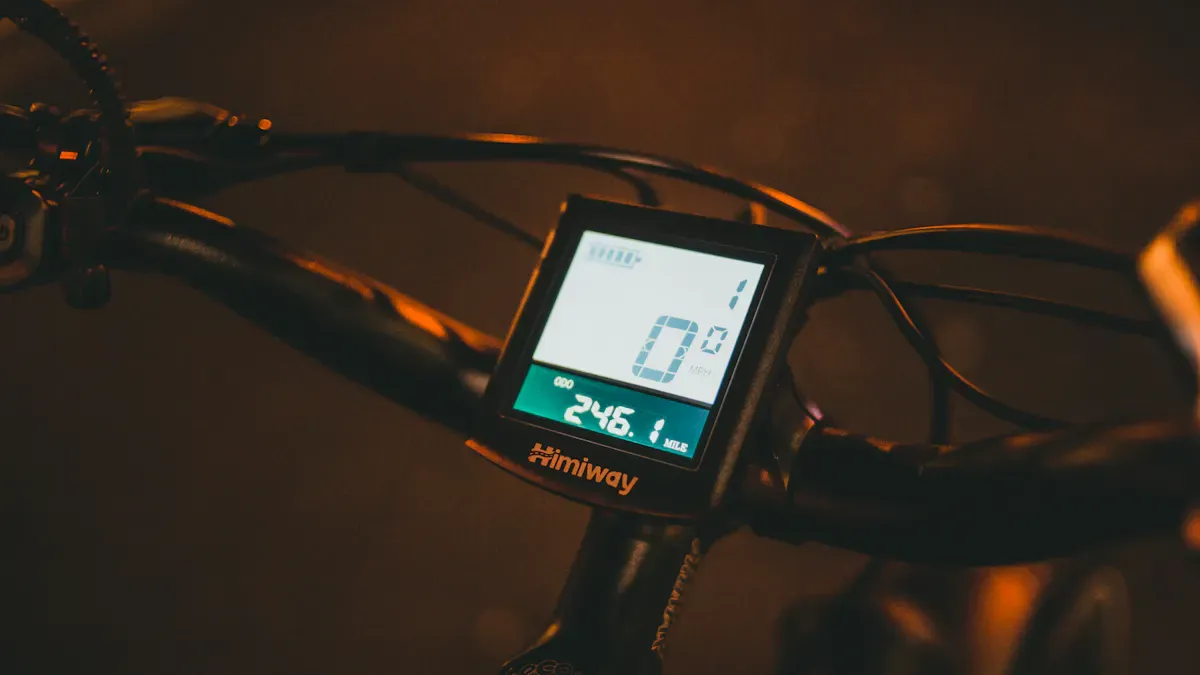
Online calculators and apps
Do you want to know how far you can get with your bike? Many online calculators and apps can help you. They ask for important data such as battery capacity, route profile, and your riding style. This gives you an estimate that fits your daily routine. A well-known example is the Bosch range calculator. It shows you how different settings affect your range.
Here is how to use an online calculator step-by-step:
Select your battery type and capacity.
Enter your weight and that of your luggage.
Select the terrain you are riding on (flat, hilly, mountainous).
Determine your riding style (economical, normal, sporty).
Start the calculation and read the result.
Tip: Try out different settings. This shows you how small changes affect the range.
Note that online calculators often assume laboratory values. Results deviate in practice. The differences are usually between 20 and 40 percent. With strong headwinds or extreme cold, the deviation can even be up to 60 percent.
Using personal observations
You can also better estimate your range yourself. Note the kilometers covered and the battery status after every ride. Observe how weather, route, and riding style affect the range. After a few rides, you will recognize patterns. This is how you learn how far you can really go.
Tip for you |
Benefit |
|---|---|
Document your rides |
Better everyday planning |
Test different routes |
Collect realistic values |
Record your experiences regularly. This will help you get a feel for your personal range.
The future of range
New technologies
You can look forward to exciting developments in e-bikes. The range depends heavily on battery technology. Modern lithium-ion batteries already offer high energy density and performance today. They are lightweight, compact, and have almost no self-discharge. This means you can ride longer distances and charge less frequently. In the coming years, solid-state batteries will hit the market. These batteries store more energy at the same weight, allowing you to cover even greater distances on a single charge.
Many manufacturers are focusing on modular systems. You can use auxiliary batteries or so-called range extenders to flexibly increase your range, for example for longer tours. Intelligent drive systems automatically detect how much support you need at any given moment. They adjust the motor output to the terrain and your riding style, which saves the battery and gets you further.
Tip: Smart sensors and digital controls help you use energy optimally, allowing you to benefit from longer battery life.
Trends and outlook
The future of e-bike range looks promising. Experts expect that premium models will soon be able to cover up to 150 kilometers on a single charge. Manufacturers are investing in lighter and more efficient bikes. Sustainability is playing an increasingly important role, with battery recycling and resource-efficient production becoming more significant.
You will soon benefit from fast-charging functions, allowing you to recharge your battery in a short amount of time. Hybrid mobility concepts connect e-bikes with other means of transport, making you even more flexible on the go. Smart systems will plan your route and automatically adjust the settings. The coming years will bring you more range, comfort, and sustainability on your e-bike.
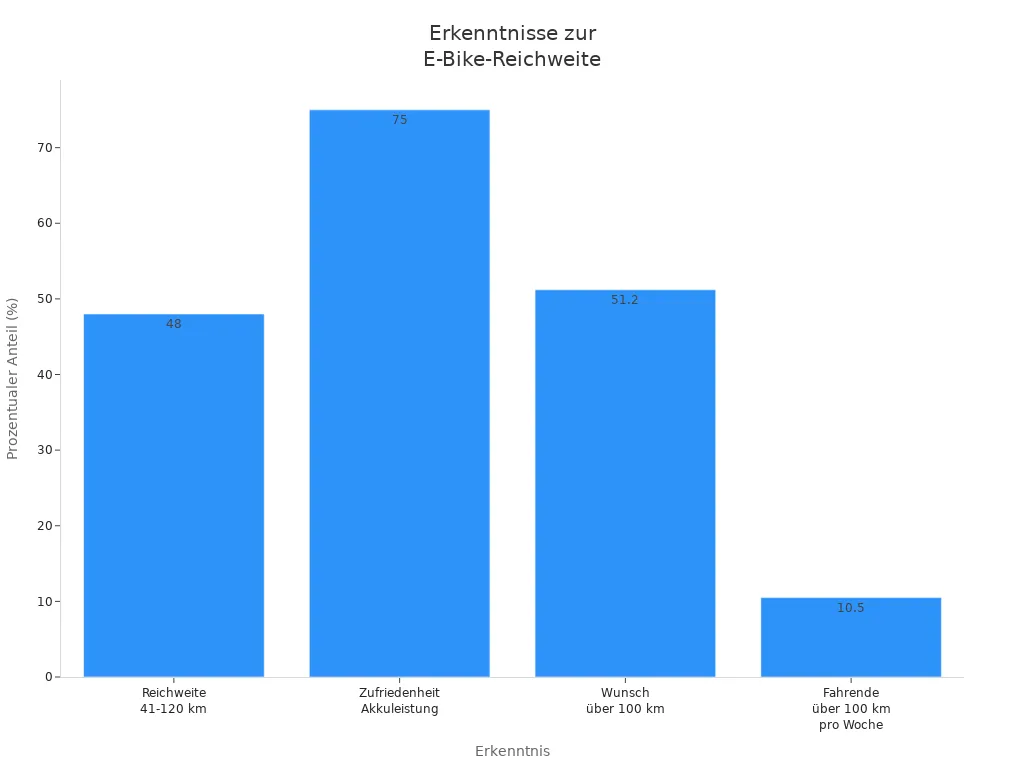
As you can see, most e-bike riders achieve a range of between 41 and 120 km. Many are satisfied with their battery performance. The table shows you the most important findings:
Finding |
Percentage |
|---|---|
E-bike riders with a range of 41–120 km |
48% |
Satisfaction with battery performance |
75% |
Desire for a range over 100 km |
51.2% |
E-bike riders who ride more than 100 km per week |
10.5% |
You can better estimate your range in everyday life by considering your riding style, weight, and the weather. Choose manufacturers that offer application-specific solutions. Modern e-bikes optimally combine range, weight, and riding dynamics.
FAQ
How long does an e-bike battery last?
You can generally expect 500 to 1,000 charging cycles with a modern battery. This often corresponds to three to five years of normal use.
Do I always have to charge the battery completely?
You don't always have to charge the battery to 100%. Partial charging is easier on the battery and extends its lifespan.
What do I do if the battery dies while I'm out?
You can continue riding, but without motor assistance. Plan your route so that you have enough energy for the return trip.