
Are you wondering which motor suits your first e-bike? Your riding style, the routes you choose, and your personal needs play a big role. Consider inclines, distance, and features like assistance modes. Think about what is important to you – this will help you find the right motor step by step.
Key Findings
Consider your riding style and the routes you frequently travel. Choose the motor that best fits your riding style.
Get informed about the different types of motors: mid-drive, rear-hub, and front-hub. Each has its own pros and cons.
Pay attention to the warranty and battery capacity of the motors. A longer warranty and higher capacity offer more security and performance.
E-bike Motor Overview
Manufacturer Comparison
You face a huge selection when choosing an e-bike motor. Many well-known manufacturers offer various models. Bosch, Shimano, Brose, and Yamaha are among the most popular brands. They supply motors that you will find in many e-bike models. Riese & Müller and Specialized are also known, especially for their high-quality systems.
It is worth taking a look at the warranty. For example, Riese & Müller provides you with two years or 500 charging cycles of warranty. After two years, you can still expect about 60% battery capacity. Specialized also offers two years, but after 300 charging cycles, 75% capacity often remains.
Manufacturer |
Warranty Period |
Battery capacity after warranty |
|---|---|---|
Riese & Müller |
2 years or 500 charging cycles |
60% after 2 years |
Specialized |
2 years or 300 charging cycles |
75% after 2 years |
Types and Differences
You will find three main types of motors for e-bikes: mid-drive, rear-hub, and front-hub. Each type has its own strengths and weaknesses. There is no single best motor. You should consider how and where you want to use your e-bike.
Motor Type |
Strengths |
Weaknesses |
Conclusion |
|---|---|---|---|
Mid-drive motor |
Natural ride feel, efficient on hills |
Higher price, more maintenance |
Ideal for trekking, touring, and off-road. |
Rear-hub motor |
Low maintenance, quiet, affordable |
Less efficient on hills |
Good for commuters and everyday riders on flat terrain. |
Front-hub motor |
Affordable, easy to retrofit |
Less traction, rarely found in high-end models |
Solid for starters, but better to invest more long-term. |
Tip: Think about whether you are riding more in the city, in the countryside, or off-road. This will help you find the motor that suits your riding style.
As you can see, there are many possibilities. The right motor depends on how you want to use your e-bike.
E-bike Motor Variants
You face a choice: mid-drive, rear-hub, or front-hub motor? Each motor brings its own strengths and weaknesses. To help you keep an overview, you can find the most important differences here at a glance:
Feature |
Front-hub motor |
Mid-drive motor |
Rear-hub motor |
|---|---|---|---|
Ride feel |
Pulling, like an "all-wheel drive" |
Very natural, like cycling with a tailwind |
Pushing, sporty and direct |
Traction |
Low on hills / on wet surfaces |
Very good, central center of gravity |
Good, weight on the drive wheel |
Weight distribution |
Front-heavy, balanced with rear battery |
Optimal, low and central center of gravity |
Rear-heavy, nervous at high speeds |
Wear |
Low, drivetrain is spared |
Higher, chain and cassette are put under more stress |
Low, drivetrain is spared |
Ideal for |
City, flat terrain, beginners |
Touring, mountains, all-rounder, trekking |
Sporty riders, fast commuters |
Mid-drive motor
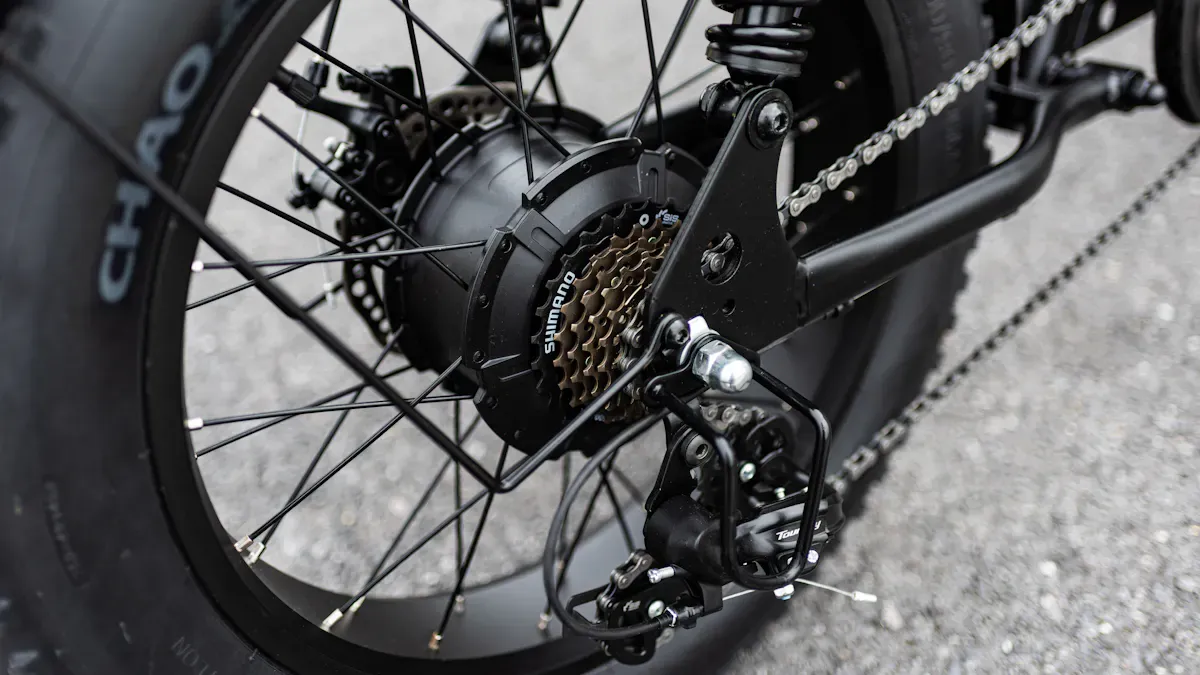
The mid-drive motor sits directly on the bottom bracket. You immediately feel how natural the riding feels. Many say it is like cycling with a constant tailwind. The weight remains central and low, giving you security on any surface. The mid-drive motor shows its power especially on inclines. You master mountains efficiently and without much effort.
Pros:
Perfect weight distribution
Natural, intuitive ride feel
High efficiency on hills and long tours
Cons:
Often slightly louder than rear-hub motors
Usually more expensive to purchase
Tip: Many e-bike manufacturers rely on mid-drive motors because they are powerful and often cheaper than other variants. If you are an all-rounder and value comfort, the mid-drive motor suits you.
Rear-hub motor
The rear-hub motor sits on the rear wheel. You feel the assistance immediately when pedaling, especially when riding in a sporty manner. The ride feel is dynamic and direct. Many commuters and sporty riders appreciate this variant.
Pros:
Low maintenance, as the drivetrain is spared
Very quiet during operation
Cheaper than mid-drive motors
Cons:
Weight is at the back, which can feel nervous at high speeds
Less efficient on hills
Not as balanced as the mid-drive motor
Note: If you ride frequently on flat routes and enjoy a sporty ride feel, the rear-hub motor is a good choice.
Front-hub motor
The front-hub motor powers the front wheel. You get a feeling like all-wheel drive. This variant is especially interesting for beginners and city riders. Retrofitting is easy and inexpensive.
Pros:
Inexpensive and easily retrofitted
Low wear on the drivetrain
Ideal for city and flat terrain
Cons:
Less traction on wet surfaces or hills
Front-heavy, which can influence handling
Hardly found in high-quality e-bike models
Attention: The front-hub motor is less suitable for longer tours or mountainous routes. However, it is often perfectly sufficient for short trips in the city.
You see: Every motor has its own advantages. Consider where and how you use your e-bike the most. This way you will find the variant that fits your everyday life.
Motor variants: Pros and Cons
Handling
You will quickly notice how the position of the motor influences the ride feel. A mid-drive motor ensures ideal weight distribution. Your e-bike remains stable, even if you ride faster or take curves. The motor sits between the pedals and gives you a natural ride feel. A front-hub motor can change steering behavior. The front wheel becomes heavier, and that can be noticeable while riding. Rear-hub motors offer you a sporty ride feel, especially if you like to ride fast.
Maintenance
If you are worried about maintenance, it is worth looking at the different motor variants. Mid-drive motors need care more often because the chain and cassette are under more stress. Rear-hub and front-hub motors are lower-maintenance because they put less stress on the drivetrain. Many users report that the smallest motor causes the lowest maintenance costs. You save time and money if you choose a low-maintenance variant.
Mid-drive motor: Higher maintenance effort, regular inspection necessary
Rear-hub motor: Low maintenance requirement, drivetrain is spared
Front-hub motor: Little maintenance, easy to care for
Price
The prices for motors differ significantly. Mid-drive motors are usually more expensive but offer more comfort and performance. Rear-hub and front-hub motors are cheaper, especially if you choose a used model. E-bike prices have risen in recent years. From 2019 to 2021, there was an increase of 42%. Industry experts expect prices to rise again starting in 2026.
Tip: If you want to save money, look for used models or wait for discounts. Production has been cut back, and stock levels are shrinking. This can make discounts smaller.
Year |
Average price (Euro) |
Price increase (%) |
|---|---|---|
2019 |
2,590 |
- |
2020 |
2,980 |
15% |
2021 |
3,680 |
42% |
Riding Profile & Motor Choice
Are you wondering how to find the right motor for your e-bike? Your riding profile plays a big role. The route length, topography, and your area of use determine which motor fits you best. Every person rides differently. Therefore, you should think carefully about what you really need.
Route length
The length of your daily rides strongly influences the motor choice. Consider how many kilometers you travel per day or per week. Here is an overview of how route length and battery capacity are related:
For short trips in the city, a smaller motor is often sufficient. It saves energy and increases range.
Are you planning longer tours or riding often in the mountains? Then you need a more powerful motor.
Battery capacity is important. It determines how far you get on one charge.
With a 500 Wh battery, you usually manage 50 to 100 kilometers. A 625 Wh battery takes you 60 to 120 kilometers. A large 800 Wh battery is even enough for 75 to 150 kilometers. If you ride often in turbo mode or in the mountains, the range drops significantly.
Tip: Write down how many kilometers you ride per week. This will help you quickly find out which motor and battery combination fits your everyday life.
Topography
Not every route is the same. Do you usually ride on flat ground, or do you often have to master inclines? The topography of your surroundings determines how much power your motor should have.
In the city with flat paths, a light motor is sufficient.
Do you live in a hilly area or like to ride in the mountains? Then you need a motor with more power and torque.
A powerful motor helps you to master steep climbs easily.
Various assistance modes help you use energy efficiently. You can adapt the assistance to the terrain and your daily shape.
Area of use
Where do you use your e-bike the most? The area of use determines the requirements your motor must meet. Look at the differences:
Area of use |
Motor requirements |
Battery capacity |
|---|---|---|
City |
Lighter motors, lower capacity |
300 to 500 Wh |
Touring |
More powerful motors, larger batteries |
500 to 625 Wh (750 Wh possible) |
Mountain bike |
Robust motors with high power |
High, not specifically stated
Your fitness level and riding style also play a role. The motor assistance makes it possible for you to tackle demanding routes even with less stamina. Different support modes ensure that you use energy optimally and can adapt your riding to your needs.
Note: There is no single perfect motor for everyone. Consider how you want to use your e-bike and what is most important to you. This is how you will find the motor that suits you.
Power & Torque
Starting and acceleration
Would you like to know how torque affects the riding experience? Torque describes the force that the motor applies to the pedals. A higher torque ensures that you get a real boost when starting and accelerating. You will notice the difference especially on inclines. Your e-bike reacts more agilely, and you make progress effortlessly.
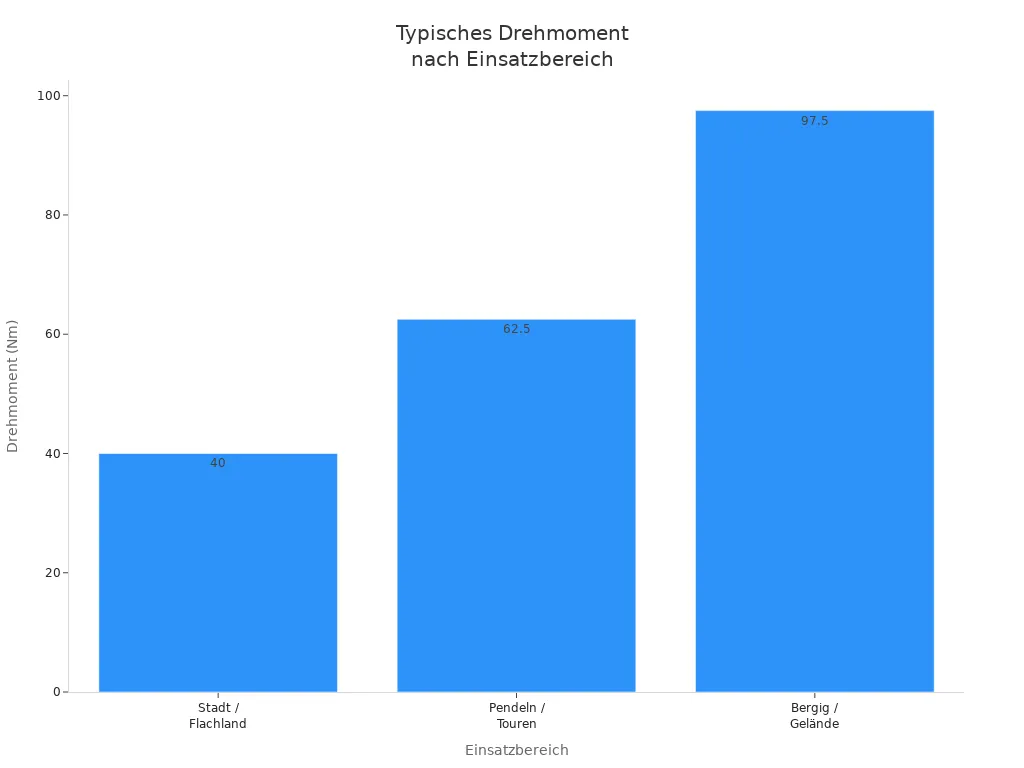
With 40 to 50 Nm, you can ride through the city in a relaxed manner.
50 to 70 Nm offer you powerful support on longer tours or hilly terrain.
70 to 90 Nm make starting on a hill a breeze.
Tip: You don't always need the maximum. Consider where you are riding and how much power you really need.
Torque recommendation
Which torque fits your everyday life? Take a look at the overview:
Nm range |
E-bike type |
Ideal terrain & use |
Riding feel |
|---|---|---|---|
City & urban e-bikes |
Flat city, short commutes |
Smooth, harmonious support |
|
50 - 70 Nm |
Trekking & everyday e-bikes |
Hilly terrain, longer tours |
Balanced and powerful |
70 - 90 Nm |
E-MTBs, SUV e-bikes |
Mountains, steep climbs, off-road |
Very powerful and sporty |
> 90 Nm |
E-cargo bikes, high-performance e-MTBs |
Transporting heavy loads, extreme trails |
Maximum thrust |
You see: A torque of 60 to 85 Nm is ideal for most riders. It offers enough power for everyday life, tours, and moderate mountains. The strongest motor is not always the best choice. You should pay attention to your riding profile and choose the torque that fits your routes. This way, you enjoy comfort and riding pleasure without using unnecessarily large amounts of energy.
Features & Comfort
Support modes
You have the choice between several support modes when you are out on your e-bike. Each mode adapts to your riding style and the route. Modern motors offer different levels, ranging from 50% to over 400% support. The more modes you have, the better you can control the riding feel. Take a look at the most important modes at a glance:
Support mode |
Description |
|---|---|
Low support, feels more natural. |
|
eMTB mode |
Dynamic adjustment depending on the riding situation. Supports between Tour (140%) and Turbo (340%). |
Automatic mode |
Detects the slope, but does not offer the same natural feel as the eMTB mode. |
Trail mode |
Adjusts the support between Eco and Boost mode, can regulate further down than Bosch. |
Many riders use the Eco mode to increase their range. The Turbo mode provides maximum power for steep ramps. A dynamic-progressive mode adjusts the support to your pedal pressure. This way, you always have the right power, whether you are riding casually or in a sporty manner.
Battery integration
The integration of the battery plays a major role in terms of comfort and handling. An integrated battery provides better balance and a clean design. You get a more stable downtube, which increases the weight of the e-bike. Larger batteries offer more range, but also bring 1–1.5 kg of additional weight with them. A 400 Wh battery weighs about 2.5 kg, while a 750 Wh battery weighs almost 4 kg. Integration improves balance, but you should keep the additional weight in mind if you often have to carry the bike.
An integrated battery looks stylish and protects against dirt.
More range means more weight.
The balance is improved, and the riding feel remains safe.
Ease of maintenance
Do you want to spend little time on maintenance? Then it is worth taking a look at the motor variants. Some motors are particularly easy to maintain. Single-cylinder motors have low mass and are easy to service. Two-cylinder boxers are very accessible for repairs, but require more effort to produce. Two-cylinder inline engines are simple and inexpensive to maintain. Ease of maintenance depends on the design. You save time and money if you opt for an easily accessible variant.
Motor variant |
Ease of maintenance |
Notes |
|---|---|---|
Single-cylinder |
High |
Ideal for light machines |
Two-cylinder boxer |
Very high |
Excellent smooth running, easily accessible |
Two-cylinder inline |
Relatively high |
Simple and inexpensive |
Two-cylinder V, 45° |
High |
Compact design |
Two-cylinder V, 90° |
Moderate |
Sporty character, high manufacturing effort |
Tip: Choose a motor that fits your everyday life and requires little maintenance. This way, your e-bike remains reliable for a long time and you have more time for riding fun.
Do you want the right motor for your e-bike? Take a look at these points:
Desired type of transmission
Weight of the bike
Many prefer to use the Eco or Tour mode:
Motor variant |
Usage frequency |
|---|---|
Eco or Tour mode |
|
Strongest support |
5% |
Test different models and feel what you like!
FAQ
Which motor is the quietest?
Are you looking for a quiet motor? Rear motors often run the quietest. They hardly bother you while riding. Many commuters appreciate this feature.
How often do I have to service the e-bike motor?
You should have your motor checked once a year. Mid-drive motors need more care. Rear and front motors are usually lower-maintenance.
Can I replace the battery myself?
Yes, you can change the battery yourself on most models. Follow the manufacturer's instructions. This way, your e-bike stays safe.