

You may be wondering what the actual difference is between a guarantee and a warranty. Many e-bike owners often confuse these terms or think they mean the same thing. This easily leads to uncertainty, for example, regarding who is responsible in the event of a problem or whether you have to cover the costs yourself. Take a look at these typical misconceptions:
You believe that guarantee and warranty are identical.
You assume that both apply automatically.
You sign the warranty card without reading the conditions carefully.
With the right knowledge, you protect your rights and save yourself trouble.
Key takeaways
A guarantee and a warranty are not the same thing. A warranty is legally mandated, while a guarantee is voluntary.
A warranty applies automatically for two years. A guarantee can vary, often between two and five years.
In the case of defects, the dealer is responsible for the warranty. A guarantee is usually provided by the manufacturer.
Keep all documents such as the purchase receipt and warranty certificate. They are important for your claims.
Read the guarantee conditions carefully. This way, you know what is covered and what your obligations are.
Guarantee vs. Warranty

Definitions at a glance
You might be faced with the question of what exactly "guarantee" and "warranty" mean. Both terms often come up when you buy or make a claim for an e-bike. Here are the most important definitions at a glance:
Term |
Definition |
|---|---|
Warranty (Gewährleistung) |
Is legally mandated and ensures that your e-bike is free from defects at the time of purchase. |
Guarantee (Garantie) |
Is a voluntary service provided by the manufacturer or dealer that can offer you additional rights. |
Tip: The warranty (Gewährleistung) is regulated in the German Civil Code (BGB). It applies automatically as soon as you buy a new product. You only receive a guarantee if the manufacturer or dealer expressly promises it to you.
The most important differences
You can easily recognize the differences between a guarantee and a warranty if you pay attention to the key characteristics:
Aspect |
Warranty (Gewährleistung) |
Guarantee (Garantie) |
|---|---|---|
Legal basis |
Legally mandated (§§ 437, 438 BGB) |
Voluntary service by the manufacturer/dealer |
Duration |
Variable, often 2-5 years, sometimes longer |
|
Opponent in a claim |
Dealer |
Manufacturer or dealer |
Start |
Automatically with the sales contract |
Only upon promise and under certain conditions |
Scope |
Defects that existed at the time of purchase |
Determined by the manufacturer, often limited to specific parts |
Proof |
In the first year, you do not have to prove a defect |
Conditions are in the warranty certificate |
The warranty protects you against material, production, or design faults that were already present at the time of purchase.
The guarantee can give you additional security, for example, on the frame or the battery of your e-bike.
The duration of the guarantee depends on the manufacturer. Some offer longer periods for specific parts like the motor or battery.
Who is responsible?
Are you wondering who to turn to if your e-bike has a defect? Responsibility varies depending on the type of claim:
For the warranty, the dealer is always your contact person. They must repair or replace the e-bike if a defect is present.
The guarantee is usually covered by the manufacturer. However, sometimes the dealer will handle the guarantee process for you.
You should always keep all documents, such as your purchase receipt and warranty certificate. This allows you to act quickly in the event of a problem.
Note: In case of problems with your e-bike, it is best to document the damage with photos and keep a written record of all conversations. This secures your claims and ensures you are taken seriously by the dealer or manufacturer.
Warranty (Gewährleistung) for e-bikes

Rights and deadlines
When you buy an e-bike in Germany, you are automatically entitled to a warranty. The legal period is two years from the date of purchase. During this time, the law protects you against material, production, and design faults that were already present at the time of purchase.
The warranty period begins on the day you receive the e-bike.
You have the right to subsequent performance, i.e., repair or replacement of the e-bike.
The seller bears all costs for subsequent performance, such as transport and assembly.
You should set the seller a reasonable deadline, usually 14 days.
For online purchases, there is an additional 14-day cancellation period.
Tip: Set the deadline in writing and keep all documents. This helps you enforce your claims more effectively.
Procedure in case of defects
If your e-bike shows a defect, it is best to proceed step-by-step:
Inform the dealer about the defect.
Submit the necessary documents, for example, purchase invoice, insurance details, and leasing documents if applicable.
Fill out the assignment form if you leased the e-bike.
Set the dealer a deadline for subsequent performance, usually 14 days.
Wait for the repair or replacement. The dealer must cover the costs.
If the dealer does not perform in time, you can withdraw from the contract.
Note: Document the damage with photos and keep a written record of all conversations. This helps you secure your rights.
Typical sources of error
Many warranty cases for e-bikes arise from specific technical problems. Here are the most common causes:
Faults in the drive unit
Communication problems between the drive and the display
Communication problems between the drive and the battery
Faulty sensors, e.g., speed sensor
Outdated or incorrect firmware
These faults often appear shortly after purchase. You should report them early so that you can utilize your warranty rights.
Guarantee for e-bikes
Voluntary services
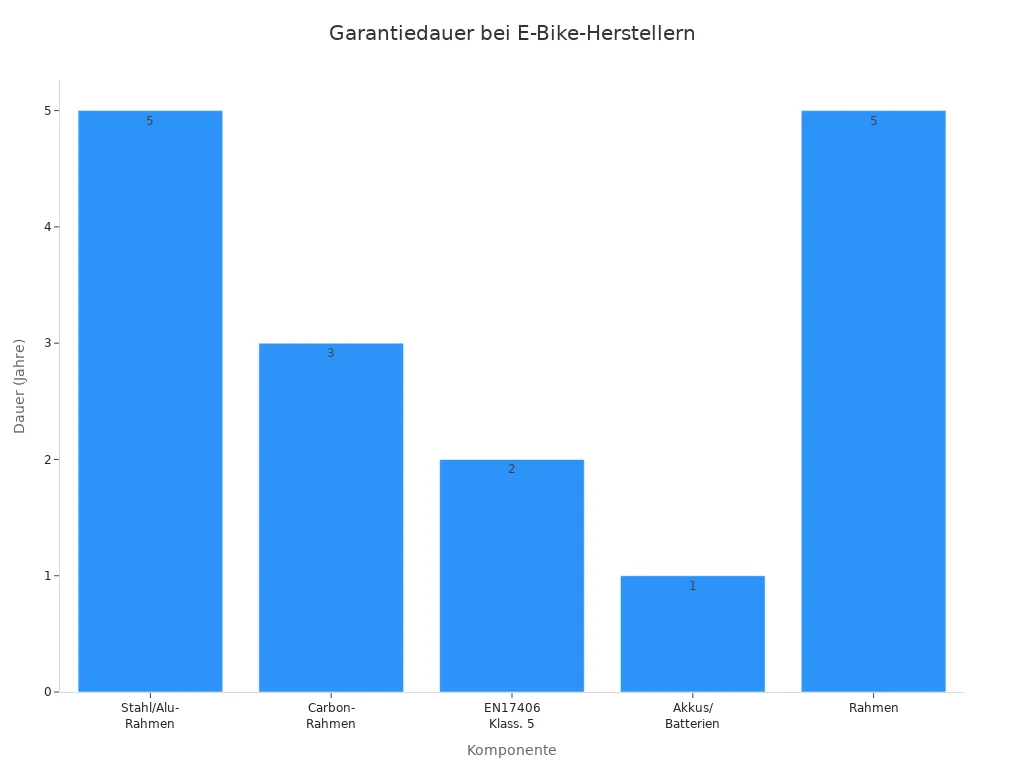
A guarantee is a voluntary promise by the manufacturer. It gives you extra security when purchasing an e-bike. The guarantee often applies longer than the legal warranty. Many manufacturers, for example, offer a three or even five-year guarantee on the frame. The guarantee usually only covers certain parts, such as the frame or the battery. The conditions differ depending on the manufacturer and model. You should always read the guarantee conditions before purchasing.
Guarantee |
Duration |
Details |
|---|---|---|
Manufacturer guarantee on steel/aluminum frames |
5 years |
Applies from date of purchase, only for original buyers at authorized dealers. |
Manufacturer guarantee on carbon frames |
3 years |
Applies from date of purchase, only for original buyers at authorized dealers. |
Guarantee on rechargeable batteries |
12 months |
Applies only to material and manufacturing defects. |
Conditions and examples
You can only use the guarantee if you meet certain conditions. This often includes registering the e-bike on the manufacturer's website after purchase. You must be the first owner and have the bike serviced regularly. The service must usually be performed by a certified dealer. Always keep the purchase receipt, because without proof, you will not receive any guarantee service. The guarantee often applies only to you as the original buyer and not to subsequent owners.
Tip: Read the guarantee conditions carefully and adhere to the maintenance requirements. This ensures you have full protection.
An example is the QWIC guarantee. It offers five years on the frame and twelve months on the battery. Other manufacturers have similar offers, but the details can vary.
Damage caused by alcohol or drugs
Damage during races
Damage due to normal wear and tear such as rust
Damage covered by other insurance
What is covered?
The guarantee usually covers only specific parts. These often include:
Frames and rigid forks
Electronics (excluding battery)
Battery
Accessories
Suspension fork
Wear parts such as tires, brake pads, chains, lights, or pedals are not covered.
Non-covered wear parts |
|
|---|---|
Frames and rigid forks |
Tires |
Electronics (excluding battery) |
Brake pads |
Accessories |
Chains |
Suspension fork |
Lights and bulbs |
Battery |
Pedals |
If you know what the guarantee covers, you can better assess when you can use it.
You now know the most important differences between a guarantee and a warranty. The warranty protects you legally, while the guarantee often provides more security through the manufacturer. Always act quickly if your e-bike has a defect. If you wait too long, you will lose important rights:
You can no longer withdraw from the contract or demand damages.
False statements by the seller can lead to further claims.
In case of intentional deception, you can challenge the contract.
Tip: Always keep your sales contract and guarantee conditions in a safe place. This way, you are well prepared for any emergency.
FAQ
What do I do if my e-bike has a defect after a year?
Report the defect immediately to the dealer. The legal warranty is valid for two years. The dealer must fix the defect or replace the e-bike. Keep all receipts and photos.
Do I have to register my e-bike for the guarantee?
Many manufacturers require registration. You should register the e-bike on the manufacturer's website immediately after purchase. This secures your full guarantee protection.
What happens if I buy the e-bike used?
You usually only have one year of warranty left. The manufacturer's guarantee often no longer applies, as it only counts for the original buyer. Check the conditions before purchasing.
What documents do I need for a guarantee or warranty claim?
You need the purchase receipt, the guarantee certificate, and possibly the service booklet. Keep a written record of all maintenance and repairs. This makes it easier to enforce your claims.