

You may be wondering what the difference between a guarantee (Garantie) and a warranty (Gewährleistung) is. The guarantee is a voluntary promise made by the manufacturer. It can apply for varying lengths of time and is not legally required. The warranty (Gewährleistung) ensures your legally established rights if your product shows defects. This knowledge plays an important role when buying an e-bike. Wearing parts that are worn out through normal use are generally not covered by the warranty.
Key takeaways
The warranty (Gewährleistung) is legally required and protects buyers in the event of defects that were already present at the time of purchase.
The guarantee is a voluntary promise by the manufacturer and can offer additional benefits, but also has limitations.
The warranty period is at least two years for new goods and one year for used goods.
Keep purchase receipts and guarantee documents in a safe place to assert your rights in the event of a defect.
Read the guarantee terms and conditions carefully to know which parts are covered and what maintenance is required.
Guarantee vs. Warranty: The differences

Overview of key features
When you buy a product like an e-bike, you should know the differences between a guarantee and a warranty. The following table shows the most important features in a direct comparison:
Aspect |
Warranty (statutory/Gewährleistung) |
Guarantee (voluntary/Garantie) |
|---|---|---|
Definition |
Voluntary service by the manufacturer/retailer |
|
Duration |
2 years for new goods, 1 year for used goods |
Usually 1 to 2 years, defined individually |
Coverage |
Defects that were present at the time of delivery |
Determined by the manufacturer/retailer, often limited |
Burden of proof |
1st year: Retailer must prove no defect existed |
Usually no reversal of the burden of proof, conditions vary |
Rights |
Entitlement to repair or exchange |
Depending on guarantee terms, often repair or replacement |
Costs |
Free of charge for you |
May have limitations, e.g., for wearing parts |
Note: The warranty (Gewährleistung) is legally regulated and protects you against defects that already existed at the time of purchase. The guarantee is an additional promise from the manufacturer or retailer and may extend beyond your statutory rights.
Comparison of rights and obligations
As a buyer, you have certain rights and obligations when claiming a guarantee or warranty. Here is an overview of the most important points:
You have the right to a repair or exchange if your product shows a defect within the warranty period.
The statutory warranty (Gewährleistung) applies for at least two years for new goods and at least one year for used goods.
In the first twelve months after purchase, the so-called reversal of the burden of proof applies. This means the retailer must prove that the defect was not already present at the time of purchase. After twelve months, you as the buyer must prove that the fault existed at the time of purchase.
The guarantee is a voluntary additional service. It can offer extra benefits, but also include limitations, such as the exclusion of wearing parts like brakes or tires on an e-bike.
You should always read the guarantee conditions exactly. This is the only way to know what services are covered and what obligations you have, for example regarding regular maintenance.
Tip: Always keep your purchase receipt and guarantee documents in a safe place. You will need these documents if you want to assert your rights.
With this knowledge, you can better assess what claims you have in the event of a defect and how you should proceed.
Statutory Warranty (Gewährleistung)
Definition and duration
The statutory warranty (Gewährleistung) protects you as a buyer if a product is already defective at the time of purchase. The law obligates the seller to provide you with defect-free goods. The warranty period begins on the date of purchase. It differs depending on the type of product:
Type of goods |
Warranty period |
|---|---|
New goods |
2 years |
Used goods |
at least 1 year |
Structures/Buildings |
5 years |
Right of recovery |
30 years |
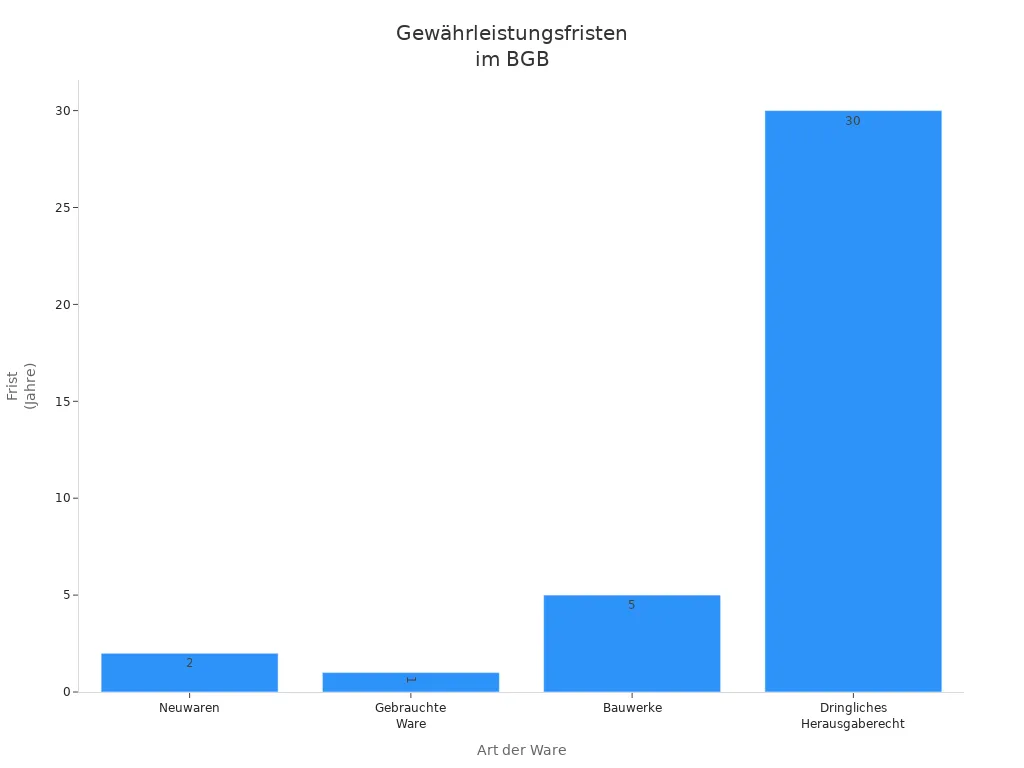
For new goods, you have two years to assert claims. For used goods, the period can be shortened to one year if stated in the contract.
Rights in case of defects
You have clear rights if your product shows a defect that was already present at the time of purchase. The most important features of the warranty (Gewährleistung) are listed here:
Feature |
Description |
|---|---|
Duration |
Two years from date of purchase (for new goods) |
Claim opponent |
Always the retailer, not the manufacturer |
Reversal of burden of proof |
In the first twelve months, the retailer must prove no defect existed |
Supplementary performance |
You can demand repair or replacement. The retailer bears the costs. |
Limitation period |
Claims must be made within the period |
Tip: Always report defects as quickly as possible and keep your purchase receipt in a safe place.
Claims procedure
If you identify a defect, it is best to proceed step by step:
Report the defect in writing to the retailer and provide your proof of purchase.
Request a repair or exchange and set a reasonable deadline.
The retailer will inspect the defect and must respond within a reasonable time.
Document all steps, for example with photos or emails.
If the retailer remains inactive, you can take legal action or contact a consumer advisory center.
For a successful claim, you need the following documents:
Proof of purchase (e.g., receipt or invoice)
Photos or videos of the defect
Correspondence with the retailer
This secures your rights and allows you to prove that you reported everything correctly in the event of a dispute.
Guarantee as an additional service
What is a guarantee (Garantie)?
You often receive a guarantee when buying many electronic devices. Manufacturers or retailers provide a voluntary, contractual promise. They assure you that the product will remain free of defects for a certain time or fulfill a certain function. The legal basis for guarantees can be found in the German Civil Code (BGB), which defines the rights and obligations of all parties. A guarantee complements the statutory warranty (Gewährleistung) and can provide additional security.
A guarantee is not a legal requirement. It is a voluntary additional service offered by manufacturers or retailers.
Typical content and conditions
A guarantee statement contains important information. You should be aware of these points:
Name and address of the guarantor
Duration of the guarantee
Geographic scope (e.g., only in Germany or Europe-wide)
Content of the guarantee (what exactly is covered)
Procedure for making a claim (how you can use the guarantee)
Reference to statutory warranty rights
Manufacturers and retailers define the conditions individually. The duration and scope differ depending on the product and provider. The following table shows the differences between manufacturer and retailer guarantees:
Aspect |
Manufacturer guarantee |
Retailer guarantee |
|---|---|---|
Legal regulation |
Not legally regulated |
Not legally regulated |
Voluntary nature |
Voluntary service by manufacturer |
Voluntary service by retailer |
Conditions |
Subject to certain conditions |
Subject to certain conditions |
Duration and scope |
Defined in the guarantee terms |
Defined in the guarantee terms |
Procedure and special features
You can use the guarantee if the product shows a defect covered by the guarantee terms. The procedure differs from the statutory warranty. You report the damage to the guarantor and present the necessary documents. The guarantor checks the case and decides whether a repair, replacement, or another solution is offered.
The guarantee is a voluntary service and can offer additional rights.
Statutory warranty claims always remain in effect.
The guarantee may involve costs, e.g., for certain repairs.
Tip: Read the guarantee conditions carefully. This way you know what services to expect and how to proceed in case of damage.
E-Bike: Focus on Guarantee and Warranty
What applies to e-bike defects?
An e-bike places special demands on guarantees and warranties. An e-bike contains many technical components such as the battery, motor, and electronics. These parts can show defects faster than those on a normal bicycle. In case of a defect, you should first check if the statutory warranty (Gewährleistung) applies. It protects you if the e-bike already had a fault at the time of purchase. The retailer must then arrange for the repair or exchange.
Many manufacturers also offer a guarantee on the e-bike. This guarantee often covers the battery or the motor. You can find the conditions in the guarantee booklet or on the manufacturer's website. Check exactly which parts are covered. Wearing parts like brakes or tires are usually excluded from the guarantee. In case of an e-bike defect, you should always have your proof of purchase and guarantee documents ready.
Tip: Report every defect on the e-bike immediately to the retailer. This ensures your claims and avoids disputes.
Tips for e-bike buyers
When buying an e-bike, you should pay attention to a few points:
Read the guarantee terms carefully. Pay attention to duration and scope.
Ask which e-bike parts are covered by the guarantee.
Keep all documents and your receipt in a safe place.
Have regular maintenance performed by a specialist dealer. Many guarantees require proof of maintenance.
Check if the dealer offers additional e-bike insurance.
A table helps you keep an overview:
What should you check? |
Why is this important? |
|---|---|
Guarantee scope |
Not all parts are covered |
Proof of maintenance |
Often a condition for guarantee claims |
Proof of purchase
Proof for statutory warranty and manufacturer's warranty
Insurance offer
Protection against theft and damage
With these tips, you protect yourself from nasty surprises and can use your e-bike safely for a long time.
You now know the differences between the manufacturer's warranty and the statutory warranty. You can find the most important deadlines when buying an e-bike in this overview:
Aspect |
Details |
|---|---|
Statutory warranty period |
24 months from handover |
Reversal of burden of proof |
In the first year, the burden of proof lies with the dealer |
Extension |
In the case of defects, the period is extended by up to four months |
To assert your rights, you should report defects immediately, secure receipts, and set a reasonable deadline. Always check the conditions and inform yourself if you are uncertain.
FAQ
What is the difference between manufacturer's warranty and statutory warranty?
With the statutory warranty, you receive legally secured rights in the event of defects. The manufacturer's warranty is a voluntary promise from the manufacturer or dealer. It can offer additional benefits but may also contain restrictions.
What do I need to consider when making a claim?
You should report the defect immediately. Have your proof of purchase ready. Document the damage with photos. Request a repair or replacement in writing. Set a reasonable deadline.
What does the e-bike warranty usually cover?
The warranty often covers the battery, motor, and frame. Wear parts such as brakes, tires, or the chain are usually excluded. Check the warranty conditions carefully so you know which parts are protected.
What happens when the deadline has expired?
After the statutory or manufacturer's warranty period has expired, you no longer have any legal claims. You will then have to pay for repairs yourself. Some manufacturers offer paid extended warranties.