
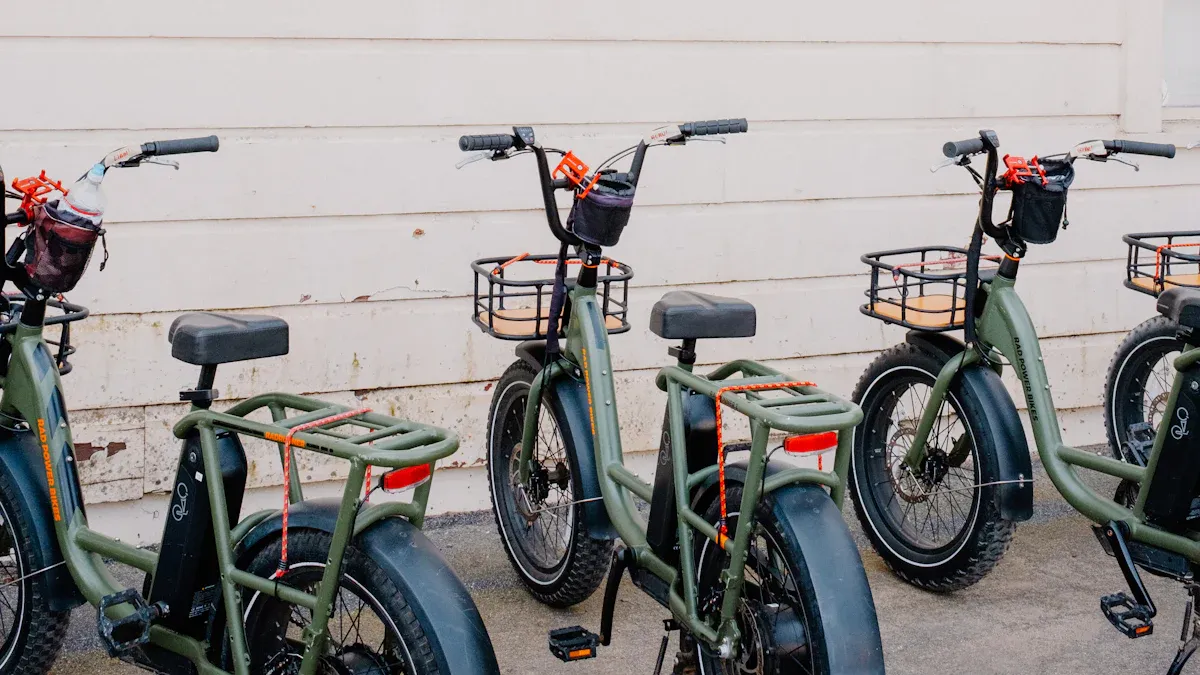
You want an e-bike, but the price is high? Many people in Germany are facing this question. In 2023, around 2 million e-bikes changed hands. More and more people are using leasing or traditional financing to make their dream a reality. However, when financing an e-bike, there are advantages like flexible installments, but also pitfalls. Consumer advice centers warn: Assess your financial burden realistically, do not let yourself be pushed into quick decisions, and carefully check additional contracts as well as the fine print.
Key takeaways
Compare different types of financing such as installment loans, dealer financing, leasing, and e-bike subscriptions to find the best solution for your budget and needs.
Pay attention to the term, interest rate, and potential additional costs to realistically estimate the total cost of financing and avoid surprises.
Check your credit rating and SCHUFA report before financing to obtain better terms and avoid unpleasant surprises.
Use unscheduled repayments and flexible repayment options to become debt-free faster and adjust your monthly burdens.
Inform yourself about subsidy programs and used e-bikes to save money and finance your e-bike more affordably.
Financing an e-bike – Paths and options
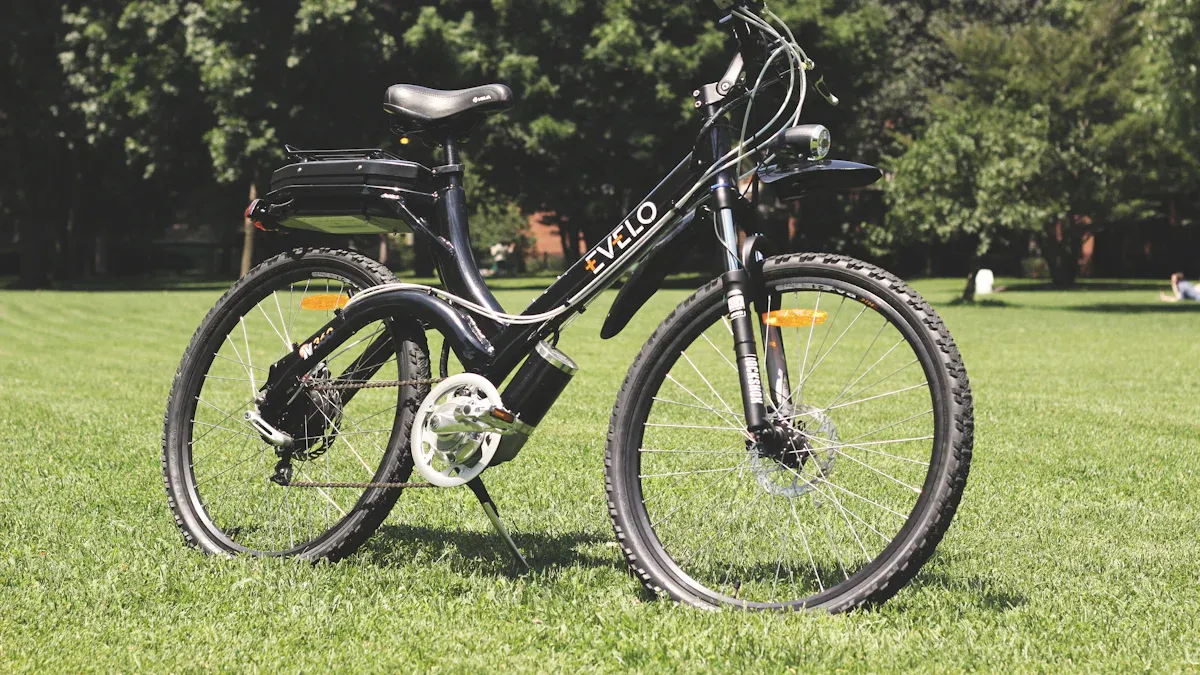
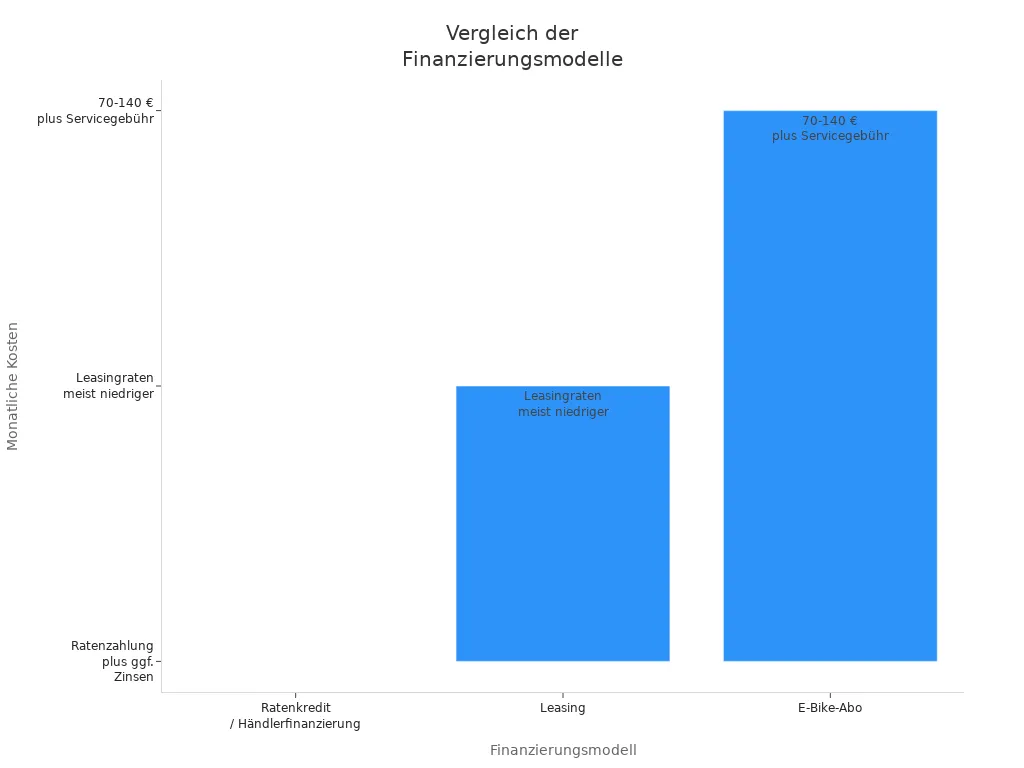
If you want to finance an e-bike, there are various paths available to you in Germany. The most popular models are installment loans, dealer financing, leasing, and the e-bike subscription. Each path has its own advantages, costs, and conditions. You should know the differences before you decide.
Installment loan
With an installment loan, you can buy the e-bike directly and become the owner immediately. The bank pays the purchase price to the dealer, and you pay the money back in monthly installments. The term is usually between 6 and 72 months. You can often choose the installment amount yourself. The longer the term, the lower the monthly burden, but total costs increase due to interest. Many banks require a positive SCHUFA score, a fixed income, and a minimum age of 18. Even with limited creditworthiness, there are providers that enable you to get a loan if you can provide proof of a regular income.
Tip: Check if 0% financing is possible. Then you won't pay any interest and can finance the e-bike particularly cheaply.
Dealer financing
Many e-bike dealers offer their own financing models. You sign the contract directly at the shop or online. The terms are often similar to a classic installment loan. You become the owner of the e-bike once you have paid all installments. Dealer financing sometimes lures customers with special promotions, such as interest-free installments or low entry costs. Terms usually range between 6 and 48 months. Here too, the dealer checks your creditworthiness and often requires proof of income.
Leasing
Leasing is particularly popular in Germany, especially as company bike leasing. Over 16 million employees can lease their e-bike through their employer. You pay monthly leasing installments, but the e-bike remains the property of the leasing company. After 36 months, you can often buy the bike at its residual value or lease a new model. Leasing offers you predictable costs and often tax advantages if your employer supports the model. For companies, there are additional tax benefits. Monthly installments are usually lower than with a loan, but in return, the bike only belongs to you after the contract ends and a potential buyout occurs.
E-bike subscription
With an e-bike subscription, you rent the bike for a fixed period, usually starting from one month. You pay a monthly fee that often includes service, maintenance, and insurance. You do not become the owner. The subscription is suitable if you want to remain flexible or want to test the e-bike first. Costs range between 70 and 140 euros per month, sometimes with an additional service fee. After the term ends, you simply return the bike.
Here is an overview of the most important differences:
Financing model |
Ownership acquisition |
Monthly costs (approx.) |
Special features / Additional costs |
|---|---|---|---|
Installment loan / Dealer financing |
Buyer becomes owner |
Installment payments plus interest if applicable (0% also possible) |
Flexible installments, no tax benefits, potential interest and additional costs for insurance, maintenance |
Leasing |
Lessor remains owner |
Monthly leasing installments usually lower than installment loan |
Tax benefits for entrepreneurs, insurance often included, return after contract end |
E-bike subscription |
No ownership (rental) |
Approx. 70 to 140 € plus service fee (e.g., 99 €) |
Short-term rental, risk-free testing, no long-term commitment |
Typical terms and requirements
Most financing models offer terms between 6 and 72 months.
You can choose the term flexibly. Shorter terms mean higher installments but lower total costs.
The first payment is usually made after receiving the e-bike.
For financing, you must be at least 18 years old, have a residence in Germany, and provide proof of a regular income.
A positive SCHUFA score is often a requirement, but some providers also accept customers with limited creditworthiness if the income is sufficient.
If you want to finance an e-bike, you should compare the different paths. Consider whether ownership is important to you, how high your monthly burden can be, and which requirements you meet. This way, you will find the right solution for you.
Payment plans & conditions
Term & installment amount
If you want to finance an e-bike, you should first look at the term and the amount of the monthly installments. The term determines how long you pay off the e-bike. Typical terms range from 6 to 84 months. A short term means higher monthly installments, but you are debt-free sooner and pay less interest. A long term lowers the monthly burden but increases total costs through additional interest.
Here you can see how the term affects the monthly installment (Example: 1,000 € purchase price):
Effective annual interest (%) |
Example rate per month |
|
|---|---|---|
12 |
0.00 |
approx. 83.34 € |
24 |
1.56 |
approx. 42.34 € |
The average e-bike prices, according to Statista, are about 2,650 €. With a term of 36 months, for example, you pay about 87.66 € gross per month for an e-bike worth 2,999 €. For a premium e-bike with a purchase price of 4,995 €, the monthly installment is around 142.68 €.
Tip: Choose the term so that the monthly installment fits your budget. Check whether you can continue to pay the installment even in the event of unexpected expenses.
Interest rate & fees
The interest rate is an important factor when you want to finance an e-bike. It determines how much money you pay to the bank or dealer in addition to the purchase price. For terms up to 12 months, many providers offer an effective annual interest rate of 0%. For longer terms, interest rates rise significantly.
Term (months) |
Effective interest (%) |
Nominal interest (%) |
Additional fees |
|---|---|---|---|
6 - 12 |
0.00 |
0.00 |
None |
13 - 24 |
4.99 |
4.90 |
None |
25 - 36 |
7.99 |
7.80 |
None |
37 - 60 |
9.99 |
9.70 |
None |
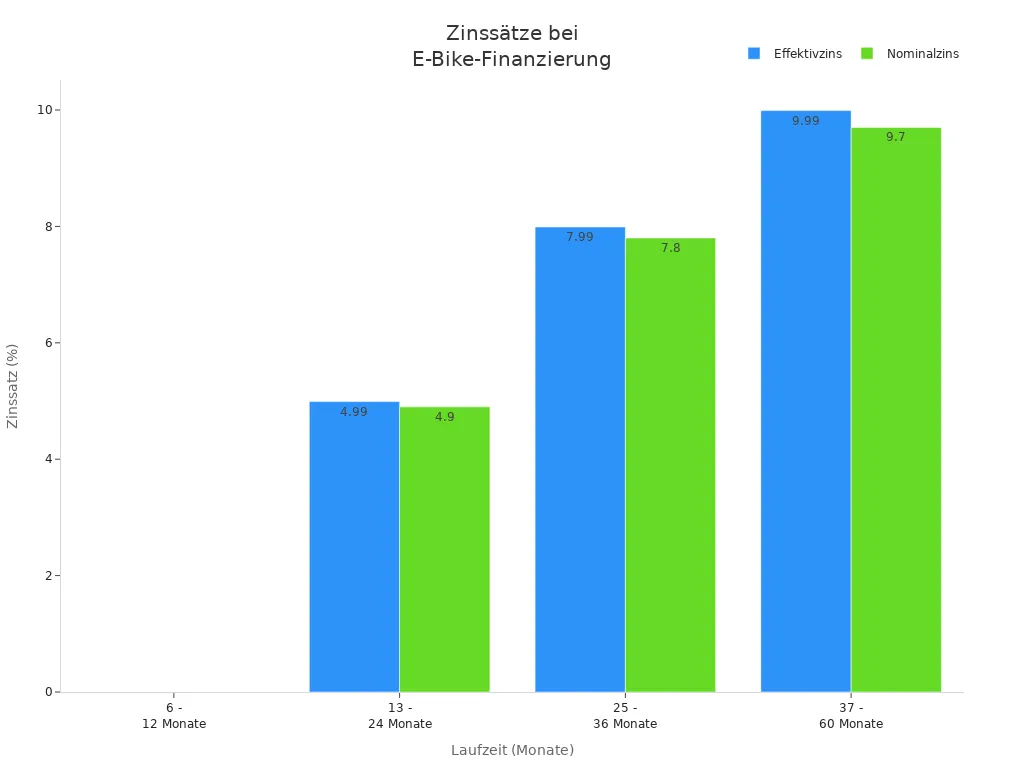
Banks usually do not charge additional fees as long as you stick to the agreed installments. Dealer financing often seems straightforward but sometimes has higher interest rates or hidden costs. An installment loan from a bank usually offers better and more flexible terms but requires a credit check.
0% financing
Many dealers advertise 0% financing. That sounds attractive because you pay no interest. However, you should check the conditions carefully. 0% financing usually only applies to short terms, often a maximum of 12 months. Frequently, you must make a down payment, which is between 10% and 30% of the purchase price. For longer terms, interest rates rise significantly.
Special features and requirements of 0% financing for e-bike purchases |
Description |
|---|---|
Interest-free |
No interest on installments for terms usually of 12 months |
Down payment |
Often required, usually between 10% and 30% of the purchase price |
Term |
Usually limited to 12 months; extension often leads to high interest |
Purchase price |
Can be higher due to hidden fees or surcharges than without financing |
Binding |
Financing usually occurs through partner banks of the dealer, no free choice |
Advantages |
Everything from one source, little effort, 0% interest possible |
Disadvantages |
Higher purchase price, no credit counseling, no flexible terms like installment breaks |
Caution: Always check the fine print. Sometimes dealers hide interest in the purchase price or demand additional fees. Compare different offers before you decide.
For 0% financing, you must be of legal age, have a permanent residence in Germany, and provide proof of a regular income. Dealers usually work with fixed partner banks. You cannot choose the bank freely.
Down payment & unscheduled repayment
With many financing models, you do not have to make a down payment. With 0% financing, however, dealers often require a down payment of 10 to 30 percent of the purchase price. This lowers the monthly installment but increases the entry hurdle.
Unscheduled repayments offer you flexibility. You can pay back a larger amount or the entire remaining debt at once at any time. Most banks and dealers allow unscheduled repayments without additional costs. This helps you become debt-free faster and save on interest.
-
Requirements for unscheduled repayments:
Permanent residence in Germany
Permanent employment contract outside the probationary period
No negative SCHUFA entries
Proof of income or collateral
Advantage: With unscheduled repayments, you can shorten the term and lower total costs. Before signing the contract, check whether unscheduled repayments are possible free of charge.
If you want to finance an e-bike, you should pay attention to flexible repayment options. Many providers allow you to choose the term and installment amount individually. This allows you to adapt the financing to your life situation.
Important criteria when financing an e-bike
Creditworthiness & SCHUFA
Your creditworthiness plays a central role when you want to finance an e-bike. Banks and dealers check whether you can reliably pay your installments. The Schufa provides important information about your credit history for this purpose. A good rating increases your chances of favorable terms. A poor Schufa rating can lead to rejections or higher interest rates. Some providers offer financing without a Schufa check, but they often require more collateral or higher installments.
Financing without credit check |
|
|---|---|
Schufa inquiry is carried out |
No Schufa inquiry required |
Evaluation of credit history and creditworthiness |
Evaluation based on current income |
Higher risk with poor creditworthiness, therefore possible rejection |
Access also possible with limited creditworthiness |
Tip: Check your Schufa report before applying. This allows you to correct errors in time.
Total costs
When financing an e-bike, you should always keep an eye on the total costs. This includes not just the purchase price, but also interest, fees, and additional costs such as insurance. The insurance costs are usually between 50 and 300 euros per year, depending on the value of the e-bike and the scope of coverage. Service packages, repairs, and potential residual values at the end of a leasing contract are also part of this.
Purchase price of the e-bike (including motor and battery)
Repair and maintenance costs
Insurance costs (e.g., theft, damages)
Leasing installments and potential taxes
Service packages and theft protection
Residual value upon leasing takeover
Contract details
Always read the contract carefully. Pay attention to hidden costs, the term, and the interest rate. Check whether additional costs such as insurance or fees are included. With leasing, you should know how high the buyout value is at the end and what tax consequences may arise.
Contract detail |
Important notes and aspects |
|---|---|
Hidden costs |
Check fees and insurance |
Term and flexibility |
Note the term, usually 12-48 months for installment purchases, 36 months for leasing |
Interest payments and rate |
Compare interest rates, pay attention to the total price |
Additional costs |
Note possible fees and expenses |
Consequences of payment default |
High penalty interest possible |
Buyout value and taxes |
Buyout value approx. 15-20% of the price, check tax consequences |
Flexibility
Flexibility is important if your life situation changes. Many providers allow extra repayments or installment breaks. Some banks even offer free extra repayments. Check whether you can adjust the term or temporarily pause installments. This gives you security if you have less money available at some point.
Provider |
Extra repayment |
Term adjustment |
Installment break |
|---|---|---|---|
Up to 100% after 6 months, min. €1,000 |
Once up to 24 months (min. 12-month term) |
Once up to 3 months (subject to creditworthiness) |
|
Extra repayment and full payoff at no extra cost |
Term can be shortened or extended by up to 24 months |
Up to 3-month installment break |
|
VR Smart basis (VR-Bank) |
Full payoff only with early repayment penalty |
No flexibility options |
No flexibility options |
Remember: The more flexible your contract, the better you can react to changes.
Alternatives & Subsidies
Used E-Bikes
You can save a lot of money when buying a used e-bike. Used models lose about 20% of their new price every year. After three years, you can often get an e-bike that is almost as good as new but significantly cheaper. Many specialist retailers offer refurbished e-bikes with a warranty. This gives you security and lowers the risk. Lease returns in particular are often well-maintained and technically checked. The financing costs are lower because the purchase price is lower. This makes it easier to manage the monthly installments.
Advantage / Aspect |
Used E-Bikes |
New E-Bikes |
|---|---|---|
Price discount |
Full retail price |
|
Condition |
Lease returns often very well maintained |
New and unused |
Warranty / Guarantee |
Often 2-year warranty from the dealer |
Standard warranty |
Financing costs |
Lower installments due to low purchase price |
Higher credit interest due to higher price |
Tip: It is best to buy used e-bikes from a specialist retailer. There, you get verified quality and often a warranty.
Subsidies
In Germany, there are various subsidy programs for e-bikes. Most are aimed at companies, municipalities, or associations. Private individuals sometimes benefit through their employer or regional campaigns. The Federal Office for Economic Affairs and Export Control (BAFA) subsidizes cargo e-bikes with up to 2,500 euros. In Hesse, as a private individual, you receive a 1,000 euro grant for an electric cargo bike. In North Rhine-Westphalia, there is up to 2,100 euros for freelancers. Cities like Neumünster or Bamberg also offer grants for e-bikes. The programs differ depending on the federal state and city. Check with your local authority whether there are currently any subsidies available.
Hesse: 1,000 euros for private individuals (cargo bike)
NRW: 30% grant, max. 2,100 euros for freelancers
Neumünster: 750 euros for private and commercial cargo bikes
Bamberg: 300 euros for speed pedelecs
Note: Grants often apply only to cargo bikes or specific target groups. Check the conditions carefully.
Riding profile & Selection
Your riding profile determines which e-bike suits you and how you should finance it. Consider how far you ride daily, how much weight you transport, and what battery power you need. An e-bike loses about 20% of its value in the first year. You should keep this in mind when financing. Prices vary greatly depending on the model and equipment. Check whether a short term makes sense for you to save on interest costs. Pay attention to the interest rate, possible down payments, and flexible repayment options. A positive SCHUFA score helps you get better terms. Compare different offers and choose the model that fits your everyday life and budget.
Criterion |
What you should note |
|---|---|
Range |
Does it fit your daily routes? |
Weight |
Do you often carry loads or ride uphill? |
Battery |
Is the capacity enough for your tours? |
Financing |
Are the installments, term, and interest rate suitable? |
Tip: Choose an e-bike that suits your riding style. This way, you make the best use of your money and will enjoy your bike for a long time.
If you want to finance an e-bike, you should look for transparent costs, flexible conditions, and reputable providers. You can recognize trustworthy providers by clear contract terms, stable installments, good accessibility, and positive customer reviews. Subsidy options play an important role:
Grants from federal, state, or local authorities reduce the purchase price and the monthly installments.
Subsidy programs change often, so current research is worthwhile.
Leasing models and loans can often be combined with subsidies.
Compare offers and choose the form of financing that fits your everyday life.
FAQ
How quickly will I receive my e-bike after finalizing the financing?
You usually receive your e-bike immediately after the contract is signed and the credit check is complete. Dealers often deliver within a few days. With banks, it may take a little longer. Ask the provider for the exact delivery time.
Can I pay off the financing early?
Yes, you can often repay the financing early. Many banks and dealers allow extra repayments at no extra cost. Check the contract terms. This way, you save on interest and are debt-free sooner.
What happens if I cannot pay an installment?
Contact the provider immediately if you cannot pay an installment. Many banks offer installment breaks or solutions. Default interest may apply. Clarify the situation early to avoid additional costs.
Is there an age limit for e-bike financing?
You must be at least 18 years old. Some providers set a maximum age, usually 70 or 75. Ask the provider about the exact conditions.
Do I have to insure the e-bike?
Insurance is not always mandatory, but it is very sensible. Many providers recommend theft or comprehensive insurance. Leasing and subscription models often already include insurance coverage.
Tip: Compare the insurance offers. This way, you protect your e-bike optimally.