
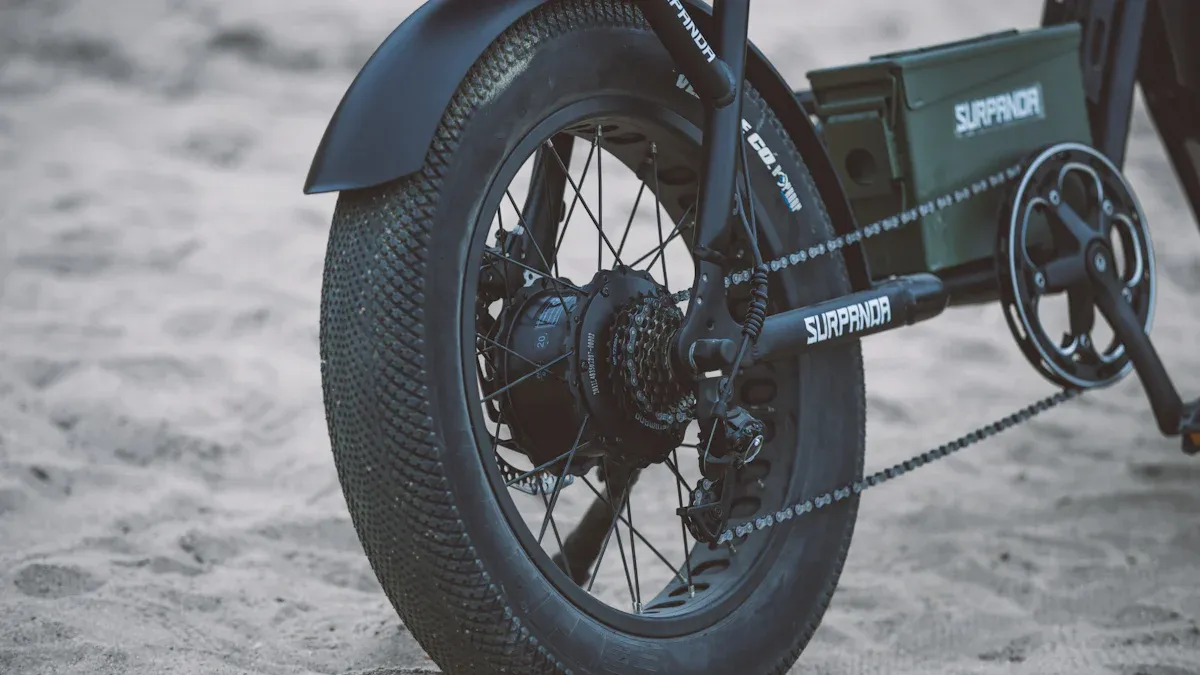
The battery is the heart of your e-bike. It provides the energy you need for long distances and steep climbs. Modern batteries offer capacities between 400 and 1000 Wh, enabling ranges of 80 to 130 kilometers. However, your riding style and external conditions can influence these values. Regular e-bike battery care can extend the lifespan of your battery by up to 30%. High-quality lithium batteries last between 500 and 1000 charging cycles if you treat them correctly. With the right care, your battery remains powerful and reliable.
Key Insights
Proper care of your e-bike battery makes it last longer.
Charge it between 20% and 80% so that it lasts longer.
Keep the battery away from heat, cold, and moisture to avoid damage.
Wipe the contacts clean often with a damp cloth.
See a specialist dealer if there are any issues to ensure your e-bike remains safe.
Fundamentals of E-Bike Battery Care
Technology and How It Works
E-bike batteries are based on modern lithium-ion technology. These batteries store electrical energy as chemical energy and convert it back into power when needed. An integrated Battery Management System (BMS) monitors the charging and discharging process, protects against overheating, and ensures optimal performance.
Aspect |
Description |
|---|---|
Watt-hours (Wh) |
The capacity varies between 400 and 500 Wh, depending on the e-bike type. |
Charging cycles |
Batteries can be charged approx. 1000 times, but lose performance after 500 cycles. |
Memory effect |
Lithium-ion batteries do not have a memory effect, which makes usage more flexible. |
The lifespan of a battery depends on its care and usage. With proper e-bike battery care, you can maintain the performance of your battery over the long term.
Different Battery Types and Their Characteristics
Frame batteries
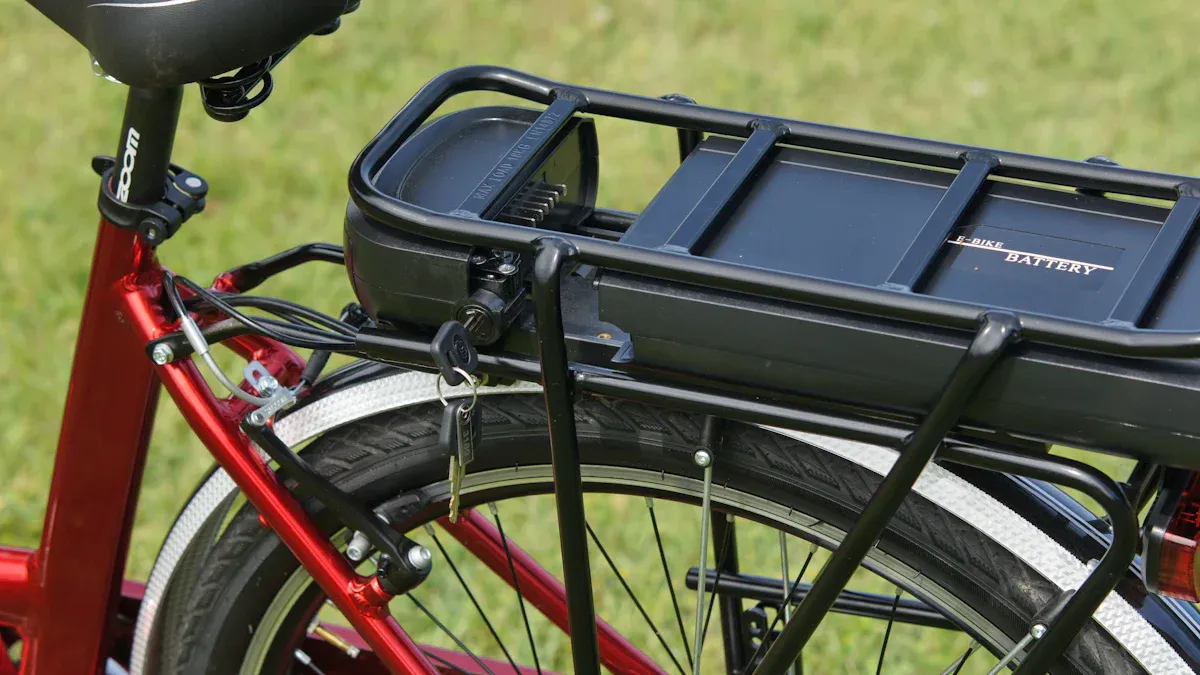
Frame batteries are attached directly to the bicycle frame. They offer good weight distribution and are easily accessible. These batteries are particularly suitable for sporty riders.
Rack batteries
These batteries are located on the luggage rack and offer easy handling. They are ideal for city e-bikes as they affect the center of gravity of the bike less.
Intube batteries
Intube batteries are integrated into the frame and offer a modern, sleek design. They protect the battery from external influences such as dirt and moisture. This variant is especially popular with mountain bikes.
Capacity and Range
Influence of capacity, riding behavior, and environmental conditions
The capacity of a battery, measured in watt-hours (Wh), determines the range of your e-bike. Higher assistance levels and heavy luggage reduce the range. Cold temperatures can also impair battery performance.
Factor |
Description |
|---|---|
Battery capacity (Wh) |
Higher capacity usually leads to a greater range. |
Motor assistance level |
Higher assistance levels discharge the battery faster, which reduces the range. |
Total weight |
Higher weight requires more assistance, which also reduces the range. |
Examples of ranges (e.g., 400 Wh = 60-80 km)
A battery with 400 Wh enables a range of about 60 to 80 kilometers. With a capacity of 500 Wh, you can cover 80 to 100 kilometers. For longer tours, batteries with 800 to 1,250 Wh are recommended, offering ranges of up to 200 kilometers.
Proper Charging Practices for E-Bike Battery Care
Optimal Charging Habits
Avoidance of overcharging and full discharge
Overcharging or fully discharging your e-bike battery can significantly shorten its lifespan. Lithium-ion batteries are sensitive to extreme charge states. Do not charge your battery beyond 100% and avoid riding it until it is completely empty. Although a battery management system (BMS) protects against damage, regular overcharging can impair capacity in the long term.
Prefer partial charging between 20-80%
Ideally, keep the charge state of your battery between 20% and 80%. This practice reduces cell wear and extends lifespan. Short charging intervals are better than infrequent, full charging cycles. Charge your battery after a ride if the charge level falls below 50%.
Use of the right charger
Use original or compatible chargers
Choosing the right charger is crucial for the safety and performance of your battery. Original chargers or certified compatible models offer higher safety standards. They minimize the risk of overheating or damage.
Category |
Details |
|---|---|
Main danger |
|
Recommended measures |
Safe charging practices, use of certified components, charging under supervision |
Differences by brand |
Higher safety standards with original parts from established brands |
Main causes of battery fires |
Technical defects and quality issues |
Improper usage |
Overcharging batteries, using non-compatible chargers, charging without supervision |
Recommendations for avoidance |
Charge only with the manufacturer-recommended charger, charge the battery in a cool, dry room |
Observe manufacturer instructions
Read the manufacturer's instructions carefully. They contain important information on the optimal use and care of your battery. Only charge your battery in a well-ventilated room and avoid direct sunlight.
Tips for first-time use
Full charging during the first three cycles
With a new battery, you should perform the first three charging cycles completely. Charge the battery to 100% and discharge it to about 20%. This method helps to activate the cells and reach maximum capacity. Afterward, you can switch to the recommended partial charging.
Protecting the E-Bike Battery from Extreme Temperatures and Moisture
Effects of temperatures
Ideal operating temperature (10-25°C)
E-bike batteries work best at temperatures between 10 and 25 degrees Celsius. In this range, the chemical processes in the battery remain stable, which guarantees optimal performance. At 20 degrees Celsius, the battery reaches its maximum efficiency. Store your battery in a dry room with temperatures between 0 and 20 degrees to protect it from damage.
Protection against cold and heat
Extreme temperatures can significantly shorten the lifespan of your battery. At temperatures below 0 degrees Celsius, the range decreases because chemical reactions in the battery are slowed down. High temperatures above 25 degrees Celsius can cause irreparable damage to the capacity. When riding uphill, the battery can heat up significantly. Temperatures from 60 degrees Celsius carry the risk of thermal runaway, which compromises safety. Protect your battery in winter with an insulating cover and avoid direct sunlight in summer.
Protection against moisture
Use of protective covers
Moisture is another enemy of your e-bike battery. Use water-repellent protective covers to protect the battery from rain and splashing water. These covers prevent moisture from penetrating into the sensitive electronic components.
Avoidance of condensation and high-pressure cleaners
Condensation occurs when the battery is moved from a cold to a warm environment. This can lead to corrosion. Let the battery slowly adapt to the new temperature before using it. You should avoid high-pressure cleaners, as the strong jet of water can damage the seals. Instead, clean your e-bike with a damp cloth to prevent damage.
Cleaning and Maintenance of the E-Bike Battery
Cleaning the battery
Use of a damp cloth, no aggressive cleaners
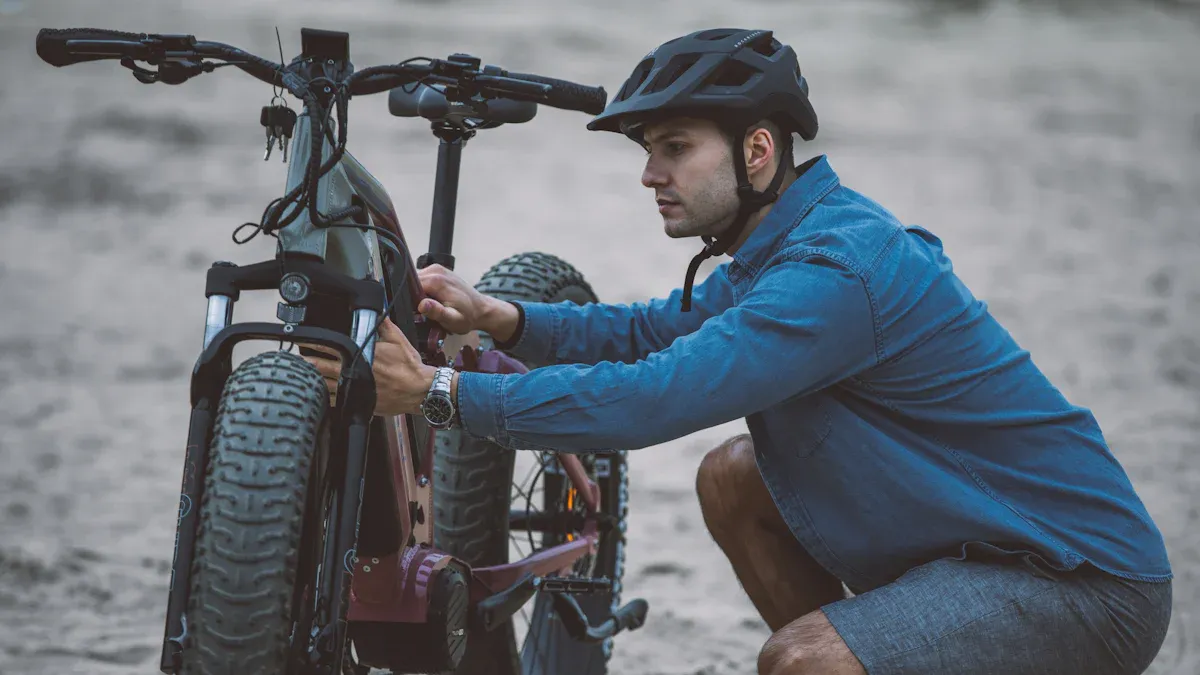
Cleaning your e-bike battery is an important step to extend its lifespan. Use a slightly damp microfiber cloth to remove dirt and dust. Aggressive cleaning agents or harsh chemicals can damage sensitive surfaces and seals. Make sure that no moisture penetrates into the terminals or the housing.
Check and clean contacts regularly
The contacts of your battery play a crucial role in power transmission. Check them regularly for dirt or corrosion. A suitable contact spray or contact grease helps to maintain conductivity and prevent corrosion. Experts recommend performing this maintenance at least once a year or after 2,000 kilometers driven.
Tip: Always clean the contacts carefully and avoid excessive pressure to prevent damage.
Regular inspection
Checking for damage or wear
A regular inspection of your battery helps to detect damage early. Examine the housing for cracks or deformations. These can indicate falls or overheating. The terminals should also be checked for wear. Studies show that many e-bikes are not maintained regularly, which leads to avoidable problems.
Use of contact spray if needed
If you notice corrosion or dirt on the contacts, apply a contact spray. This protects the terminals and improves electrical conductivity. Experts recommend having your e-bike inspected at least once a year or after 1,000 to 1,500 kilometers. The first inspection should take place after the first 500 to 800 kilometers to ensure that all components are functioning optimally.
Note: Regular maintenance is a key part of e-bike battery care and helps to ensure the safety and performance of your e-bike.
Storage Tips for a Longer E-Bike Battery Lifespan
Ideal storage conditions
Room temperature (10-20°C) and dry environment
Proper storage of your e-bike battery is crucial for its lifespan. Store it in a room with a temperature between 10 and 20 degrees Celsius. Extreme temperatures, whether heat or cold, can impair the chemical processes in the battery. A dry and well-ventilated place also protects the battery from moisture and corrosion.
Tip: Avoid direct sunlight and humid environments. A basement or a cool storage room is ideal.
Partial charging (30-60%) during storage
Before storing the battery, charge it to a level between 30% and 60%. This charge state minimizes stress on the battery cells and prevents damage from deep discharge. Scientific studies show that a charge level of 40% to 60% is optimal for extending lifespan.
Long-term storage
Use and charge battery regularly
Even during storage, you should not forget the battery. Recharge it every three to six months to avoid deep discharge. Regular use keeps the cells active and ensures that the battery retains its capacity longer.
Important: Frequent and partial charging reduces stress on the battery cells.
Recommendation: Avoid leaving the battery fully discharged for long periods.
Protection against deep discharge by BMS
A modern Battery Management System (BMS) protects your battery from deep discharge. Nevertheless, you should take care not to leave the battery unused for months. Deep discharge can permanently reduce capacity and shorten lifespan.
Note: With proper e-bike battery care, you can extend the lifespan of your battery by up to 30%.
Riding behavior and its influence on e-bike battery care
Efficient riding
Use of low assistance levels
The choice of assistance level directly affects the energy efficiency of your e-bike. Low assistance levels relieve the battery and extend the range. High-quality e-bikes offer various modes that you can adjust depending on the terrain and riding style. A high assistance mode consumes more energy and drains the battery faster. Plan your rides consciously and choose an assistance level that meets your requirements without putting unnecessary strain on the battery.
Tip: Use low assistance levels for flat sections and increase the efficiency of your battery.
Adjusting riding style to the terrain
A proactive riding style saves energy and preserves the battery. Shift into lower gears in good time to reduce the strain on the motor. Starting off in high gears uses more energy and reduces range. The motor works most efficiently with a steady cadence of 60 to 80 revolutions per minute. Avoid stop-and-go, as frequent stopping and starting increases energy consumption.
-
Efficient riding habits:
Consistent cadence
Early shifting
Avoiding strain
Reducing peak loads caused by high assistance levels
Peak loads occur when you use high assistance levels or accelerate abruptly. These loads lead to increased energy consumption and shorten the battery's service life. Plan your route so that you tackle steep climbs and difficult terrain with moderate assistance. A smooth riding style reduces stress on the battery cells and improves energy efficiency.
Note: Frequent peak loads can impair your battery's capacity in the long term.
-
Tips for reducing strain:
Adjust assistance level to the terrain
Plan your route consciously
Maintain a steady pace
With adapted riding behavior and the right e-bike battery maintenance, you can extend the life of your battery and maximize your range.
When professional help for e-bike battery maintenance is required
Signs of battery problems
Capacity loss or charging problems
A noticeable loss of capacity or charging problems indicate that your battery requires professional attention. If your battery no longer offers the range you are used to or discharges unusually quickly, you should take action. Charging problems, such as failing to reach a full state of charge, can also indicate internal damage.
Note: Regular battery checks help identify such problems early and extend service life.
Error messages on the display
Modern e-bikes show error messages directly on the display. These can point to problems with the battery or other electrical components. Common messages concern the condition of the battery, charge capacity, or the need for a professional inspection.
-
Typical signs of urgent maintenance needs:
Battery condition and charge capacity are deteriorating.
Error messages appear on the display regularly.
The battery is not functioning as expected.
Tip: Have your e-bike's error log read out to determine the exact cause. A bicycle mechanic can assist you with this.
Tasks of a specialist dealer
Electrical diagnostics and software updates
A specialist dealer performs important diagnostics to assess the condition of your battery. This includes a visual inspection, measuring battery voltage, and checking charge capacity. They also ensure that your e-bike's software is kept up to date.
Task |
Description |
|---|---|
Visual inspection and battery voltage measurement |
|
Perform software updates |
Ensure software is up to date |
Inspect electrical components |
Check all electrical systems |
Replacing defective cells or components
If your battery is damaged, a specialist dealer can replace defective cells or other components. They will also check the contacts and clean them if necessary. These measures ensure that your battery continues to work efficiently and that no safety risks arise.
Task |
Description |
|---|---|
Check batteries and rechargeable batteries |
Inspection and, if necessary, replacement |
Clean and check contacts |
Ensure contacts are clean |
Perform electronics tests |
Testing wiring and plug connections |
Note: Professional maintenance by a specialist dealer is a central component of e-bike battery care. It ensures the safety and efficiency of your e-bike.
Good e-bike battery maintenance ensures a longer service life and reliable performance for your battery. Charge your battery correctly, protect it from extreme temperatures, and clean it regularly. Store it under optimal conditions and check it for damage. With these measures, your battery will remain efficient and powerful. If you encounter problems, make use of a specialist dealer's help. This allows you to take full advantage of your e-bike and enjoy it for a long time.
FAQ
How often should I clean my e-bike battery?
Clean your battery at least once a month. Remove dirt and dust with a damp cloth. Check the contacts regularly for corrosion. A clean battery functions more efficiently and lasts longer.
Can I store my e-bike battery outside in winter?
Never store your battery outside in winter. Cold temperatures below 0°C can reduce capacity. Keep it in a dry room at 10-20°C. An insulating protective cover provides additional protection.
How do I know if my battery is defective?
Watch for signs such as capacity loss, charging problems, or error messages on the display. If your battery discharges unusually quickly, you should have it checked by a specialist dealer.
Can I use a different charger for my battery?
Only use the charger recommended by the manufacturer. Other chargers can damage the battery or cause safety risks. Original chargers guarantee optimal performance and safety.
How do I extend the life of my e-bike battery?
Keep the charge level between 20-80%. Avoid extreme temperatures and clean the contacts regularly. Ride efficiently and use lower assistance levels. Store the battery under optimal conditions.