
When mounting an e-bike on a bike rack, you must pay special attention to weight and load capacity. A secure hold not only protects your bike but also other road users. Before every trip, check all fastenings and ensure everything is firmly in place. Mounting errors quickly lead to damage or even accidents. With the right preparation and attention, you can transport your e-bike safely and without risk.
Key takeaways
Choose a bike rack with sufficient load capacity specifically suited for heavy e-bikes, and pay attention to your vehicle's nose weight.
Remove the battery, onboard computer, and loose accessories before transport to avoid damage and increase safety.
Fasten your e-bike firmly and gently using padded holding arms and suitable straps, and check all fixings before every journey.
Use protective covers and high-quality locks to protect your e-bike from dirt, theft, and weather.
Observe legal regulations, regularly check the fastenings while on the road, and drive carefully to ensure a safe trip.
Choosing a bike rack
Selecting the right bike rack is crucial for the safe transport of your e-bike. E-bikes are heavier than normal bicycles, so you need to pay attention to several important points.
Check load capacity
E-bikes often weigh between 20 and 30 kg. A standard bike rack is usually not enough for this. You should choose a rack that can carry at least 30 kg per bike. Many tow bar racks offer a maximum payload of up to 60 kg. These models are stable and built specifically for heavy bikes. They often feature reinforced holding arms and robust materials. Practical extras like loading ramps make loading easier for you.
Tip: Always check the manufacturer's information regarding maximum load capacity. A rack that is too weak can break and damage your e-bike.
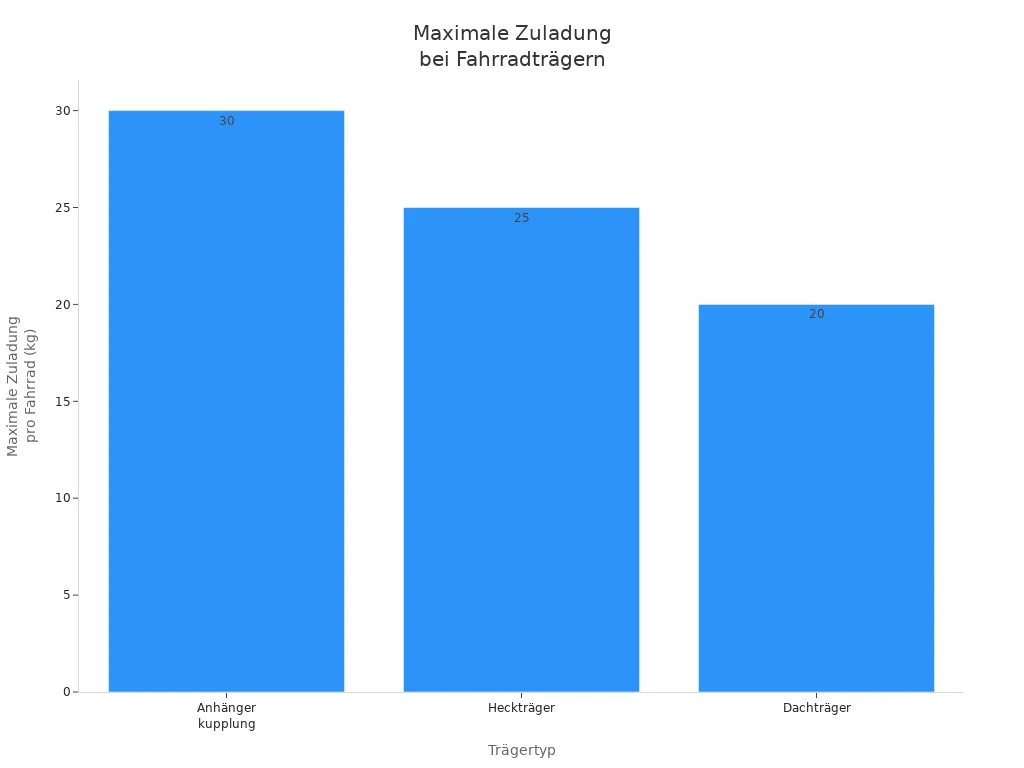
Here you can see the differences between rack types:
Rack type |
Max. payload per bike |
Special features |
|---|---|---|
Tow bar |
30 kg |
Very stable, easy to mount, suitable for e-bikes |
Rear rack |
25 kg |
Tiltable for trunk access, suitable with restrictions |
Roof rack |
20 kg |
Weight limitation, not recommended for heavy e-bikes |
Observe nose weight
The nose weight (Stützlast) is the maximum weight that may rest on the tow bar. It is usually between 50 and 100 kg. You must calculate the combined weight of the rack and the e-bikes. If you exceed the nose weight, you risk fines and potential points on your license. You can find the permissible nose weight in your vehicle documents. Ensure that your rack is explicitly approved for e-bikes.
The weight of the rack (usually 13 to 18 kg) is included in the nose weight.
With two e-bikes and a heavy rack, the nose weight can be exceeded quickly.
The load must always be securely fastened.
Compatibility
Not every bike rack fits every e-bike. The frame shape, tire width, and construction of the rack play a major role. Check if the rails are wide enough for your tires. Some racks offer special rails for wide tires. The mounting arms must be able to grip the frame securely. Ideally, test if your e-bike fits on the rack before purchasing. Many manufacturers offer accessories for different frame shapes.
There is no universal rack for all e-bikes.
The combination of rack and bike determines safety.
If in doubt, seek advice or test the assembly before purchasing.
With these tips, you will find the right rack and transport your e-bike safely.
E-bike preparation
Before you place your e-bike on the bike rack, you should make some important preparations. These protect not only your bike but also the technology and other road users.
Remove the battery
The battery is the heart of your e-bike and is particularly sensitive. You should always remove the battery before transport. It is better protected from impacts, heat, and theft inside the car. Ideally, pack the battery in a padded case and secure it so it cannot shift. Ensure that the contacts are covered so no water or dirt can enter. A securely stowed battery prevents damage and protects traffic safety. If you transport the battery in the vehicle, you also prevent fines that can arise from improper securing.
Tip: Never store the battery loosely in the trunk. A non-slip base and a case provide optimal protection.
Protect the onboard computer
The onboard computer controls many functions of your e-bike. Remove it before transport to protect it from vibrations, moisture, and pressure. Transport the onboard computer inside your car. This keeps the electronics safe and dry. Avoid leaving the onboard computer on the bike with a protective cover, as it can loosen due to wind pressure while driving. Also, be mindful of the temperature in the vehicle, as excessive heat can damage the electronics.
Remove accessories
Loose parts can easily be lost or endanger others during transport. Remove all removable accessories such as air pumps, baskets, bags, bike computers, and locks. Secure sensitive contacts with special protective covers or some tape with foil in between. This protects the technology from dirt and moisture. Stow the accessories safely in the car so nothing can fall out or be damaged.
Cover contacts and plug connections
With these steps, you prepare your e-bike optimally for transport and ensure maximum safety on every trip.
Fastening the e-bike on the bike rack
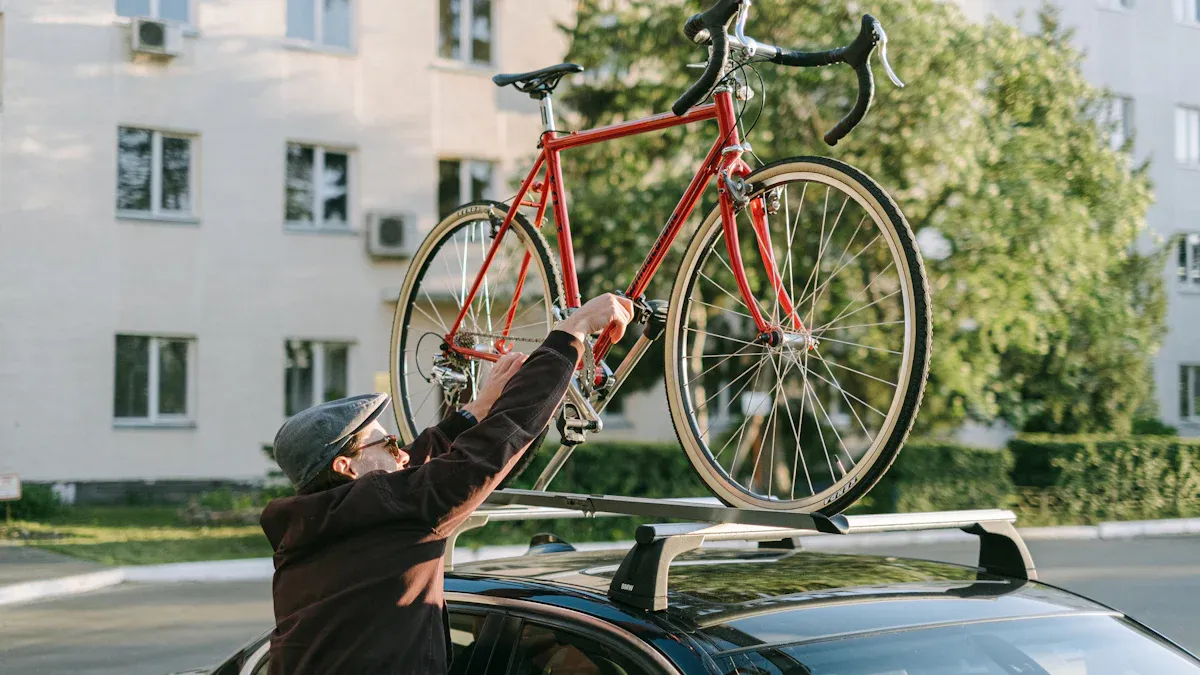
The correct fastening is the centerpiece for safe transport. When mounting your e-bike on a bike rack, you must perform every step carefully to protect your bike and other road users.
Fixing the frame
Start with the frame. First, check all fixation points for damage or dirt. Only clean and intact mounts offer a secure hold. Place the e-bike correctly on the rack so the wheels sit firmly in the rails. Use the frame mount to fasten the bike. For thick or unusual frames, special adapters help. For sensitive frames like carbon, padded holding arms or loops are suitable. Pipe insulation from a hardware store provides additional protection against scratches.
Proceed step-by-step as follows:
Check the fixation points and clean them if necessary.
Position the e-bike centered on the rack.
Use padded holding arms or loops to protect the frame.
Tighten the fasteners securely, but do not damage the frame.
Perform a pull and shake test to check stability.
If you have multiple bikes: alternate the crank positions so they do not collide.
Tip: An additional tension strap increases safety and prevents movement during the trip.
Securing the tires
The tires must sit firmly in the mounts. Open the bike rack's mounts and carefully push the e-bike onto the guide rail. Hold the bike with one hand while closing the mounts with the other. Adjust the rim holders to the width of your e-bike. Fasten the straps to the rims so the tires do not slip.
Follow these steps:
Push the e-bike onto the rail and hold it steady.
Close the frame holders and adjust the rim holders accordingly.
Tighten the straps on the rims without damaging the tires.
Check if the bike is sitting securely.
Use special adapters or longer straps for wide tires.
Warning: Straps that are too loose lead to dangerous movements. Check for a firm hold before every trip.
Adjusting cranks and straps
The correct crank position prevents collisions between the bikes. Set the cranks so they do not touch. The bike closer to the rear of the car should have the handlebars facing the driver's side. Align the second bike in the opposite direction. This avoids cranks or handlebars bumping into each other.
Strap length also plays an important role. They must be long enough to allow for secure fixation even on e-bikes with a long wheelbase or thick tires. Many manufacturers offer longer retaining straps. For large bikes, straps about 40 cm long are recommended.
Aspect |
Importance for secure e-bike fastening |
|---|---|
Crank position |
Prevents collisions between cranks and other components, especially with multiple bikes. |
Strap length |
Reliably secures long or wide e-bikes. Straps that are too short jeopardize stability. |
Padding |
Protects sensitive frames and ensures gentle fixation. |
After mounting, check all fastenings with a quick shake test. This ensures your e-bike is firmly on the rack and ready for the trip.
Protection and safety
Use protective covers
When transporting your e-bike on a rack, you should always think about good protection. E-bikes are sensitive to dirt, spray water, and wind. Especially at high speeds, moisture can penetrate through small crevices and damage the electronics. Thrown-up dirt and stone chips can also hit the battery and motor. A high-quality protective cover protects your bike reliably.
Here is an overview of different types of protective covers:
Cover type |
Material / Construction |
Advantages |
Disadvantages |
Suitable for |
|---|---|---|---|---|
Full protection cover |
600D ripstop fabric with PU coating, welded double seams, fixation points |
All-round protection from wind, water, dirt; stable fit via fixation straps |
Relatively heavy, requires storage space, two people recommended for mounting |
Larger cars, straight rear |
E-bike transport set |
Individual neoprene covers (battery, motor), waterproof handlebar cover |
Lightweight, targeted protection, quick mounting, less susceptible to wind |
Not completely waterproof, multiple individual parts, higher price |
Small cars, sloping rear |
Additional protection sets |
Special covers for handlebars, frame, pedals |
Protects paint and sensitive parts, prevents scratches |
Must be purchased and mounted separately |
All vehicle types |
Tip: Before every trip, check that the protective cover is seated correctly and no parts are loose.
Theft protection
You should always secure your e-bike well when it is on the bike rack. Thieves take advantage of every opportunity, especially at rest stops or parking lots. With these steps, you increase theft protection:
Use at least one high-quality lock, preferably two different types of locks.
Always secure the e-bike through the frame to a fixed part of the rack.
Use a single-key system to operate multiple locks with one key.
A lock with an alarm function additionally deters thieves.
Insure your e-bike to ensure you are covered in an emergency.
Note: A good lock and insurance offer you greater security during transport.
Visibility
Make sure your e-bike always remains clearly visible on the bicycle rack. Reflectors and lighting on the rack are mandatory. They help other drivers recognize your vehicle in time. Check regularly that all lights are working and the reflectors are clean. In darkness or bad weather, additional lighting increases safety. You can also attach reflective stickers to further improve visibility.
Before every trip, check that all safety precautions have been taken. This way, you protect yourself and others in road traffic.
Legal Aspects
Observe the Road Traffic Regulations (StVO)
You must observe the Road Traffic Regulations (StVO) when transporting your e-bike on a bicycle rack. These regulations ensure safety on the road and protect you from fines.
Observe the following important rules:
For rear-mounted racks, you need a trailer hitch or a sturdy tailgate approved by the manufacturer.
The bicycle rack requires an operating permit. This applies only to bicycles, not to other objects.
The load capacity of the rack and the tongue weight of the trailer hitch must not be exceeded. Check the specifications in your vehicle documents.
You must fix your e-bike to the frame and secure the tires with straps. Additional tension belts increase safety.
Remove attachments such as the battery, air pump, or baskets to reduce weight and secure the load better.
Load securing is mandatory. Your e-bike must not slide or fall off during braking maneuvers or when cornering.
Visibility of the license plate and lighting must always be guaranteed. If the taillights are covered, an additional lighting system is mandatory.
Special marking requirements often apply abroad, for example, warning signs in Italy, Spain, or Austria.
Tip: Improperly secured cargo can lead to fines and increases the risk of accidents.
License Plate
You must check whether your bicycle rack obscures the rear license plate of your car. In many cases, you will then need an additional license plate on the rack. The following table shows you when a license plate is necessary:
Bicycle rack type |
Visibility of the rear license plate |
License plate on rack required? |
Reason |
|---|---|---|---|
Hitch rack |
License plate is completely covered |
Yes |
The rack is attached to the trailer hitch and completely covers the rear license plate. |
Rear rack |
Visibility can vary |
Yes, if the license plate is covered |
Some models cover the license plate, so you must check individually. |
Roof rack |
License plate remains visible |
No |
Bicycles on the roof do not cover the license plate. |
According to Section 10, Paragraph 9 of the Vehicle Registration Ordinance, you need an additional license plate if the rear license plate is covered by the rack or the bicycle. If the license plate is missing, a fine of 60 euros may be imposed.
Insurance
You should be aware of the insurance coverage when transporting your e-bike. Partial comprehensive car insurance pays out if someone steals the bicycle rack. Comprehensive car insurance covers at-fault accidents that damage the rack. Damage to other vehicles caused by your bicycle rack is covered by car liability insurance.
Your e-bike is usually protected against theft via home contents insurance if you have a bicycle theft clause and the bike was locked. In the event of accidents caused by third parties, the opposing party's car liability insurance covers the costs.
A special bicycle insurance is worth it if you want to protect your e-bike particularly well. It often also covers accidental damage, vandalism, and technical defects.
Make sure that you always fasten the bicycle rack correctly. If the rack comes loose on its own, no insurance will pay.
Driving Tips
Speed
When you are traveling with a loaded bicycle rack, the driving behavior of your car changes. An e-bike weighs about 6 kg more than a normal bicycle. The additional weight and greater air resistance make your vehicle more susceptible to crosswinds. This can be noticeable, especially at high speeds. There is no legal speed limit for driving with a bicycle rack. However, most manufacturers recommend not driving faster than 100 to 130 km/h. You should stick to these guidelines. It is better to drive a little slower, especially if you are traveling with an e-bike on the rack for the first time. This gives you more control and allows you to react better in an emergency.
Tip: Reduce your speed in strong winds or rain. This keeps your vehicle stable and the fastenings hold better.
Intermediate Stops
Regular breaks are important when you are transporting an e-bike. Fastenings can loosen during the trip. Take a short stop at least every two hours. At every stop, check whether the bike is still firmly seated and the straps are tight. Also check the protective covers and reflectors. This way, you can detect early on if something has come loose or needs readjustment.
A small checklist for intermediate stops:
Is the e-bike still sitting firmly in the rack?
Are all straps and belts tightened?
Is the protective cover properly attached?
Do the lights and reflectors work?
Checking While Driving
You should remain attentive while driving. Listen for unusual noises or movements at the rear of your car. Rattling or wobbling can be a sign of loose fastenings. In this case, stop immediately and check everything. Adjust your driving behavior if you notice that the car is reacting differently. You will feel the additional weight, especially when cornering, braking, or overtaking. Stay calm and drive defensively.
Remember: Safety comes first. It is better to stop and check one time too many than to take a risk.
After Transport
Check the E-Bike
After transport, you should take a close look at your e-bike. Soiling occurs frequently because dirt and insects stick to the bike during the trip. First, check the frame, the tires, and the gears. Watch out for scratches or other mechanical damage. If you have used protective films or covers, you will rarely find scratches. Check whether all parts move smoothly. Chains and gears can become sluggish after long trips. Clean your e-bike with a damp cloth and remove coarse dirt. This way, your bike will remain functional for a long time.
Damage/Problem |
Description / Frequency |
|---|---|
Soiling |
Occurs often, especially due to road dust and insects. |
Maintenance requirement |
Chains and gears sometimes run sluggishly, maintenance is important. |
Mechanical damage (scratches) |
Rare, if you use protective materials. |
Risk with roof racks |
Higher risk of damage, therefore it is better to use rear or hitch racks. |
Advantages of rear and hitch racks |
Gentler on the bike, regular checks during the trip are recommended. |
Tip: Always check your e-bike immediately after the trip. This allows you to detect damage early and fix it quickly.
Maintain the Rack
A clean and well-maintained bicycle rack lasts longer and functions better. Follow this procedure after transport:
Clean the rack thoroughly to remove dirt, dust, and salt. This prevents rust.
Check all screws, fastenings, and joints for tightness and wear.
Lubricate moving parts so that everything remains smooth.
Store the rack in a dry, protected place.
Regularly check the mounting points on the vehicle.
For cleaning, you can use commercially available care products. For heavy dirt, a high-pressure cleaner with low pressure and distance helps. Retighten screws as needed with the appropriate tool. This prevents malfunctions and extends the life of your rack.
Insert the Battery
Only reinsert the battery once you have cleaned your e-bike. Proceed step by step:
Carefully place the battery into the battery compartment or the luggage rack.
Ensure that the battery is properly locked.
Tighten the fastening screw, if available.
Charge the battery with the original charger and monitor the charging process.
Keep the contacts dry and clean.
Store the e-bike in a cool, dry place.
Note: Avoid extreme temperatures to prevent damage to the battery. A well-maintained battery lasts longer and provides reliable performance.
When you transport an e-bike on a bicycle rack, good preparation counts most. Stick to these most important safety tips:
Remove the battery and secure it inside the car.
Check the load capacity of the rack and vehicle.
Remove loose parts and protect sensitive areas.
Pay attention to visibility and working lighting.
Check all fastenings regularly.
Observe the legal regulations.
Maintain your e-bike and the rack after every trip.
With these steps, you protect your e-bike and ensure a safe trip.
FAQ
Do I always have to remove the e-bike battery during transport?
Yes, you should always remove the battery. It stays safe and dry inside the car. This protects the electronics and reduces the weight on the rack.
How often should I check the fastenings during the trip?
You should check the fastenings at least every two hours. Also check them after every stop. This allows you to detect early on if something has come loose.
Am I allowed to transport several e-bikes at the same time?
Yes, that is possible. Pay attention to the maximum load capacity of your rack and the tongue weight of your car. Check that all e-bikes are securely fastened.
What do I do if my license plate is covered by the e-bike?
You need an additional license plate on the bicycle rack. This must be clearly visible and securely attached. This way, you avoid fines.
What speed is recommended with an e-bike on the rack?
Most manufacturers recommend a maximum of 120 km/h. It is better to drive a little slower, especially in wind or rain. This keeps your e-bike securely fastened.