
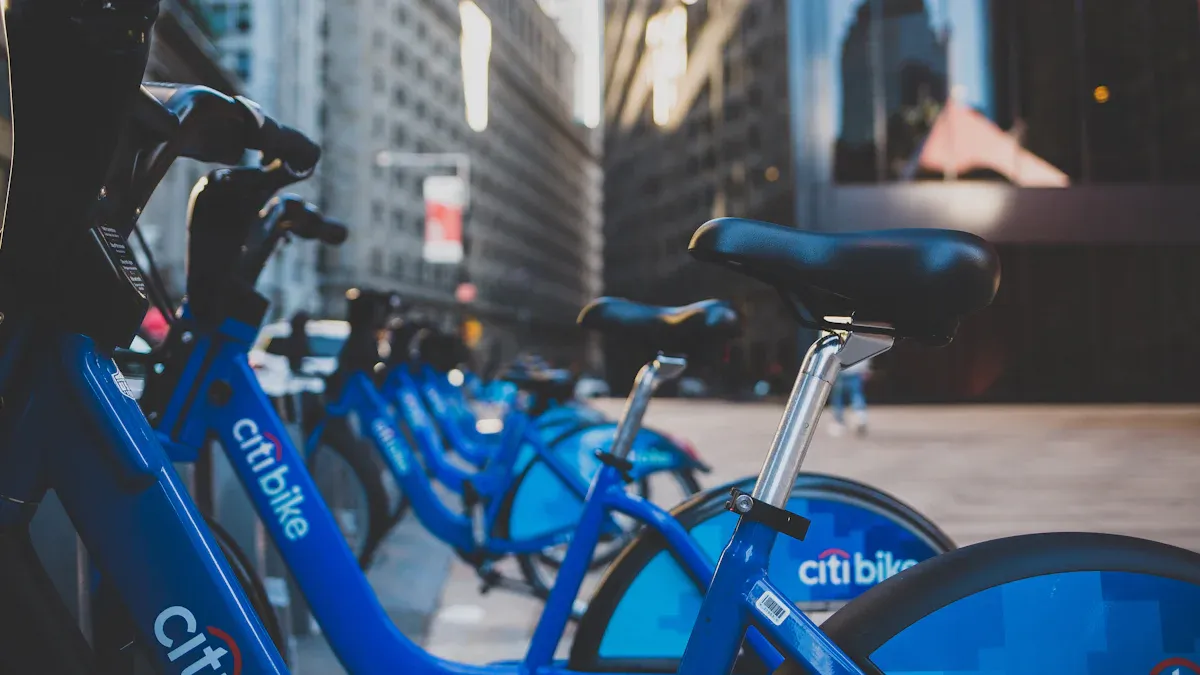
You are witnessing how city bike programs and e-bike sharing are directly transforming urban transport. Many cities around the world are already embracing these solutions.
More than 180 cities offer cargo bike sharing, illustrating how widespread modern city bike systems have become.
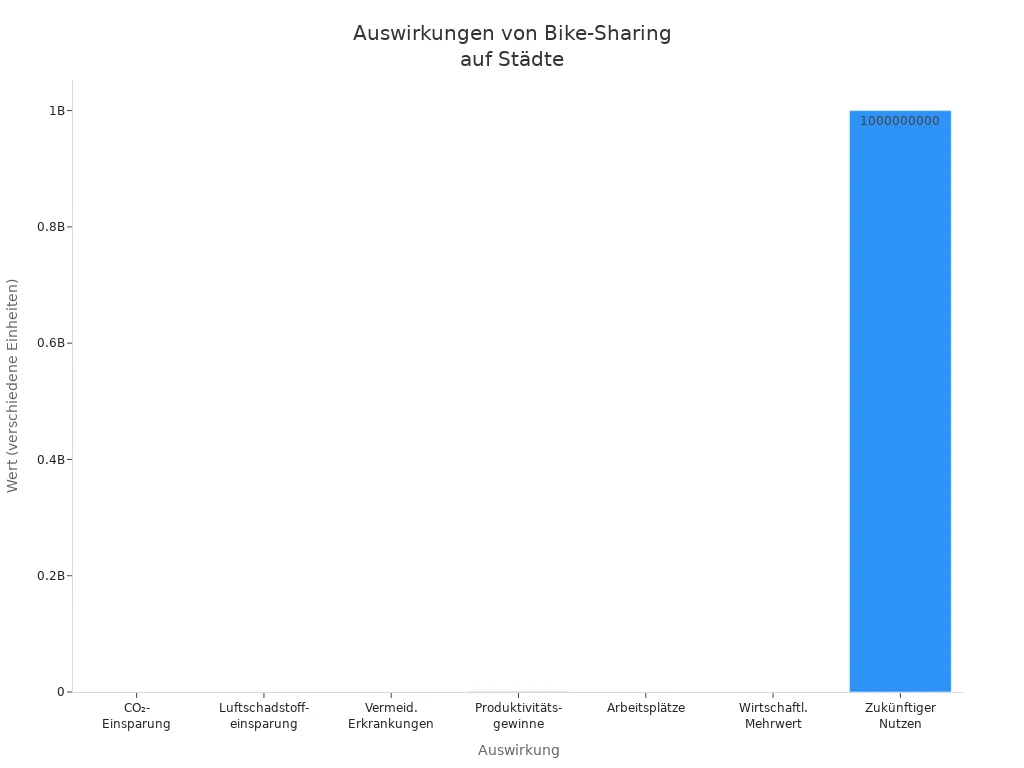
When you use a city bike, you contribute to the reduction of CO₂ and air pollutants. You boost your health and save time in your daily life. The benefits are measurable:
Measurable impacts |
Details |
|---|---|
CO₂ savings |
Bike sharing saves 46,000 tons of CO₂ annually. |
Reduction of air pollutants |
An additional 200 tons of air pollutants are saved. |
Prevention of chronic diseases |
Approximately 1,000 chronic diseases are prevented, leading to savings of 40 million euros in healthcare costs. |
Productivity gains |
Reduced traffic congestion results in 760,000 hours of gained productivity time, worth 30 million euros annually. |
Job creation |
Approximately 6,000 full-time jobs are created through the operation and maintenance of the systems. |
Economic added value |
For every euro invested, there is an annual added value of 1.10 euros. |
Future benefits |
The benefit could rise to around one billion euros per year by 2030. |
You benefit from sustainable mobility, cleaner air, more leisure time, and new jobs.
Key takeaways
City bike and e-bike sharing significantly reduce CO₂ emissions. 46,000 tons of CO₂ are saved annually, contributing to improved air quality.
Regular cycling promotes your health. It lowers the risk of chronic diseases and improves your overall well-being.
Using city bikes supports the local economy. Businesses near bike paths benefit from more customers and increasing demand for bicycles.
A well-developed network of bike paths and modern infrastructure are crucial to the success of bike-sharing systems. Investments in these areas make cycling safer and easier.
The future of urban transport lies in the combination of different modes of transport. Apps help you connect city bikes with buses and trains for greater flexibility.
City bike and e-bike sharing
New mobility
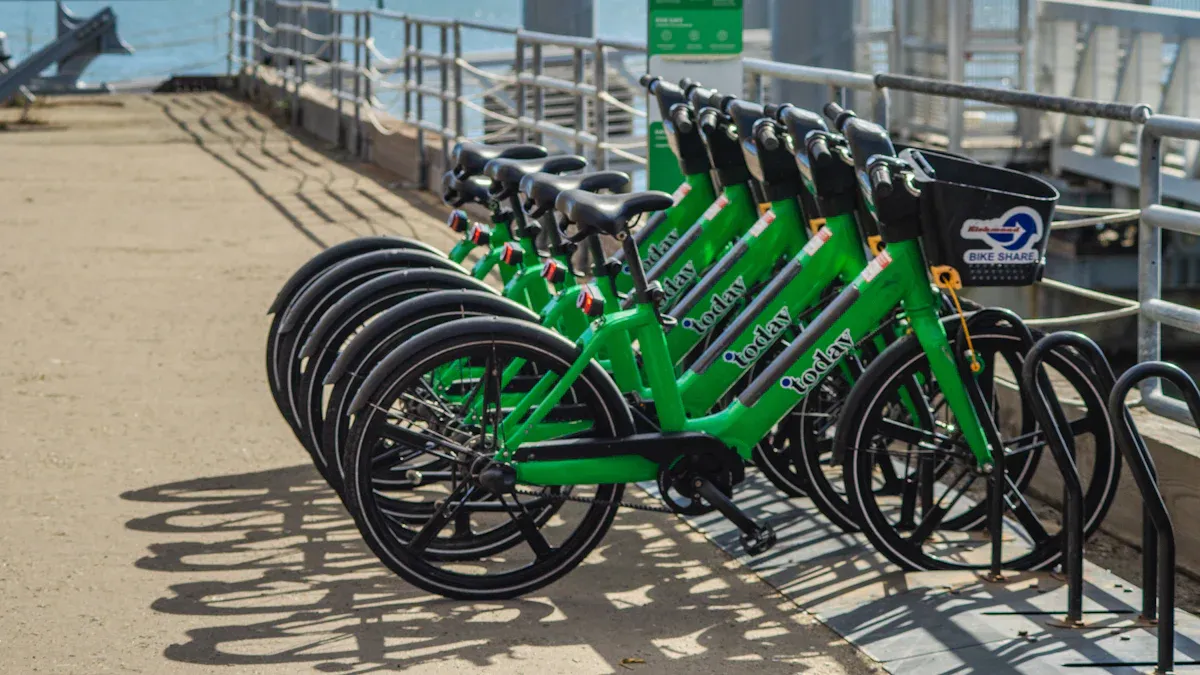
You are experiencing how mobility in your city is changing. With a city bike, you can move through your daily life flexibly and independently. E-bike sharing makes longer distances and steep paths easier. Many people are now consciously choosing to ride a bike. This choice is more than just practical; it shows that sustainable mobility can become a part of your lifestyle.
Regular cycling improves your physical and mental health. You conserve resources and use a means of transport that requires little space. Bicycles blend into the cityscape and make streets more livable.
Cities promote city bike systems because they offer many advantages. You can rent a bike spontaneously and aren't dependent on schedules. This makes you independent and saves time. E-bikes help you tackle longer distances without much effort, allowing you to reach your destination relaxed and in an environmentally friendly way.
Multimodal mix
In large cities, traffic is constantly growing. You know the problem: traffic jams, crowded buses, and poor air quality. This is where the multimodal mix helps. You combine different modes of transport to get to your destination faster and more comfortably. A city bike perfectly complements buses, trains, or cars.
Cycling culture is developing into a true lifestyle choice.
Cities with bike paths and bike sharing promote sustainable mobility.
The share of bicycle traffic is increasing, especially in cities with heavy traffic and air pollution.
Bike sharing provides an annual benefit of 305 million euros in Europe.
It lowers CO₂ emissions and improves people's health.
Combining with other modes of transport makes city bike services particularly successful.
You can already use various apps today to combine your city bike with buses and trains, keeping you flexible and able to choose the best route every time. The future of urban transport is in your hands.
Benefits for cities
Environment and CO₂
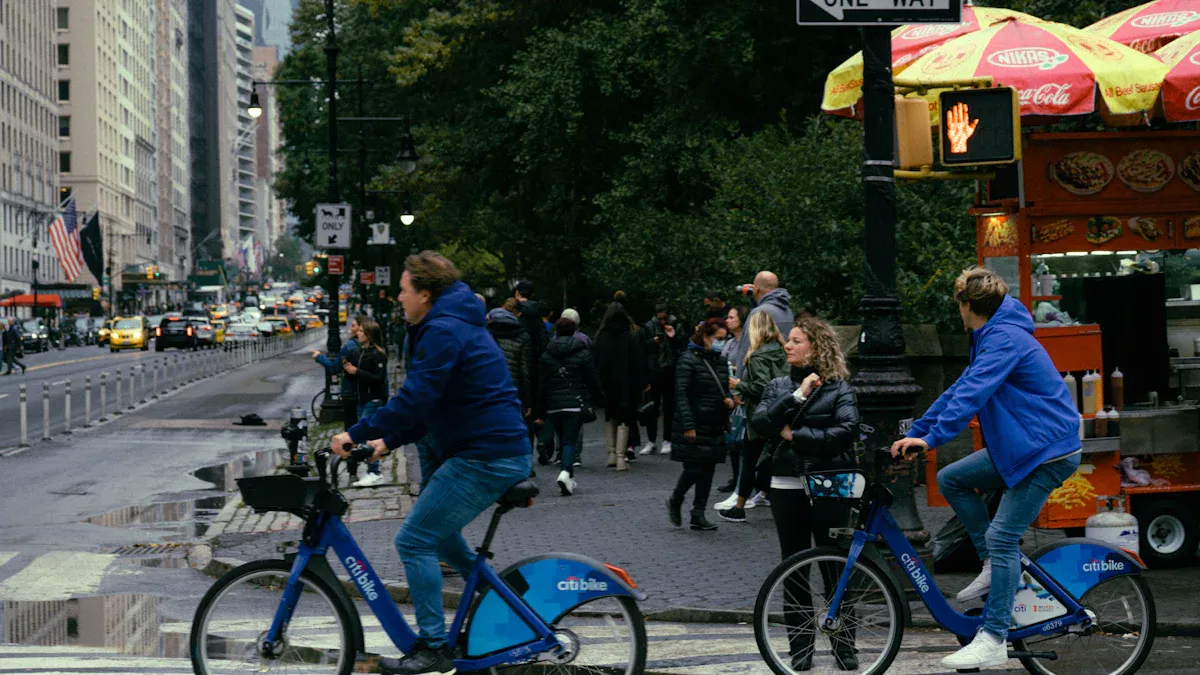
You can make an important contribution to environmental protection with a city bike. When you share a bicycle or e-bike, the number of cars on the road decreases. The sharing economy helps to reduce the number of vehicles. By sharing resources, you protect the environment and the climate. E-bike sharing reduces the need for new vehicles and saves energy.
Fewer cars mean less exhaust fumes and less noise.
Every station-based car-sharing vehicle replaces up to twelve private vehicles.
Environmental impact decreases noticeably.
When you switch to a bicycle, you save CO₂. The following table shows how much CO₂ different modes of transport produce:
Mode of transport |
CO₂ emissions per passenger kilometer |
|---|---|
E-bike |
|
Public transport |
80 grams |
Car |
150 - 170 grams |
You can see that e-bikes and city bikes emit significantly less CO₂ than cars, helping your city reach its climate goals.
Health
You strengthen your health by riding your bike regularly. Bike-sharing systems encourage everyday movement. You improve your cardiovascular fitness and strengthen your immune system. The risk of heart disease, diabetes, and obesity decreases. Physical activity reduces stress and increases your well-being.
Health effect |
Description |
|---|---|
Cardiovascular fitness |
Regular cycling increases cardiovascular fitness. |
Strengthening the immune system |
Cycling strengthens the immune system and lowers the risk of illness. |
Risk of heart disease, diabetes, obesity |
Significant reduction in the risk of heart disease, diabetes, and obesity. |
Mental health |
Physical activity reduces stress and improves general well-being. |
“Bike-sharing is affordable, active, clean mobility that promotes health and reduces noise and pollutant emissions on a large scale. By implementing a public bicycle rental system, a municipality instantly generates thousands of cyclists and makes them visible every day.” – Mareike Rauchhaus, Director of Communications and Public Policy, nextbike
Economy
You support the local economy when you use city bike services. Businesses near bike paths receive more customers. Demand for bicycles, e-bikes, and accessories increases. The cycling industry grows, creating new jobs. Areas with many cyclists become more popular, and property prices in these areas often rise.
Area of impact |
Description |
|---|---|
The programs increase customer traffic for businesses near bike paths. |
|
Demand for bicycles |
There is an increase in demand for bicycles, e-bikes, and accessories, which strengthens the cycling industry. |
Property values |
Areas with many cyclists become more popular, which increases property prices in these areas. |
You can see that city bike programs not only promote the environment and your health but also strengthen your city's economy.
Success criteria
Infrastructure
You can see how good infrastructure determines the success of bike-sharing systems. Wide bike paths, safe parking options, and a dense distribution of stations make renting easy. Cities like Wuppertal show that targeted investments increase the use of city bike services.
Investments in cycling infrastructure make your everyday cycling easier.
Reliable funding and data-driven planning ensure growth.
Expansion of bike paths and integration with public transport are crucial.
Many cities are relying on e-cargo bikes. Freiburg im Breisgau offers you 20 e-cargo bikes in the “Frelo” fleet. Hamburg has increased the number of cargo bikes from 19 to 37 and recorded 3,700 rentals in 2022. Munich and Düsseldorf are also considered pioneers.
Tip: The denser the network of stations, the easier it is to find a bike near you.
Politics and financing
You benefit from political measures and smart financing. Leipzig applied for EU funds to expand mobility hubs. The Alliance 90/The Greens parliamentary group promotes cycling mobility and sustainable transport concepts.
Increase of the compensation amount in the transport service financing contract.
Financing of Bike & Ride spaces.
Mobility stations with e-cargo bikes as a climate-friendly alternative.
Stable political and financial frameworks help you utilize these services and promote the development of new systems.
User-friendliness
You want a system that works simply. A user-friendly app, clear information, and quick rental are important.
A stronger connection to public transport makes switching easy.
Integration into cycling infrastructure ensures short routes.
Electrification of fleets and expansion into new city districts increase attractiveness.
When you rent a city bike, you benefit from modern and flexible mobility. The best systems adapt to your needs and make everyday life easier.
Trends and data
User numbers
You can see how bike sharing is becoming increasingly popular. In many cities, user numbers are rising every year. According to current studies, millions of people regularly use public bicycles and e-bikes. Demand is growing, especially in large cities where traffic often stalls. Many people choose to ride a bike because they save time and stay flexible. Studies by EIT Urban Mobility and EY show that bike sharing saves tens of thousands of tons of CO₂ annually. You contribute to this when you use a city bike.
| Year --- Users (Europe) --- CO₂ savings (Tons) | | 2020 --- 15 million --- 40,000 | | 2023 --- 22 million --- 46,000 |
More and more people are discovering bike sharing as a fast and environmentally friendly solution for everyday life.
Technological progress
You benefit from new technologies in bike sharing. Modern bicycles offer you smart features. Manufacturers are developing compact and high-performance drive systems. Improved batteries enable longer trips and alleviate concerns about running out of power. Many models feature anti-theft protection and assistance systems, especially with e-cargo bikes. Artificial intelligence helps plan maintenance and optimize fleets.
Smart technologies in bicycles
New, compact drive systems
Improved battery technologies for longer distances
Safety features such as anti-theft protection and assistance systems
Artificial intelligence for maintenance and fleet management
You can often find, book, and pay for a bicycle via an app. Mobility as a Service (MaaS) plays an important role. In Zurich, the city tested the "ZüriMobil" app. There, you can find hiking and cycling routes, bikesharing, public transport, taxis, and carsharing in one app. ZüriMobil stations make it easier for you to switch between different modes of transport.
Challenges
You face a number of challenges. Demand is growing, but not all cities offer enough bicycles or stations. Sometimes safe bike lanes are missing. The integration of different modes of transport into one app is not yet possible everywhere. Many people wish for better batteries and more charging points. Fleet maintenance remains a task. You can help by providing feedback and using sustainable offerings.
The future of urban transport depends on how well cities connect technology, infrastructure, and user needs.
Practical Examples
Wuppertal
In Wuppertal, you can see how a city is breaking new ground in e-bike sharing. In the summer of 2018, Wuppertal launched a pilot project for e-bike sharing. For the first time, the city is distinguishing between classic bicycles and e-bikes in urban traffic. The goal is a city-wide network of rental stations for e-bikes and e-cargo bikes. A research team from the University of Wuppertal developed a model that takes the differences between conventional and electric bicycles into account. E-bikes are measurably changing the mobility behavior of people in Wuppertal.
You can use e-bikes to tackle steep paths more easily.
The city wants to serve as a role model nationwide.
The project shows how e-bikes influence traffic.
Wuppertal received a score of 4.3 in the 2022 Bicycle Climate Test. Many users want better conditions for cyclists.
International Comparisons
You can compare the results of bike-sharing programs in various cities. In Germany and Europe, there are major differences in usage and integration into local public transport.
City |
Bikesharing System |
Rentals per bike per day |
Integration into local transport |
|---|---|---|---|
Wuppertal |
No |
N/A |
N/A |
Karlsruhe |
Yes |
High |
Yes |
Mannheim |
Yes |
High |
Yes |
Dresden |
Yes |
Medium |
Yes |
Porto |
No |
N/A |
N/A |
Athens |
No |
N/A |
N/A |
Paris |
Yes |
High |
Yes |
Antwerp |
Yes |
High |
Yes |
Ljubljana |
Yes |
High |
Yes |
You can see that cities with a dense network of bikes and good integration into local transport are particularly successful. International metropolises rely on various factors to make bike-sharing attractive:
You can find bikes everywhere due to a dense network.
Cities collaborate with other mobility providers.
New users can get started easily because the barriers to entry are low.
Providers analyze app data to improve their offerings.
The rental bikes are high-quality and reliable.
Investments in bicycle infrastructure make cycling safer.
As you can see, successful bike-sharing systems are created through good planning, collaboration, and modern technology. International examples show you how cities are promoting sustainable mobility.
Outlook
Future of Urban Transport
You are experiencing how urban transport is changing in the coming years. More and more people are using bicycles and e-bikes because they are flexible and environmentally friendly. Cities are investing in better bike paths and secure parking spaces. You benefit from new technologies that make riding more comfortable. E-bike sharing will continue to grow and offer new possibilities. The future will bring you more safety and comfort on your bike.
Here you can see important developments for urban transport:
| Development --- Description | | Improvement of cycling infrastructure --- Significantly improved cycling infrastructure will make cycling safer. | | Low-emission mobility --- E-bikes play a decisive role as a sustainable mobility solution. | | Comfort and safety --- Future features will increase comfort and safety while riding. |
You can get around the city quickly and easily with a city bike. Cities are focusing on low-emission mobility so that you and other people can live healthier lives. New apps help you combine different modes of transport. You will find more and more services that make your everyday life easier.
Visions
You are helping to shape the future of your city. Visions for sustainable mobility show how you and other people benefit from new solutions. Cargo bikes offer you an ecological alternative to the car, especially for short distances. The integration of cargo bikes increases the quality of life in your environment. You see fewer cars on the roads and more space for pedestrians and cyclists.
Here you will find some visions for sustainable urban mobility:
| Aspect --- Description | | Ecological alternative --- Cargo bikes are an environmentally friendly option compared to the car, especially for short distances. | | Quality of life --- The integration of cargo bikes can increase the quality of life in cities. | | CO2 reduction --- Cargo bikes contribute to the reduction of CO2 emissions. | | Space for pedestrians --- More space for pedestrians and cyclists due to fewer cars in urban traffic. | | Service bikes in the public sector --- Promoting the use of service bikes in the public sector to support sustainable mobility. |
You can actively contribute to making your city greener and more livable. Every trip by bike or e-bike brings you closer to this goal. The vision is a city in which you can move around safely, healthily, and freely.
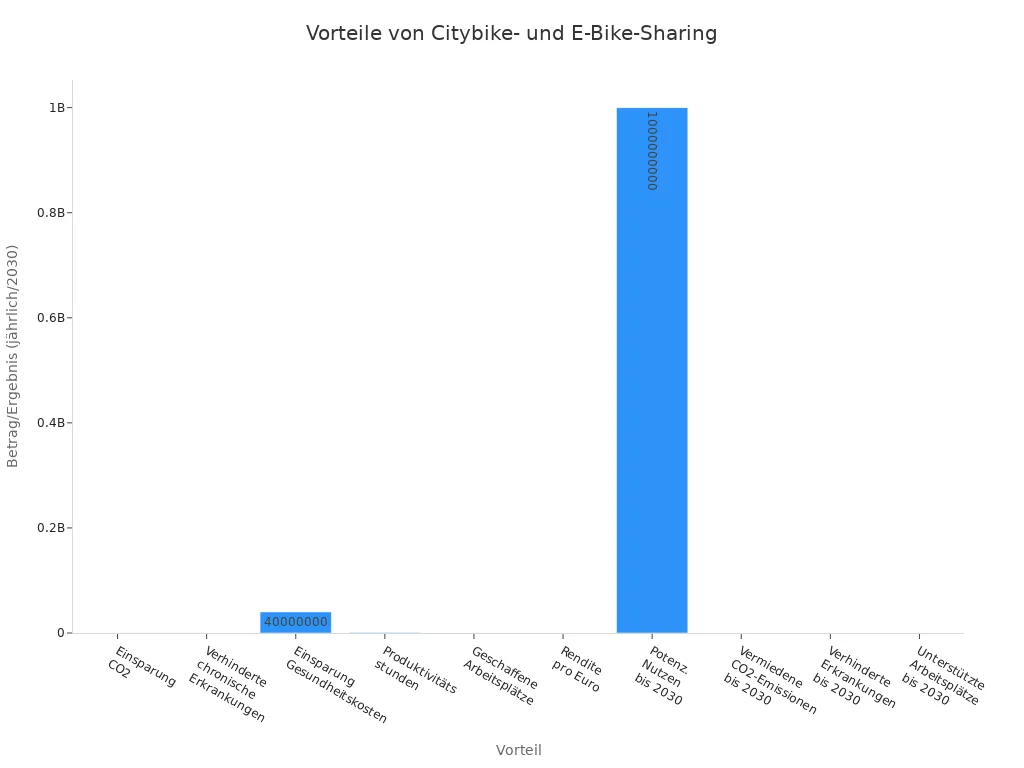
You can see how city bike programs and e-bike sharing are changing your city. You can find the main benefits in the table:
| Benefit --- Amount/Result | | CO2 savings --- 46,000 tons annually | | Prevented chronic diseases --- 1,000 annually | | Healthcare cost savings --- 40 million euros annually | | Jobs created --- 6,000 full-time positions |
You can actively help shape the future. Mobility as a Service makes sustainable mobility even easier for you. Use the benefits and move your city forward! 🚲
FAQ
How does renting a city bike work?
You open the app, search for a station, and select a bike. With one click, you unlock the bike. After your ride, you return it to a station and end the rental in the app.
What does it cost to use e-bike sharing?
Prices vary depending on the provider and the city. Usually, you pay per minute or per hour. Many providers offer daily or monthly tariffs. A brief overview:
Tariff |
Price example |
|---|---|
30 minutes |
€1–2 |
Day ticket |
€8–12 |
Can I also use an e-bike for longer distances?
You can use an e-bike for longer distances. The battery often lasts for 40 to 80 kilometers. You can find charging points at many stations. The app will show you the battery level before booking.
What do I do if the bike is defective?
Report the defect directly in the app. You can leave the bike at the nearest station. The provider will take care of the repair. That way, you help keep the system reliable.
Are city bikes and e-bikes also suitable for children?
Many providers have special bikes for children. You can find information about this in the app or on the website. Pay attention to the recommended height and minimum age.