
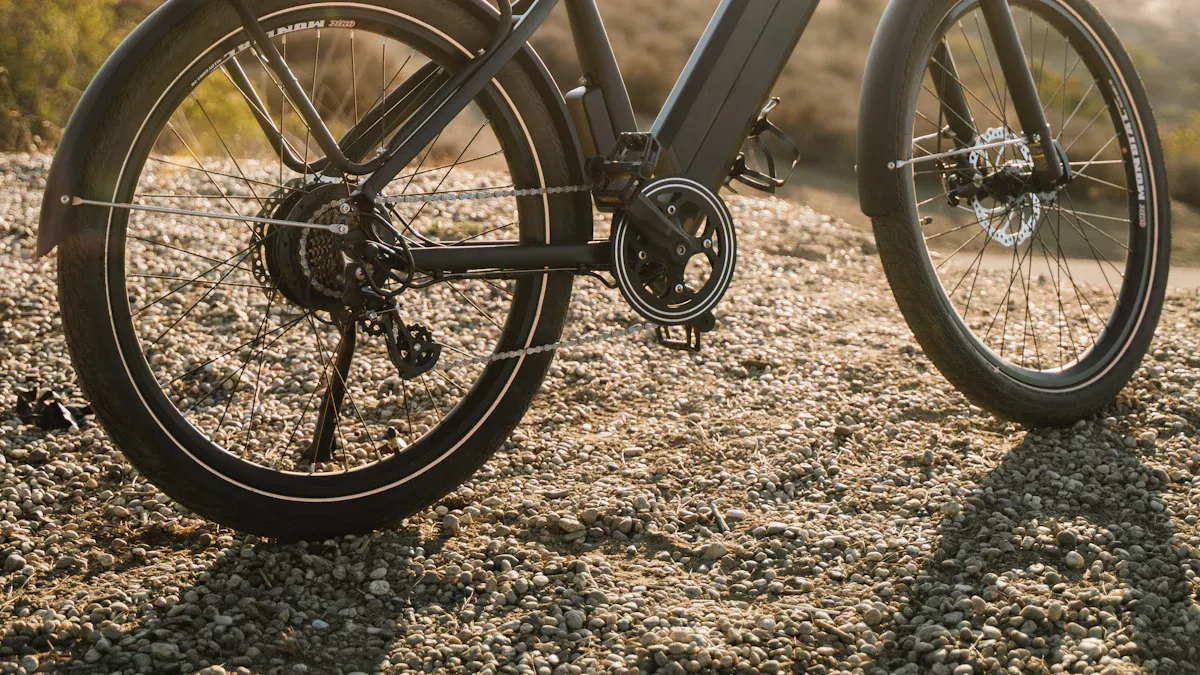
Are you facing the decision of whether an e-mountain bike is right for you? Many beginners wonder what they should look for and which features are important. Perhaps you want assistance on inclines. Maybe the prospect of riding longer and more versatile tours appeals to you. Riding enjoyment for all fitness levels, eco-friendly mobility, and versatility across different terrains also often play a major role. An e-mountain bike can help you strengthen your fitness and discover new paths.
Assistance on inclines
Longer and more versatile tours
Riding enjoyment for all fitness levels
Eco-friendly mobility
Versatility across different terrains
Improved fitness
With the right choice, you can overcome uncertainty and start your adventure immediately.
Key takeaways
E-mountain bikes offer assistance on inclines and enable longer tours, increasing riding enjoyment for beginners.
Choosing the right type, such as a hardtail or full-suspension, affects comfort and handling off-road.
Pay attention to motor power and battery capacity to ensure your bike is suitable for your riding needs.
A test ride is crucial to finding the right e-mountain bike and testing the feel of the ride.
Regular maintenance and care extend the lifespan of your e-mountain bike and ensure more safety while riding.
What is an e-mountain bike?
Definition
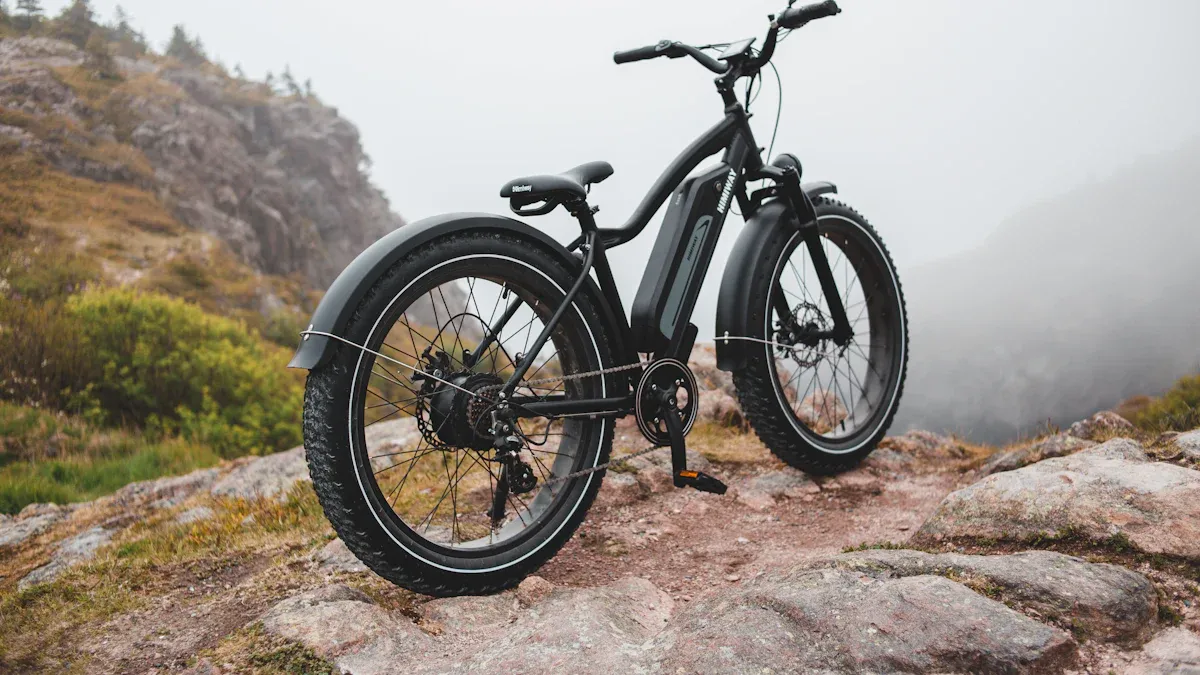
You might be wondering what an e-mountain bike actually is. Essentially, it is a mountain bike with an integrated motor. This motor assists you while pedaling and makes riding easier, especially when you want to climb steep hills. To better understand the differences, take a look at this table:
Feature |
E-Mountain Bike |
Conventional Mountain Bike |
|---|---|---|
Motor assistance |
Integrated motor that amplifies power |
No motorized assistance |
Speed |
Assistance up to 25 km/h |
No speed limit |
Types |
Various types based on motor and usage |
Mainly based on travel and efficiency |
With an e-mountain bike, you can cover longer distances and master challenging terrain. The motor helps you when your legs get tired or you simply want more fun on your ride.
Benefits for beginners
Are you new to mountain biking? An e-mountain bike offers many benefits that make starting easier. Here are a few reasons why beginners often choose an E-MTB:
You get around faster than with a normal bicycle.
You need less physical effort to cover the same distance.
Technical terrain becomes easier, allowing you to enjoy beautiful tours.
:
Tip: With an e-mountain bike, you can ride on almost any surface. Steep inclines are no problem, even if you still have little experience.
Many beginners report that they feel safer on an e-mountain bike. You can focus on the ride and worry less about your fitness level. The electronic support ensures that you can manage longer outings without becoming overly exhausted. This allows you to explore new paths and have more fun with the sport.
E-mountain bike types
You have likely already noticed that there are many different types of e-mountain bikes. Each type has its own strengths and is suitable for different purposes. Take a look at this overview to get a better impression:
Description |
|
|---|---|
Full-suspension e-mountain bike |
Both ends are suspended, ideal for uneven terrain. |
Rigid e-mountain bikes |
No rear suspension, lighter and more efficient on flat terrain. |
Hardtail e-mountain bikes |
Front suspended, rear rigid, for less demanding terrain. |
E-MTB Cross Country (XC) |
For longer distances, emphasizing speed and efficiency. |
Trail E-MTB |
Versatile, suitable for various types of terrain. |
Enduro E-MTB |
Technically demanding, for fast descents. |
Downhill (DH) E-MTBs |
Specifically for downhill, large forks and high travel. |
Fatbike E-MTBs |
Wide tires for soft or unstable surfaces. |
All-Mountain E-MTBs |
Combines features of trail and enduro bikes, versatile in use. |
Hardtail
Are you looking for a light and uncomplicated bike? Then a hardtail might be just right for you. Hardtail e-mountain bikes only have front suspension. This makes them particularly lightweight and low-maintenance. Many riders use hardtails on forest, field, and woodland trails. You can also use them for everyday life, for example, for commuting to work or running errands.
Benefits of a hardtail e-mountain bike:
Lower weight
Less maintenance required
Tip: If you are just starting with mountain biking and primarily ride on paved or groomed paths, a hardtail will suit you well.
Full-suspension
Do you want more comfort and safety off-road? Then you should take a look at a full-suspension e-mountain bike. These bikes have suspension in the front and back. This provides more stability and comfort, especially when riding on rough trails.
Benefits of a full-suspension e-mountain bike:
E-support on climbs
Stability on rough terrain
Assistance on technically demanding trails
Assistance on high-speed descents
Hard to imagine without full suspension in some disciplines
With a full-suspension e-mountain bike, you can master even difficult routes and feel safe, no matter how demanding the terrain is. You can fully concentrate on the adventure and worry less about bumps or uneven ground.
Technical features
Motor
The motor is the heart of your e-mountain bike. It ensures that you can effortlessly master even steep climbs. There are various types of motors that differ in their position, riding feel, and price. Check out this overview:
Hub Motor |
Mid-drive Motor |
|---|---|
Position |
in the rear wheel |
Riding experience |
direct, powerful |
Maintenance |
simple, less wear |
Price |
often cheaper |
Suitable for |
flat routes, higher speeds |
For beginners, a mid-drive motor is often suitable. It feels more natural and helps you especially on terrain. Most e-mountain bikes for beginners have a nominal continuous power of 250 watts. This is completely sufficient for most tours. There are also stronger motors with up to 750 watts, which provide advantages especially in challenging terrain. The 250-watt rating refers to the European test standard and does not say everything about the actual power. Do not let that confuse you – for starting out, a 250-watt motor is usually ideal.
Battery
Nothing works on an e-mountain bike without a battery. The capacity of the battery determines how far you can go on a single charge. Here is a brief overview:
Battery Capacity (Wh) |
Impact on Range |
|---|---|
400 |
Shorter rides without recharging |
750 |
Longer rides without recharging |
For beginners, a battery with 400 to 500 Wh is often enough. You can undertake many tours with this without constantly needing to recharge. If you are planning longer excursions or want to play it safe, choose a larger battery. Fully charging a battery takes an average of between 5 and 9 hours. It is best to charge the battery overnight so your bike is ready for action the next day.
Tip: Pay attention to how easily the battery can be removed and reinserted. That makes charging in everyday life much easier!
Suspension
The suspension ensures that you are comfortable and safe even on bumpy paths. There are various systems that influence handling:
Suspension System |
Description |
Influence on handling |
|---|---|---|
Single-pivot |
Supported single-pivot with linkage that influences the leverage ratio. |
Reduces harmful lateral forces, lowers center of gravity. |
Four-bar linkage |
Double swingarm where the rear wheel rotates around a virtual pivot point. |
Provides stability and control, especially on uneven terrain. |
Patented systems |
Exclusive systems that differ in design and choice of material. |
Determines the riding characteristics and unique identity. |
For getting started, simple suspension is often enough. It makes riding more pleasant and gives you more security, especially if you do not have much experience on terrain yet.
Weight
Weight plays a major role with an e-mountain bike. Most entry-level models weigh between 20 and 30 kilograms. A higher weight provides more stability and security, especially on fast descents or uneven surfaces. You feel safer because the bike lies more firmly on the ground. However, in tight turns or when carrying the bike, the extra weight can also be a hindrance. Consider where you ride most often and what weight is still comfortable for you.
Average weight: 20–30 kg
More weight = more stability
Less agile in tight turns
Tip: Try out different models. That way you will find out which weight suits you best!
Frame and size
Frame material
You are facing a choice: which frame material suits you? The decision affects the weight, stability, and price of your e-mountain bike. Look at the most important materials and their characteristics:
Frame Material |
Benefits |
Drawbacks |
|---|---|---|
Aluminum |
Lightweight, robust, hardly rusts |
Less stiff |
Carbon |
Very light, high stiffness, does not rust |
Vulnerable in crashes, expensive |
Titanium |
Durable, low-maintenance, medium stiffness |
Very expensive, complex manufacturing |
You often find aluminum on entry-level bikes. It is light and can withstand a lot. Carbon feels particularly sporty. You feel the stiffness and low weight immediately, but carbon is vulnerable in crashes. Titanium is rare but extremely durable. However, it costs significantly more.
Tip: If you are just starting out, an aluminum frame is usually sufficient. You save money while still getting a robust bike.
Frame Size
The right frame size ensures comfort and safety. You want to ride in a relaxed way and maintain control at all times. Here is how to find the right size:
Measure your inseam: Stand up straight. Take a yardstick and a book. Measure from the floor to your crotch.
Measure your arm length: Let your arm hang loosely. Measure from your shoulder to your wrist.
Measure your height: Your body height is important. Also pay attention to the ratio of leg length to torso length.
The frame size directly affects how you sit on the bike. The wrong size can lead to posture problems. You should be able to reach the ground quickly with your feet. This gives you confidence, especially off-road.
The seating position determines how secure you feel.
A high reach value forces you to stretch far forward. This can make control more difficult.
An upright seating position is often more comfortable and safer.
Note: Try out different frame sizes. You will immediately feel whether you are comfortable and can control the bike well.
Riding Style and Terrain
Types of Terrain
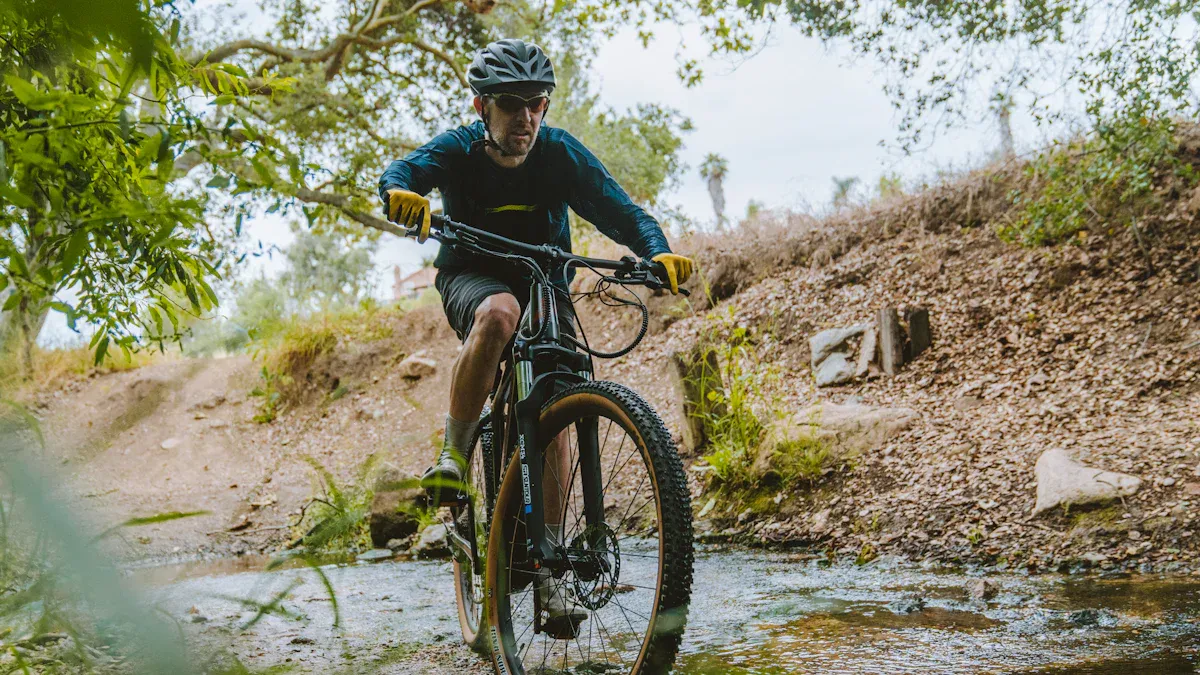
You might be wondering where you can ride your E-Mountain bike. The answer: almost anywhere! E-Mountain bikes are true all-rounders. They are comfortable on many surfaces. Here is an overview of the most popular types of terrain:
On a root-covered forest path.
They are also suitable for forest paths and trails.
Gravel roads are also easy to ride on.
They offer good performance on paved roads.
An E-Mountain bike (E-MTB) turns any terrain into a bike path. Uphill and downhill rides are best handled with an E-MTB because it is designed so that you maintain control at every moment, even on difficult terrain and under high stress on the trail.
So, you can decide for yourself whether you prefer riding through the forest, climbing steep mountains, or simply cruising comfortably on asphalt. The motor assistance helps you master even difficult passages. This allows you to discover new paths and always feel good on the bike.
Riding Style
Your riding style plays a major role in choosing the right E-Mountain bike. Consider how you prefer to ride. Do you like fast descents, technical trails, or relaxed tours? Depending on how you ride, you need a different bike.
The riding style influences the frame geometry, suspension travel, tire size, and motor power of your E-Mountain bike.
Different riding styles require different bike configurations so that you are always optimally set up.
The choice of the right mountain bike depends heavily on the terrain you ride most frequently.
If you like riding sportily and fast, you should look for a bike with plenty of suspension travel and a powerful motor. If you love relaxed tours, a lighter model with less suspension is often sufficient. Always remember: your riding style decides which E-Mountain bike fits you. Try out different models and find out what is most fun for you! 🚵♂️
Price and Budget
Price-Performance Ratio
You are probably wondering how much you should spend on your first E-Mountain bike. Prices for entry-level models are usually between 2300 and 3000 euros. Many good models are available from as little as 2500 euros. If you want a full-suspension bike, you should expect to pay at least 3000 to 4000 euros. Hardtails are cheaper and offer plenty of riding fun for less money.
"You have to invest at least 2300 euros for a good E-MTB."
When it comes to the price-performance ratio, it is not just the price that counts. You should also pay attention to the equipment. Mid-range models often offer you the best balance of price and performance. They usually have a mid-drive motor, a larger battery, and better suspension. High-quality components ensure more safety and comfort.
Here you can see what influences the price:
Motor type and performance – A powerful motor costs more but gives you more support.
Battery capacity – A larger battery increases the range, but also the price.
Frame material – Aluminum is cheaper; carbon and titanium are more expensive.
Components – High-quality brakes, gears, and suspension make the bike more expensive, but also better.
An E-Mountain bike often offers you more options than a regular mountain bike. You get more power and can go on longer tours.
Follow-up Costs
The purchase is just the beginning. You should also keep an eye on the ongoing costs. Here is an overview of the most important follow-up costs:
Type of Cost |
Description |
Estimated Costs |
|---|---|---|
Electricity costs |
Charging the battery (400-500 Wh) |
13-15 cents per charge |
Battery replacement |
New battery after approx. 700 charge cycles |
approx. 1 euro per charge |
Wear parts |
Chain, sprockets, brakes, tires |
20-100 euros per year |
Maintenance and care |
Cleaning, annual inspection |
up to 130 euros per year |
Insurance |
Liability for S-Pedelecs |
approx. 50 euros annually |
Comprehensive insurance |
Additional insurance for S-Pedelecs |
75-120 euros annually |
E-Mountain bikes require more maintenance than normal mountain bikes. The motor and the heavier weight put more strain on the parts. Brakes and chains wear out faster. Repairs and battery replacements also cost more. The technology in the E-bike makes maintenance more complex.
Tip: Budget for these costs from the very beginning. This way, you won't face any nasty surprises and will enjoy your bike for a long time! 🚲
Test Ride and Purchase
Test Ride
Do you have an E-Mountain bike in mind? Then you should definitely take a test ride. This is the only way to find out if the bike really suits you. While riding, you will immediately feel how the weight sits and whether the components meet your expectations. You can test different models and quickly notice which handling behavior is the most fun for you.
An E-bike is a major purchase. Before you buy one, you should therefore test it extensively on a test ride. Electric bicycles differ in terms of their motor types, batteries, riding and starting behavior, suspension comfort, and, just like their relatives without an electronic assist motor, also in their bicycle type or intended use.
Many bikes look similar at first glance. But you can feel the differences when riding. You can find out whether the bike supports your riding style and whether you feel safe. A test ride helps you understand the variety of E-Mountain bikes. You get a feel for the handling and the technology. This is how you make a decision that truly fits you.
Why is a test ride important?
You test the riding behavior and components.
You get a feel for the weight and your riding style.
You identify differences that are not obvious in theory.
You find the model that suits you best.
Take your time for the test ride. Ride on different routes and pay attention to how the bike reacts on various surfaces. This ensures you make the right choice.
Choosing a Dealer
Do you want to find the perfect E-Mountain bike? Then the dealer plays a big role. A good dealer offers advice, service, and the opportunity for a test ride. Online direct-sellers often attract customers with low prices, but service is usually limited there. On-site, you can try out different models and get support during the selection process.
Make sure that the dealer has service partners or brand stores near you. This ensures you are well looked after even after the purchase. Arrange a free test ride and check whether the bike really meets your needs. Do not let price be your only guide. Take your time with your decision. A good dealer will help you find the right model and will be there for you if you have any questions later on.
Tip: A personal conversation with the dealer can alleviate many uncertainties. You get answers to your questions and can test the bike directly. This is how you find the E-Mountain bike that really suits you! 🚲
Maintenance and Care
Maintenance Tips
Do you want to enjoy your E-Mountain bike for a long time? Then you should perform small maintenance tasks regularly. You can do many tasks yourself. They help you keep your bike safe and reliable.
Battery care: Never charge the battery in freezing temperatures. It is best to store it at about 60% charge. Occasionally clean the contacts with a dry cloth.
Chain and drive: Clean and lubricate the chain every 200 to 300 kilometers. Check if it is worn out. Do you have a belt drive? Then water is enough for cleaning. Check the tension regularly.
Brakes: Take a look at the brake pads. If they are worn down, you should change them. Also check the hydraulics so that you can always brake safely.
Motor and drive: Listen for unusual noises. Check if everything is tight and no cables are loose.
Tires and wheels: Check the spoke tension. Pay attention to the tire pressure and the tread of the tires.
Only regular maintenance protects your valuable E-bike from corrosion and harmful impurities in the long term, thereby ensuring the functionality of all important components.
With these checks, you can identify small defects early. This allows you to avoid expensive repairs and extend the life of your bike. A well-maintained E-bike is also much safer to ride.
Care Instructions
Proper care keeps your E-Mountain bike fit and ensures more riding fun. Keep your bike clean and dry. After every ride, it is best to remove dirt and moisture. This protects the frame and electronics from rust.
Take care of the chain and gears regularly.
Make sure the tire pressure is correct.
Check the lighting so you are always clearly visible.
Tip: Before every ride, check the brakes, the condition of the tires, and the lighting. That way you are always riding safely! 🚲
With a little attention, your E-Mountain bike will remain reliable and ready for every adventure.
You now have a good overview. When making your choice, pay attention to important factors such as motor power, battery capacity, frame material, suspension, and brake systems. Wider tires and sensitive suspension provide more safety and riding fun.
Start with these steps:
Check the motor and battery.
Consider how you want to ride.
Test different models on a test ride.
That is how you find the E-Mountain bike that fits you perfectly! 🚵♀️
FAQ
How far can I go on one battery charge?
The range depends on the battery, the terrain, and your riding style. Usually, you can manage 50 to 120 kilometers. If you ride many mountains, the range decreases. On flat routes, the battery lasts longer.
Do I need to be able to ride the E-Mountain bike without the motor?
Yes, that is possible! You can use the bike like a normal mountain bike. However, it will be heavier without motor assistance, especially on inclines. For short distances, it still works well, though.
How often should I have my E-Mountain bike serviced?
You should have your bike serviced every 500 kilometers or at least twice a year. Regularly check the chain, brakes, and battery. Small checks before every ride increase safety.
Can I ride my E-Mountain bike in the rain?
Yes, you can ride in the rain. The electronics are protected. Dry the bike after your ride. This prevents rust and extends the service life.
Do I need special insurance for my E-Mountain bike?
For normal E-Mountain bikes (up to 25 km/h), you do not need insurance. An S-Pedelec requires liability insurance. Theft insurance is always worthwhile if you often leave your bike outside.