
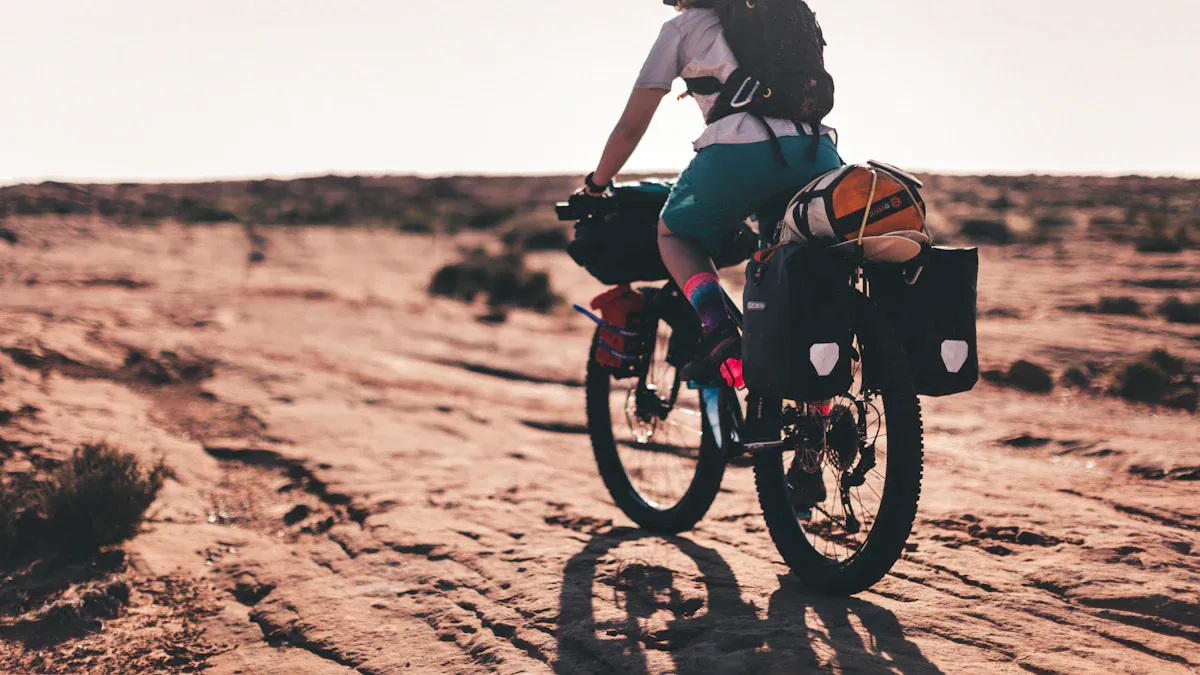
You might be wondering what really matters in bikepacking. The most essential equipment is a lightweight, sturdy bike with cleverly distributed bags. Compared to classic cycle touring, you rely on compact bags on the frame, handlebars, and saddle instead of heavy luggage racks.
Classic cycle touring |
Bikepacking |
|---|---|
4–6 large panniers on the luggage rack |
Compact bags on the frame, handlebars, and saddle |
Lots of storage space, but heavy & bulky |
Minimal luggage, lightweight & agile |
Good for asphalt & long, comfortable tours |
Ideal for adventure, off-road, and flexibility |
More dead weight, less agility |
Reduced weight, more sense of adventure |
Bikepacking is suitable for anyone who wants to travel independently. You can spontaneously discover new paths and experience true adventures both in the city and off the beaten path.
Key Insights
Choose a lightweight and sturdy bike that suits your adventure. Gravel bikes are ideal for versatile routes.
Pack your gear in compact bags on the frame, handlebars, and saddle. Pay attention to good weight distribution for stability.
Plan your route carefully. Use apps like Komoot or Outdooractive to find suitable paths and make navigation easier.
Ensure you have the right clothing for all weather conditions. Functional clothing keeps you dry and warm during your tour.
Be prepared for breakdowns. Keep essential tools and spare parts handy to resolve minor issues yourself.
Bikepacking Gear
Bags & Luggage
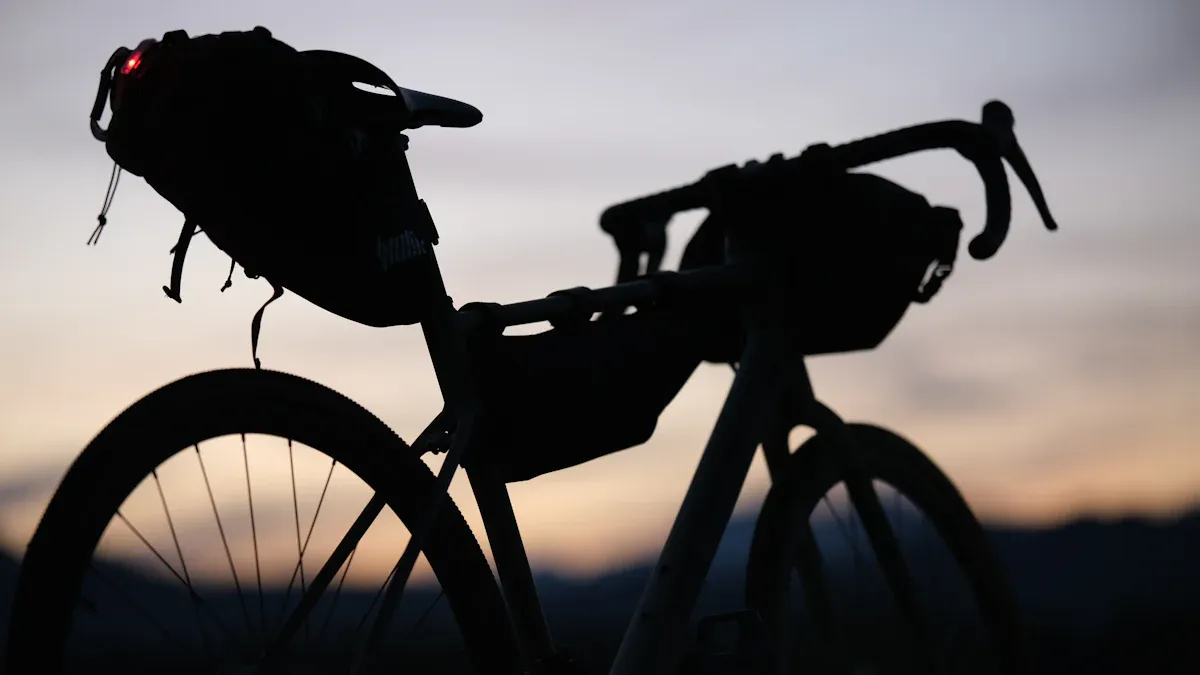
For bikepacking, you need special bags that attach directly to the bike. You distribute these bags across the frame, handlebars, and under the saddle. Good weight distribution is very important. If you have too much weight in one place, the bike becomes unstable. It is best to pack heavy items like tools or food in the frame triangle. Lighter items like clothing go up front on the handlebars. You can attach sleeping gear to the back of the saddle.
Heavy and firm items belong in sturdy bags.
Bags without a fixed shape should be packed tightly so they do not slip.
With this method, your bike remains agile and you have everything within reach. This allows you to ride safely even on narrow paths or in the city.
Choosing a Bike
For bikepacking, it is best to choose a bike that fits your adventure. Many use a gravel bike because it is lightweight and handles many types of paths well. Mountain bikes and fat bikes are also options. The following table shows you the most important differences:
Bike type |
Advantages |
Disadvantages |
|---|---|---|
Mountain bike |
Very good off-road capability, comfort due to suspension and wide tires, robust construction, many mounting points |
Heavy, less efficient on asphalt, less space in the frame triangle |
Gravel bike |
Fast on the road, stable off-road, versatile, low weight, many mounting options |
Less comfort on rough terrain, no suspension travel |
Fat bike |
Traction on snow, sand, and mud |
Heavy, slow, and sluggish |
A good gravel bike for bikepacking should have these features:
Upright riding position
Sturdy frame construction
Mounting points for bags
Low center of gravity for more stability
Wide tires (45 to 50 millimeters) for comfort and good grip
You will benefit from a versatile bike that works on different surfaces. Make sure there is enough room for bags and sensible equipment.
Clothing
The right clothing protects you in any weather. You should choose functional clothing that dries quickly and keeps you warm. The following table helps you find the right clothing for every season:
Body area |
Spring |
Summer |
Autumn |
Winter |
|---|---|---|---|---|
Head (incl. helmet) |
Under-helmet cap |
Summer cap / headband |
Under-helmet cap |
Thermal under-helmet cap / balaclava |
Upper body |
Base layer (short or long) |
Sleeveless base layer (optional) |
Base layer (short or long) |
Thermal base layer |
Legs |
Cycling underwear (shorts) |
Cycling underwear (shorts) |
Cycling underwear (long) |
Thermal cycling underwear (long) |
Hands |
Full-finger gloves |
Summer gloves / half-finger |
Full-finger gloves |
Winter gloves |
Feet |
Cycling socks |
Thin cycling socks |
Long cycling socks |
Thermal cycling socks |
With this gear, you stay dry and warm, whether you're riding in the city or off-road.
Sleeping Systems
Every gram counts when bikepacking. Therefore, you should look for lightweight and compact sleeping systems. Sleeping bags with a small pack size fit well in your bags. Quilts are even lighter because they lack a back section and a zipper. Down sleeping bags are particularly popular because they are very warm and lightweight.
Down sleeping bags provide a comfortable sleep environment and are warmer than synthetic models.
Quilts save weight and space.
You can choose between a bivy sack and a tent. A bivy sack is very light (about 150 grams) and quickly ready for use. It protects your sleeping bag and keeps you warm, but you have less privacy and less protection in bad weather. A tent offers more comfort and storage space but weighs more.
Tools & Spare Parts
You should always have the most important tools and spare parts with you. This allows you to handle small repairs yourself and continue your bikepacking tour. Pros recommend:
Tools for loosening the axles (e.g., Allen key, wrench)
Tire levers
Repair kit for tubes or tubeless
Mini pump with pressure gauge or CO2 cartridge
Spare tube or sealant for tubeless
Chain link and chain links
Spare brake pads and shift cable
Multi-tool with chain breaker
Spoke wrench
Cable ties, duct tape, superglue
Pocket knife and rag
Many report that they have hardly any breakdowns on long bikepacking tours. Nevertheless, you should be prepared, as conditions can change quickly.
With this equipment, you are prepared for any adventure. You can react flexibly and enjoy your tour.
Bikepacking Routes
City Adventures
Do you want to discover cities by bike? In Germany, you will find many exciting routes that take you through well-known places. These paths are particularly suitable for beginners and offer you many opportunities to experience culture and nature. Here are some of the most popular urban bikepacking routes:
Tour Brandenburg: A 1,116 km circuit that leads you through 31 cities. Perfect if you want to see a lot.
Radweg Deutsche Einheit: You cycle 1,157 km from Bonn to Berlin, passing through seven federal states.
Baltic Sea Coast Cycle Route: This route runs 1,096 km along the Baltic coast. You can enjoy fresh sea air and beautiful views.
Mittellandroute: A demanding tour with 1,059 km and over 8,000 meters of elevation gain. You will need endurance here.
Rhine Cycle Route: You follow the Rhine for about 1,320 km and discover many historic cities.
Tip: Plan your daily stages so that you have enough time for breaks and sightseeing. In cities, you will often find accommodation and food.
Off-Road Routes
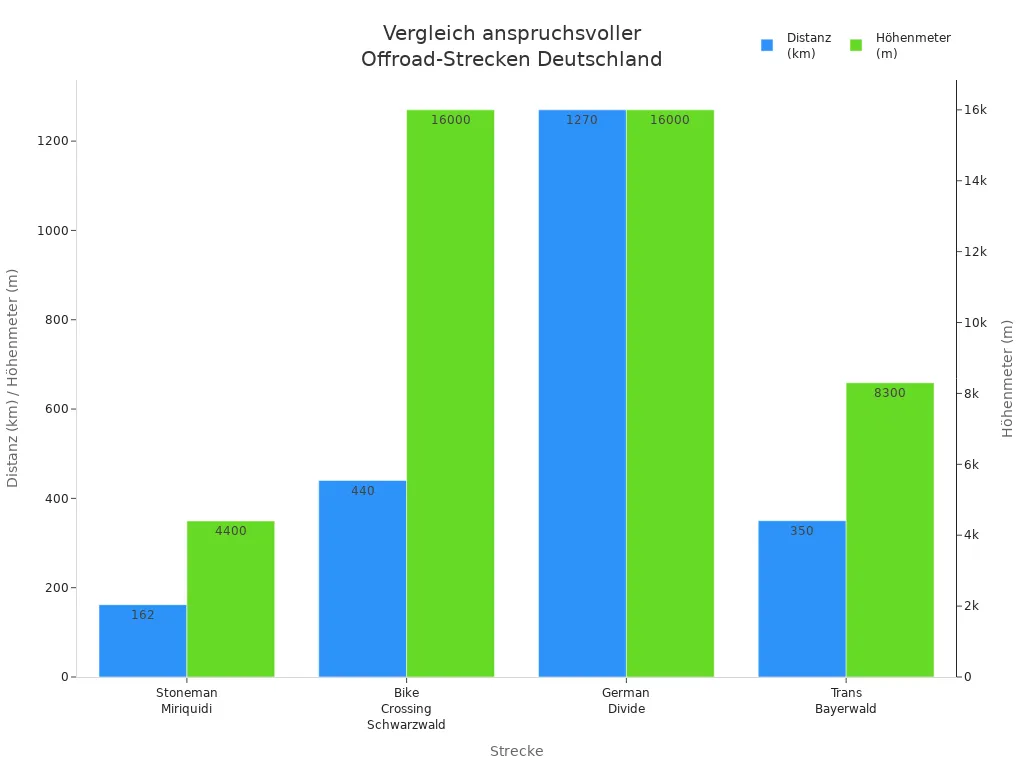
Are you looking for a challenge off the beaten path? In Germany, there are many demanding off-road routes that take you through forests, mountains, and nature parks. These tours demand more from you but offer a real adventure. The following table shows you some of the most famous off-road routes:
Route |
Duration |
Distance |
Elevation |
Description |
|---|---|---|---|---|
Stoneman Miriquidi |
1 - 2 days |
162 km |
4,400 m |
One of the most famous bikepacking routes, requiring technical skill and fitness. |
Bike Crossing Schwarzwald |
7 - 8 days |
440 km |
16,000 m |
A continuously signposted route that leads from Pforzheim to the Swiss border. |
German Divide |
12 - 14 days |
1,270 - 1,300 km |
16,000 - 18,000 m |
A demanding tour with challenges like root passages and fallen trees. |
Trans Bayerwald (North/South) |
7 days |
350 km |
8,300 m |
Offers two routes through the Bavarian Forest with well-known mountain bike hotspots. |
If you decide on an off-road route, you should be well prepared. Here are some important points to keep in mind:
You need good equipment.
Your bike must be in perfect condition.
Always wear the right protective gear.
Take enough water and snacks with you.
A map or GPS device will help you with orientation.
A cell phone is important in case you need help.
Note: Off-road routes are often more strenuous than urban routes. Plan enough time for breaks and check your gear regularly.
Navigation
Good navigation is very important when bikepacking. It makes it easier to find your way and discover new routes. Many bikepackers use special apps that help with planning and on the go. Here are the most popular navigation apps:
Komoot: This app is particularly popular with gravel and bikepacking fans. You can easily plan tours and use them offline.
Outdooractive: Ideal for long tours. The app provides precise maps and elevation profiles.
Ride with GPS: Many pros use this app. It offers simple operation and detailed route planning.
Tip: Download your maps before the tour. This way, you'll always be safe on your journey, even without internet access.
With the right navigation, you will always find the best way – whether in the city or off-road.
Tour Planning
Route Selection
Choosing your route is crucial to the success of your bikepacking trip. First, you should consider how much experience you have. Beginners benefit from simple, flat routes. More experienced riders can venture onto more challenging paths with more inclines.
Use online platforms like Komoot or Outdooractive to find suitable routes.
Look for bike paths, campsites, and points of interest along the route.
Plan accommodation in advance, such as youth hostels or bike-friendly guesthouses.
Tip: Many inclines and difficult terrain will cost you more time and energy. Flat, well-paved paths are easier to plan and ride.
Overnight Stays
You have many options for where to sleep while on the road. Choose the option that best suits your adventure:
Hostels and youth hostels are affordable and practical.
Couchsurfing connects you with locals.
Managed mountain huts are suitable for groups.
Camping or trekking sites allow for nights close to nature.
You can often find trekking sites in beautiful areas. They offer basic facilities such as toilets and fire pits. On the website “bettundbike.de,” you can find many bike-friendly accommodations that are certified by the ADFC.
Nutrition
The right nutrition keeps you fit and motivated. You should always carry enough water and high-energy snacks.
Take a water filter or purification tablets with you if you have to use water from streams or lakes.
An extra hydration bladder helps on long, dry sections.
Lightweight stoves like gas or spirit burners are practical for warm meals.
Nuts, dried fruit, and protein bars provide plenty of energy and weigh very little.
Tip: Use apps to find public water points and plan your daily stages so you can refill your water regularly.
Safety & Tips
Breakdown Assistance
You will sometimes experience minor breakdowns on your tour. With the right knowledge and tools, you can solve many problems yourself. Check your bike before every ride. Inspect the brakes, tire pressure, and the chain. Cycling gloves protect you from shocks and vibrations during repairs. They provide a better grip on the handlebars and protect your hands from cold, wet, and UV rays. A bike helmet protects your head in the event of a fall. Reflectors and lights on the helmet increase your visibility, especially in the dark. Choose waterproof bike bags to keep your luggage dry in the rain.
Tip: Practice changing an inner tube and patching a tire at home. That way, you will be back on the road faster when you're out.
Weather & Emergencies
The weather can change quickly. You should always be prepared. Start with lightweight clothing so you don't overheat. Pack extra layers like arm and leg warmers. Put them on or take them off as needed. In the mountains, there are often large temperature differences. Pay attention to your surroundings and adjust your clothing accordingly. Windproof jackets protect you in changeable weather. Always keep an eye on the sky and look for a safe shelter during thunderstorms.
Clothing Tip |
Benefit |
|---|---|
Lightweight clothing |
Prevents overheating |
Extra layers |
Flexible in the cold |
Windproof jacket |
Protection against wind |
You should save emergency numbers in your mobile phone. A first-aid kit belongs in every bag.
Hygiene on the Road
You will stay healthy and feel comfortable if you pay attention to hygiene. Pack a toothbrush and toothpaste. Tissues or toilet paper will help you along the way. Disinfectant gel protects you from germs. Sunscreen and insect repellent keep you safe from sunburn and insect bites. Tablets for headaches or allergies are practical. A lightweight hairbrush, shampoo, and shower gel ensure freshness. Lotion protects your skin. A small towel takes up little space and is versatile.
Tip: Use public toilets or rest stops for your hygiene. Keep nature clean and always dispose of your trash properly.
You now have the most important knowledge for your bikepacking adventure. With the right equipment, a good route choice, and clever planning, you will start safely and relaxed.
Choose your bike and luggage wisely.
Plan your route and accommodation.
Pay attention to safety and hygiene.
Take the first step! Every tour brings new experiences. Use these tips and discover how much fun bikepacking is. 🚴♂️
FAQ
What is the difference between bikepacking and traditional cycle touring?
When bikepacking, you use lightweight bags directly on the bike frame. You often ride off-road. In traditional cycle touring, you carry more luggage on racks and usually stick to paved roads.
How do I find the best route for my trip?
You can use apps like Komoot or Outdooractive. These apps show you many routes. Choose a route that matches your experience. Pay attention to length, elevation gain, and terrain.
What equipment do I need for sleeping outside?
You need a sleeping bag, a sleeping pad, and a lightweight tent or a bivy sack. These items fit into special bike bags. They protect you from the cold and rain.
How do I keep my bike in good shape on the road?
Check the brakes, tire pressure, and chain regularly. A small tool kit will help with repairs. You should practice patching a tire beforehand.
What do I do in bad weather?
Put on a rain jacket and waterproof clothing. Look for shelter under trees or at sheds. Plan your tour so that you can take a break during heavy rain.