
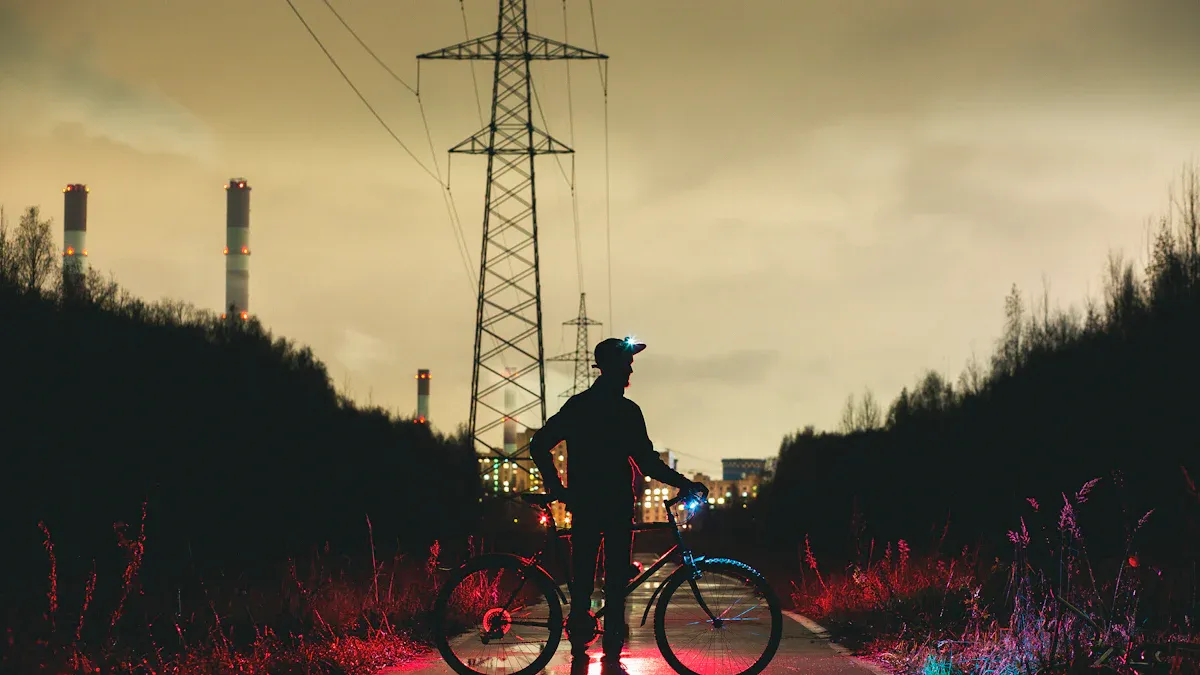
Good bicycle lighting protects you and other road users. It ensures that you are seen in time when it is dark or visibility is poor. Statistics show that almost one in five bicycle accidents occurs at dusk or in the dark. In 2019, over 16,000 cyclists were injured in such situations, 3,000 of them seriously.
The new legal requirements for bicycle lighting now allow for features such as daytime running lights and brake lights. Batteries are also permitted as an energy source. These advancements significantly increase your safety and visibility in road traffic.
Key takeaways
Good bicycle lights make you safer and more visible in traffic.
Make sure your lights meet the regulations, e.g., 10 lux.
Choose appropriate brightness: 100-200 lumens for the city, 400+ for rural areas.
Buy waterproof lamps with a high protection rating for riding in the rain.
Maintain your lights often so they last longer and shine brightly.
Legal requirements for bicycle lighting
StVZO requirements
Front and rear lights: Minimum requirements for lux and position
The Road Traffic Licensing Regulations (StVZO) set clear requirements for your bicycle's lighting. Your headlight must provide at least 10 lux, must be glare-free, and must not flash. Two headlights are required for wider bicycles. The rear light must be red, mounted at a height of 25 to 120 cm, and also must not flash. A brake light function is permitted and can increase your safety.
Component |
Requirements |
|---|---|
Headlight |
At least 10 lux, glare-free, non-flashing; two required for wider bicycles. |
Rear light |
At least one red light, at a height of 25 to 120 cm, non-flashing, may have a brake light function. |
Reflectors: Regulations for front, rear, pedals, and wheels
In addition to active lighting, reflectors are also mandatory. Your bicycle requires at least one white front reflector at a height of 40 to 120 cm and a red "Z" category rear reflector. Spoke reflectors must be attached to each wheel, and pedals require yellow reflectors at the front and back. These regulations ensure that you remain visible even when your lights are turned off.
Special regulations for e-bikes
Lux requirements and battery support
Special regulations apply to e-bikes. Pedelecs up to 25 km/h may use lamps with a "K-number" that meet StVZO requirements. S-Pedelecs require more powerful lamps with an ECE approval mark. These lamps are regulated EU-wide and often offer higher lux output. LED lighting is recommended because it is efficient and durable.
Compatibility with e-bike systems
Your e-bike's lighting should be compatible with the electrical system. Dynamo lighting must be permanently mounted, whereas battery-operated lamps may be detachable. Ensure that your lights are always attached at dusk or in the dark to avoid fines.
Newer regulations and updates
Permission for battery-powered lights since 2017
Since 2017, the StVZO has allowed the use of battery-powered lights. These offer more flexibility, as they are easily detachable and rechargeable. They are a popular choice, especially for sports bicycles or mountain bikes.
Additional functions such as daytime running lights and brake lights
New regulations allow headlights with daytime running lights and high beams. These features increase your visibility during the day and improve safety at night. Rear lights may now also have a brake light function, which is particularly helpful in urban traffic.
Regulation |
Description |
|---|---|
Daytime running light |
Allows the use of headlights with daytime running lights to improve visibility. |
Brake lights |
Rear lights may now include a brake light, which increases safety. |
Batteries |
Permitted as an energy source, offering more flexibility. |
Tip: Turn on your bicycle lights early, especially during the dark time of year. This protects you and other road users.
Important criteria when choosing bicycle lighting
Brightness and light output
Differences between lumens, lux, and candela
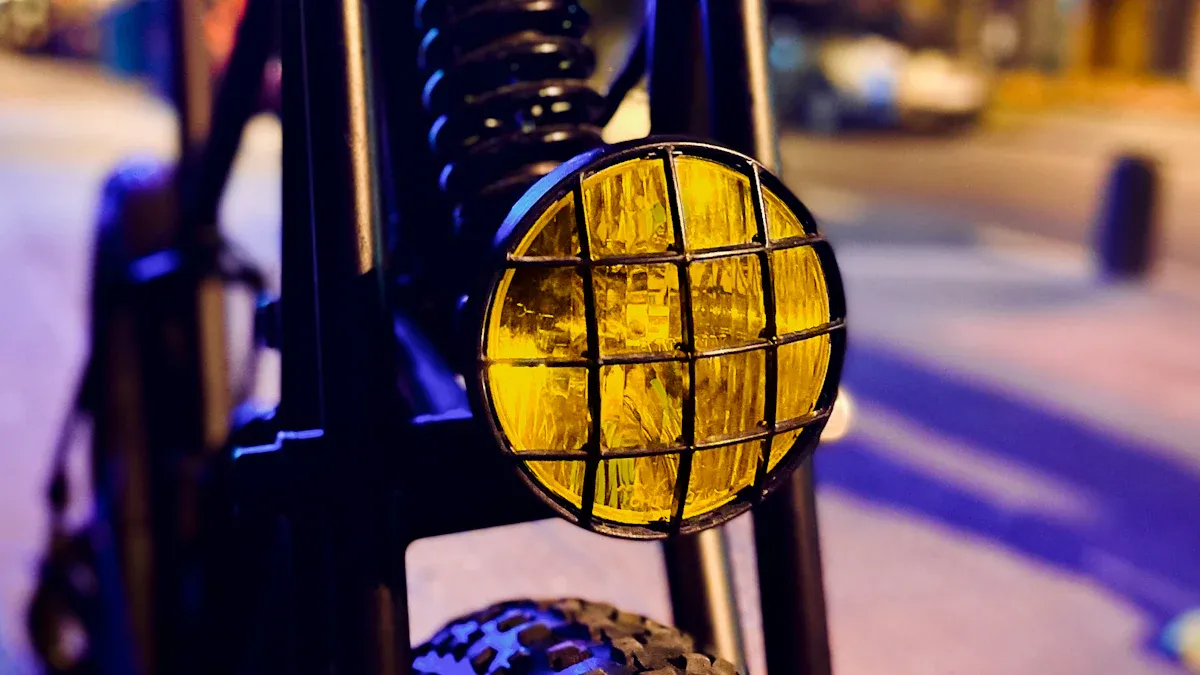
When buying bicycle lighting, it is important to understand the differences between lumens, lux, and candela. Lumens measure the total luminous flux, i.e., the amount of light emitted. Lux, on the other hand, describes how much light arrives on a specific surface. Candela indicates the luminous intensity in a specific direction.
Unit |
Description |
|---|---|
Lumens |
Measures luminous flux, the total amount of light emitted by a light source. |
Lux |
Measures illuminance, i.e., how much light reaches a surface. |
Candela |
Measures luminous intensity, i.e., the intensity of the light in a specific direction. |
For city traffic, 100-200 lumens are sufficient. On country roads or off-road, you need at least 400 lumens to detect obstacles early.
Recommendations for the city (100-200 lumens), rural areas (400+ lumens), and off-road
In the city, moderate brightness is sufficient as streets are often illuminated. On country roads or trails, you should opt for models with higher light output. Ensure that the illumination is uniform and also covers the side area.
Energy sources: Dynamo vs. rechargeable battery
Advantages and disadvantages of dynamos (e.g., weather-independent)
Dynamo lights are reliable and weather-independent. They always work as long as you are pedaling. However, they create slight resistance and are permanently mounted on the bicycle, which makes them less flexible.
Advantages and disadvantages of battery lights (e.g., portable)
Battery lights offer flexibility. They are easily detachable and rechargeable, often via USB. Modern lithium-ion batteries are efficient and long-lasting. The disadvantage: you have to charge them regularly, and on longer trips, the battery can run out.
Additional functions and light modes
Daytime running light and parking light
Daytime running lights increase your visibility during the day. Parking lights ensure that you remain visible even when stationary, such as at a traffic light. These functions are particularly useful in city traffic.
Flashing modes and their legal status
Flashing modes can increase your visibility but are not permitted for front and rear lights in Germany. Make sure your bicycle lighting complies with legal requirements.
Tip: Choose bicycle lighting with LED technology. It offers better light yield and a longer service life.
Waterproofing and robustness
Meaning of IP protection classes
Your bicycle lighting must also function reliably in rain or wet conditions. This is where IP protection classes come into play. The abbreviation "IP" stands for "Ingress Protection" and indicates how well a device is protected against the ingress of water and dust. The first digit describes protection against solid foreign objects, the second against water.
A model with an IP68 protection class, for example, is completely dust-tight and can be used continuously under water. For everyday use, IPX5, which offers protection against water jets from all directions, is often sufficient. These classifications are tested against standards such as EN 343, which evaluate the waterproofness of products.
Certification |
Description |
|---|---|
EN 343 |
This standard confirms the waterproofness of protective clothing against precipitation and humidity. Classes 1-4 indicate effectiveness, with class 4 being the highest level. |
Tip: Pay attention to the IP protection class of your lighting, especially if you frequently ride in the rain or off-road.
Examples of waterproof models (e.g., IP68, IPX5)
Some bicycle lamps offer excellent protection against water. Models such as the Knog Blinder Road 400 with IP68 are ideal for extreme conditions. They withstand not only rain but also brief submersion. For city traffic, a model like the Bookman Volume 800 with IPX5 is often enough. This protects your lighting against heavy rain and spray water.
If you regularly ride in poor weather, you should invest in robust and waterproof lighting. This ensures your visibility remains guaranteed even in adverse conditions. Robustness and waterproofness not only increase the lifespan of your lighting but also your safety in road traffic.
🚴♂️ Note: Waterproof models are often slightly more expensive but offer more long-term reliability and protection.
Recommendations for different use cases
Bicycle lighting for city traffic
Models with medium brightness (100-200 lumens)
In city traffic, a moderate brightness of 100 to 200 lumens is ideal. This light output is enough to be well seen and to detect obstacles in time. Models such as the Osram Race 100 set offer excellent light distribution in the long-range area. This is particularly important for perceiving other road users early on.
Environment |
Light output (lumens) |
|---|---|
City traffic |
100 to 200 |
Country roads |
at least 400 |
Compact and lightweight designs
Compact and lightweight designs are suitable for city traffic. These can be easily mounted and removed. Models such as the Sigma Aura 80 USB impress with their ease of use and multiple light modes. They also offer a brake light function, which increases your safety in dense traffic.
Tip: Choose a model with USB charging. This saves on batteries and is environmentally friendly.
Bicycle lighting for country roads
Models with high brightness (400+ lumens)
On country roads, you need bicycle lighting with at least 400 lumens. This ensures good illumination of the road and increases your visibility. The Cat Eye GVolt 70 offers high luminous intensity and multiple modes that can be adapted to the environment.
Long battery life and good distance vision
Long battery life is crucial for rides on country roads. Models like the Büchel BLC 820 score with automatic light control and a day-night mode. These features ensure optimal vision in changing light conditions.
Bicycle lighting for off-road and trails
Powerful front lights and helmet lamps
Off-road, you need powerful front lights with high brightness and long battery life. A good lamp should illuminate the near, far, and side areas evenly. Helmet lamps are a useful addition as they allow you to flexibly steer the light beam.
Additional reflectors and accessories
Additional reflectors increase your visibility off-road. Ensure that your lighting is mounted stably. Tests have shown that good workmanship and easy installation are crucial. Accessories such as spare batteries and mounts can usefully complement your equipment.
🚴♂️ Note: For trails, waterproof models with an IP68 protection class are particularly recommended.
Care and maintenance of bicycle lighting
Tips for dynamo lights
Regular checking of cables and contacts
Dynamo lights are reliable, but their cables and contacts require regular maintenance. You should check the cables for breaks or wear. Damaged cables can impair the function of your lighting. Contacts also deserve attention. Corrosion at the contact points can disrupt the power transmission. Regular inspection extends the service life of your lighting.
Use of contact spray
Contact spray is a useful aid for avoiding corrosion. Apply it to the contact points to protect them from moisture. This improves conductivity and ensures reliable function. Store your bicycle in a dry place whenever possible to minimize moisture damage.
💡 Tip: Hub dynamos are particularly robust, but cables and contacts should be checked regularly here as well.
Tips for battery lights
Avoidance of deep discharge
Battery lamps are practical, but you should avoid deep discharge. Charge the battery in time before it is completely depleted. Deep discharge can permanently reduce the battery's capacity. Modern lithium-ion batteries are long-lasting if you maintain them correctly.
Storage at room temperature
Store your battery lamps at room temperature. Extreme temperatures, whether hot or cold, can shorten the battery's lifespan. If you do not use your bicycle for a long time, remove the battery and store it in a dry place.
🔋 Note: Battery-powered bicycle lamps are less susceptible to corrosion, but good battery care is crucial.
General maintenance
Cleaning and protection against moisture
Keep your bike lights clean. Regularly remove dirt and dust from the lamps. Use a soft cloth and avoid aggressive cleaning agents. Protect the lighting from moisture, especially when riding in the rain. A clean lamp ensures optimal light output.
Replacing defective parts
You should replace defective parts such as light bulbs or damaged mounts immediately. Correct adjustment of the front headlight is also important. Align it so that it illuminates the road well without blinding other road users.
🚴♂️ Tip: LEDs are more durable and robust than conventional light bulbs. They are a good choice for low-maintenance lighting.
-
Summary of maintenance tips:
Check cables and contacts regularly.
Avoid deep discharge of batteries.
Keep the lighting clean and dry.
Replace defective parts in good time.
With these measures, your bike lighting will remain reliable and long-lasting.
Top products and brands for 2025
Recommended front lights
Knog Blinder Road 400 (400 lumens, IP68)
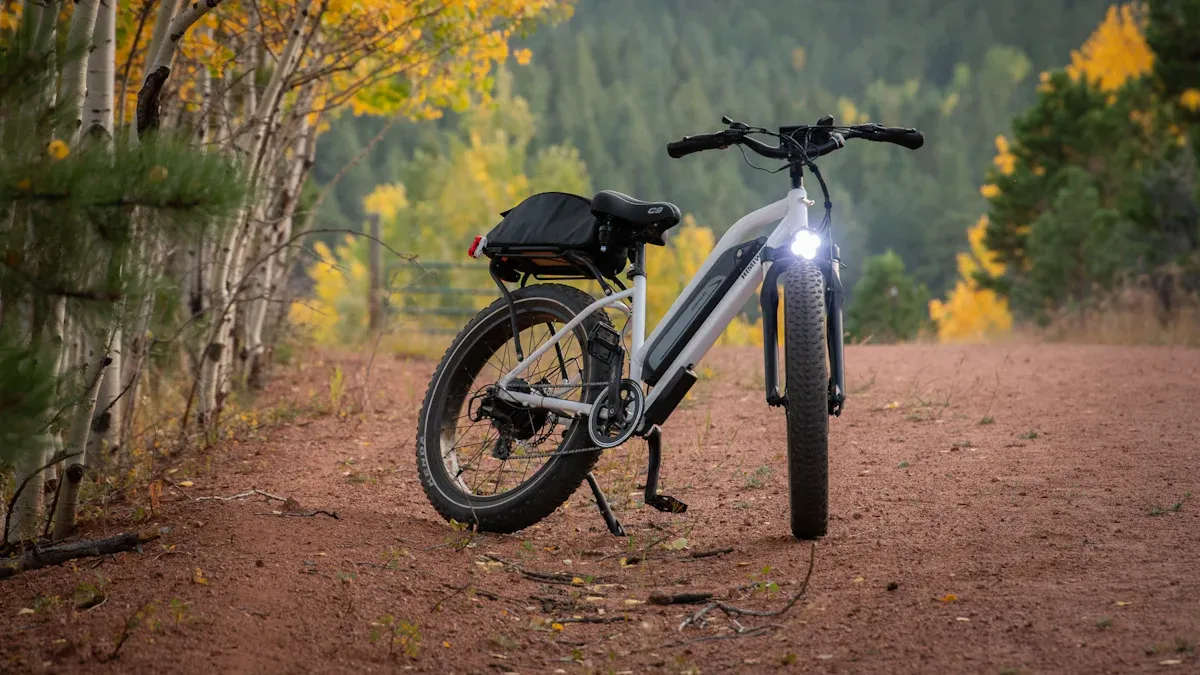
The Knog Blinder Road 400 is an excellent choice for cyclists looking for powerful and robust lighting. With 400 lumens, it offers excellent illumination, ideal for city and country roads. The IP68 protection class makes it completely dust and waterproof, perfect for all weather conditions. Thanks to its compact design and simple mounting, you can attach it to your bike quickly.
Bookman Volume 800 (800 lumens, IPX5)
The Bookman Volume 800 impresses with an impressive light output of 800 lumens. It is particularly suitable for riding on dark country roads or off-road. The IPX5 certification protects it from heavy rain, while USB charging enables easy handling. Customers praise the long battery life and the even light distribution.
Model |
Illuminance (Lux) |
Burn time (hours) |
Additional functions |
|---|---|---|---|
Knog Blinder Road 400 |
400 |
5 |
Waterproof (IP68) |
Bookman Volume 800 |
800 |
4 |
Waterproof (IPX5), USB charging |
Recommended rear lights
Kryptonite Avenue R-75 (75 lumens, 6 modes)
The Kryptonite Avenue R-75 offers you strong visibility in traffic with 75 lumens. It has six different modes that you can set as needed. It provides additional safety, especially in city traffic.
Sigma Blaze Flash (50 lumens, IPX4)
The Sigma Blaze Flash is a reliable rear light with 50 lumens. It offers a brake light function that increases your safety during sudden stops. The IPX4 certification protects it from splashing water, making it ideal for everyday use.
Top brands
Busch & Müller, SIGMA SPORT, Trelock
Busch & Müller is known for its high-quality bike lights, which offer a long service life and excellent light output. SIGMA SPORT impresses with innovative designs and practical functions such as USB charging. Trelock offers robust models with a long battery life, which are particularly suitable for frequent riders.
Innovative brands like MonkeyLink and Lezyne
MonkeyLink stands out with its magnetic mounting system, which enables quick assembly. Lezyne scores with stable aluminum housings and powerful battery lighting. Both brands combine functionality with modern design and are a good choice for demanding cyclists.
🚴♂️ Tip: Brands such as Busch & Müller and Lezyne offer an excellent price-performance ratio. Their products have been praised in tests for their quality and functionality.
Product name |
Quality |
Brightness |
Functionality |
|---|---|---|---|
Contecs LS-247+ |
Good |
High |
Simple |
Bumm Ixon Core |
Very good |
High |
Simple |
Lezyne Power |
Very good |
High |
Simple |
With these recommendations, you are guaranteed to find the right bike lighting for your needs. Pay attention to the technical data and choose a model that meets your requirements.
The right bike lighting is crucial for your safety and visibility in traffic. Make sure your lighting complies with legal requirements and offers sufficient brightness. Invest in high-quality models that are durable and robust. Features such as daytime running lights or brake lights additionally increase your safety. With well-chosen lighting, you effectively protect yourself and other road users. Remember to maintain your lighting regularly to ensure optimal performance.
FAQ
What is the difference between lux, lumens, and candela?
Lux measures the illuminance on a surface, lumens describe the total luminous flux, and candela indicates the light intensity in one direction. For city traffic, 100-200 lumens are sufficient, while you need at least 400 lumens on country roads.
Am I allowed to use flashing lights on my bike?
In Germany, flashing lights for front and rear lamps are not permitted. They can irritate other road users. Instead, use continuously lit lamps that comply with legal requirements.
How often should I maintain my bike lighting?
Check your lighting at least once a month. Pay attention to clean lenses, functioning cables, and charged batteries. For dynamo lights, you should clean the contacts regularly to avoid corrosion.
Which bike lighting is suitable for e-bikes?
E-bikes require lighting that is compatible with the electrical system. Pedelecs up to 25 km/h may use lamps with a K-number. S-pedelecs require more powerful lamps with an ECE test mark. LED lamps are particularly efficient and long-lasting.
What does the IP protection class for bike lamps mean?
The IP protection class shows how well your lamp is protected against dust and water. IP68 means complete dust protection and water protection during permanent submersion. For everyday use, IPX5, which offers protection against water jets, is often sufficient.
💡 Tip: Choose a lamp with at least IPX4 if you often ride in the rain.